
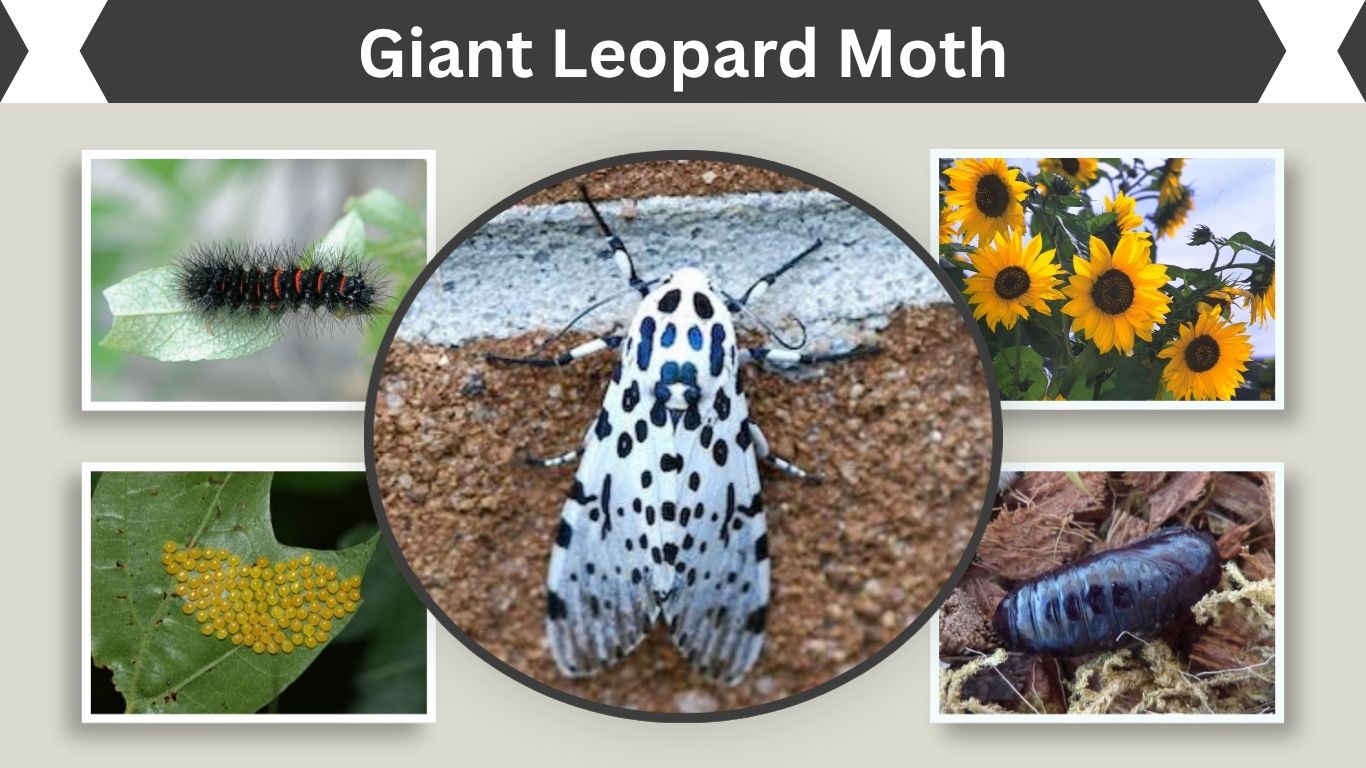
The giant leopard moth is a striking white moth covered with bold black spots. Its caterpillar is just as famous: a large black “woolly bear” with stiff bristles and red-orange bands hidden between the body segments. Many people search for this moth because they find a giant black caterpillar, a large spotted moth on a wall, or a fuzzy caterpillar in the garden and want to know if it is poisonous, rare, or dangerous.
What Is a Giant Leopard Moth?
The giant leopard moth, also called the great leopard moth, is a large tiger moth. Its scientific name is Hypercompe scribonia. The adult has white wings marked with black rings and spots, while the abdomen may show blue-black and orange colors when the wings are lifted. Texas A&M describes the adult as a white moth with black open-circular spots and a metallic blue abdomen with orange markings.
| Feature | Giant Leopard Moth |
| Scientific name | Hypercompe scribonia |
| Other name | Great leopard moth |
| Family group | Tiger moth group, family Erebidae |
| Adult color | White with black spots or rings |
| Caterpillar color | Black with red-orange bands |
| Adult activity | Mostly nocturnal |
| Main question | Is it poisonous or dangerous? |
The giant leopard moth is not the same as a giant silk moth. UF/IFAS explains that the giant leopard moth is the largest eastern tiger moth and belongs in the subfamily Arctiinae within the family Erebidae.
Giant Leopard Moth Identification
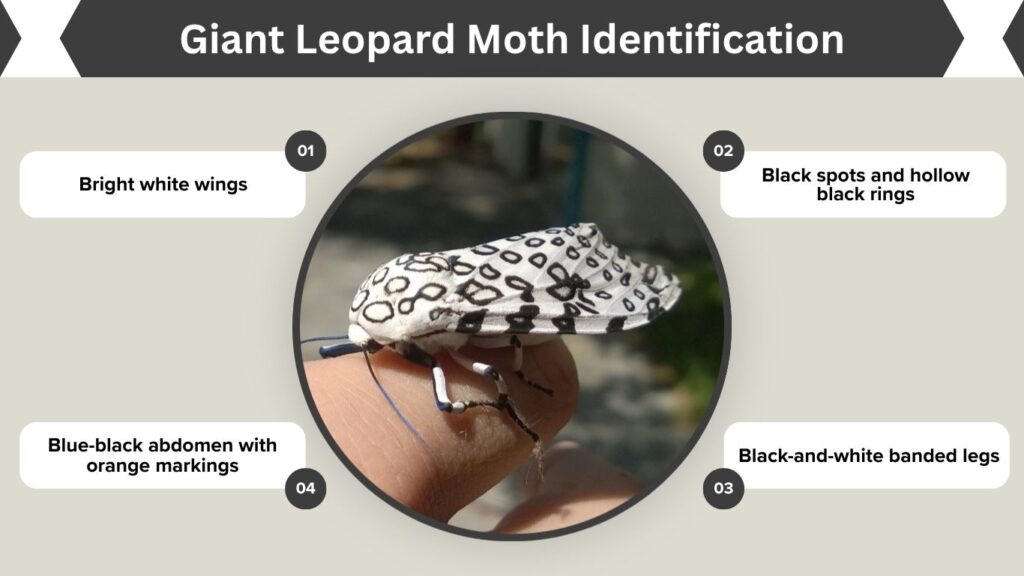
The adult giant leopard moth is one of the easiest large moths to recognize. Its white wings have black hollow rings and solid black spots, creating a leopard-like pattern. At rest, it may look like a giant white moth with black markings on a wall, window screen, porch light, or tree trunk.
Adult Identification Signs
Look for these features:
- Bright white wings
- Black spots and hollow black rings
- Black-and-white banded legs
- Blue-black abdomen with orange markings
- Large, soft-looking body
- Usually active at night
- Often attracted to porch lights
The Missouri Department of Conservation notes that giant leopard moth caterpillars eat many plants and that adults fly from early May to September, with multiple broods in some areas.
Giant Leopard Moth Caterpillar
The giant leopard moth caterpillar is often searched more than the adult. It is a large black caterpillar covered in stiff bristles. When relaxed or stretched out, red or orange bands can be seen between the black body segments. When disturbed, it curls into a tight ball and exposes those red bands as a warning display.
BugGuide describes late-instar giant leopard moth caterpillars as mostly black, with stiff black hairs of equal length, red intersegmental rings visible when curled, and orange or red spiracles.
Caterpillar Identification Signs
A giant leopard moth caterpillar usually has:
- Dense black bristles
- Red or orange bands between segments
- Black “woolly bear” appearance
- Stiff hairs, not soft fur
- Curling defensive behavior
- Large body, often around 2 inches long
- Habit of wandering on sidewalks, lawns, gardens, or patios
Texas A&M states that the caterpillars grow to about 2 inches and have a fuzzy black body with red to orange underlying body color.
Is the Giant Leopard Moth Caterpillar Poisonous?
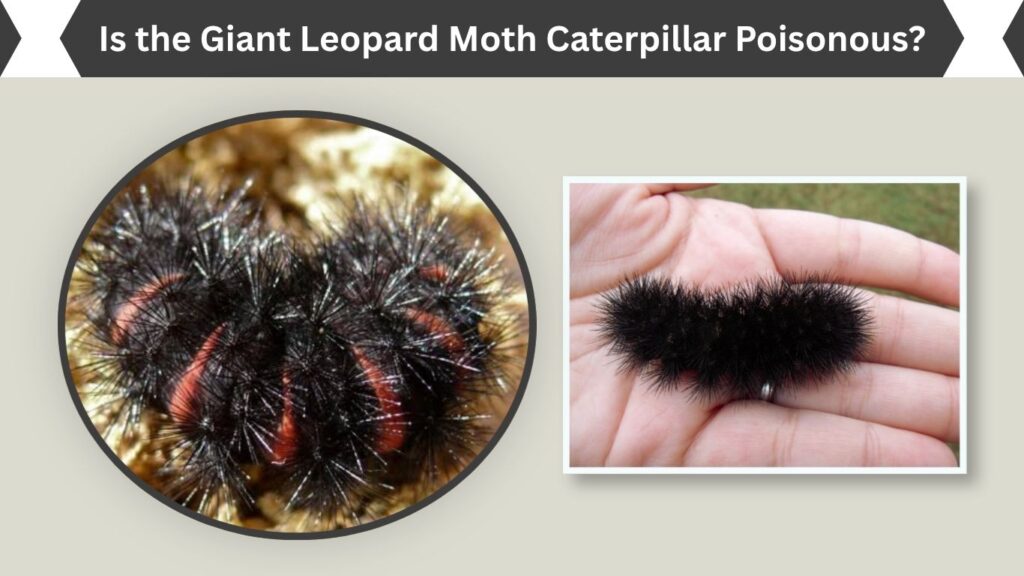
The giant leopard moth caterpillar looks dangerous, but it is not a stinging caterpillar. UF/IFAS says tiger moth larvae lack stinging spines and do not bite, though their stiff setae likely help defend them from predators.
That means the caterpillar is not dangerous in the same way as a venomous puss caterpillar or saddleback caterpillar. Still, it is smart not to handle hairy caterpillars unless you are sure of the species. Some people may have sensitive skin, and handling can also stress or injure the caterpillar.
Safety Tips
Use these simple rules:
- Do not squeeze the caterpillar.
- Move it with a leaf or stick if needed.
- Keep small children from playing with it.
- Do not let pets chew it.
- Wash hands after handling garden insects.
- Avoid touching unknown fuzzy caterpillars.
The giant leopard moth caterpillar is usually better admired than handled.
What Do Giant Leopard Moth Caterpillars Eat?
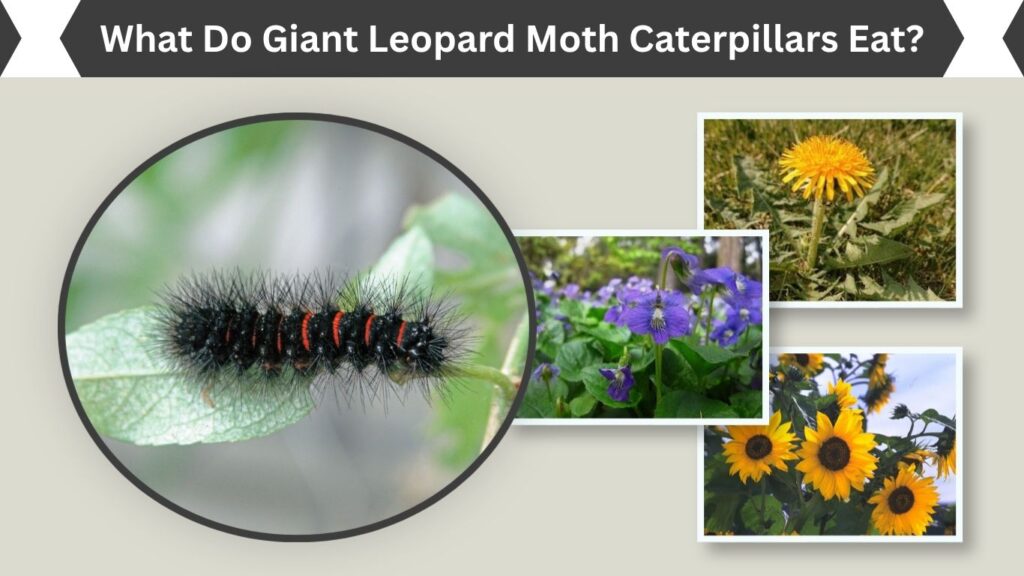
Giant leopard moth caterpillars eat many broadleaf plants. They are not limited to one host plant, which is why people may find them in gardens, yards, fields, and along weedy edges.
The Missouri Department of Conservation lists food plants such as maples, dandelions, sunflowers, cabbages, cherries, willows, and violets, and notes that caterpillars are often found on low-growing plants but may also feed on trees and shrubs.
Common Food Plants
They may feed on:
- Dandelion
- Plantain
- Violet
- Sunflower
- Cabbage
- Lettuce
- Willow
- Maple
- Cherry
- Magnolia
- Honeysuckle
- Lilac
- Citrus in southern areas
- Banana leaves in southern areas
UF/IFAS also provides a long host-plant list for Hypercompe scribonia, showing that this caterpillar can use many different broadleaf plants.
Giant Leopard Moth Life Cycle
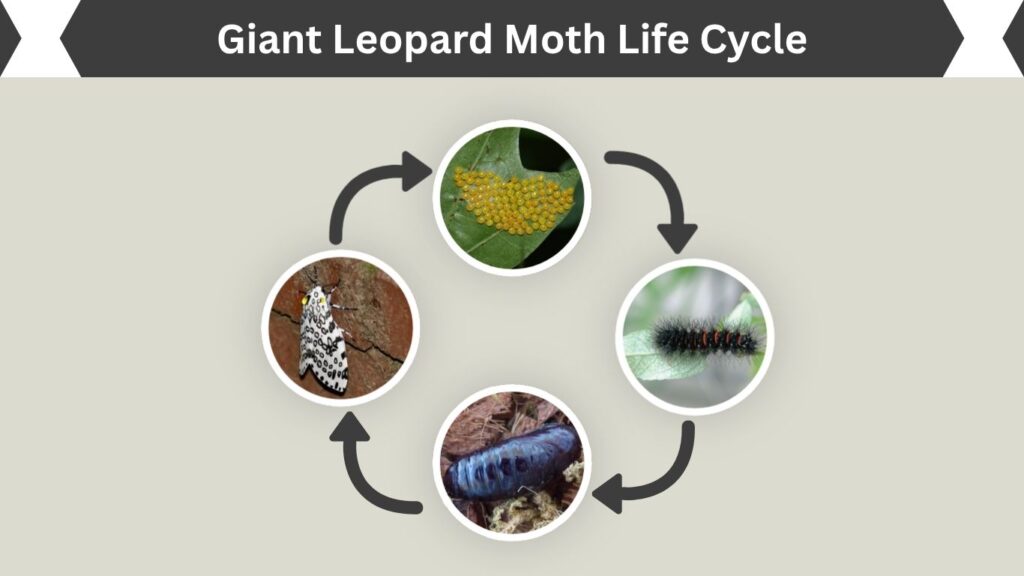
The giant leopard moth has a complete life cycle: egg, caterpillar, pupa, and adult moth. Females lay eggs on or near host plants. The caterpillars hatch, feed, grow, molt, and eventually wander to find a protected place to pupate.
| Stage | What Happens |
| Egg | Laid near host plants |
| Caterpillar | Feeds on broadleaf plants |
| Overwintering | Often passes winter as a caterpillar |
| Cocoon/pupa | Changes into adult moth |
| Adult moth | Flies at night, mates, and lays eggs |
Mississippi State Extension notes that in the South, giant leopard moth caterpillars can complete two generations per year, and the second generation overwinters as caterpillars.
Giant Leopard Moth Cocoon and Eggs
A mature caterpillar eventually stops feeding and searches for a hidden place to pupate. It may use leaf litter, loose debris, bark, or sheltered garden areas. If you find a caterpillar wandering across a driveway or patio, it may be looking for a safe place to form its cocoon.
Giant leopard moth eggs are small and laid where caterpillars can access suitable food plants. Because the caterpillars use many host plants, eggs may be found near weeds, garden plants, shrubs, or trees.
Giant Leopard Moth Antenna and Male vs Female
People also search for “giant leopard moth antenna” because moth antennae help with identification and mating behavior. In many moths, males use their antennae to detect female pheromones. Hilton Pond Center explains that female giant leopard moths release pheromones, and males detect these chemicals with their antennae to find mates.
Male and female giant leopard moths can differ in size. Some field sources report that males are usually larger than females in this species. Because size can vary, photos from above and side views are helpful when trying to compare individuals.
Is the Giant Leopard Moth Rare?
The giant leopard moth is not usually considered extremely rare across its range, but it is not always commonly seen. It is nocturnal, so many people only notice it when it comes to lights at night. The caterpillar may be seen more often in fall when it wanders away from food plants.
UF/IFAS notes that giant leopard moths are nocturnal and that males are commonly attracted to lights at night, sometimes in numbers when habitat is good.
Giant Leopard Moth vs Woolly Bear Caterpillar
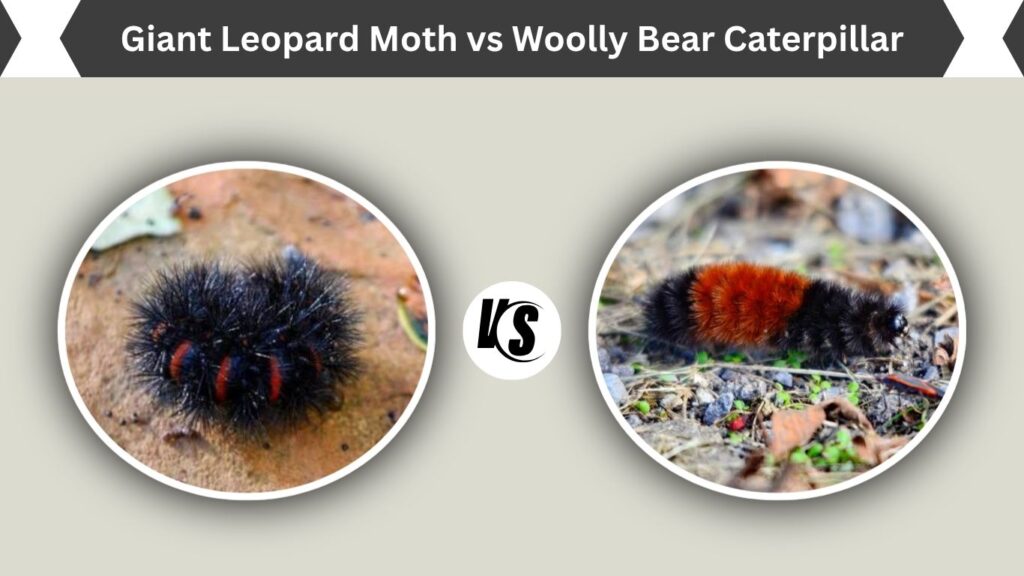
The giant leopard moth caterpillar is sometimes confused with the banded woolly bear. Both are fuzzy-looking caterpillars, but the giant leopard moth caterpillar is usually black with red-orange bands hidden between the segments. A banded woolly bear usually has a broad brown or orange middle band with black ends.
| Feature | Giant Leopard Moth Caterpillar | Banded Woolly Bear |
| Main color | Black with red-orange bands between segments | Black ends with brown middle band |
| Body hairs | Stiff black bristles | Fuzzy black and brown hairs |
| Defense | Curls into ball, shows red bands | Curls into ball |
| Adult moth | White with black spots | Isabella tiger moth |
| Common confusion | “Giant woolly bear” | “Woolly worm” |
BugGuide’s description of red rings visible when the giant leopard moth caterpillar curls is one of the best separation clues.
Giant Moth vs Giant Leopard Moth
The keyword “giant moth” can refer to many large moths, not only the giant leopard moth. Some giant moths are much larger, especially giant silk moths and atlas moths.
| Giant Moth Type | Main Feature |
| Giant leopard moth | White wings with black leopard spots |
| Cecropia moth | One of North America’s largest native moths |
| Luna moth | Pale green giant silk moth |
| Polyphemus moth | Large eyespots on wings |
| Atlas moth | One of the world’s largest moths |
| Giant wood moth | Very large Australian moth |
| Giant sphinx moth | Strong-flying hawk moth group |
University of Maine Extension describes the cecropia moth as North America’s largest native moth, with documented wingspans over 6.2 inches. The Natural History Museum says the atlas moth is among the biggest insects on Earth, with a wingspan up to 27 cm.
Are Giant Moths Dangerous?
Most giant moths are harmless to people. Adult moths do not bite, sting, or attack. Many are simply attracted to lights at night. The caterpillars vary more: some are harmless, some have irritating hairs, and some species in other groups can sting.
For giant silk moths, the University of Kentucky notes that most saturniid caterpillars feed on trees and shrubs, and handpicking is usually enough for control, but gloves should be worn for io moth caterpillars because they can sting.
Giant Leopard Moth in Ohio, Texas, Florida, and Other States
Searches for giant moths in Ohio, Arizona, Texas, Florida, Michigan, Georgia, Pennsylvania, California, and Illinois often come from people finding large moths on walls or porch lights. The giant leopard moth is most associated with eastern and southern North America, but other “giant moth” sightings may involve cecropia, luna, polyphemus, sphinx, wood, or silk moths depending on region.
If the moth is white with black leopard spots, it is likely a giant leopard moth. If it is green, it may be a luna moth or another green moth. If it is huge and brown with eyespots, it may be a polyphemus, cecropia, or other giant silk moth.
FAQs
Is the giant leopard moth poisonous?
The adult giant leopard moth is not poisonous to people. The caterpillar looks scary but lacks stinging spines and does not bite, according to UF/IFAS.
Is the giant leopard moth caterpillar dangerous?
It is not usually dangerous. It has stiff black bristles and curls into a ball when disturbed, but it is not a true stinging caterpillar. Avoid unnecessary handling to protect both your skin and the caterpillar.
What does a giant leopard moth caterpillar eat?
It eats many broadleaf plants, including dandelion, violet, sunflower, cabbage, willow, cherry, maple, and other plants.
What does a giant leopard moth look like?
The adult is a white moth with black spots or rings on the wings and a blue-black abdomen with orange markings. The caterpillar is black and bristly with red-orange bands between the segments.
Is a giant leopard moth rare?
It is not usually considered extremely rare, but it can seem uncommon because adults fly at night. Many sightings happen when adults come to porch lights or when caterpillars wander in gardens and yards.
