
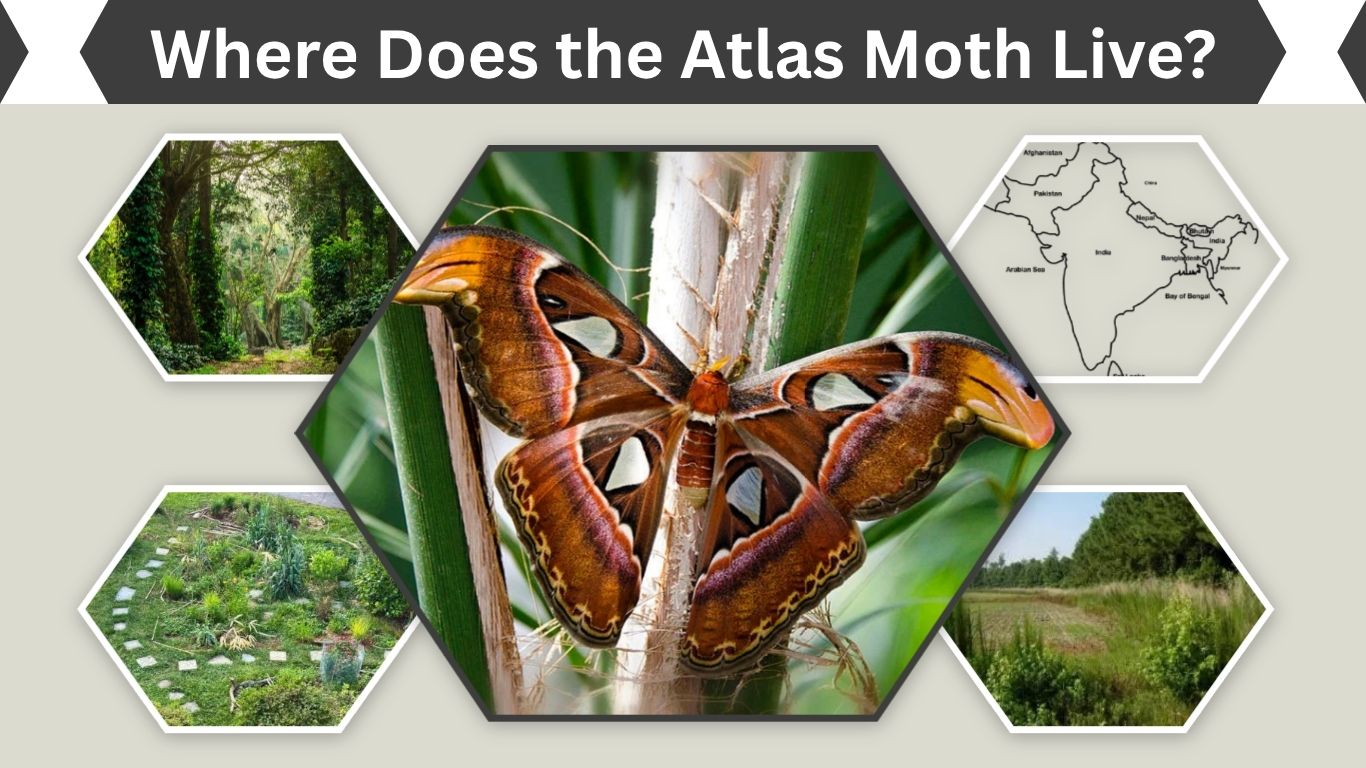
The atlas moth lives mainly in warm parts of Asia, especially tropical and subtropical forest regions. Known scientifically as Attacus atlas, this giant moth is native to countries such as India, China, Malaysia, Indonesia, and much of Southeast Asia. It is strongly linked with forests because its caterpillars need leafy host plants to grow. Adult atlas moths do not feed, so their habitat must support the caterpillar stage first. This guide explains the atlas moth’s range, habitat, and where people may see it.
Where Does the Atlas Moth Live?
The atlas moth lives in tropical and subtropical regions of Asia. Its natural home is not just one country, but a broad range of warm forested areas where caterpillars can find enough leaves and adults can rest safely.
Native Range of the Atlas Moth
The atlas moth is native to Asia. The Natural History Museum lists the species as native to China, India, Malaysia, and Indonesia, while Animal Diversity Web describes a wider Southeast Asian distribution that includes Nepal, northeastern India, Bangladesh, Bhutan, southeastern China, Laos, Cambodia, Vietnam, Taiwan, Indonesia, and Brunei. Localized populations are also reported in places such as the Philippines and Papua New Guinea.
In simple terms, atlas moths live mostly in South Asia, East Asia, and Southeast Asia. They are best suited to warm climates, not cold regions with long winters.
Quick Habitat Overview
| Habitat Factor | Atlas Moth Preference |
| Main region | Asia |
| Common climate | Tropical and subtropical |
| Main habitat | Forests and rainforests |
| Activity time | Mostly nocturnal |
| Adult food | Adults do not eat |
| Caterpillar food | Leaves of host plants |
| Wild in the US? | No, usually seen only in exhibits or collections |
Countries Where Atlas Moths Are Found
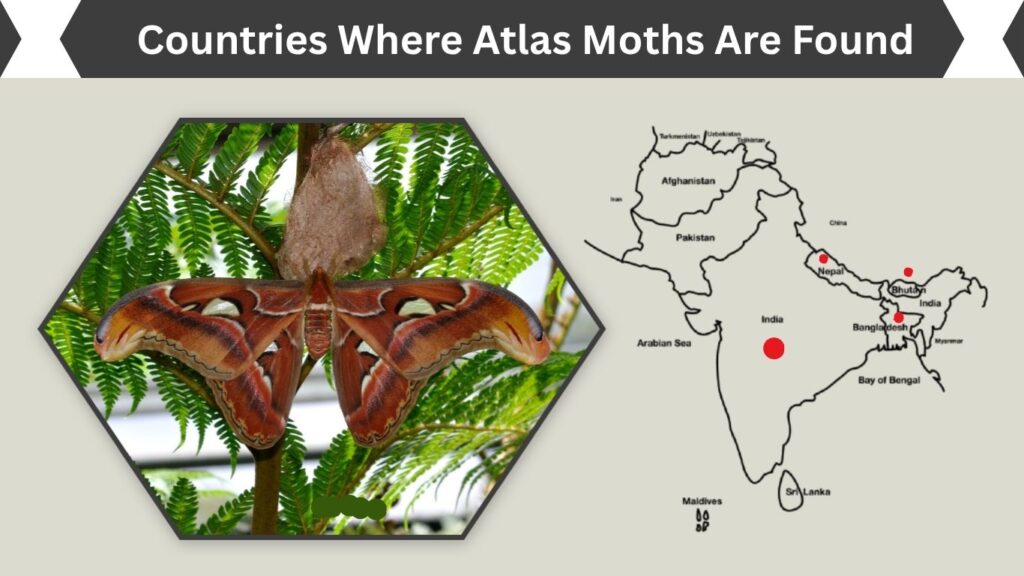
Atlas moths are spread across many Asian countries, but they are not equally common everywhere. Their presence depends on climate, forest cover, host plants, and local environmental conditions.
South Asia
In South Asia, atlas moths are associated with India, Bangladesh, Bhutan, Nepal, and nearby areas. Animal Diversity Web includes Nepal, northeastern India, Bangladesh, and Bhutan in the species’ distribution.
India is especially important in atlas moth discussions because the species occurs in warm forested regions where suitable host plants grow. The moth is not usually found in cold mountain zones, but it may occur in lower-elevation forested areas and humid regions where caterpillars can survive.
Southeast Asia
Southeast Asia is one of the strongest regions for atlas moth habitat. The species is native to tropical and subtropical forests of Southeast Asia, according to the Florida Museum of Natural History.
Countries and areas often linked with atlas moths include Malaysia, Indonesia, Laos, Cambodia, Vietnam, Brunei, and parts of the Philippines. These places provide the warm, humid conditions and broad-leaf plants that atlas moth caterpillars need.
East Asia
Atlas moths are also found in parts of East Asia, including southeastern China and Taiwan. Animal Diversity Web includes southeastern China and Taiwan within the species’ range.
In these regions, atlas moths are still connected with warm forest habitats rather than cold or dry open landscapes. Their range is limited by temperature, seasonal conditions, and available larval host plants.
Natural Habitat of the Atlas Moth
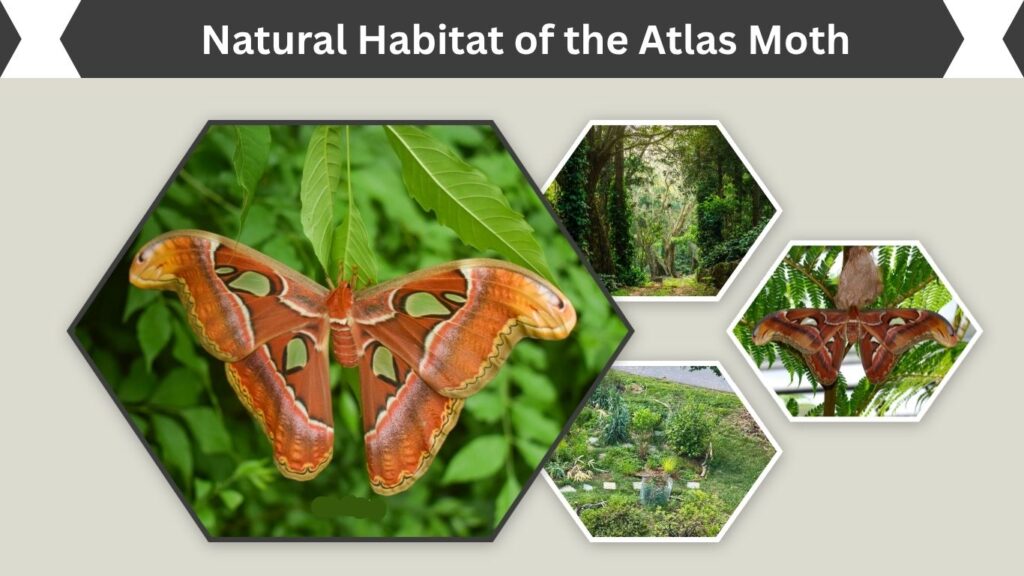
The atlas moth does not live just anywhere in Asia. It is most strongly connected with forest habitats where the caterpillars can feed and complete their life cycle.
Tropical and Subtropical Forests
Animal Diversity Web says Attacus atlas is primarily found in tropical and subtropical rainforests. These habitats often have broad-leafed evergreen trees, closed canopies, and wet and dry seasons instead of four sharply divided seasons.
These forests are important because atlas moth larvae are heavy feeders. A large moth begins as a large caterpillar, and that caterpillar must eat enough leaves to store energy for the adult stage. Without enough host plants, the species cannot complete its life cycle successfully.
Rainforests, Secondary Forests, and Shrublands
Atlas moths are commonly linked with rainforests, but they may also occur in other warm, plant-rich habitats. Some references describe their habitat as including tropical forests, secondary forests, and shrublands across parts of Asia. The key requirement is not simply “forest” but the presence of suitable plants and a climate that supports eggs, caterpillars, pupae, and adults.
Secondary forests can be useful because they often contain fast-growing plants and shrubs. In some areas, atlas moths may also occur around plantations, gardens, or managed landscapes if host plants are available nearby.
Elevation Range
Animal Diversity Web reports that atlas moths are widely considered to occupy habitats from sea level up to about 1,500–2,000 meters, although it notes that formal elevation studies are limited.
This means the atlas moth can live in both lowland and some upland habitats, as long as the climate stays suitable. However, it is still mainly a warm-region moth, not a cold-climate species.
Why Atlas Moths Live Near Host Plants
The atlas moth’s habitat is closely tied to the food needs of its caterpillar. Adult atlas moths do not eat, so the caterpillar stage is the only real feeding stage.
Caterpillar Food Plants
Atlas moth caterpillars feed on leaves. The Natural History Museum notes that wild atlas moth caterpillars eat leaves from cinnamon, citrus fruit, guava, and Jamaican cherry trees.
This helps explain why atlas moths live in areas with rich plant growth. Adult moths may look like the main attraction, but the survival of the species depends on whether larvae can find enough leaves.
Why Adults Stay Close to Suitable Habitat
Adult atlas moths have tiny, non-working mouthparts, so they cannot feed after emerging from the cocoon. The Natural History Museum explains that adult atlas moths live on stored energy and usually survive only one to two weeks.
Because adults have limited energy, they do not travel endlessly in search of food. Their main purpose is to mate and reproduce. Females release pheromones to attract males, and eggs are laid where the next generation of caterpillars has a chance to feed.
Do Atlas Moths Live in the United States?
Atlas moths are not native to the United States. When people see atlas moths in the US, they are usually in butterfly houses, insect exhibits, educational displays, or controlled breeding programs.
Wild vs Captive Sightings
The Florida Museum describes the atlas moth as native to Southeast Asia and notes that visitors may see them in museum exhibit settings. In other words, seeing one in Florida, Texas, California, or another US state does not usually mean there is a wild local population.
Atlas moths may be raised in controlled environments because they are popular in butterfly houses and educational exhibits. These settings provide temperature, humidity, space, and host plants that imitate the conditions the moth needs.
Why They Do Not Normally Live in Cold Regions
Atlas moths are adapted to warm tropical and subtropical environments. Cold winters, lack of suitable host plants, and unsuitable seasonal patterns make many regions poor habitat for the species.
Even if an adult atlas moth escaped in a colder country, it would not automatically establish a population. A stable wild population would need males and females, successful mating, egg laying, larval food plants, proper humidity, and survival through seasonal changes.
How to Identify Atlas Moth Habitat
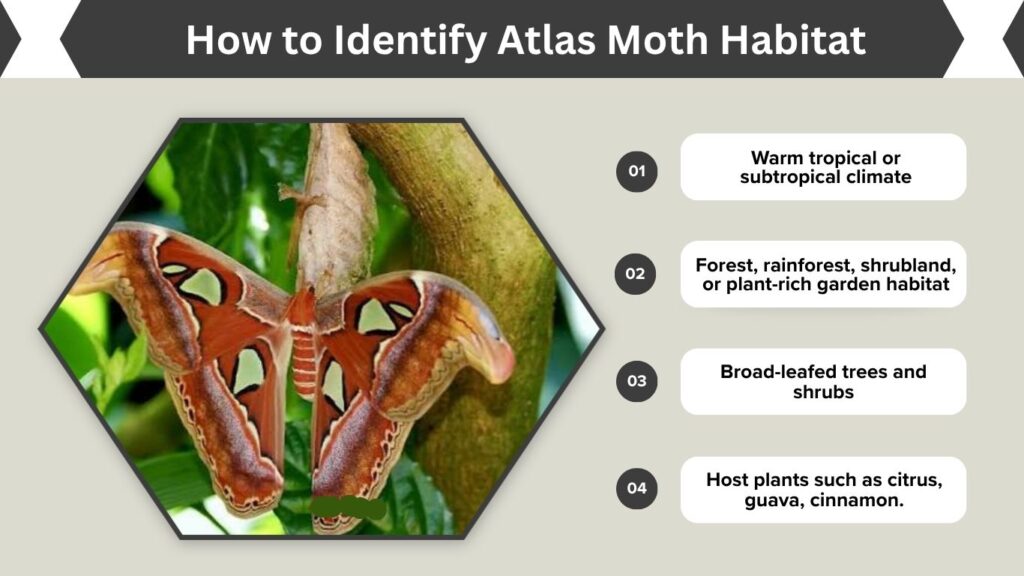
Atlas moth habitat is easiest to understand by looking for warm, leafy, plant-rich environments. The adult moth may be seen resting, but the real sign of suitable habitat is whether the caterpillars can feed and pupate there.
Habitat Clues
- Warm tropical or subtropical climate
- Forest, rainforest, shrubland, or plant-rich garden habitat
- Broad-leafed trees and shrubs
- Host plants such as citrus, guava, cinnamon, or similar leafy plants
- Humid conditions that support eggs, larvae, and pupae
- Places with limited cold-season stress
- Nighttime activity and sheltered daytime resting spots
Where Adults Rest
Adult atlas moths often rest during the day to conserve energy. The Florida Museum notes that atlas moths are nocturnal and use energy carefully because flight takes effort.
In suitable habitats, adults may rest on tree trunks, branches, leaves, walls, or protected surfaces. Their large reddish-brown wings can help them blend with bark, dried leaves, and forest backgrounds.
Atlas Moth Habitat and Life Cycle
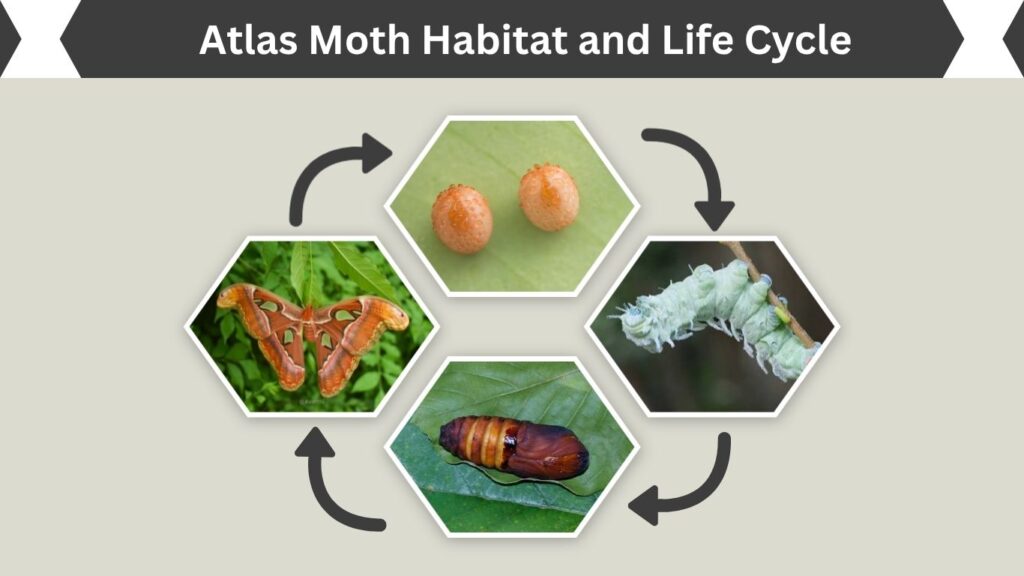
The atlas moth’s life cycle explains why habitat matters so much. Every stage depends on the environment, from egg placement to caterpillar feeding and adult mating.
Egg Stage
The female atlas moth lays eggs on or near host plant leaves. This placement matters because young caterpillars must begin feeding soon after hatching. If eggs are laid far from suitable plants, the larvae may not survive.
Caterpillar Stage
The caterpillar stage is the main growth stage. Atlas moth caterpillars can become very large, and the Natural History Museum says they may reach up to 12 centimeters long.
During this stage, they eat heavily and build the energy reserves needed for pupation and adult life. This is why atlas moths live where leafy plants are available.
Cocoon and Adult Stage
After feeding, the caterpillar spins a cocoon and becomes a pupa. The adult later emerges as a giant moth with a short life focused on reproduction. Adults do not eat or drink, which makes the caterpillar’s habitat and diet even more important.
The adult moth’s large size, snake-like wing tips, and reddish-brown wings may get the most attention, but its habitat needs are shaped by the larval stage.
Atlas Moth Habitat Compared With Similar Giant Moths
Atlas moths are often compared with other large moths, but each giant moth has its own natural range. Knowing this helps readers avoid confusing atlas moth habitat with the habitat of other large species.
| Giant Moth | Main Natural Range | Common Habitat |
| Atlas Moth | South, East, and Southeast Asia | Tropical and subtropical forests |
| White Witch Moth | Central and South America | Tropical forest regions |
| Hercules Moth | Northern Australia and New Guinea | Rainforests |
| Comet Moth | Madagascar | Rainforest habitats |
| Black Witch Moth | Americas | Tropical and subtropical areas |
The atlas moth is an Asian giant silk moth. If someone finds a very large moth in the Americas, Africa, or Europe, it is more likely to be a different species unless it is in captivity or an exhibit.
FAQs
Where does the atlas moth live naturally?
The atlas moth lives naturally in Asia, especially in tropical and subtropical regions. Its range includes parts of India, China, Malaysia, Indonesia, Southeast Asia, and nearby regions.
What type of habitat does the atlas moth prefer?
The atlas moth mainly prefers tropical and subtropical forests, including rainforest habitats. These areas provide warm conditions, shelter, and host plants for the caterpillars.
Do atlas moths live in the United States?
Atlas moths are not native to the United States. In the US, they are usually seen in butterfly houses, museums, insect exhibits, or controlled captive settings rather than as wild moths.
Why do atlas moths need host plants?
Atlas moth caterpillars need host plants because they are the feeding stage. Adults do not eat after emerging, so the caterpillars must consume enough leaves to store energy for the adult stage.
Can atlas moths live in gardens?
Atlas moths can occur near gardens in their native range if the climate is warm and suitable host plants are present. Outside their native range, garden sightings are unlikely unless the moth came from a captive or exhibit setting.
