
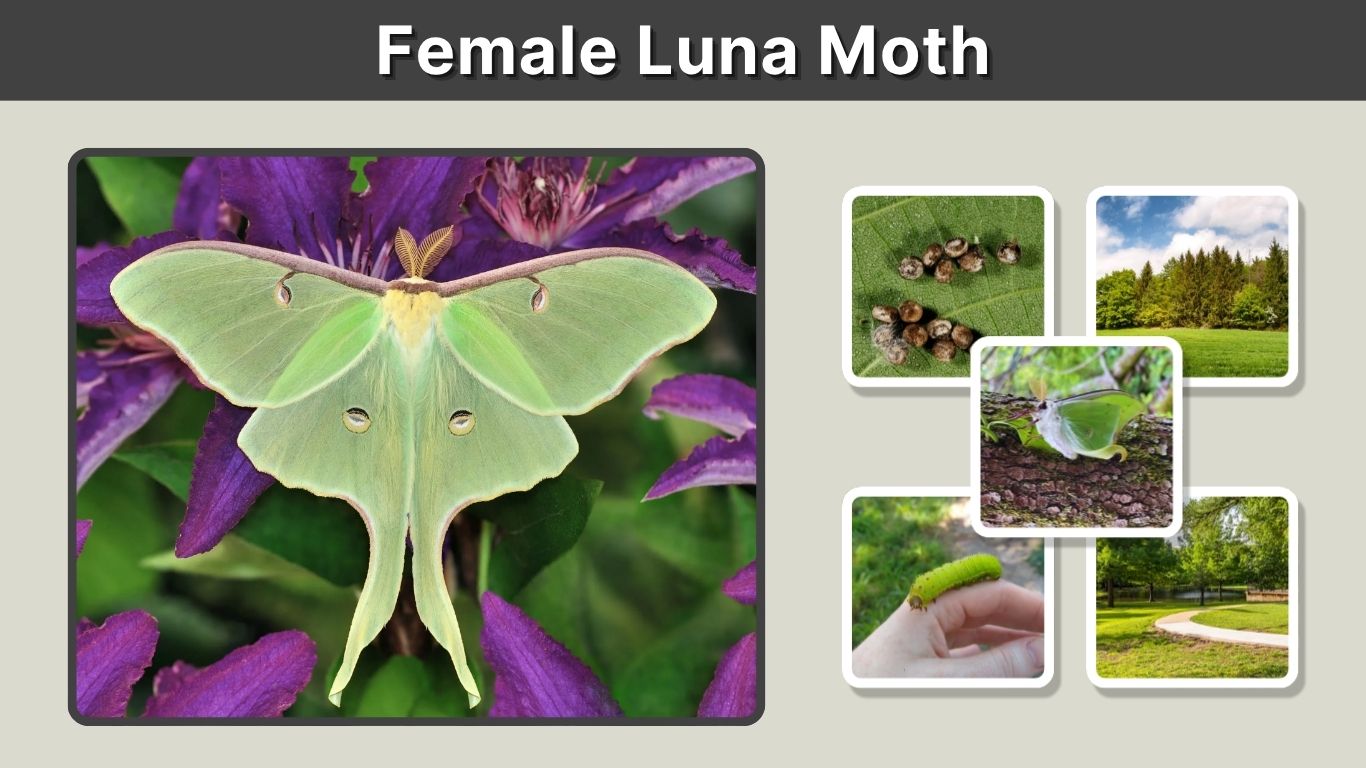
Female luna moths are beautiful green silk moths known for their soft wings, rounded body, and important role in reproduction. Many people confuse male and female luna moths because both have pale green wings, long tails, and eyespots. The easiest way to tell them apart is by checking the antennae, body shape, and behavior. This guide explains female luna moth features and male vs female differences.
What Is a Female Luna Moth?
A female luna moth is the egg-laying adult of the species Actias luna. Like the male, she has pale green wings, long curved tails, and round eyespots on her wings. However, her body is usually fuller because she carries eggs, and her antennae are thinner than a male’s.
Female luna moths are most active at night. After emerging from the cocoon, they wait for males to find them. They release chemical signals called pheromones, which males can detect from a distance. Once mating is complete, the female lays eggs on suitable host plants.
Female Luna Moth Identification
You can identify a female luna moth by looking for these features:
- Pale green wings with long hindwing tails
- Rounded or fuller body shape
- Thinner, less feathery antennae than males
- Large wings with eyespots on each wing
- Often less active than males before mating
- May rest near trees, walls, lights, or shrubs
- Usually carries eggs after emerging as an adult
- Releases pheromones to attract males at night
The antennae are the best clue. Female luna moth antennae look narrower and less bushy. Male antennae are much wider because males need them to detect female scent signals.
Female Luna Moth Appearance
The female luna moth has the same elegant green appearance that makes this species famous. Her wings are usually pale green or yellow-green, with a white body and long tails. The edges of the wings may show a pinkish, yellowish, or purple-brown line depending on age, season, and region.
Females may look heavier than males because their abdomen can be filled with eggs. This gives the body a thicker appearance. A newly emerged female may appear fresh, bright, and clean, while an older female may look faded or worn after mating and egg laying.
Female Luna Moth Size
Female luna moths are large moths, with a wingspan often around 3 to 4.5 inches. In many cases, females look slightly larger or bulkier than males, especially in the abdomen. However, wing size alone is not always the best way to identify sex.
A small female may overlap in size with a large male. This is why body shape and antennae are more reliable. If the moth has narrow antennae and a rounded abdomen, it is likely female. If it has very wide, feathery antennae, it is likely male.
Male vs Female Luna Moth
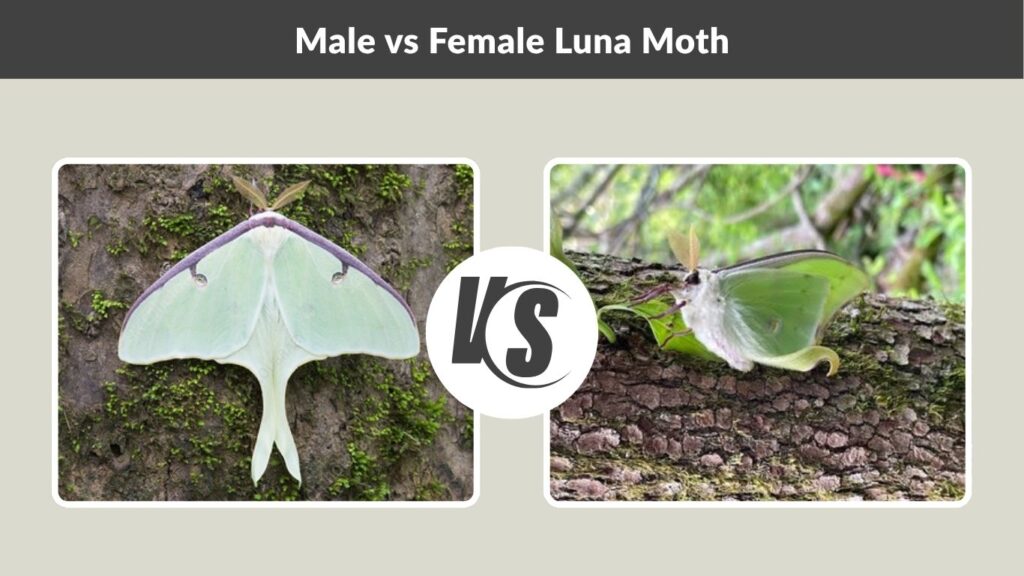
Male and female luna moths look similar at first, but they have several clear differences. The most useful difference is the antennae. Male luna moths have wider, more feather-like antennae, while female antennae are thinner. Their body shape and behavior also help with identification.
Both sexes do not eat as adults. Their adult life is short, usually around one week. During this time, males search for females, while females attract males and lay eggs.
| Feature | Female Luna Moth | Male Luna Moth |
| Antennae | Thinner and less feathery | Wide, bushy, and feather-like |
| Body shape | Fuller abdomen, often egg-filled | Slimmer body |
| Main role | Attracts mate and lays eggs | Searches for females |
| Activity | Often waits before mating | Flies more actively at night |
| Size | May look heavier or larger | May look lighter and slimmer |
Male vs Female Luna Moth Antennae
Antennae are the easiest way to tell male and female luna moths apart. Male luna moths have large, feathery antennae. These antennae are highly sensitive and help males detect pheromones released by females.
Female antennae are smaller and less bushy. They do not need the same large antennae because females usually do not search long distances for males. Instead, they release scent signals and wait for males to come.
If you are trying to identify a luna moth, look closely at the antennae first. Wide, comb-like antennae usually mean male. Narrower antennae usually mean female.
Body Shape Differences
Female luna moths often have a fuller abdomen than males. This is especially noticeable before she lays eggs. Her body may look rounder, heavier, or thicker compared with the slimmer male.
Male luna moths usually look lighter and more streamlined. Since they fly more actively to find females, their bodies may appear narrower. However, body shape can vary, so it should be used along with antennae.
A damaged or older moth may be harder to identify by body shape alone. In that case, antennae remain the strongest clue.
Wing Differences
Male and female luna moth wings are very similar. Both have pale green wings, long tails, and eyespots. There is no simple wing color rule that always separates males from females.
Some people think females are always larger or males always have longer tails, but this is not always reliable. Wing condition, age, temperature, and local variation can affect appearance. The wings may also fade after several days.
For accurate identification, do not rely only on wing size or color. Use antennae, abdomen shape, and behavior together.
Female Luna Moth Behavior
Female luna moth behavior is focused on mating and egg laying. Adult females do not eat or drink. They use stored energy from the caterpillar stage to survive long enough to reproduce. This short adult life makes their behavior simple but important.
A female may remain still for long periods, especially when calling males. She may rest on tree trunks, leaves, walls, or other surfaces. At night, she releases pheromones that males can detect.
How Female Luna Moths Attract Males
Female luna moths attract males by releasing pheromones. These are chemical signals that travel through the air. Male luna moths use their large antennae to detect these signals, sometimes from far away.
This process usually happens at night. A female may stay in one place while males fly around searching. Once a male finds her, mating can occur.
This behavior explains why male luna moths have larger antennae. Their antennae work like scent detectors. Female antennae are smaller because females are the signal senders, not the main long-distance searchers.
How Long Will a Female Luna Moth Wait to Mate?
A female luna moth may wait for a mate soon after emerging from her cocoon. Because adult luna moths live only a short time, mating usually needs to happen quickly. Females may begin releasing pheromones during the night to attract males.
If no male arrives, she may continue calling on following nights. However, her stored energy is limited. Adult luna moths cannot eat, so every day matters. A female that does not mate may still live only about a week.
Female Luna Moth Egg Laying
After mating, the female lays eggs on suitable host plants. These plants provide food for the caterpillars after they hatch. Common host plants include sweetgum, hickory, walnut, birch, persimmon, sumac, willow, and related trees.
A female may lay many eggs over a short period. She usually places them on or near leaves where young caterpillars can begin feeding. Once she has laid her eggs, her life is nearly complete.
Female Luna Moth Life Cycle
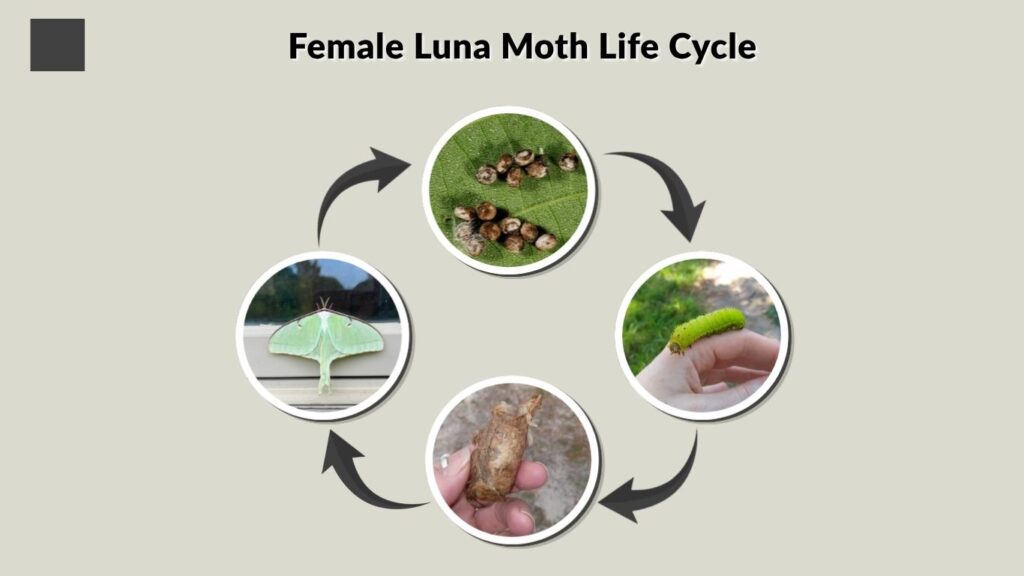
The female luna moth goes through the same life cycle as males: egg, caterpillar, cocoon, and adult. Sex is not easy to identify during the early stages. Most people can only tell male and female luna moths apart after they become adults.
The adult female stage is short but essential. Without females laying eggs on host plants, the next generation cannot continue.
Can You Tell Male and Female Caterpillars Apart?
It is very difficult to tell male and female luna moth caterpillars apart by normal observation. Caterpillars usually look alike, whether they will become male or female. Both feed on host plant leaves and pass through several growth stages.
Most identification happens after the adult moth emerges. At that point, antennae and abdomen shape become visible. Before adulthood, sexing a luna moth usually requires expert methods and is not practical for casual observers.
Female Luna Moth Cocoon
A female luna moth cocoon looks similar to a male cocoon. The cocoon is usually made with silk and leaves. It may be found in leaf litter, under host trees, or in protected places near the ground.
You usually cannot tell whether a cocoon contains a male or female just by looking at it. The adult moth must emerge before sex can be identified easily. Once it emerges, a fuller abdomen and thinner antennae may indicate a female.
Female Luna Moth Lifespan
An adult female luna moth usually lives around 7 to 10 days. Some may live a little shorter or longer depending on conditions. Protection from predators may help her survive the full natural period, but she cannot live much longer because she does not eat.
Her life as an adult is centered on reproduction. She emerges, attracts a male, mates, lays eggs, and dies naturally. The short lifespan is normal for this species.
Female Luna Moth Habitat
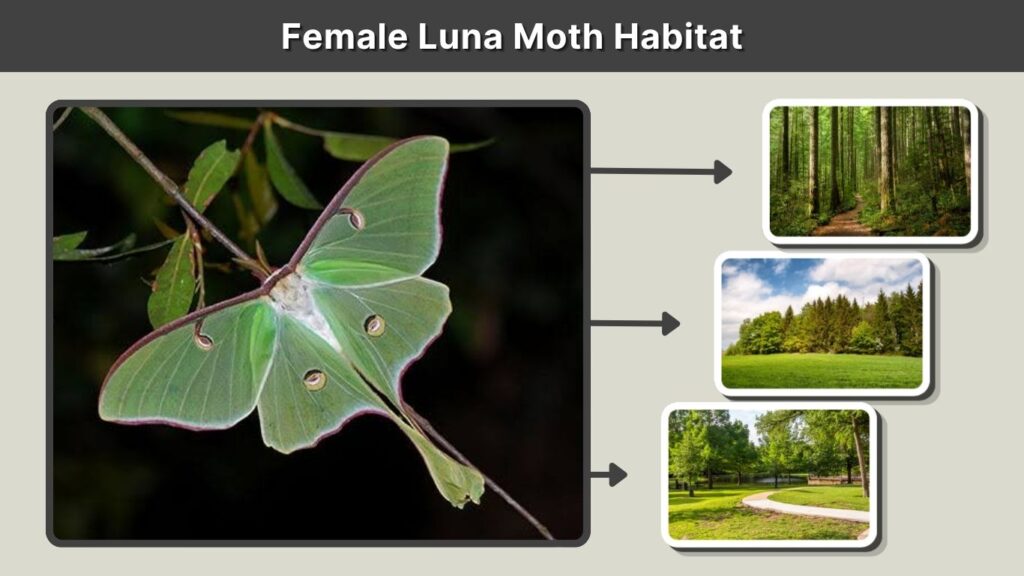
Female luna moths live in the same habitats as males. They are found in wooded areas, forest edges, parks, gardens, and neighborhoods with suitable trees. They need host plants for their caterpillars and safe places for cocoons.
A female may appear near a porch light or window at night. Lights can attract moths, but they can also confuse them. If a female luna moth is resting near a door or walkway, it is best to move carefully around her.
Where Female Luna Moths Are Found
Female luna moths are usually found near areas with hardwood trees. They may rest on tree trunks, leaves, fences, walls, or outdoor structures. Because they are nocturnal, they are easier to see at night or early morning.
During the day, they often stay still. Their green wings help them blend into leaves. This camouflage protects them from birds and other predators.
If you find a female, avoid handling her wings. Moth wings are delicate and can be damaged easily.
Host Plants for Female Egg Laying
Female luna moths choose host plants that can feed their caterpillars. Important host plants include:
- Sweetgum
- Hickory
- Walnut
- Birch
- Persimmon
- Sumac
- Willow
- Pecan
- Alder
- Beech
These plants are important because newly hatched caterpillars need the right leaves immediately. A female’s egg-laying choice helps determine whether the young caterpillars survive.
How to Tell If a Luna Moth Is Male or Female
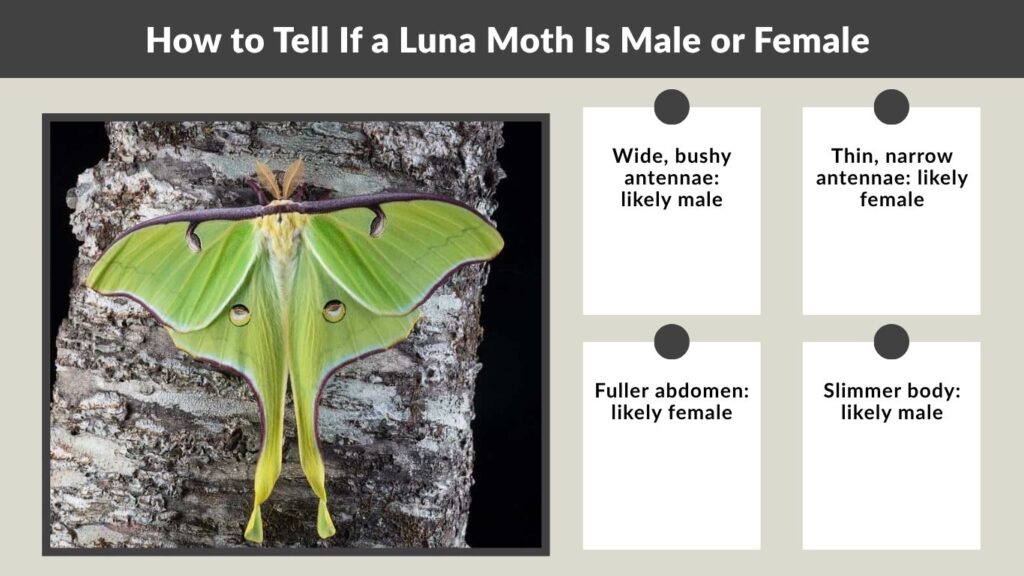
To tell if a luna moth is male or female, start with the antennae. This is the most reliable visual sign. Then check the body shape and behavior. A female usually has thinner antennae and a fuller abdomen. A male usually has bushier antennae and a slimmer body.
Quick Identification Checklist
Use this checklist when identifying a luna moth:
- Wide, bushy antennae: likely male
- Thin, narrow antennae: likely female
- Fuller abdomen: likely female
- Slimmer body: likely male
- Flying actively at night: often male
- Resting and releasing pheromones: likely female
- Laying eggs on host plants: female
- Freshly emerged with heavy body: may be female
These signs are helpful, but antennae are still the best feature. Body size and wing shape can vary, so they should not be used alone.
Common Mistakes in Identification
One common mistake is assuming the larger moth is always female. Females may look bulkier, but size can overlap. Another mistake is using wing color. Both males and females are usually pale green, and both can fade with age.
Some people also confuse luna moths with other green moth species. True luna moths have long hindwing tails and eyespots. Other moths may have similar colors but different shapes.
Are Female Luna Moths Rare?
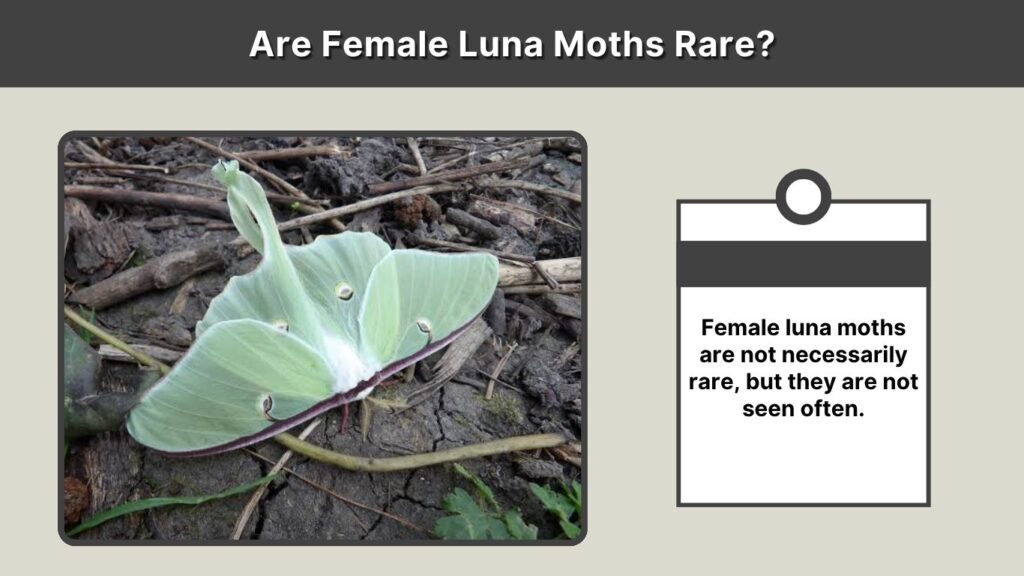
Female luna moths are not necessarily rare, but they are not seen often. Adult luna moths live only about a week and are active mostly at night. Females may also stay hidden while calling males or laying eggs.
Because of this, seeing a female luna moth can feel special. If you find one, observe it gently and avoid disturbing it. She may be trying to mate or lay eggs nearby.
Why You May See More Males Than Females
People may notice males more often because males fly actively while searching for females. They may come to light during their search. Females may stay closer to one place, especially when releasing pheromones.
This difference in behavior can make males seem more common. In reality, females are present too, but they may be less visible.
How to Help Female Luna Moths
You can help female luna moths by protecting their habitat. Avoid spraying pesticides on host trees. Leave some natural leaf litter under trees so cocoons can survive. Reduce bright outdoor lights during the month.
Planting native host trees is one of the best ways to support luna moth reproduction. If females have safe places to lay eggs, caterpillars have a better chance of survival.
FAQs
What does a female luna moth look like?
A female luna moth has pale green wings, long hindwing tails, eyespots, and a white body. She usually has thinner antennae than a male and a fuller abdomen because she carries eggs. Her wings look similar to a male’s, so antennae are the easiest identification feature.
How can you tell a male from a female luna moth?
The best way to tell them apart is by looking at the antennae. Male luna moths have wide, feathery antennae, while females have thinner antennae. Females may also have a fuller abdomen, especially before laying eggs, while males often look slimmer.
Are female luna moths bigger than males?
Female luna moths may look bigger or heavier because their abdomen can be filled with eggs. However, wing size can overlap between males and females. Size alone is not the best clue. Antennae and body shape are more reliable for identification.
What do female luna moths do?
Female luna moths release pheromones to attract males, mate, and lay eggs on host plants. They do not eat or drink as adults. Their short adult life is focused on reproduction, and they usually live only about 7 to 10 days.
Can you tell male and female luna moth caterpillars apart?
It is very difficult to tell male and female luna moth caterpillars apart by appearance. Caterpillars usually look the same to casual observers. The easiest time to identify sex is after the adult moth emerges, when antennae and abdomen shape can be seen clearly.
