
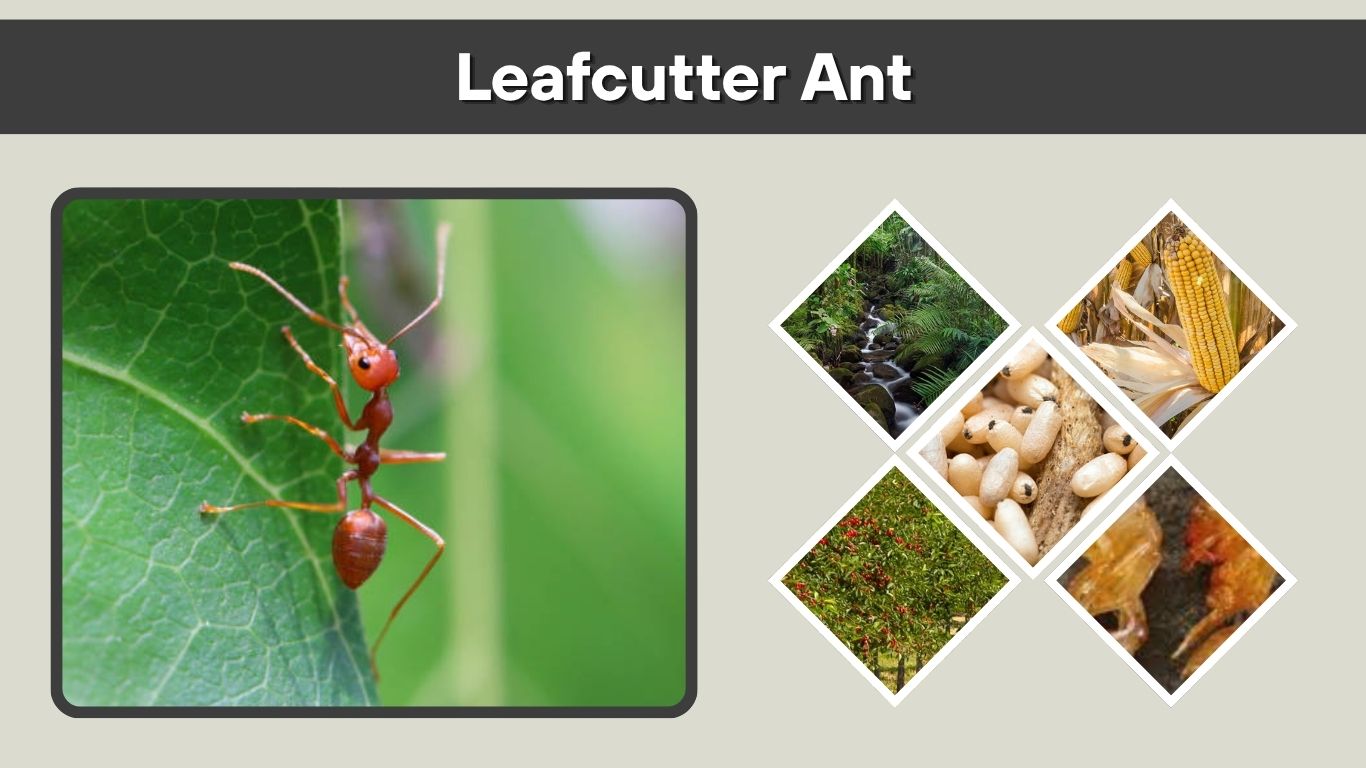
Leafcutter ants are famous for carrying pieces of leaves in long trails, but they do not eat the leaves directly. Instead, they use leaves to grow fungus inside underground gardens. This farming behavior makes leafcutter ants one of the most advanced social insects in the world. They live in large colonies with queens, workers, soldiers, trails, tunnels, and a complex relationship with the fungus they cultivate.
What Is a Leafcutter Ant?
A leafcutter ant is a fungus-farming ant that cuts pieces of fresh leaves, flowers, grass, and other plant material. The ants carry these pieces back to the nest, chew them into pulp, and use them as a growing medium for their fungus garden. The fungus becomes the main food source for the colony, especially for larvae.
Leafcutter ants belong mainly to the genera Atta and Acromyrmex. These ants are native to the Americas and are especially common in tropical and subtropical regions. Their farming system is so specialized that the ants and fungus depend on each other for survival. Smithsonian researchers describe this relationship as a form of crop domestication similar in concept to human agriculture.
Leafcutter Ant Identification
Leafcutter ants are usually reddish-brown, brown, or dark brown. Their bodies are strong and often spiny, especially in larger workers and soldiers. A colony contains different worker sizes, so the ants on a trail may not all look the same. Some are tiny workers, while others are larger leaf carriers or defensive soldiers.
The easiest sign is behavior. If you see ants carrying leaf pieces in a line, they are likely leafcutter ants. Their trails can stretch across yards, forests, farms, or roads. They often cut neat circular or crescent-shaped pieces from leaves.
Key Characteristics
- Color: Reddish-brown, brown, or dark brown.
- Body: Hard, strong, and often spiny.
- Worker size: Different sizes within the same colony.
- Behavior: Workers cut and carry leaf pieces.
- Nest: Large underground colony with many chambers.
- Trail: Clear ant highways between plants and nest entrances.
- Diet system: Leaves are used to grow fungus, not eaten directly.
- Defense: Larger workers and soldiers may bite if disturbed.
Leafcutter ants are not usually confused with small kitchen ants because their leaf-carrying behavior is very distinctive. However, small workers without leaf pieces may be harder to identify unless you find the trail or nest.
Where Do Leafcutter Ants Live?
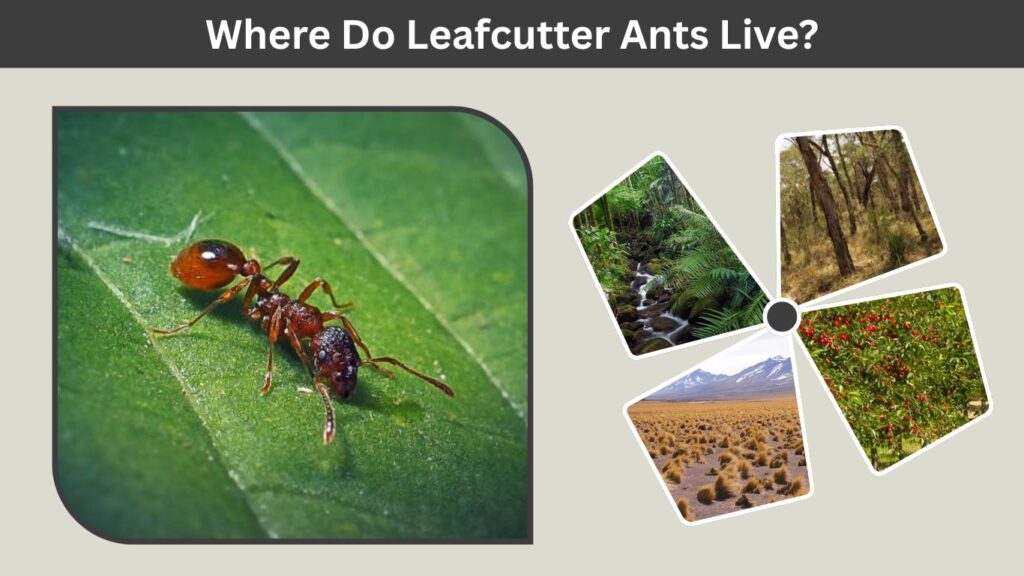
Leafcutter ants live in North, Central, and South America. They are most diverse in tropical forests, but some species live in dry forests, grasslands, scrublands, farms, and urban landscapes. In the United States, the best-known species is the Texas leafcutting ant, Atta texana.
The Texas leafcutting ant occurs in parts of Texas and Louisiana. Texas A&M Forest Service notes that Atta texana can be a serious pest in newly established pine plantations and may also damage citrus groves in South Texas.
Common Habitats
- Tropical forests
- Dry forests and scrublands
- Grasslands and open woodland
- Farms and orchards
- Pine plantations
- Gardens and yards
- Roadsides and disturbed soil
- Urban landscapes with suitable plants
Leafcutter ants prefer places where they can find steady plant material and suitable soil for underground nests. Their nests may be very large and can remain active for years.
Leafcutter Ant Nest and Tunnels
A leafcutter ant nest is more than a simple ant hole. It is an underground system with tunnels, chambers, fungus gardens, brood areas, waste chambers, and multiple entrances. Large colonies may have many nest openings spread across a wide area.
The visible nest entrances may look like soil mounds or openings with loose soil around them. Trails often connect nest entrances to nearby trees, shrubs, gardens, or crops. Some colonies build long, clear trails that look like tiny roads.
Nest Features
- Several entrance holes
- Loose soil around openings
- Underground fungus garden chambers
- Brood chambers for eggs, larvae, and pupae
- Waste chambers separated from the fungus garden
- Long tunnels connecting parts of the nest
- Foraging trails leading to plants
The fungus garden must be protected from drying out, contamination, and disease. Workers constantly clean, maintain, and feed the garden with fresh plant material.
Leafcutter Ant Fungus
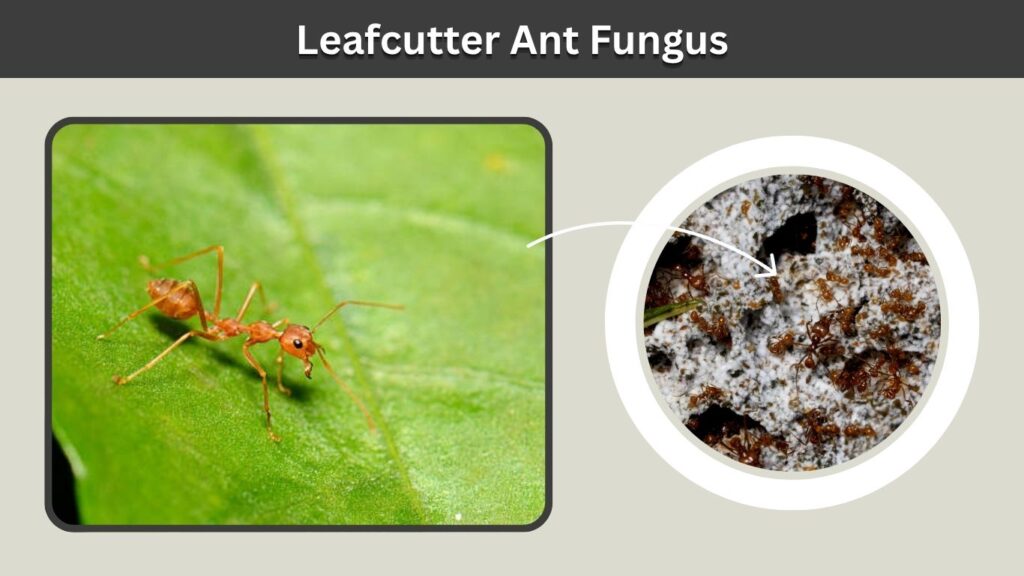
Leafcutter ants are famous because they farm fungus. Workers cut leaves and bring them into the nest, but the leaves are not the main food. Inside the nest, ants chew and prepare the leaves so the fungus can grow on them. The colony then feeds on specialized fungal growth.
Pacific Northwest National Laboratory explains that the fungus helps degrade plant material inside the ants’ complex microbial garden. This relationship is important enough that scientists study it for insights into plant breakdown and biofuel research.
The fungus garden is usually pale, whitish, cream, or light tan. It may look like a spongy mass inside the nest. Workers remove harmful material, add fresh leaf pulp, and protect the garden from mold and parasites.
Leafcutter Ants and Fungi: A Symbiotic Relationship
The relationship between leafcutter ants and fungi is mutualistic. The ants provide the fungus with fresh plant material, protection, cleaning, and a stable underground environment. In return, the fungus provides food for the ants and their larvae.
This is also an example of coevolution. Over millions of years, the ants became better farmers, while the fungus became more dependent on the ants. Smithsonian researchers reported that ant agriculture began about 66 million years ago, and higher agriculture later became highly specialized in groups such as leafcutter ants.
How They Represent Coevolution
- Ants evolved behaviors for cutting leaves and farming fungus.
- The fungus evolved into a crop that depends on ant care.
- Ants protect the fungus from pests and mold.
- Workers choose plant material that supports the garden.
- The colony depends on fungus as a food source.
- The fungus depends on ants for survival and spread.
This relationship is one of the most impressive examples of insect agriculture in nature.
What Do Leafcutter Ants Eat?
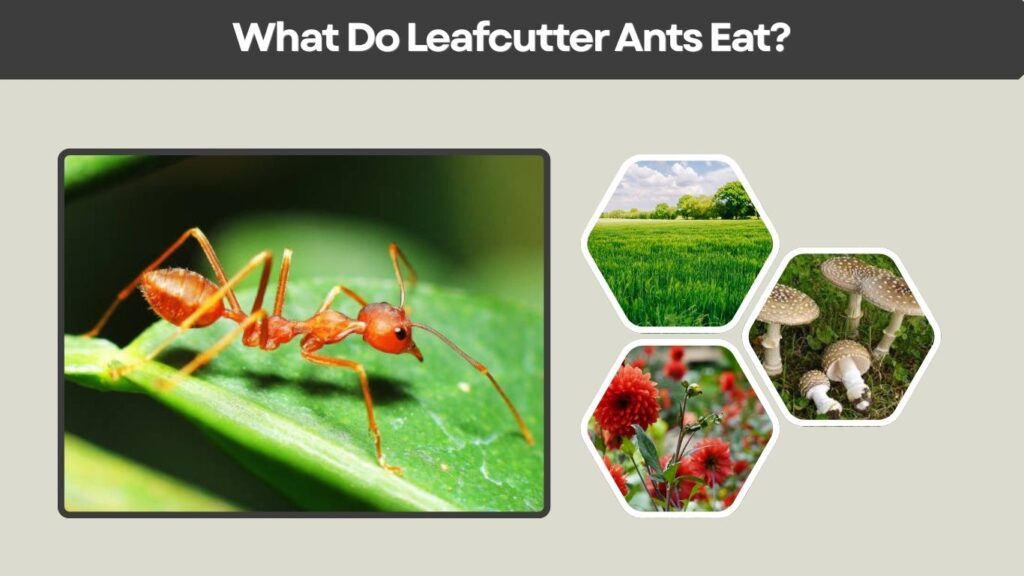
Leafcutter ants do not simply eat leaves. Adult ants may drink plant sap and feed on small liquid nutrients, but the colony depends heavily on the fungus they grow. Larvae especially rely on the fungus for nutrition.
This is why leafcutter ants collect leaves. They are not carrying leaf pieces as food in the normal sense. They are collecting farming material. The leaves are processed and added to fungus gardens, where the fungus breaks them down and produces edible growth for the ants.
| Item | Role in the Colony |
|---|---|
| Fresh leaves | Used as fungus-growing material |
| Flowers | Sometimes cut and added to the garden |
| Grass | Used by some species as garden material |
| Fungus | Main food source for larvae and colony nutrition |
| Plant sap | May be consumed by adult workers |
| Dead plant material | Sometimes used depending on species |
Leafcutter Ant Queen
The leafcutter ant queen is the largest and most important member of the colony. She lays the eggs that produce workers, soldiers, males, and future queens. A young queen starts a new colony after mating. She carries a tiny piece of fungus from her parent colony and uses it to start her first fungus garden.
This behavior is one reason leafcutter ants are so remarkable. The queen does not start only an ant colony; she also starts a farm. Without the fungus, the young colony cannot survive.
Queen Size and Role
Leafcutter ant queens are much larger than workers. Size varies by species, but queens can be several times larger than small workers. Their abdomen is large because they produce eggs. In mature colonies, the queen stays deep inside the nest and is protected by workers.
A healthy queen may live for many years. As the colony grows, her egg production supports thousands, hundreds of thousands, or even millions of ants, depending on the species.
Leafcutter Ant Castes
Leafcutter ant colonies have a strong division of labor. Different worker sizes perform different jobs. This caste system helps the colony cut leaves, defend the nest, maintain fungus gardens, raise brood, and remove waste efficiently.
Main Castes
- Queen: Lays eggs and starts the colony’s fungus garden.
- Minims: Tiny workers that care for fungus and brood.
- Minors: Small workers that tend trails and process plant material.
- Media workers: Cut and carry leaf pieces.
- Majors: Large workers that defend trails and the nest.
- Soldiers or supermajors: Very large defensive workers in some species.
- Males: Winged ants that mate with young queens.
Leafcutter ant soldiers have strong jaws and can bite if handled. Their main job is defense, especially around trails and nest entrances.
Leafcutter Ant Trail
A leafcutter ant trail is one of the easiest ways to recognize these ants. Workers often move in organized lines, carrying pieces of leaves over their heads or backs. Trails may run from a plant to a nest entrance and may remain active for long periods.
Some trails are cleared of debris, making them look like small roads. Workers may travel both directions at the same time: some leave the nest to cut leaves, while others return carrying plant pieces.
Trail traffic can be intense in large colonies. If a colony is near a garden or orchard, workers may remove large amounts of plant material overnight.
Leafcutter Ant Life Cycle
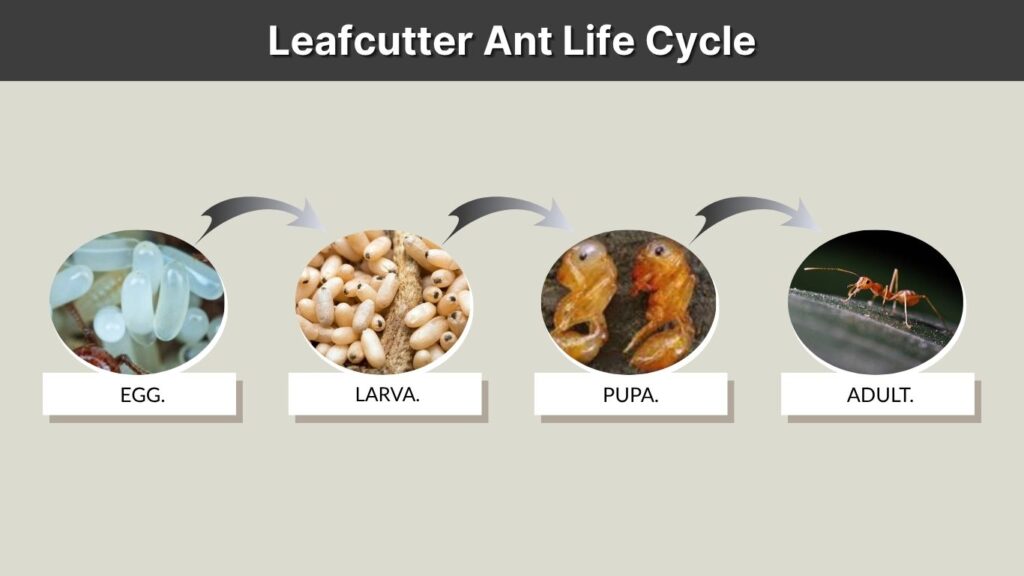
Leafcutter ants go through complete metamorphosis: egg, larva, pupa, and adult. The queen lays eggs deep in the nest. Larvae hatch and are cared for by worker ants. They are fed fungal material from the colony’s garden. After pupation, new adults emerge and begin colony tasks.
Winged males and queens are produced when the colony is mature. During mating flights, young queens mate and then search for a suitable place to start a new colony. The queen uses her stored fungus culture to begin the first garden.
Life Cycle Stages
- Egg: Laid by the queen.
- Larva: Fed and cleaned by workers.
- Pupa: Developing stage before adulthood.
- Adult worker: Performs colony duties.
- Winged reproductive: Mates and helps start new colonies.
Leafcutter Ant Damage
Leafcutter ants can be fascinating in forests but frustrating in gardens, orchards, and farms. They may strip leaves from young trees, ornamental plants, vegetables, and crops. Damage can happen quickly because many workers may harvest from the same plant at once.
In Texas, the Texas leafcutting ant can damage pine plantations and citrus. Texas A&M Forest Service describes it as one of the most damaging pests in newly established pine plantations in affected areas.
Plants They May Damage
- Young pine seedlings
- Citrus trees
- Roses
- Fruit trees
- Vegetables
- Ornamental shrubs
- Garden flowers
- Oak and other broadleaf trees
- Landscape plants
Healthy mature plants may recover from some leaf loss, but young plants and seedlings can be severely weakened.
Are Leafcutter Ants Dangerous?
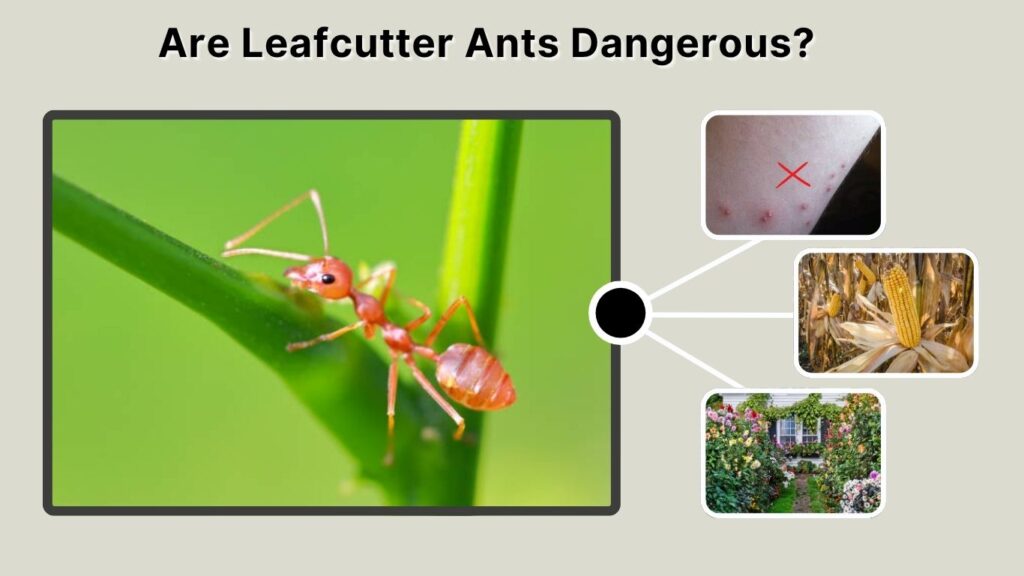
Leafcutter ants are not usually dangerous to people, but larger workers and soldiers can bite. They do not behave like fire ants and do not usually attack in swarms unless the nest is disturbed. However, their jaws are strong, and a bite from a large soldier can be painful.
They are more dangerous to plants than to humans. The main concern is damage to gardens, crops, and young trees. Avoid handling them, especially large workers near nest entrances.
How to Get Rid of Leafcutter Ants
Leafcutter ant control can be difficult because nests are large and deep. Removing visible ants on trails is not enough. Effective control must reach the colony and fungus garden. In serious infestations, local extension guidance or professional pest control may be needed.
Texas A&M Forest Service notes that control options for Texas leafcutting ants are limited, and products must be used according to label directions. Some treatments are designed for direct application into entrance and exit holes.
Control and Prevention Tips
- Identify the species before treatment.
- Locate nest entrances and active trails.
- Protect young trees and valuable plants first.
- Avoid disturbing the nest without a plan.
- Use labeled products only for leafcutter ants.
- Follow regional extension recommendations.
- Remove preferred plant material near sensitive areas when practical.
- Monitor after treatment because colonies may remain active underground.
- Use professionals for large, established nests.
Do not pour gasoline, bleach, or harsh chemicals into nests. These methods can harm soil, plants, animals, and people, and they may not eliminate the colony.
FAQs
What do leafcutter ants do with leaves?
Leafcutter ants use leaves to grow fungus inside their underground nests. Workers cut leaves, carry them to the nest, chew them into pulp, and add them to fungus gardens. The ants do not simply eat the leaves. The fungus grown on the leaf material becomes an important food source for the colony.
Do leafcutter ants eat leaves?
Leafcutter ants do not eat leaves directly in the way caterpillars or grasshoppers do. They use leaves as farming material for their fungus. Adult ants may drink plant sap, but the colony depends strongly on the cultivated fungus, especially for feeding larvae and supporting colony growth.
Where do leafcutter ants live?
Leafcutter ants live in the Americas, especially in tropical and subtropical regions. They are common in Central and South America, and some species occur in the southern United States. The Texas leafcutting ant, Atta texana, is found in parts of Texas and Louisiana.
Are leafcutter ants dangerous?
Leafcutter ants are not usually dangerous to people, but large workers and soldiers can bite if handled or if the nest is disturbed. Their bigger impact is plant damage. They can remove leaves from gardens, orchards, young trees, crops, and pine seedlings, sometimes very quickly.
How big is a leafcutter ant queen?
A leafcutter ant queen is much larger than the workers. Exact size depends on the species, but queens can be several times larger than small workers and have a large abdomen for egg production. A young queen also carries a small piece of fungus to start a new colony.
