
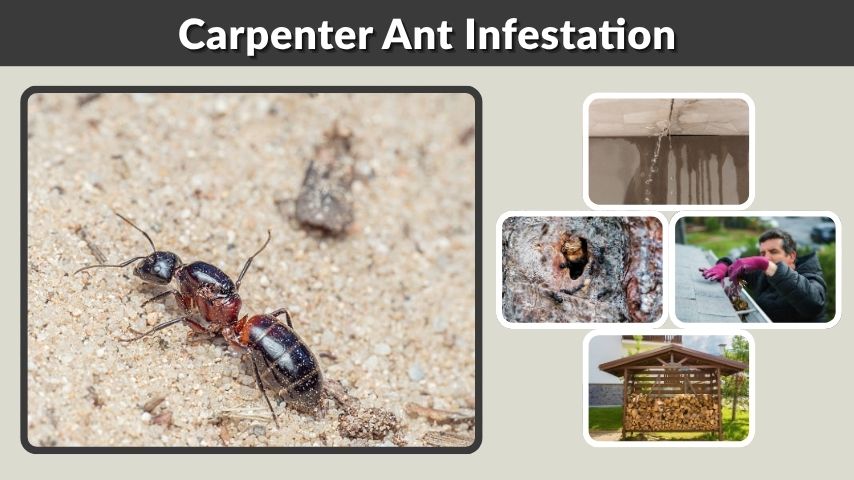
A carpenter ant infestation can be stressful because these ants are often linked with hidden moisture, damaged wood, and possible structural problems. Unlike termites, carpenter ants do not eat wood. They tunnel through it to create nesting galleries. This guide explains how to spot carpenter ant infestation signs, what causes them, and how to get rid of carpenter ants before the problem spreads.
What Is a Carpenter Ant Infestation?
A carpenter ant infestation happens when carpenter ants establish a colony or satellite nest in or around a home. These ants are usually large and dark, though some species may be black, brown, red, or a combination of colors. They are most active at night and often travel in trails between food sources and nesting areas.
Carpenter ants are different from ordinary nuisance ants because they can tunnel through wood. They do not consume the wood like termites. Instead, they excavate galleries to create space for the colony. Over time, this activity can weaken wood, especially if the nest is in already damp or damaged areas.
Do Carpenter Ants Infest Houses?
Yes, carpenter ants can infest houses. They often enter through cracks, gaps, utility lines, tree branches, foundation openings, window frames, or areas where wood touches soil. Once inside, they may nest in wall voids, crawl spaces, attics, insulation, door frames, window sills, damp subfloors, or wood damaged by leaks.
A house infested with carpenter ants may have one main colony outside and one or more satellite nests indoors. Satellite nests can make treatment harder because killing visible ants may not eliminate the source.
Are Carpenter Ants the Same as Termites?
No. Carpenter ants and termites are different pests. Termites eat cellulose and can consume wood from the inside. Carpenter ants tunnel through wood but do not eat it. Carpenter ant galleries are often smoother and cleaner, while termite damage may contain mud or soil.
Still, both pests deserve attention. If you see winged insects indoors, wood damage, or piles of debris near wood, proper identification is important before treatment.
Signs of Carpenter Ant Infestation
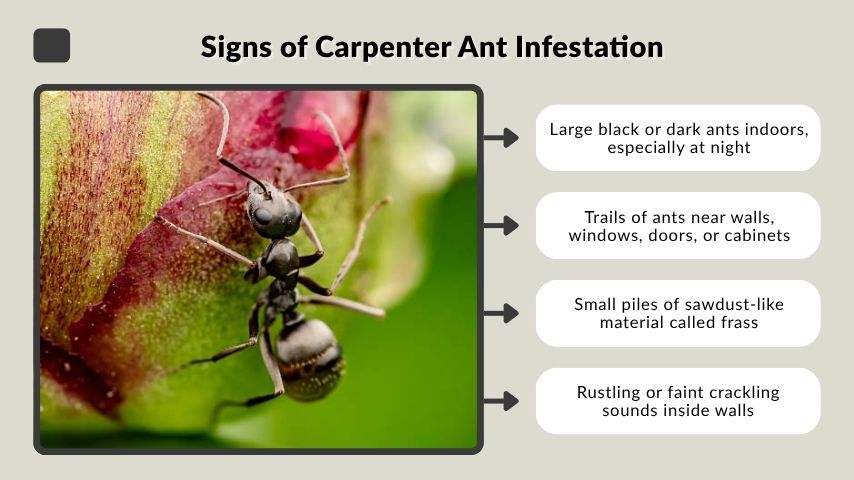
The signs of a carpenter ant infestation can be subtle at first. Many homeowners notice only a few large ants and ignore the problem until activity becomes more obvious. Early detection is important because nests can grow and expand into hidden areas.
Common Carpenter Ant Infestation Signs
Look for these warning signs around the home:
- Large black or dark ants indoors, especially at night
- Trails of ants near walls, windows, doors, or cabinets
- Small piles of sawdust-like material called frass
- Rustling or faint crackling sounds inside walls
- Winged carpenter ants indoors
- Ants coming from holes, gaps, or wall voids
- Damaged, damp, or hollow-sounding wood
- Activity near sinks, dishwashers, bathrooms, or leaks
The most important sign is repeated activity. Seeing one ant once may not always mean a nest is inside, but seeing large ants regularly, especially in the same area, should be taken seriously.
What Does Carpenter Ant Frass Look Like?
Carpenter ant frass looks like fine wood shavings, sawdust, or small debris piles. It may also contain insect parts or bits of insulation. Since carpenter ants push debris out of their galleries, frass may appear below baseboards, window sills, beams, door frames, or wall openings.
Frass is one of the clearest signs that ants may be tunneling nearby. If you clean it up and it returns, there may be an active nest inside the wood or wall void.
Does Seeing One Carpenter Ant Mean Infestation?
Seeing one carpenter ant does not always mean you have an infestation. A single worker may have wandered in from outdoors while searching for food. However, one carpenter ant should not be ignored if it appears indoors during winter, shows up repeatedly, or is found far from doors and windows.
You are more likely dealing with an infestation if you see:
- Several large ants indoors
- Ants appearing from the same wall or gap
- Winged ants inside the house
- Frass near wood
- Activity during cold weather
- Ants near water-damaged wood
If you only see one ant near an open door in warm weather, monitor the area. If more appear, inspect more closely.
What Causes Carpenter Ant Infestation?
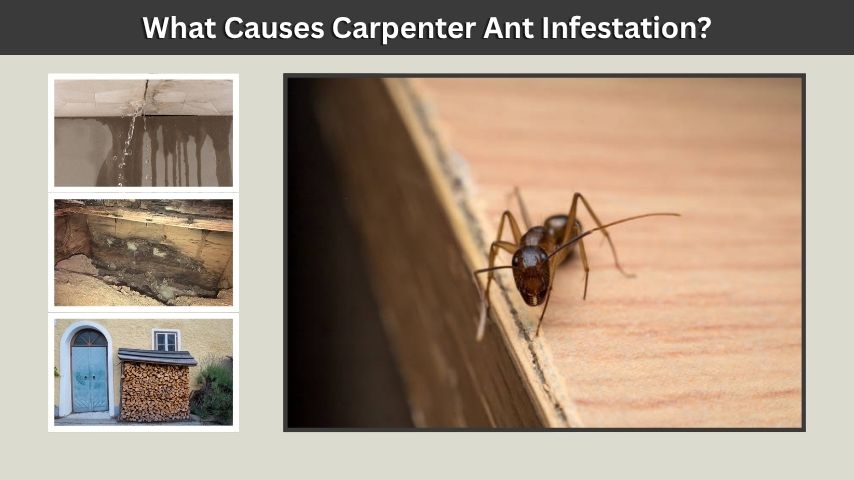
Carpenter ants are attracted to conditions that make nesting easier. Moisture is one of the biggest factors. Damp, softened, or decaying wood is easier for ants to tunnel through, so homes with leaks or poor ventilation are more vulnerable.
Common Causes
Carpenter ant infestations are often linked to:
- Roof leaks
- Plumbing leaks
- Poor drainage around the foundation
- Damp crawl spaces
- Wet insulation
- Rotting window or door frames
- Wood touching soil
- Firewood stored against the house
- Tree branches touching the roof
- Dead trees or stumps near the home
- Gaps around utility lines or siding
Food also attracts carpenter ants. They may feed on sweets, grease, pet food, crumbs, and other insects. Outdoor colonies may move indoors when conditions are favorable or when nearby nests are disturbed.
Sudden Carpenter Ant Infestation
A sudden carpenter ant infestation may happen when a nearby colony is disturbed. Tree removal, storm damage, construction, rotting wood removal, or changes in weather can push ants to relocate. Heavy rain may also drive ants toward drier shelter.
If carpenter ants suddenly appear in large numbers, look for nearby wood piles, dead trees, stumps, fences, sheds, or moisture-damaged parts of the home.
Where Carpenter Ants Infest Homes
Carpenter ants prefer hidden, protected spaces. They often nest where moisture and wood meet, but they can also move into dry spaces once a colony is established.
| Infestation Area | What to Look For | Why It Happens |
| Walls | Ants from outlets, gaps, or baseboards | Hidden voids and moisture |
| Kitchen | Ants near dishwasher, sink, or cabinets | Water leaks and food |
| Bathroom | Ant trails near tub, toilet, or vanity | Plumbing moisture |
| Attic | Ants near rafters or roof leaks | Damp wood and insulation |
| Crawl space | Activity near beams or joists | Poor ventilation and damp soil |
| Yard | Ants in stumps, logs, or fences | Outdoor nesting sites |
| Trees | Ants entering cavities or dead limbs | Decayed interior wood |
Carpenter Ant Infestation in Walls
A carpenter ant infestation in walls is one of the most concerning situations because the nest may be hidden. You may see ants entering through tiny cracks, electrical outlets, baseboards, window frames, or plumbing gaps.
Signs in Walls
Possible wall infestation signs include:
- Ants appearing from the same wall area
- Soft rustling sounds at night
- Frass below trim or outlets
- Ant trails along baseboards
- Moisture stains on drywall
- Hollow-sounding wood nearby
- Winged ants emerging indoors
Do not randomly spray visible ants and assume the problem is solved. Sprays may kill workers but fail to reach the nest. In some cases, they can scatter the colony and make control harder.
Carpenter Ant Infestation in Bedroom
A carpenter ant infestation in a bedroom may happen if there is moisture near windows, exterior walls, roof leaks, or wall voids. Ants may also wander into bedrooms from nearby nests while foraging.
Check window sills, baseboards, closets, attic access points, and exterior walls. If ants appear near a specific corner or window, inspect the outside of the wall for branches, gaps, wet siding, or damaged trim.
Carpenter Ant Infestation in Trees and Yard
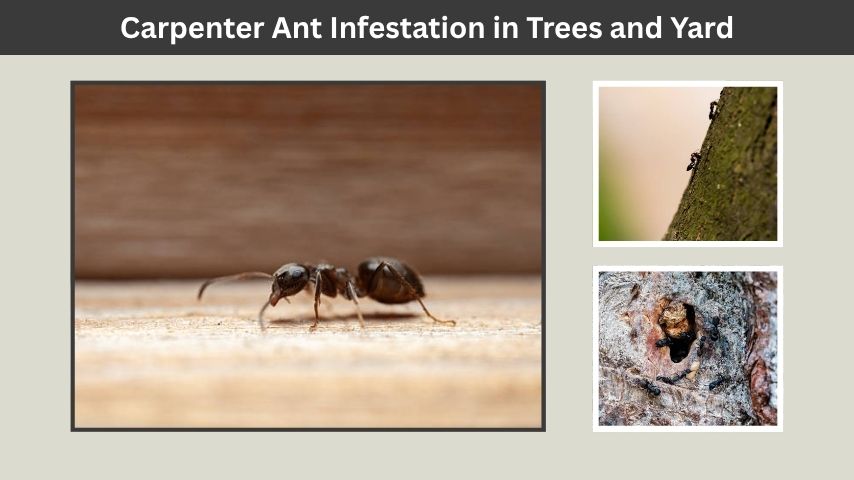
Carpenter ants commonly nest outdoors in trees, stumps, logs, fences, landscape timbers, and firewood. Outdoor nests do not always mean your home is infested, but they can increase the risk if the colony is close to the structure.
Tree Infested With Carpenter Ants
A tree infested with carpenter ants often has internal decay, cavities, dead limbs, or moisture damage. Carpenter ants usually take advantage of wood that is already softened. Their presence may signal that the tree has a health issue.
Signs include:
- Ants moving up and down the trunk
- Ants entering holes or cavities
- Sawdust-like debris near the base
- Dead branches or hollow areas
- Ant activity near wounds or cracks
If the tree is large, close to the house, or structurally questionable, contact an arborist. Killing ants will not fix a decayed or unsafe tree.
Carpenter Ant Infestation in Yard
Carpenter ants in the yard may nest in old logs, stumps, mulch, railroad ties, sheds, or wooden borders. Yard colonies can send workers into the house for food. Remove rotting wood, keep mulch away from siding, and store firewood off the ground and away from the home.
How to Get Rid of Carpenter Ant Infestation
The best carpenter ant infestation treatment starts with locating the nest. Simply killing visible ants is rarely enough. You need to find where they are nesting, remove conditions that attract them, and use targeted treatment when necessary.
Step-by-Step Treatment
Follow these steps:
- Confirm the pest is a carpenter ant, not a termite.
- Track ant trails at night when activity is higher.
- Look for frass, moisture damage, and entry points.
- Inspect kitchens, bathrooms, crawl spaces, attics, and exterior wood.
- Repair leaks and improve ventilation.
- Remove rotting wood, stumps, and debris near the home.
- Use bait or targeted treatment based on the nest location.
- Call a pest control professional if the nest is hidden or activity continues.
Baits may work when ants carry the product back to the colony, but success depends on choosing the right bait and placing it along active trails. Dusts or professional treatments may be needed for wall voids and hidden nests.
Carpenter Ant Infestation Treatment in Walls
Wall infestations are difficult because the nest may be hidden behind drywall, insulation, or structural wood. Treatment may involve careful inspection, moisture correction, baiting, dust application, or professional equipment.
Avoid drilling or treating walls unless you know what you are doing. Improper treatment can miss the nest, damage your home, or expose people and pets to pesticides unnecessarily.
When to Call a Professional
Professional help is recommended if:
- You see winged carpenter ants indoors
- Frass keeps returning
- Ants appear inside during winter
- You hear activity in walls
- There is visible wood damage
- DIY baiting fails
- The nest is hidden
- The infestation involves structural areas
A professional can identify the species, locate nests, treat wall voids safely, and help prevent reinfestation.
How to Prevent Carpenter Ant Infestation
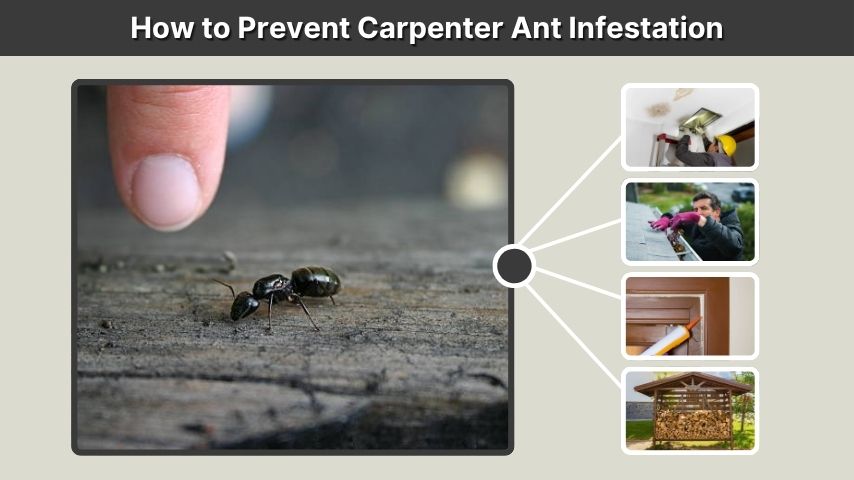
Prevention focuses on moisture control, exclusion, and removing outdoor nesting sites. Carpenter ants are much less likely to move into a dry, sealed, well-maintained home.
Prevention Checklist
Use these steps to reduce risk:
- Fix roof, plumbing, and appliance leaks quickly.
- Keep gutters clean and draining away from the foundation.
- Improve ventilation in crawl spaces, basements, and attics.
- Seal cracks around doors, windows, pipes, and utility lines.
- Trim branches away from the roof and siding.
- Store firewood away from the house and off the ground.
- Remove rotting stumps, logs, and damaged wood.
- Keep mulch several inches away from siding.
- Replace moisture-damaged wood.
- Clean up food crumbs, grease, and pet food.
Prevention is especially important if your home is near wooded areas, mature trees, or older structures with moisture problems.
FAQs
How many carpenter ants is an infestation?
There is no exact number. One ant may be a scout, but repeated sightings, indoor trails, winged ants, frass, or ants emerging from walls suggest an infestation. If you see carpenter ants regularly in the same area, inspect for moisture damage and nesting sites.
What are the early signs of carpenter ant infestation?
Early signs include large ants indoors, especially at night, small piles of frass, faint rustling in walls, and ants near damp wood. You may also notice activity around sinks, windows, doors, crawl spaces, or exterior wood that has moisture damage.
How do you treat a carpenter ant infestation?
Treatment starts by finding the nest and correcting moisture problems. Track ant trails, inspect damp wood, remove rotting materials, seal entry points, and use targeted bait or professional treatment. Wall nests, recurring activity, or winged ants indoors usually require professional pest control.
Can carpenter ants infest pressure-treated wood?
Carpenter ants are less likely to infest sound, dry pressure-treated wood, but they may still use nearby gaps, damaged areas, or softened wood if moisture and decay are present. If ants are active around treated wood, inspect adjacent untreated wood, soil contact, and moisture sources.
What causes carpenter ants in a house?
Carpenter ants are often caused by moisture problems, damaged wood, nearby outdoor colonies, entry gaps, or food sources. Leaky roofs, plumbing leaks, damp crawl spaces, rotting trim, wood-to-soil contact, and tree branches touching the house can all increase infestation risk.
