

Dragonflies are often admired for their bright colors and graceful flight, but many people feel uneasy when one flies close to them. A common question is whether dragonflies sting or bite humans. Their long bodies, fast movements, and hovering behavior sometimes make them look threatening. In reality, dragonflies are not aggressive toward people. Understanding what dragonflies can and cannot do helps clear up myths and shows why these insects are generally harmless and even beneficial.
Do Dragonflies Sting? The Direct Answer
Dragonflies do not sting. They do not have a stinger, venom gland, or any structure capable of injecting venom. Unlike bees, wasps, or scorpions, dragonflies belong to a different insect group that lacks stinging organs entirely.
The long, thin abdomen of a dragonfly often leads people to think it might contain a stinger. In fact, this part of the body holds the digestive and reproductive organs, not a weapon. There is no sharp, venomous tip designed to pierce skin.
Because dragonflies frequently fly quickly and hover close to faces, they can feel intimidating. However, their flight behavior is related to hunting insects, not attacking people. From a biological standpoint, dragonflies are incapable of stinging.
Do Dragonflies Bite or Sting Humans?

Although dragonflies cannot sting, they can bite. However, biting is extremely rare and usually happens only when a dragonfly is handled or trapped.
Can Dragonflies Bite People?
Dragonflies have strong jaws called mandibles, which they use to catch and chew insects. These jaws are effective for crushing mosquitoes and flies, but they are not designed to harm humans.
- Dragonflies do not have stingers
- They use mandibles to eat insects
- Bites are defensive, not aggressive
- Most bites occur when a dragonfly is grabbed
- They are not venomous
A bite is the dragonfly’s last defense if it feels threatened. In the wild, dragonflies almost never bite people because they prefer to fly away rather than confront something much larger than themselves.
What Does a Dragonfly Bite Feel Like?
When a dragonfly bite does happen, it usually feels like a small pinch or light prick. In most cases, the skin is not broken, and there is no bleeding. Large species may cause slightly more pressure, but even then, serious injury is extremely unlikely.
There is no venom involved, so dragonfly bites do not cause poisoning, tissue damage, or allergic reactions associated with stings. At most, a mild redness may appear for a short time before fading.
Do Dragonflies Have a Stinger?
Dragonflies do not have a stinger at any stage of their lives. Their bodies are built for flying and hunting insects, not for defense through venom.
The tip of a dragonfly’s abdomen may look pointed, but it is soft and flexible. It plays a role in reproduction and balance, not attack. Unlike bees and wasps, dragonflies lack the specialized organs needed to pierce skin and inject toxins.
This anatomical difference is the main reason dragonflies cannot sting. Any pain associated with dragonflies comes only from rare bites, not from stinging.
Why Do People Think Dragonflies Sting?
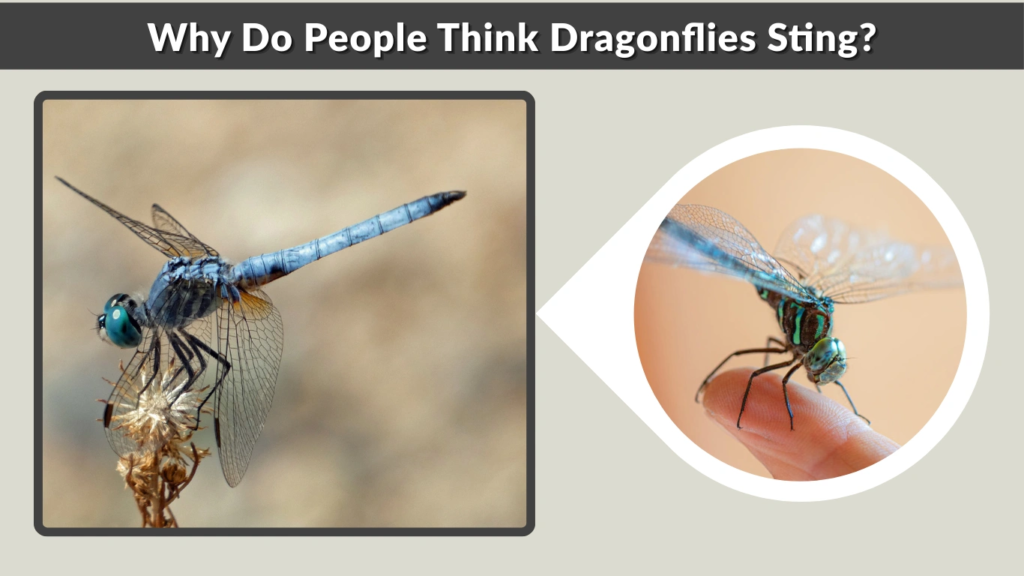
Many myths about dragonflies date back hundreds of years. In some cultures, dragonflies were once called “devil’s darning needles” or “ear cutters,” suggesting they could sew mouths shut or pierce skin. These names created long-lasting fears that still exist today.
Appearance and Fast Flight
Dragonflies have long, narrow bodies, large eyes, and powerful wings. When they dart suddenly or hover near a person’s head, they can feel threatening. Their quick movements are often mistaken for aggression, when they are actually tracking mosquitoes or other small insects nearby.
The way dragonflies sometimes fly straight toward people before turning away at the last second can also reinforce the false idea that they are attacking.
Old Myths and Cultural Beliefs
Folklore has played a big role in shaping fear of dragonflies. In the past, people often misunderstood insects they could not easily observe. Over time, exaggerated stories turned harmless dragonflies into imagined stinging or biting threats.
Modern science has shown these beliefs to be false, but the myths still influence how people react when dragonflies appear.
Do All Dragonflies Bite or Sting?
No species of dragonfly can sting. Across the world, there are thousands of dragonfly species, including emperor dragonflies, red dragonflies, blue dragonflies, and black dragonflies. None of them possess a stinger or venom gland.
All dragonflies share the same basic mouth structure: mandibles for chewing insects. While larger species have stronger jaws, they are still built for catching prey such as mosquitoes, flies, and moths. They are not designed to attack animals the size of humans.
Even among the biggest dragonflies, biting is rare and defensive. Dragonflies prefer escape over confrontation and usually fly away when approached.
Do Big Dragonflies Sting More Than Small Ones?

Large dragonflies often look more intimidating, which leads many people to assume they are more dangerous. In reality, size does not change the facts. Big dragonflies still do not have stingers.
Larger species may be able to pinch slightly harder if handled, but they are no more aggressive than smaller dragonflies. Their strength is meant for capturing prey, not for self-defense against large animals.
Whether big or small, dragonflies are far more interested in hunting insects and protecting territory from other dragonflies than interacting with people.
Do Dragonflies Sting Pets Like Dogs or Cats?
Dragonflies do not sting dogs, cats, or other pets. They are not capable of stinging any animal. Occasionally, a curious pet may snap at a dragonfly, and the insect might attempt a defensive bite. Even then, the risk of injury to a pet is extremely low.
Most encounters between dragonflies and pets end quickly, either with the dragonfly escaping or being ignored. There is no venom, no poison, and no disease transmission involved.
Dragonflies are actually beneficial around pets because they reduce mosquito populations, which helps lower the risk of mosquito-borne problems.
Do Dragonflies Sting Inside Houses?
Dragonflies sometimes fly indoors by accident, especially through open windows or doors. Inside homes, they often become disoriented by light and reflective surfaces. This can make them fly erratically, which some people mistake for aggressive behavior.
Dragonflies do not sting indoors or outdoors. If one is trapped inside, it is stressed and simply trying to escape. The safest approach is to remain calm and help guide it back outside.
Using a cup and a piece of paper to gently trap and release the dragonfly is the best method. This protects both you and the insect.
What to Do If a Dragonfly Lands on You or Bites
Dragonflies may occasionally land on people to rest. This behavior is harmless and does not mean the insect intends to bite or sting.
How to Handle Dragonflies Safely
- Stay calm and avoid sudden movements
- Do not grab the wings
- Let the dragonfly fly away on its own
- Use a cup-and-paper method if needed
- Gently release it outdoors
If you must move a dragonfly, avoid squeezing its body. Their wings are delicate and easily damaged.
When to Be Concerned
In the very rare event of a bite that breaks the skin, simply wash the area with soap and water. Because dragonflies are not venomous, medical treatment is almost never required. Seek care only if normal signs of infection appear, which is extremely uncommon.
Are Dragonflies Dangerous at All?
Dragonflies are not dangerous to humans. They do not sting, they are not poisonous, and they do not spread disease. Their primary interest is hunting insects such as mosquitoes, flies, and gnats.
Dragonflies are considered beneficial insects. They help control pest populations and are important indicators of healthy ecosystems. Their presence usually means that local water sources and insect communities are in good balance.
Rather than fearing dragonflies, many people encourage them in gardens and yards for their natural pest-control abilities.
FAQs
Do dragonflies sting humans?
No, dragonflies do not sting humans. They do not have a stinger or venom glands. They are biologically incapable of stinging and pose no venom-related danger to people.
Do dragonflies bite or sting people?
Dragonflies cannot sting, but they can rarely bite if handled or trapped. A dragonfly bite is usually mild, feels like a small pinch, and does not involve venom or serious injury.
Do big dragonflies sting more?
No, big dragonflies do not sting at all. Larger species may have slightly stronger jaws, but they are no more dangerous than smaller dragonflies and almost never bite.
Do dragonflies sting dogs or cats?
Dragonflies do not sting pets. They are harmless to dogs and cats. At most, a stressed dragonfly might try to nip if caught, but this rarely causes any injury.
Do dragonflies have stingers?
No dragonfly species has a stinger. The pointed-looking end of their abdomen does not function as a stinger and cannot inject venom.
