
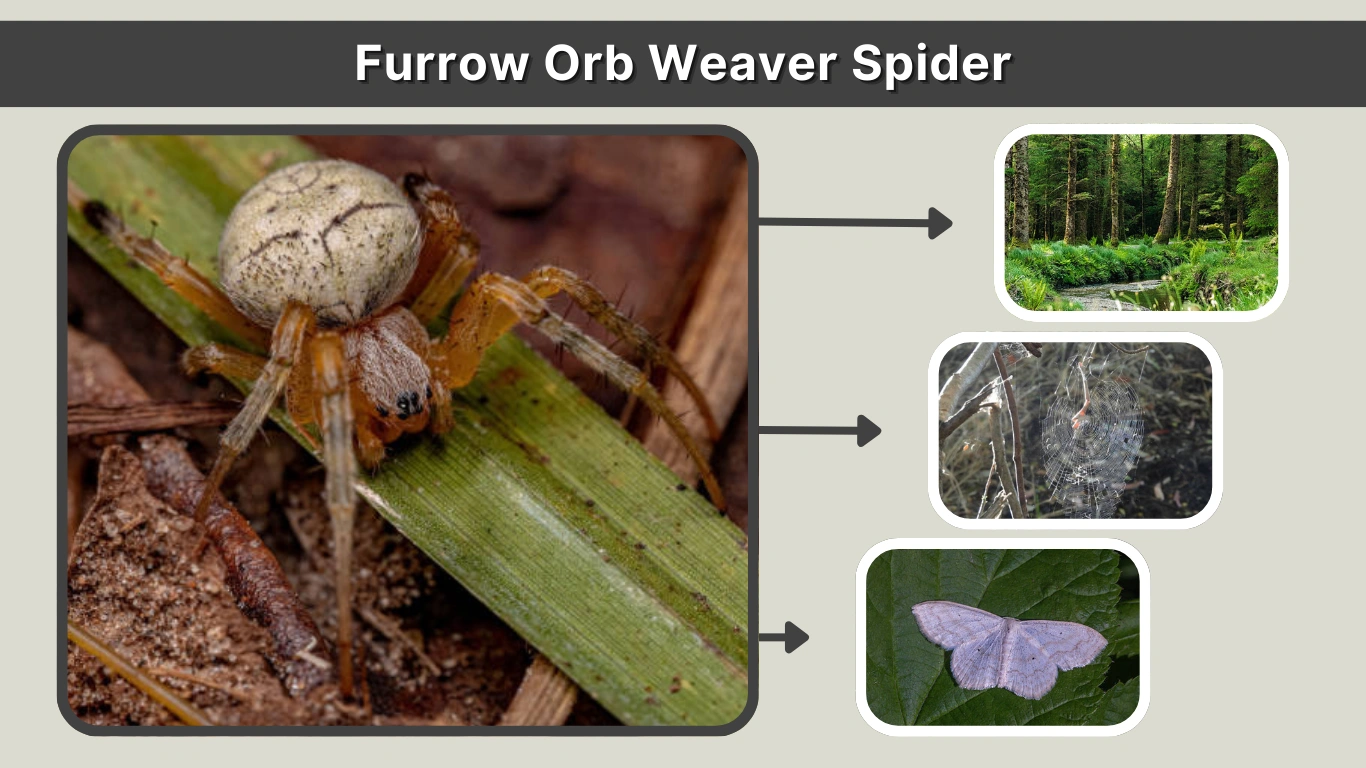
The furrow orb weaver spider is a well-camouflaged garden and woodland spider recognized by the subtle grooves or furrows on its abdomen. Often overlooked due to its earthy colors, this spider quietly builds large circular webs that appear overnight between trees, fences, and shrubs. Although its web may seem prominent, the spider itself blends easily into its surroundings. Harmless to humans and highly effective at controlling insects, the furrow orb weaver plays an important role in local ecosystems.
Furrow Orb Weaver Spider Classification and Background
Scientific Classification
The furrow orb weaver spider belongs to the orb-weaver group, a large family of spiders known for constructing circular, wheel-shaped webs. Orb weavers rely on precise silk engineering rather than speed or strong venom to capture prey. The furrow orb weaver fits this pattern, using its web as the primary hunting tool rather than active pursuit.
Meaning of the Furrow Name
The name “furrow orb weaver” comes from the shallow grooves or ridges visible on the spider’s abdomen. These furrows give the body a textured appearance rather than a smooth surface. The pattern helps distinguish this spider from other similarly colored orb weavers and contributes to its natural camouflage.
Furrow Orb Weaver Spider Size and Body Structure
Furrow orb weaver spiders are medium to large-sized orb weavers. Adult females typically measure between 12 and 20 millimeters in body length, while males are noticeably smaller and slimmer. This size difference between sexes is common among orb-weaver spiders and is known as sexual dimorphism.
The spider’s abdomen is rounded but slightly flattened, with visible grooves running across its surface. These furrows do not affect movement but give the spider a rough, bark-like texture. The legs are relatively long and sturdy, allowing the spider to move quickly across its web when prey is detected.
Females usually occupy the center of the web and are responsible for building and maintaining it. Males are less visible and often stay near the web’s edge or in nearby vegetation, especially during mating season.
Furrow Orb Weaver Spider Coloration and Markings
Coloration in the furrow orb weaver spider is generally muted, helping it blend into its surroundings. Common colors include shades of brown, gray, tan, or dull orange. These earth tones allow the spider to remain inconspicuous against tree bark, dried leaves, or wooden structures.
The furrowed abdomen often displays faint patterning rather than bold markings. Color intensity can vary depending on age, environment, and seasonal conditions. Younger spiders may appear lighter, while mature individuals often develop darker or more defined tones.
Legs are usually banded or slightly darker than the body, adding to the spider’s overall camouflage. When resting in the web or against a surface, the spider can be surprisingly difficult to spot.
How to Identify a Furrow Orb Weaver Spider
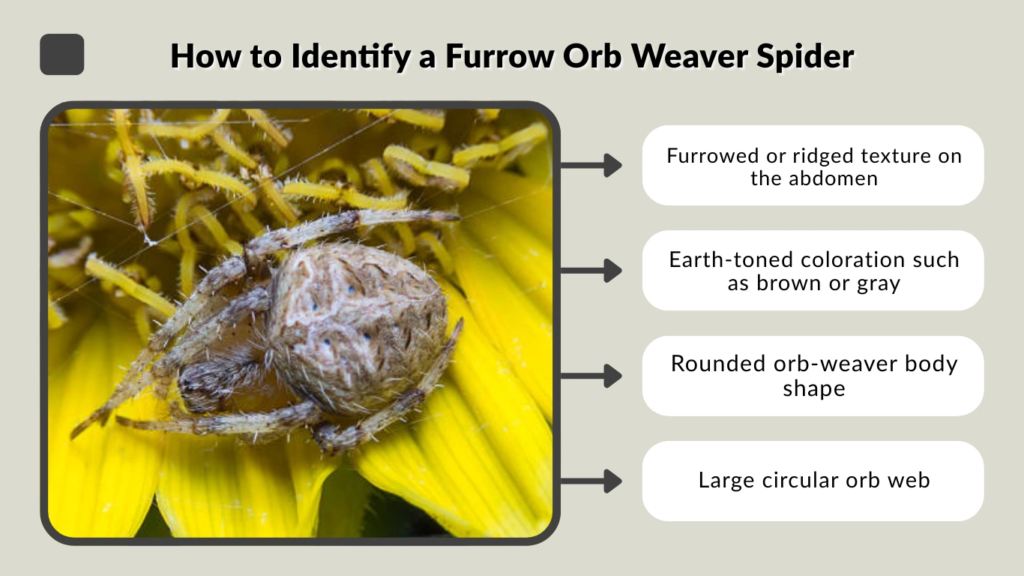
You can identify a furrow orb weaver spider using the following characteristics:
- Furrowed or ridged texture on the abdomen
- Earth-toned coloration such as brown or gray
- Rounded orb-weaver body shape
- Large circular orb web
- Spider resting at or near the center of the web
Furrow Orb Weaver Spider Habitat and Range
Typical Living Environments
Furrow orb weaver spiders are commonly found in woodlands, forest edges, gardens, and areas with mature trees. They prefer environments that offer sturdy anchor points for web construction, such as tree branches, fences, and shrubs. Areas with regular insect activity are especially favored.
These spiders adapt well to human-modified environments and are often seen near homes, particularly in yards with trees or dense vegetation. As long as suitable web sites and prey are available, they can thrive close to human activity.
Geographic Distribution
The furrow orb weaver spider is widely distributed across North America. It is commonly found in temperate regions where seasonal changes support its life cycle. Its ability to blend into various environments has helped it establish a broad range across different habitats.
Furrow Orb Weaver Spider Web Structure
The web of a furrow orb weaver spider is a classic orb-shaped design, typically large and symmetrical. Webs are often positioned at chest height or higher and stretched between stable structures to intercept flying insects.
Strong radial threads form the web’s framework, while sticky spiral threads capture prey. The spider usually waits at the center of the web, relying on vibrations to detect trapped insects. Webs are repaired or rebuilt regularly to maintain effectiveness, especially after wind or rain.
Furrow Orb Weaver Spider Behavior
Web-Building Patterns
Furrow orb weaver spiders usually build or repair their webs during the evening or early nighttime hours. Constructing webs at this time helps reduce disturbance and allows the web to be fully functional by morning, when insect activity increases. If a web is only slightly damaged, the spider often repairs specific sections rather than rebuilding the entire structure.
Feeding and Resting Behavior
Once the web is complete, the spider remains mostly still at the center or slightly off-center. When an insect becomes trapped, vibrations travel through the silk and alert the spider immediately. The prey is quickly wrapped in silk before feeding begins. During inactive periods, the spider conserves energy by remaining motionless.
What the Furrow Orb Weaver Spider Eats
The furrow orb weaver spider feeds on a variety of flying insects that become caught in its web, including:
- Flies
- Mosquitoes
- Moths
- Beetles and other flying insects
This diet allows the spider to thrive in gardens and woodland areas with steady insect populations.
Furrow Orb Weaver Spider Reproduction and Life Cycle
Mating typically occurs in late summer when adult spiders are most active. Males approach females cautiously to avoid being mistaken for prey. After mating, the female produces egg sacs that are hidden in sheltered locations such as bark crevices, leaf litter, or under loose wood.
Each egg sac contains hundreds of eggs. Spiderlings hatch after several weeks but remain protected until environmental conditions allow them to disperse. In colder regions, adult spiders usually die after the first frost, completing a one-year life cycle.
Natural Enemies of the Furrow Orb Weaver Spider
Despite their camouflage, furrow orb weaver spiders face several natural threats:
- Birds that remove spiders from webs
- Parasitic wasps targeting egg sacs
- Strong wind and heavy rain
- Human disturbance in gardens and yards
Their ability to blend into the environment helps reduce predation, but survival rates remain limited.
Furrow Orb Weaver Spider and Humans
Furrow orb weaver spiders are not aggressive and pose little risk to humans. Bites are extremely rare and typically occur only if the spider is handled. When they do happen, bites usually cause mild irritation similar to an insect sting.
These spiders provide clear benefits by controlling populations of flying insects. Their presence around homes and gardens is generally helpful, and many people choose to leave their webs undisturbed.
FAQs
Is the furrow orb weaver spider dangerous to humans?
Furrow orb weaver spiders are not considered dangerous. They are shy and rarely bite. If a bite does occur, it usually causes minor redness or discomfort and does not require medical treatment.
How can you identify a furrow orb weaver spider?
You can identify this spider by the furrowed or ridged texture on its abdomen, earth-toned coloration, and large circular orb web. It is often seen resting at the center of its web in gardens or wooded areas.
Where are furrow orb weaver spiders most commonly found?
Furrow orb weaver spiders are commonly found in woodlands, forest edges, gardens, and areas with mature trees. They are widespread across North America and adapt well to both natural and human-modified environments.
When are furrow orb weavers most active?
They are most active during late summer and early fall. During this time, adult females build large webs and feed heavily before reproducing and completing their life cycle.
Does the furrow orb weaver spider rebuild its web often?
Furrow orb weaver spiders regularly repair their webs and may rebuild them entirely if damaged. Web maintenance usually occurs in the evening or at night to ensure the web remains effective.
