
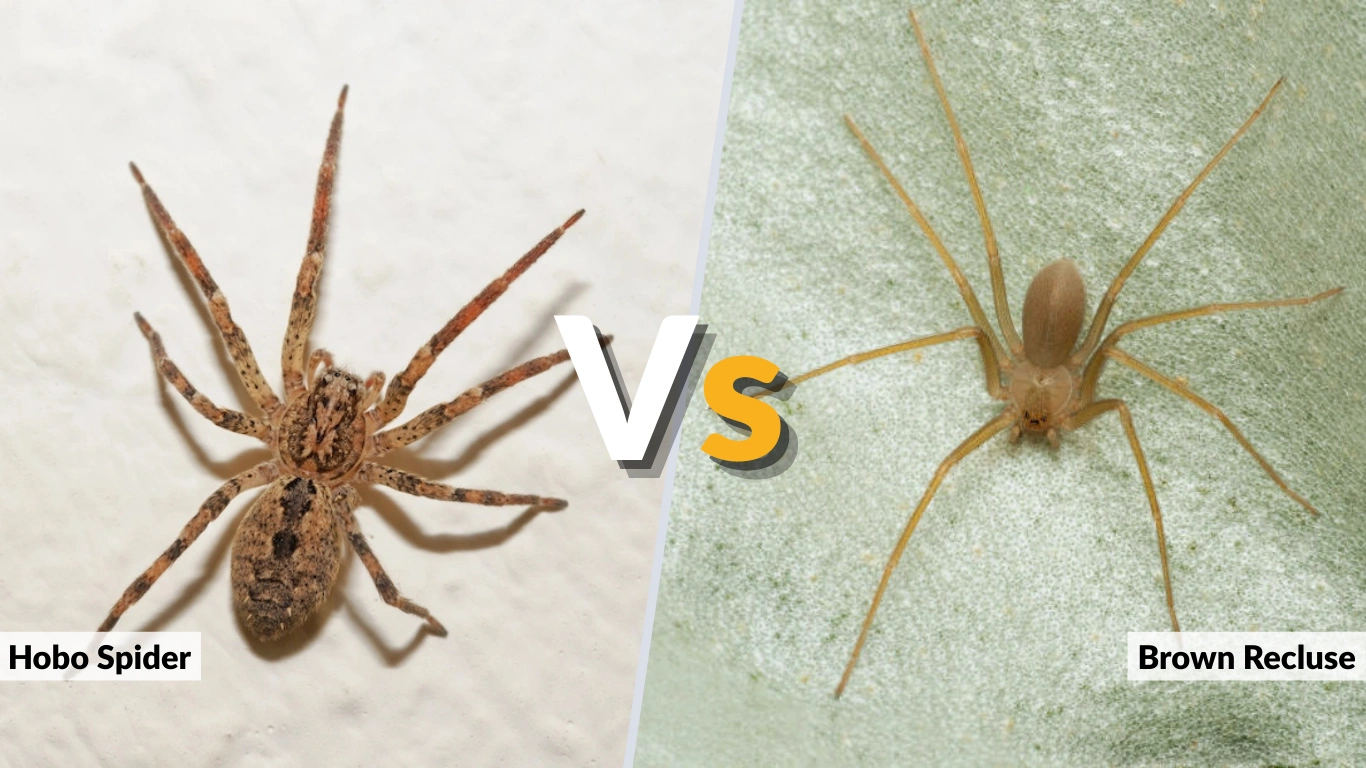
Hobo spiders and brown recluse spiders are often confused with each other, especially when people find a brown spider indoors or experience a suspicious bite. Online photos, outdated information, and fear-based articles have made the confusion worse. Although these two spiders are sometimes mentioned together, they are very different species with distinct appearances, habitats, and medical relevance. Understanding how to tell a hobo spider from a brown recluse—and knowing where each one actually lives—can prevent unnecessary panic and misdiagnosis.
Overview: Hobo Spider vs Brown Recluse Spider
At a glance, both spiders may appear brown and similar in size, but that is where the similarity ends. Hobo spiders and brown recluse spiders:
- Belong to different spider families
- Live in different geographic regions
- Have different body structures
- Pose very different levels of medical concern
Many comparisons online mix myths with facts, making accurate identification difficult for non-experts.
Identification: Brown Recluse vs Hobo Spider
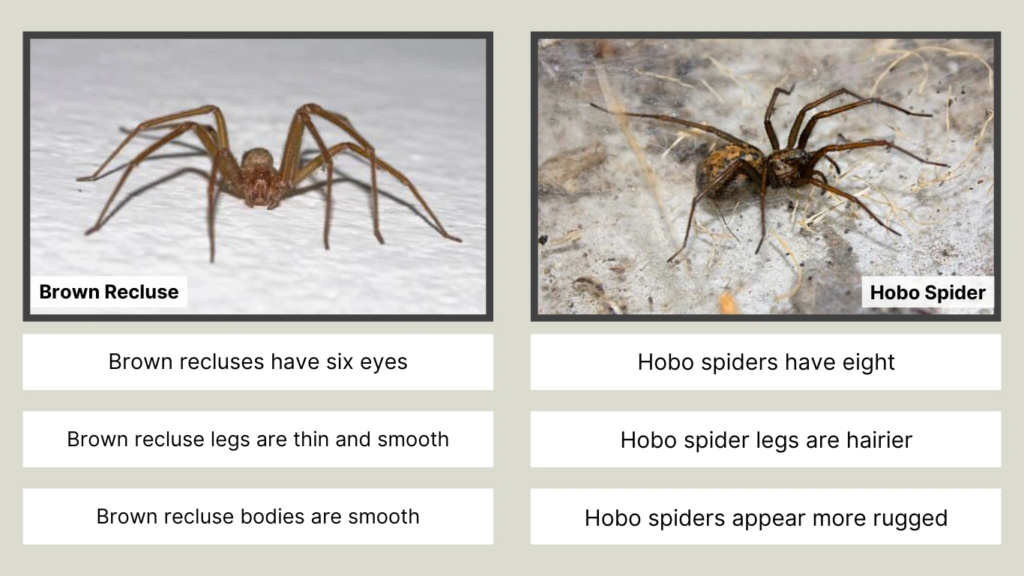
- Eye arrangement: Brown recluses have six eyes; hobo spiders have eight
- Body markings: Brown recluses have a violin-shaped marking; hobo spiders do not
- Legs: Brown recluse legs are thin and smooth; hobo spider legs are hairier
- Body texture: Brown recluse bodies are smooth; hobo spiders appear more rugged
- Overall look: Brown recluses are uniformly colored; hobo spiders often have mottled patterns
Eye count and body markings are the most reliable distinguishing features.
What Does a Brown Recluse Spider Look Like?
A brown recluse spider has a light to dark brown body with a distinct violin-shaped marking on the cephalothorax. The “neck” of the violin points toward the abdomen. Its legs are long, thin, and evenly colored without bands or stripes.
One of the most important identifying traits is the eye arrangement. Brown recluse spiders have six eyes arranged in three pairs, which is unusual among spiders. Their bodies are smooth and lack thick hair. Because these details are hard to see without magnification, brown recluses are often misidentified.
What Does a Hobo Spider Look Like?
Hobo spiders are brown to dark brown with mottled or chevron-like patterns on the abdomen. Unlike brown recluses, hobo spiders have eight eyes, although they are small and difficult to see clearly.
Hobo spiders have thicker, hairier legs and a more robust appearance. They do not have a violin-shaped marking. Their patterned bodies and larger build are often overlooked, causing people to mistake them for brown recluses.
Brown Recluse vs Hobo Spider Size
Both spiders are often described as “large,” but this is misleading. Brown recluse spiders have relatively small bodies, usually less than half an inch long. Their long legs make them appear bigger than they really are.
Hobo spiders are generally bulkier and may appear larger overall, especially when seen indoors. This size difference is one reason hobo spiders are frequently misidentified as brown recluses.
Habitat and Geographic Range Differences
Where Brown Recluse Spiders Live
Brown recluse spiders are native to the central and southeastern United States. They prefer dry, undisturbed indoor environments such as closets, basements, and storage areas. Brown recluses are rarely found outdoors and tend to stay hidden.
Where Hobo Spiders Live
Hobo spiders are primarily found in the Pacific Northwest, including parts of Washington, Oregon, and nearby regions. They prefer ground-level habitats and are often found in basements, crawl spaces, and along foundations. Unlike brown recluses, hobo spiders are more commonly encountered outdoors.
Hobo Spider vs Brown Recluse Bite (Overview)
Spider bites from either species are uncommon. Most suspected spider bites are actually caused by skin infections, allergic reactions, or other insects. Fear surrounding hobo and brown recluse bites largely comes from misinformation rather than confirmed cases.
Brown recluse bites have been studied more extensively due to their potential medical effects, while hobo spider bite danger has been greatly exaggerated in the past.
Hobo Spider Bite vs Brown Recluse Bite
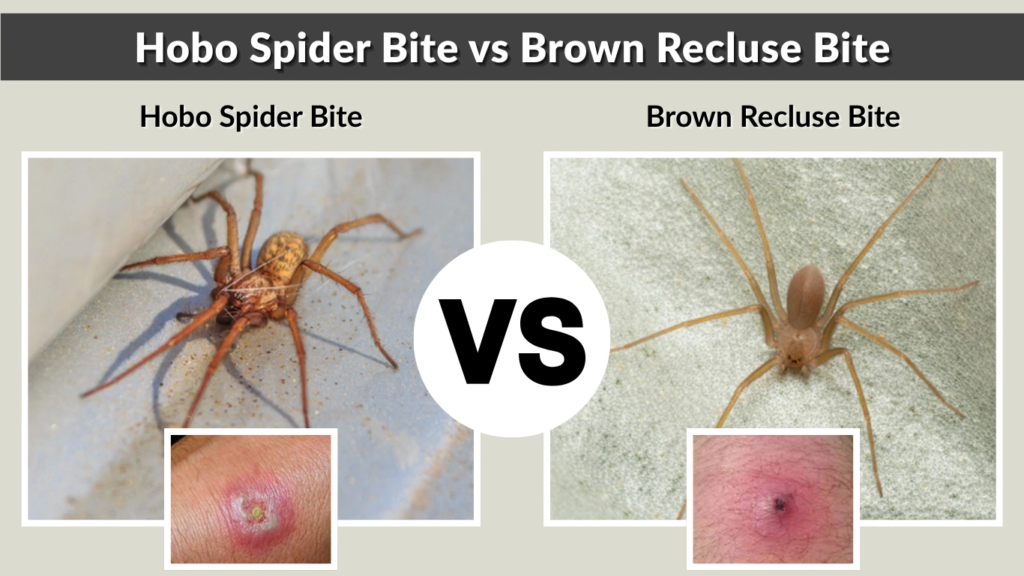
Brown Recluse Spider Bite Characteristics
A brown recluse bite is often painless at first. Over time, the bite area may become red, swollen, or blistered. In rare cases, tissue damage can occur. Severe reactions are uncommon and depend on individual health factors.
Hobo Spider Bite Characteristics
Hobo spider bites are usually mild and resemble common insect bites. There is no strong evidence that hobo spider venom causes necrotic wounds. Most symptoms resolve without medical intervention.
Hobo Spider vs Brown Recluse Bite Comparison
When comparing bites, it is important to understand that confirmed bites from either spider are rare. Most cases attributed to spiders are later found to be skin infections or insect stings.
Key differences to highlight in a comparison table (for final formatting):
- Pain onset (immediate vs delayed)
- Skin reaction severity
- Likelihood of tissue damage
- Medical concern level
Brown recluse bites carry a higher medical risk, while hobo spider bites are generally mild and self-limiting.
Hobo Spider vs Brown Recluse vs Wolf Spider
Wolf spiders are frequently included in these comparisons because they are large, brown, and commonly encountered in homes. This leads many people to confuse all three species.
Wolf spiders differ significantly in behavior, appearance, and medical relevance, making them an important part of accurate identification.
Wolf Spider vs Hobo vs Brown Recluse (Identification Breakdown)
Wolf Spider vs Brown Recluse
Wolf spiders are larger, hairier, and more muscular than brown recluses. They have eight eyes arranged in three rows, and their eyes reflect light at night. Brown recluses have smooth bodies, thin legs, six eyes, and do not exhibit eye shine.
Wolf spiders actively hunt prey, while brown recluses avoid movement and prefer hidden spaces.
Wolf Spider vs Hobo Spider
Hobo spiders use webs near ground level, while wolf spiders do not rely on webs to hunt. Wolf spiders have stronger legs, faster movement, and a bulkier body. Hobo spiders appear flatter and less muscular.
Hobo Spider vs Brown Recluse vs Fiddleback
The term “fiddleback” is simply another name for the brown recluse spider, referring to the violin-shaped marking on its back. Hobo spiders are not fiddlebacks and do not have this marking.
Online sources often misuse the term, which adds to confusion and leads people to incorrectly label hobo spiders as recluses.
Why These Spiders Are So Often Misidentified
Misidentification happens for several reasons:
- Brown coloration shared by many spider species
- Poor-quality or mislabeled online images
- Fear-driven pest control content
- Misdiagnosed skin conditions blamed on spiders
Without examining eye count, body structure, and geographic location, accurate identification is extremely difficult.
Pictures of Hobo Spider vs Brown Recluse
Search results for comparison images are often unreliable. Many photos labeled “hobo spider” or “brown recluse” are incorrect. Stock images and social media posts frequently show unrelated spiders.
Photos alone should never be used for identification. Structural traits such as eye arrangement, leg thickness, and body markings are far more reliable.
Which Spider Is More Dangerous?
Between the two, the brown recluse spider poses a greater medical risk due to its venom, which can cause localized tissue damage in rare cases. Hobo spiders were once believed to cause severe bites, but modern research has largely disproven this claim.
Neither spider is aggressive, and both prefer to avoid human contact whenever possible.
What to Do If You Find a Spider You Can’t Identify
If you encounter a spider and are unsure what it is:
- Do not panic or attempt to kill it
- Capture it safely using a container if possible
- Avoid handling it directly
- Seek identification from an extension service or expert
If you suspect a bite, avoid self-diagnosis and consult a medical professional.
FAQs
How can I tell a hobo spider from a brown recluse?
Check eye count, body markings, and location. Brown recluses have six eyes and a violin-shaped marking, while hobo spiders have eight eyes and no violin mark.
Are hobo spider bites as dangerous as brown recluse bites?
No. Brown recluse bites can cause tissue damage in rare cases, while hobo spider bites are usually mild.
Do hobo spiders and brown recluses live in the same areas?
Rarely. Brown recluses live mainly in the central and southeastern U.S., while hobo spiders are found in the Pacific Northwest.
What spider is most commonly confused with both?
Wolf spiders are the most commonly confused species due to their size and brown coloration.
Should I worry if I find either spider in my home?
In most cases, no. Proper identification and basic precautions are usually sufficient.
