
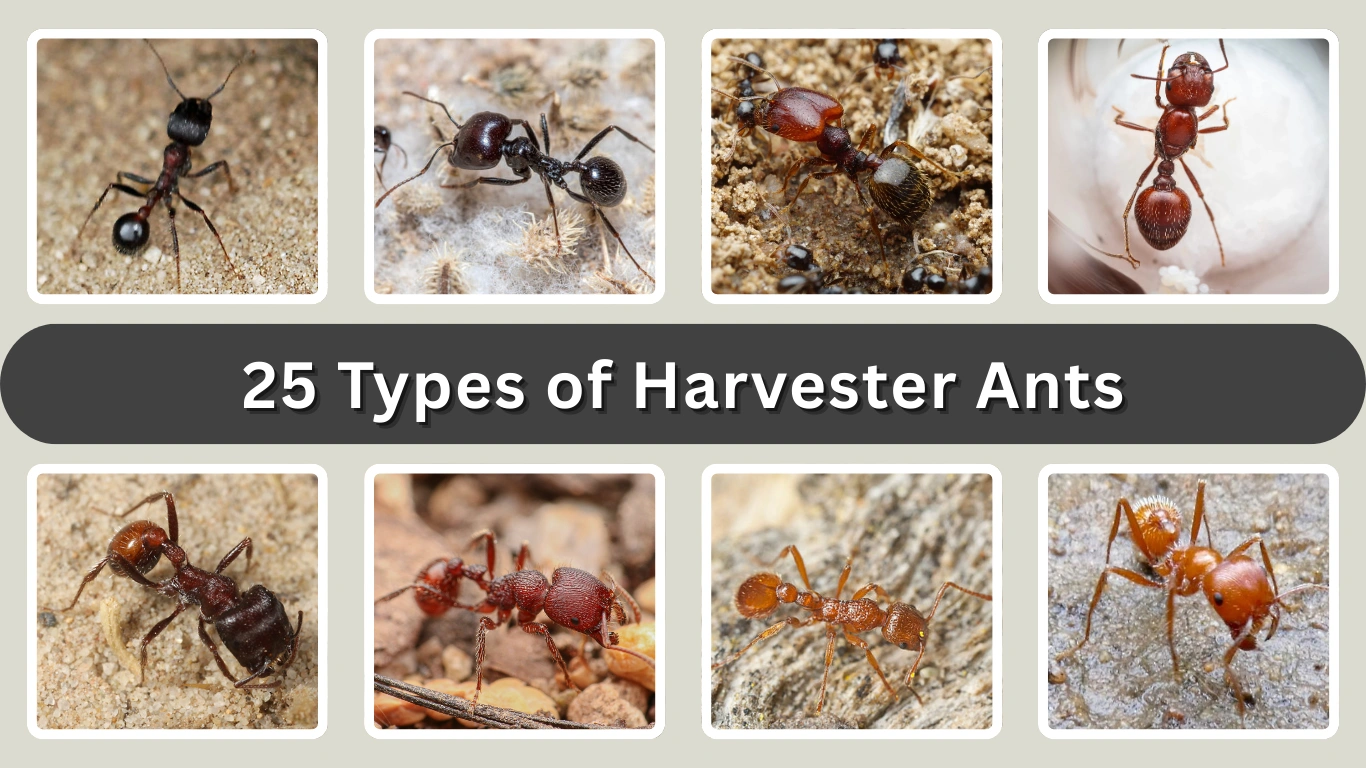
Harvester ants are a diverse group of seed-collecting ants found across deserts, grasslands, and Mediterranean regions worldwide. Known for their complex nests, organized foraging, and ecological importance, these ants play a major role in seed dispersal and soil aeration. The following list highlights 25 different species, each with unique adaptations shaped by their environment, behavior, and diet. Together, they showcase the remarkable diversity within harvester ant communities.
1. Pogonomyrmex barbatus
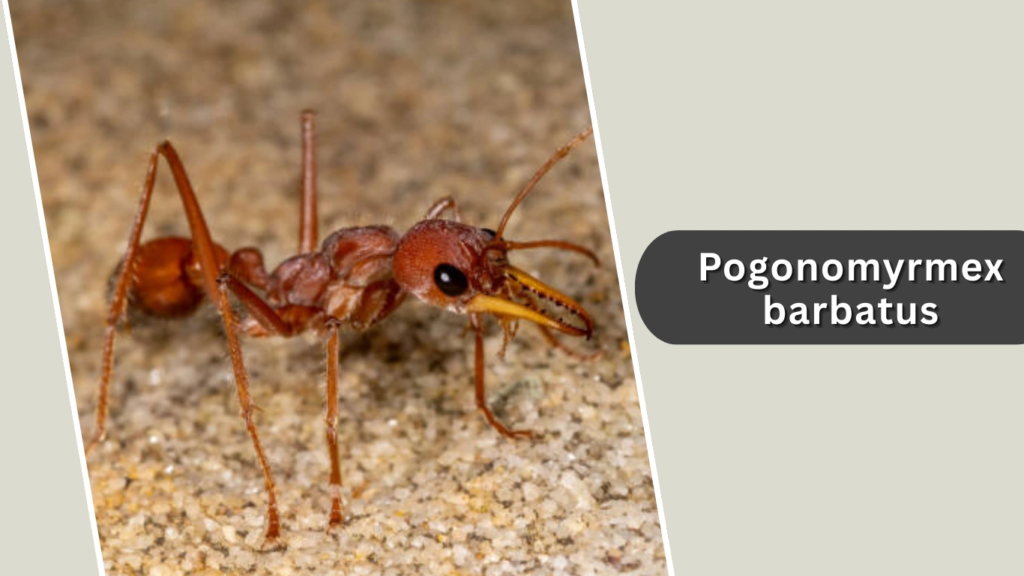
The red harvester ant (Pogonomyrmex barbatus) is one of the most studied harvester ants in North America. Known for its striking red coloration and organized foraging trails, this species plays an important role in seed dispersal and soil turnover across arid regions.
Identification
- Medium-sized ant, typically 5–7 mm
- Bright red to reddish-brown body
- Coarse hairs on the head and mesosoma
- Distinct psammophore (hairy “beard”) under the head for carrying soil
- Workers have strong mandibles and a smooth, shiny gaster
Habitat
Pogonomyrmex barbatus thrives in arid and semi-arid environments, commonly found in deserts, grasslands, and scrublands. Colonies prefer open, sunny areas with loose sandy or gravelly soil ideal for constructing deep nest chambers. Their nests often appear as large, cleared circular patches surrounding the entrance.
Behaviors
This species is known for its highly organized foraging system, where workers follow well-defined trails to collect seeds. Colonies defend themselves aggressively when disturbed, relying on a potent sting. Workers also regulate nest temperature by adjusting soil movement around the entrance.
Diet and Lifecycle
The red harvester ant diet is dominated by seeds, though workers may also consume small insects. Food is stored in underground granaries to support the colony through harsh seasons. New colonies begin when a fertilized queen establishes a nest after nuptial flights, leading to gradual growth that may span several years before reaching full maturity.
2. Pogonomyrmex rugosus
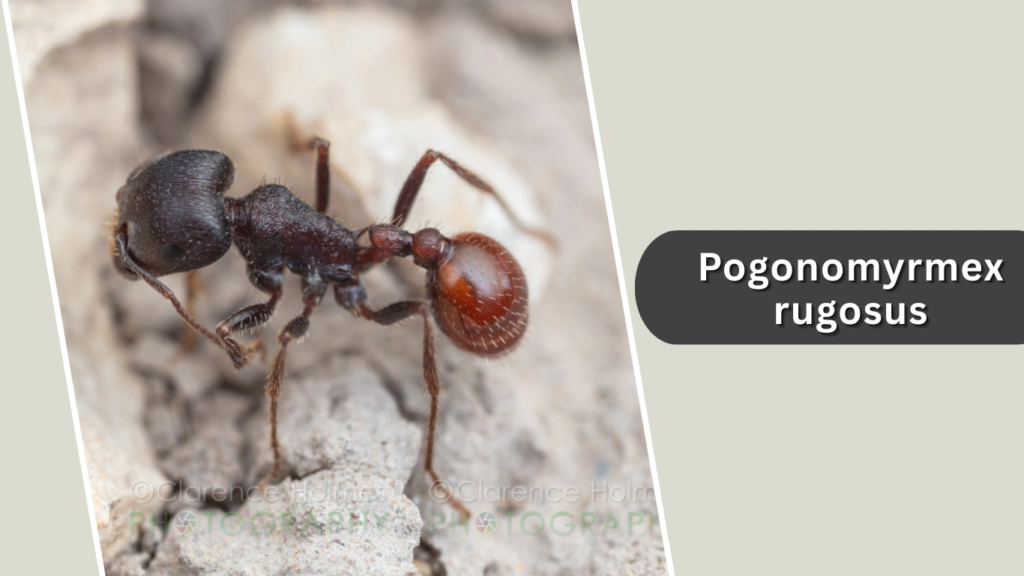
The rough harvester ant (Pogonomyrmex rugosus) is a robust desert-dwelling species known for its deeply sculptured exoskeleton and efficient seed-harvesting behavior. Common in the American Southwest, it builds large, conspicuous nests and plays an important role in desert ecosystem dynamics.
Identification
- Medium to large worker ants, 6–8 mm
- Reddish-brown to dark brown coloration
- Distinct rugose (rough, sculptured) texture on the head and mesosoma
- Pronounced psammophore beneath the head
- Strong mandibles adapted for seed processing
Habitat
Pogonomyrmex rugosus inhabits hot, dry deserts and scrublands, especially in the Mojave, Sonoran, and Chihuahuan regions. Colonies prefer open, sandy or gravelly soil where they create extensive nests with wide, cleared discs around the entrance. These open areas help regulate heat and moisture.
Behaviors
This species forms well-organized foraging columns, often traveling long distances to gather seeds. Workers are known for their defensive nature and powerful sting. Colonies display efficient division of labor, with specialized workers responsible for foraging, nest maintenance, and brood care.
Diet and Lifecycle
Seeds make up the bulk of their diet, supplemented occasionally by arthropod fragments. Workers store seeds in underground chambers to sustain the colony during harsh periods. After mating flights, queens establish new colonies independently, with growth occurring steadily over several years until the colony reaches full strength.
3. Pogonomyrmex occidentalis
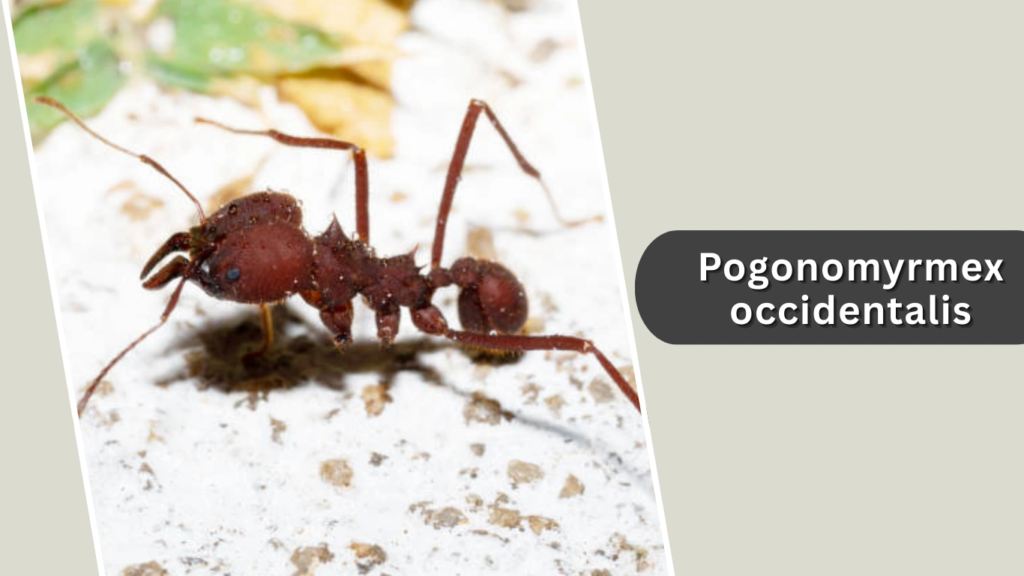
The western harvester ant (Pogonomyrmex occidentalis) is a widespread species across the western United States, known for its large mound nests and efficient seed-gathering behavior. It is a keystone species in many prairie and desert ecosystems, contributing significantly to soil aeration and seed dispersal.
Identification
- Medium-sized workers, typically 5–7 mm
- Reddish-brown to darker brown coloration
- Noticeable psammophore (hairy underside of the head)
- Smooth, shiny gaster with minimal sculpturing
- Strong mandibles specialized for grinding seeds
Habitat
This species primarily inhabits grasslands, prairies, and semi-arid regions. Colonies prefer open, sandy or loamy soil, where they construct distinctive crater-shaped mounds. These mounds can become quite large and may persist for years, expanding as the colony grows.
Behaviors
Pogonomyrmex occidentalis is known for its organized surface foraging, often forming radial trails leading away from the nest. Workers are diligent seed collectors and may travel considerable distances to locate food. The species is defensive and will sting when threatened, protecting both the colony and its valuable seed stores.
Diet and Lifecycle
Seeds are the primary food source, although workers may occasionally incorporate small insects into their diet. Colonies store large quantities of seeds in underground granaries. New colonies begin when a single queen establishes a nest following nuptial flights. Colony growth is gradual, with mature nests supporting thousands of workers.
4. Pogonomyrmex californicus
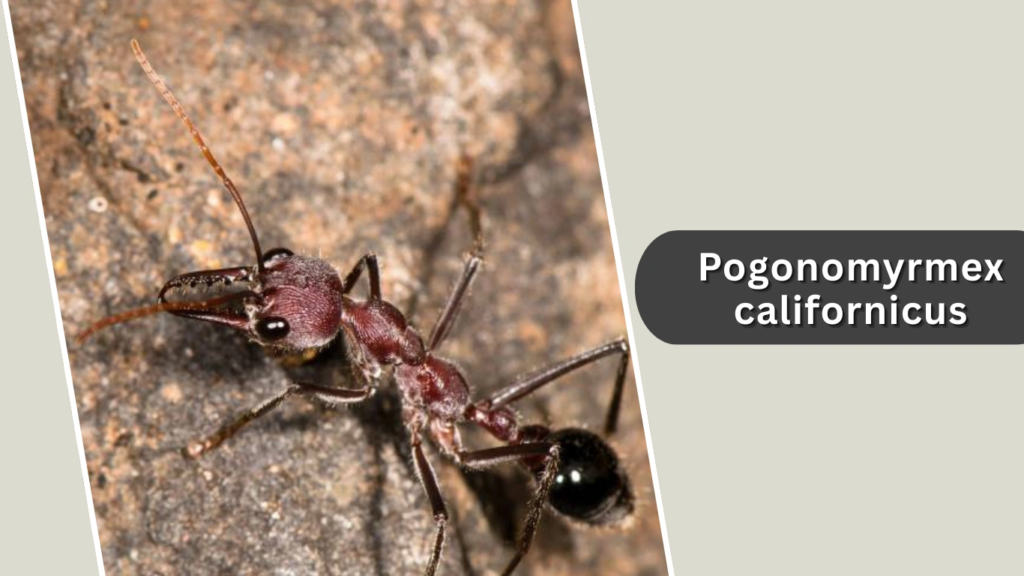
The California harvester ant (Pogonomyrmex californicus) is a common species in the western United States, particularly recognized for its adaptability to coastal, desert, and chaparral environments. It is an important seed disperser and soil engineer in many habitats.
Identification
- Medium-sized workers, 4–6 mm
- Reddish-brown to orange-red body coloration
- Distinct psammophore beneath the head
- Smooth gaster with minimal sculpturing
- Slender legs and slightly elongated body shape
Habitat
Pogonomyrmex californicus occupies coastal scrublands, deserts, and open foothills, thriving in sandy or loose, well-drained soils. Colonies typically create shallow crater-like nests with modest cleared areas around the entrance. Their ability to tolerate a wide range of microhabitats makes them one of the more versatile harvester ant species.
Behaviors
Workers forage primarily during warm daylight hours, forming loose and scattered foraging trails. Although generally less aggressive than some related species, they will defend the nest if disturbed. Their colony structure is highly organized, with workers performing tasks such as food collection, brood care, and nest maintenance.
Diet and Lifecycle
Seeds form the core of their diet, supplemented by small arthropods and plant material when available. Colonies maintain seed caches underground to survive seasonal fluctuations. After nuptial flights, fertilized queens establish new nests and gradually build colonies that may persist for many years.
5. Pogonomyrmex maricopa
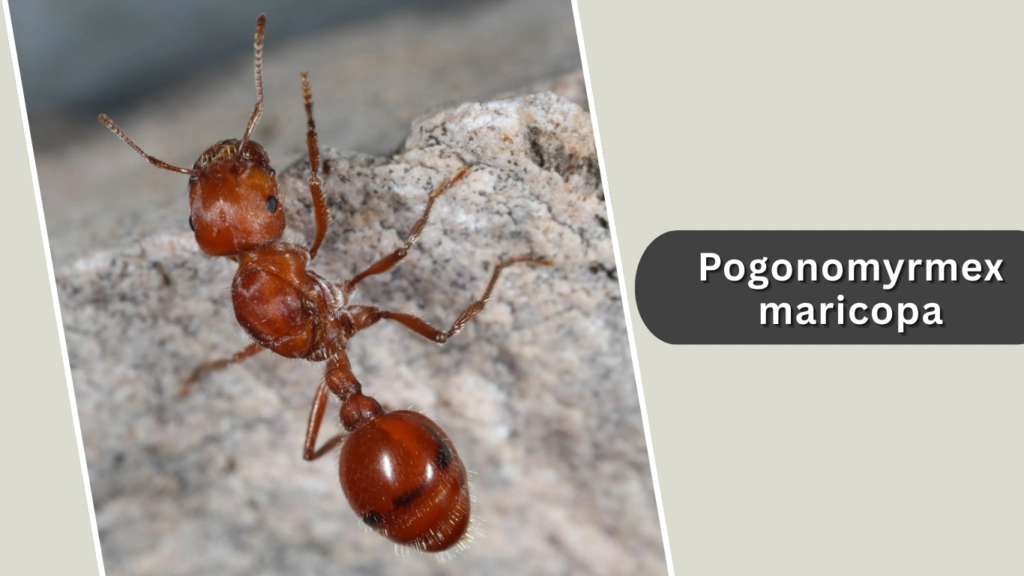
The Maricopa harvester ant (Pogonomyrmex maricopa) is well known not only for its efficient seed-gathering behavior but also for possessing one of the most potent insect stings recorded. Found primarily in the southwestern United States, it plays a significant ecological role in desert environments.
Identification
- Medium-sized workers, 5–7 mm
- Bright reddish-orange to dark red coloration
- Strong sculpturing on the head and mesosoma
- Well-developed psammophore beneath the head
- Robust mandibles adapted for handling seeds
Habitat
Pogonomyrmex maricopa inhabits hot desert regions, particularly the Sonoran Desert. Colonies are typically found in open, sandy, or gravelly soils where sunlight exposure is high. Their nest entrances are often surrounded by cleared discs of soil and small stones, a signature feature of many harvester ants.
Behaviors
This species is known for its highly defensive nature. Disturbance often triggers rapid worker emergence and coordinated stinging. Foraging occurs along well-traveled pathways, and workers may collect seeds from a considerable radius around the colony. Temperature regulation of the nest through excavation and soil movement is an essential behavioral trait.
Diet and Lifecycle
The diet consists mainly of seeds, occasionally supplemented by dead insects. Colonies store seeds in underground granaries to ensure survival during extreme heat or drought. After mating flights, queens establish independent nests, gradually expanding the colony. Mature colonies can endure for many years with stable worker populations.
6. Pogonomyrmex desertorum
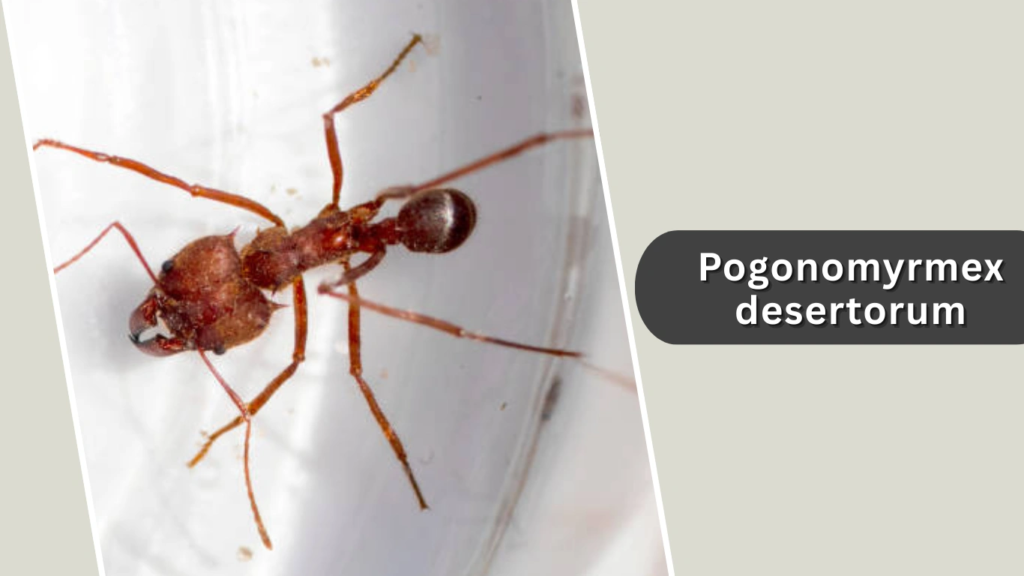
The desert harvester ant (Pogonomyrmex desertorum) is a hardy species adapted to some of the hottest and driest regions in North America. Known for its impressive tolerance to extreme temperatures, it is a key seed disperser in desert ecosystems.
Identification
- Medium-sized workers, 5–7 mm
- Reddish-brown to dark red coloration
- Moderately sculptured head and mesosoma
- Pronounced psammophore under the head
- Strong mandibles suited for cracking seeds
Habitat
This species thrives in arid deserts, scrublands, and sparsely vegetated plains. Colonies are typically established in sandy or gravelly soils, often in fully exposed areas where sunlight is abundant. Their nest structures include small, low crater-like entrances surrounded by cleared soil patches.
Behaviors
Pogonomyrmex desertorum displays heat-adapted foraging patterns, often active during early morning and late afternoon to avoid peak desert temperatures. The species is defensive when threatened, emerging quickly to protect the nest. Foraging trails are moderately organized, and workers frequently transport seeds over long distances.
Diet and Lifecycle
Seeds dominate the diet, though workers sometimes gather small arthropod remains. The colony stores seeds in chambers to buffer against unpredictable desert conditions. After mating flights, queens establish new colonies independently. Growth is slow at first but accelerates as the worker population increases, leading to long-lasting colonies.
7. Pogonomyrmex magnacanthus
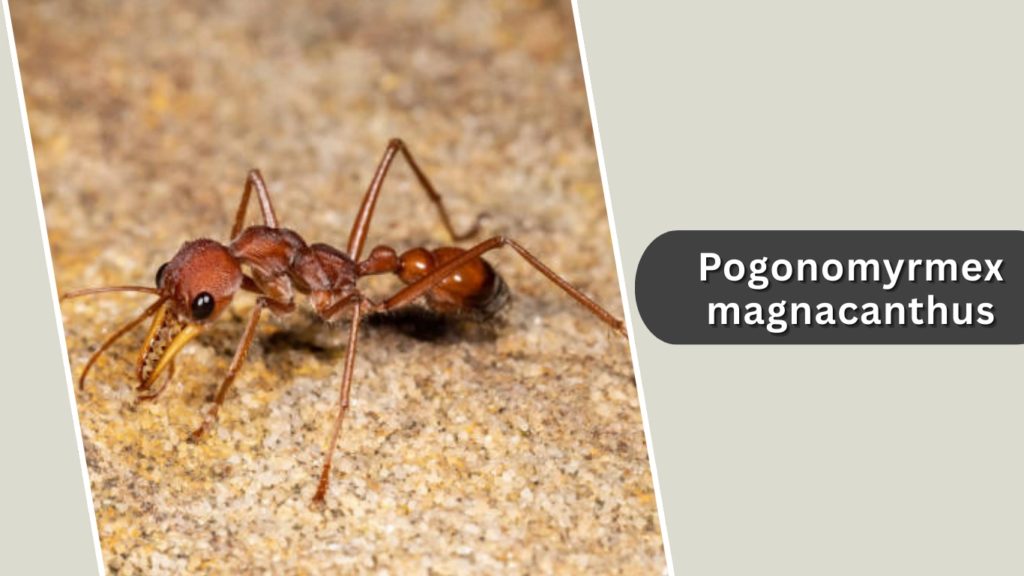
The large-spined harvester ant (Pogonomyrmex magnacanthus) is a distinctive species recognized for its prominent spines and strong adaptations to desert living. Although less widespread than some other harvester ants, it plays an important ecological role in seed dispersal within its range.
Identification
- Medium to large workers, 6–8 mm
- Reddish-brown coloration
- Notable elongated spines on the propodeum
- Well-developed psammophore under the head
- Sculptured head and mesosoma with coarse texture
Habitat
Pogonomyrmex magnacanthus inhabits desert flats, arid basins, and scrublands, typically in regions with loose sandy or fine gravel soils. Colonies often construct low, inconspicuous nests with light soil clearing around the entrance. They prefer wide-open spaces with direct sun exposure.
Behaviors
This species is known for active seed foraging and strong defensive behavior. Workers often travel individually rather than forming long trails, though they can maintain consistent foraging routes. The large propodeal spines may provide structural protection during defensive interactions with predators or rival ants.
Diet and Lifecycle
Seeds are the primary food source, complemented by occasional insect fragments. Colonies maintain seed granaries to ensure survival through harsh, dry periods. Queens found new colonies after nuptial flights, and growth progresses steadily as workers assume roles in foraging, brood care, and nest expansion.
8. Pogonomyrmex montanus
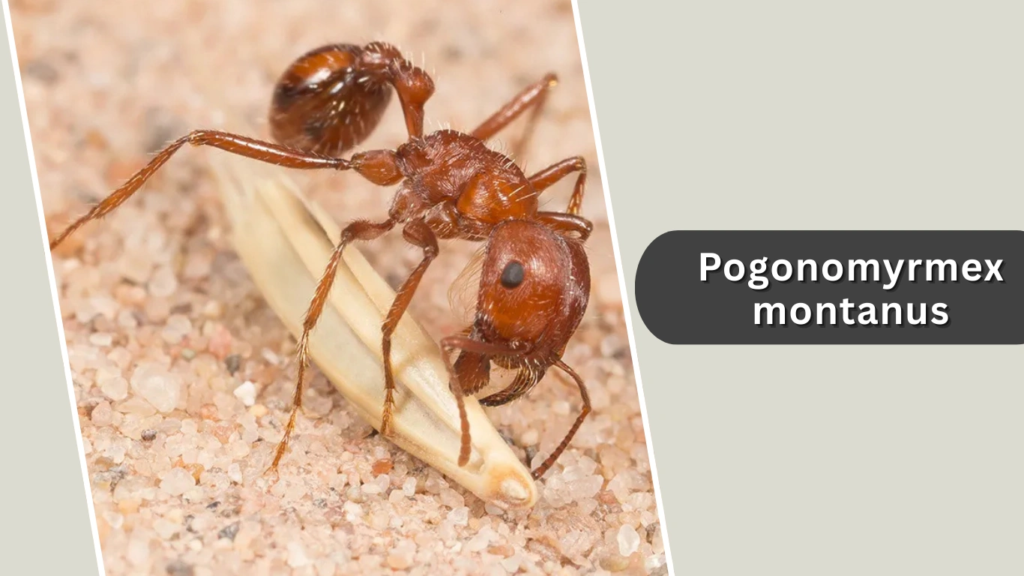
The mountain harvester ant (Pogonomyrmex montanus) is a resilient species adapted to higher elevations and cooler climates than many of its desert relatives. Often found in open woodland and montane habitats, it plays a vital role in local seed dispersal.
Identification
- Medium-sized workers, 5–7 mm
- Reddish-brown to dark brown coloration
- Moderately sculptured head and mesosoma
- Noticeable psammophore beneath the head
- Sturdy mandibles for processing seeds
Habitat
Pogonomyrmex montanus inhabits mountain slopes, foothills, open forests, and dry meadows. Unlike strictly desert species, it tolerates cooler temperatures and thrives in well-drained soils, including sandy loam and gravel. Nests are typically low mound structures with small cleared areas around the entrance.
Behaviors
Workers display flexible foraging patterns, often adapting their activity schedules to temperature fluctuations at higher elevations. Trails may be loosely organized, with foragers dispersing widely in search of seeds. The species exhibits moderate defensive behavior and responds quickly to nest disturbances.
Diet and Lifecycle
Seeds make up the majority of the diet, supplemented by occasional insect material. Colonies store seeds in specialized chambers to withstand seasonal temperature shifts. After mating flights, queens establish new nests and gradually build worker populations. Colonies can persist for many years once mature.
9. Pogonomyrmex subnitidus
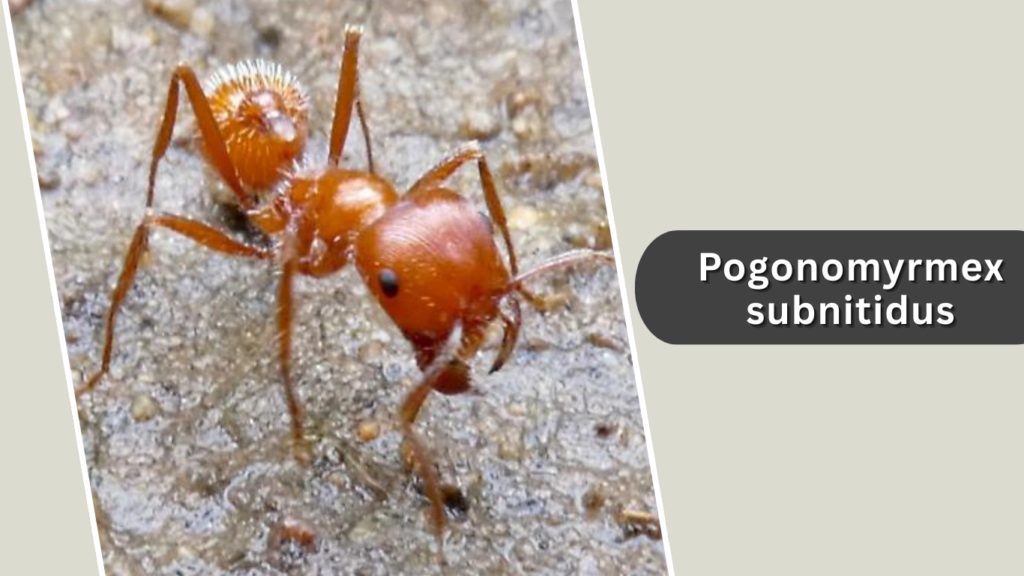
The shiny harvester ant (Pogonomyrmex subnitidus) is known for its smoother, more polished body surface compared to many related species. Found in arid and semi-arid environments, it contributes significantly to soil turnover and seed dispersal.
Identification
- Medium-sized workers, 5–7 mm
- Reddish-brown to bright red coloration
- Characteristically smooth and somewhat glossy gaster
- Light sculpturing on the head and mesosoma
- Distinct psammophore beneath the head
Habitat
Pogonomyrmex subnitidus inhabits deserts, dry valleys, and scrublands, typically favoring sandy or loose-gravel soils. Colonies often build low, subtle nest mounds with sparse soil clearing. They select open areas with direct sun exposure and minimal vegetation cover.
Behaviors
Workers forage individually or in loosely organized trails, often traveling considerable distances for seeds. The species is alert and moderately defensive, responding quickly when the nest is disturbed. Soil excavation for nest expansion is a continual activity throughout the warmer months.
Diet and Lifecycle
Seeds form the core of their diet, though workers may occasionally retrieve small insect fragments. Colonies store seeds in underground chambers to support brood development and survive drought periods. Queens establish new colonies after nuptial flights, and population growth accelerates as workers assume specialized roles.
10. Pogonomyrmex anzensis
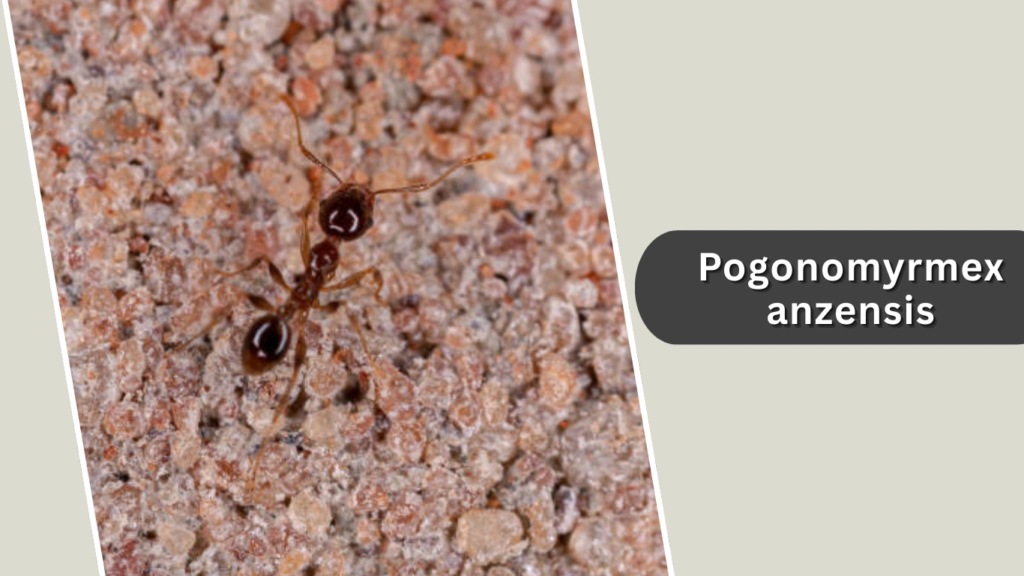
The Anza harvester ant (Pogonomyrmex anzensis) is a lesser-known but ecologically significant species found in arid regions. Its adaptations allow it to thrive in harsh, dry conditions where seed resources are scattered and temperatures are extreme.
Identification
- Medium-sized workers, 5–7 mm
- Reddish-brown coloration
- Moderately sculptured head and mesosoma
- Well-developed psammophore beneath the head
- Strong mandibles suited for collecting and processing seeds
Habitat
Pogonomyrmex anzensis is typically found in desert basins, scrublands, and open sandy flats. Colonies favor loose, sandy or fine-gravel soils where nest construction is efficient and drainage is excellent. Nests are often simple, low mounds with minimal surrounding debris.
Behaviors
Workers forage actively during warm periods, usually forming broad, loosely organized trails rather than tight columns. The species is moderately defensive, emerging quickly during disturbances. Excavation and nest maintenance are continual, helping regulate internal temperature and humidity.
Diet and Lifecycle
Seeds make up the majority of the diet, although workers may include small insects or plant fragments when available. Colonies maintain underground seed granaries as a buffer against unpredictable desert conditions. New colonies are founded by single queens following nuptial flights, with gradual population growth over time.
11. Pogonomyrmex badius
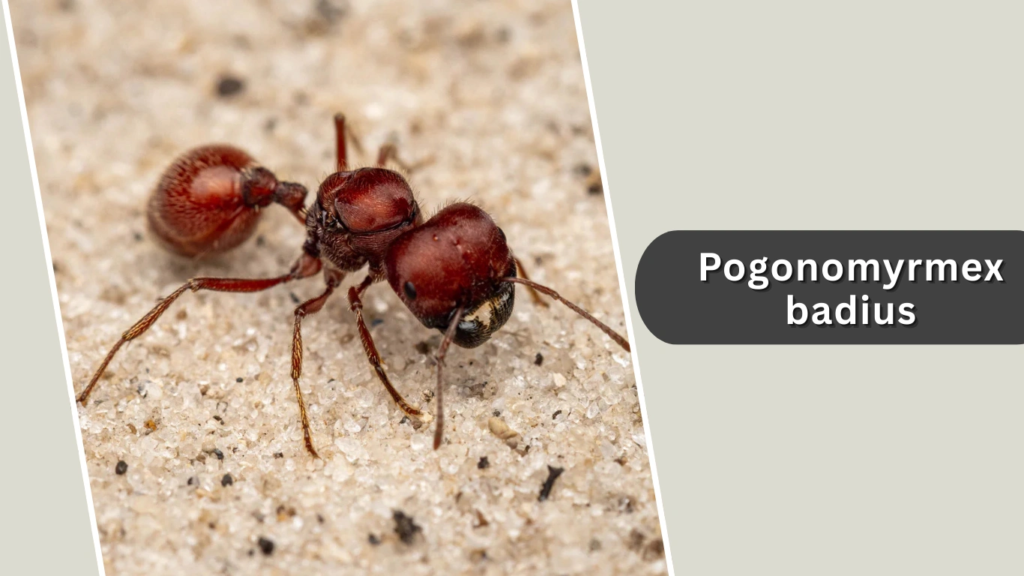
The Florida harvester ant (Pogonomyrmex badius) is a striking species known for its vibrant coloration and impressive underground nest structures. Primarily found in the southeastern United States, it plays an essential role in seed dispersal within sandy ecosystems.
Identification
- Medium-sized workers, 6–8 mm
- Bright red head and mesosoma with a contrasting dark brown to black gaster
- Smooth, glossy gaster surface
- Distinct psammophore beneath the head
- Strong mandibles adapted for seed processing
Habitat
Pogonomyrmex badius thrives in sandy pine forests, coastal plains, dunes, and scrub habitats. Colonies prefer deep, loose, well-drained sand, which supports their large, multichambered nests. Mounds include spiral-pattern openings that shift with seasonal soil adjustments.
Behaviors
This species is known for long-distance foraging, often establishing multiple pathways radiating from the nest. Workers are diligent seed collectors but also exhibit defensive responses when the colony is threatened. Nest architecture is highly sophisticated, often extending more than a meter deep with numerous chambers.
Diet and Lifecycle
Seeds form the primary diet; however, workers may supplement with insects or plant material. Colonies maintain extensive seed granaries that support brood development throughout the year. Queens establish new colonies after nuptial flights, and as the worker population grows, nest complexity increases significantly.
12. Pogonomyrmex novomexicanus
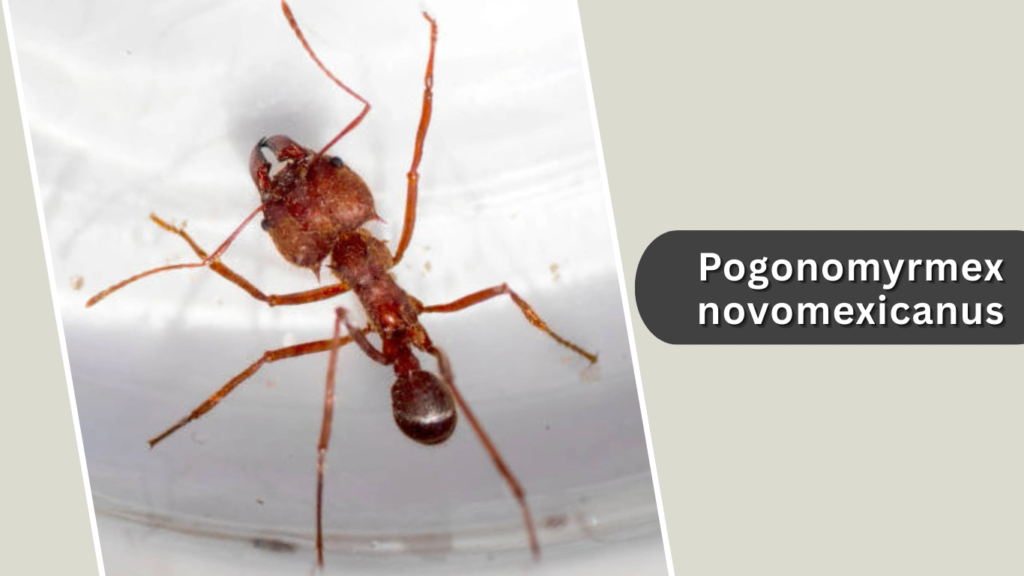
The New Mexico harvester ant (Pogonomyrmex novomexicanus) is a specialized species found primarily in the southwestern United States. Adapted to dry, open habitats, it plays a valuable ecological role through seed harvesting and soil modification.
Identification
- Medium-sized workers, 5–7 mm
- Reddish-brown to dark red coloration
- Moderately sculptured head and mesosoma
- Noticeable psammophore beneath the head
- Strong, curved mandibles suited for handling seeds
Habitat
Pogonomyrmex novomexicanus inhabits semi-arid grasslands, desert margins, and open scrub regions. It prefers well-drained soils, including sandy loam and fine gravel. Nests are typically subtle, low mounds with modest soil clearing, allowing the colony to remain well-hidden from predators and harsh environmental conditions.
Behaviors
Workers forage in scattered, independent patterns, often covering wide areas to locate seeds. The species is moderately defensive and responds quickly when disturbed. Soil excavation is a regular behavior, helping maintain proper nest ventilation and temperature through seasonal changes.
Diet and Lifecycle
The diet is predominantly seed-based, though workers may occasionally collect small insects. Colonies store seeds in underground chambers that sustain them during unfavorable seasons. After mating flights, queens found new colonies independently, and population growth increases steadily as the worker caste expands.
13. Pogonomyrmex salinus
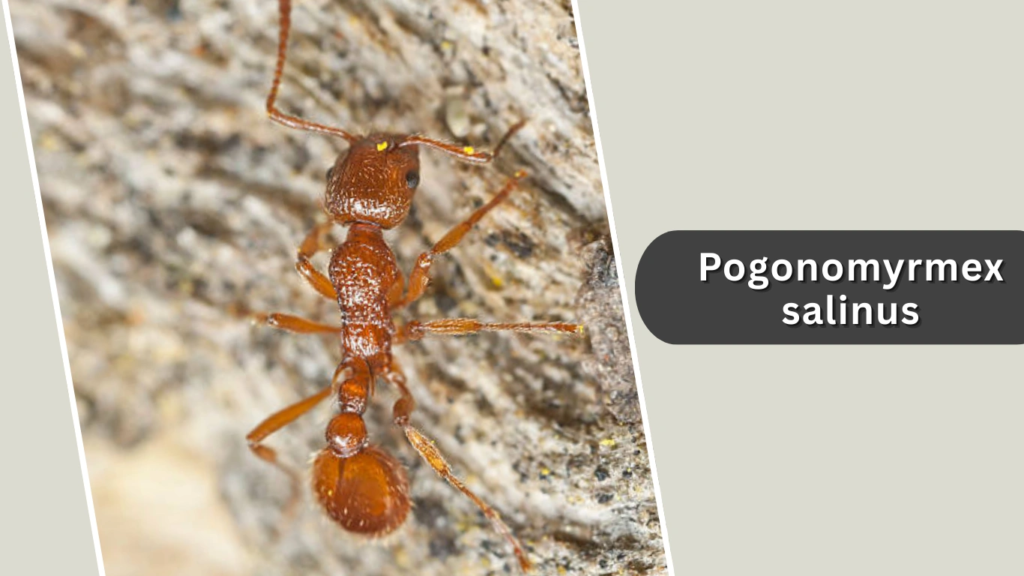
The salt flat harvester ant (Pogonomyrmex salinus) is a resilient species adapted to some of the most challenging environments, including alkaline flats and arid desert regions. Its unique tolerance to harsh soil conditions sets it apart from many other harvester ants.
Identification
- Medium-sized workers, 5–7 mm
- Reddish-brown to dull red coloration
- Moderately sculptured head and mesosoma
- Well-developed psammophore beneath the head
- Sturdy mandibles designed for seed handling
Habitat
Pogonomyrmex salinus is commonly found in salt flats, desert basins, and dry scrublands, thriving in areas with alkaline or saline soils that few species can tolerate. Colonies construct low, often inconspicuous nests with minimal external mounding. The nest entrances blend well into barren ground surfaces.
Behaviors
Workers typically forage during moderate temperature periods, forming loosely defined search patterns rather than rigid pathways. The species is moderately defensive and quickly mobilizes workers when disturbed. Nest maintenance is continual due to shifting, unstable soil conditions in saline environments.
Diet and Lifecycle
Seeds remain the primary dietary component, though small arthropod fragments may be collected when available. Colonies store seeds underground to ensure survival during extreme temperature changes. Following nuptial flights, queens establish new colonies, and population growth proceeds steadily as workers take over foraging and brood care.
14. Pogonomyrmex tenuipubens
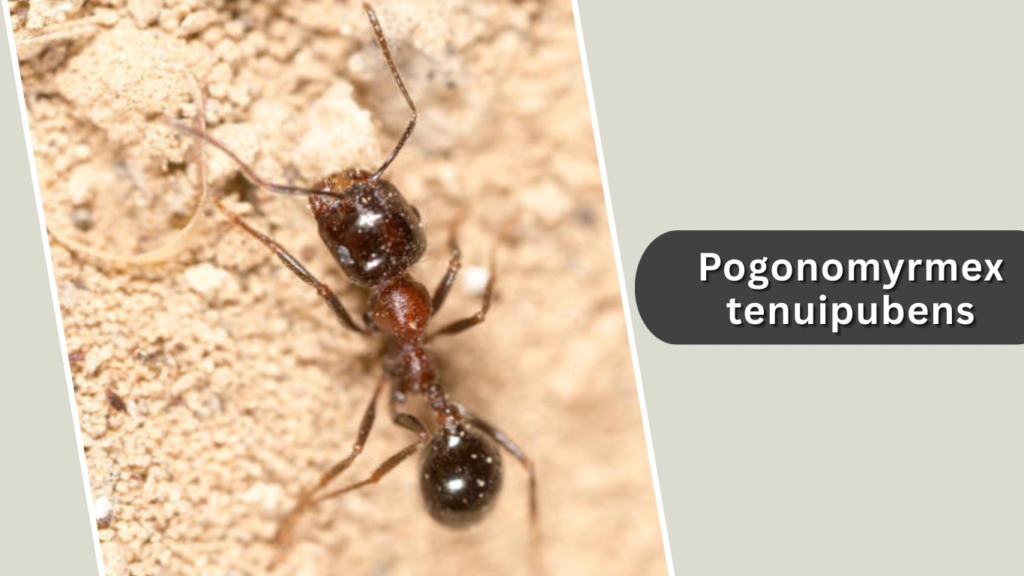
The thin-haired harvester ant (Pogonomyrmex tenuipubens) is a lesser-known species adapted to dry, open habitats across parts of the southwestern United States and northern Mexico. Its subtle morphological traits make it more challenging to identify than some of its close relatives.
Identification
- Medium-sized workers, 5–7 mm
- Reddish-brown coloration
- Characteristically thin, sparse body hairs, especially on the gaster
- Lightly sculptured head and mesosoma
- Noticeable psammophore beneath the head
Habitat
Pogonomyrmex tenuipubens occupies arid scrublands, desert plains, and open grasslands, most often in sandy to fine-gravel soils. Nests are usually small, low-profile mounds with minimal soil accumulation around the entrance, allowing colonies to remain discreet in sparse landscapes.
Behaviors
Workers forage individually or in loose trails depending on food availability. The species is moderately defensive and responds quickly when the nest is disturbed. Excavation and soil turnover are continuous activities, aiding in temperature regulation of the colony chambers.
Diet and Lifecycle
Seeds make up the bulk of the diet, though workers will occasionally supplement with small insects. Colonies store seeds in underground granaries to withstand seasonal scarcity. After nuptial flights, queens establish new nests independently, and colonies grow gradually as worker numbers increase.
15. Pogonomyrmex inermis
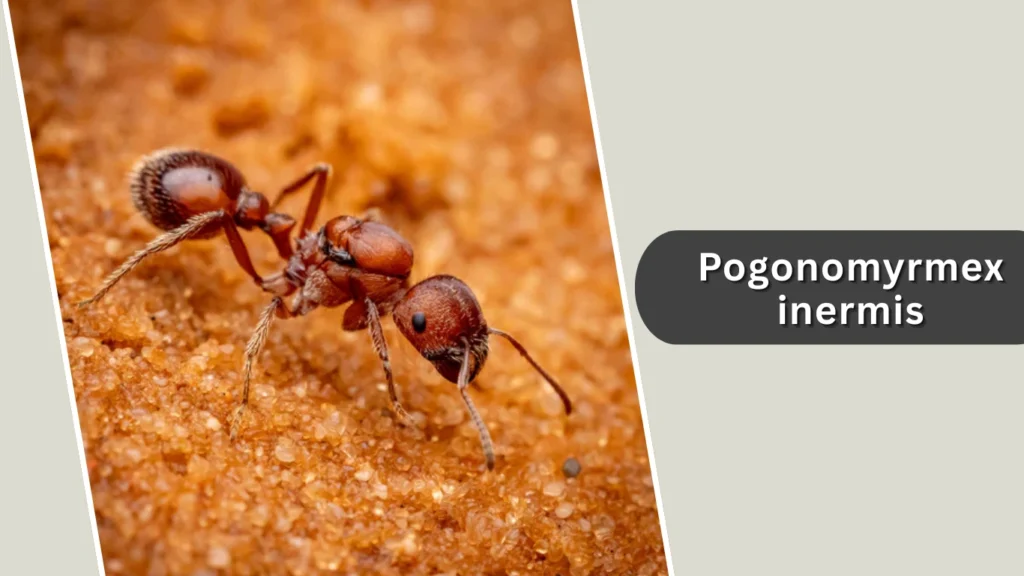
The unarmed harvester ant (Pogonomyrmex inermis) is a distinctive species notable for its lack of propodeal spines, a trait that sets it apart from many close relatives. Found in arid and semi-arid habitats, it plays an active role in seed collection and soil aeration.
Identification
- Medium-sized workers, 5–7 mm
- Reddish-brown to dark red coloration
- Lacks propodeal spines (hence “inermis,” meaning unarmed)
- Moderately sculptured head and mesosoma
- Well-defined psammophore beneath the head
Habitat
Pogonomyrmex inermis inhabits desert flats, scrublands, and semi-arid grasslands, favoring sandy, loose, or compacted soils. Nests are often modest, flat structures with minimal surrounding soil buildup, blending easily into open terrain with limited vegetation.
Behaviors
Workers forage widely in scattered search patterns, often active during moderate morning and evening temperatures. Although not as aggressive as some species, they still defend the nest when disturbed. Regular excavation helps ventilate and stabilize the colony’s underground chambers.
Diet and Lifecycle
Seeds make up the primary diet, but workers may also bring in small insects or plant debris. Colonies store seeds in subterranean granaries to endure harsh seasonal conditions. After mating flights, queens establish new colonies alone, with worker populations gradually increasing as the nest matures.
16. Pogonomyrmex apache
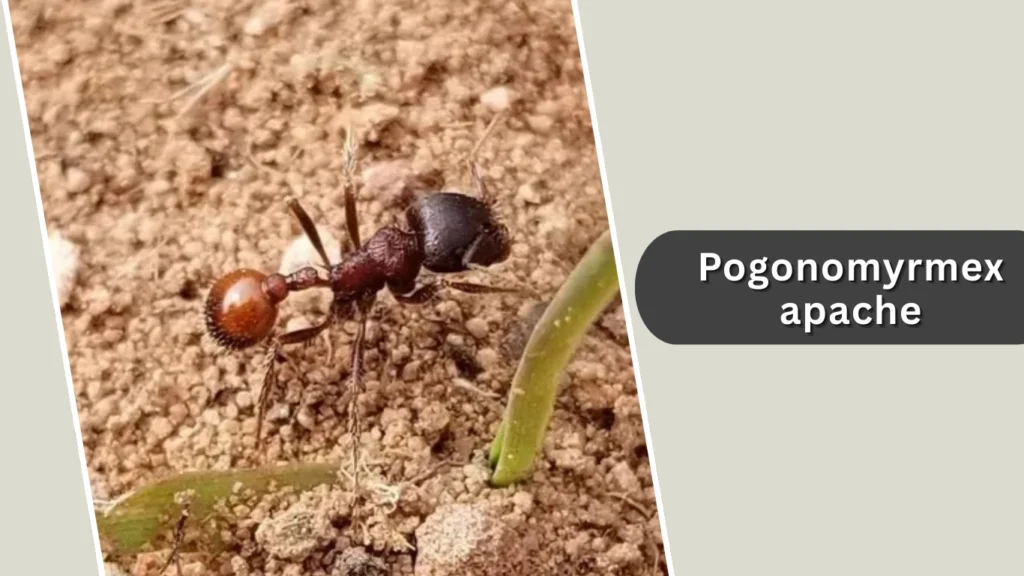
The Apache harvester ant (Pogonomyrmex apache) is a desert-adapted species found in the southwestern United States and northern Mexico. Known for its strong foraging behavior and resilience in harsh climates, it plays an important ecological role in seed dispersal and soil turnover.
Identification
- Medium-sized workers, typically 5–7 mm
- Reddish-brown coloration
- Moderately sculptured head and mesosoma
- Prominent psammophore beneath the head
- Strong mandibles ideal for gathering and processing seeds
Habitat
Pogonomyrmex apache inhabits arid deserts, rocky flats, and open scrublands, thriving in sandy, gravelly, or compact soils. Nests are usually subtle, low-profile mounds with minimal external debris. These nests often occur in exposed, sunlit areas that help maintain warm internal temperatures.
Behaviors
Workers typically forage during cooler portions of the day, forming loosely organized trails radiating from the nest. The species is moderately defensive and reacts swiftly to disturbances. Excavation and nest maintenance are continuous, allowing the colony to regulate humidity and airflow effectively.
Diet and Lifecycle
Seeds are the primary food source, though workers may occasionally retrieve small insects or plant fragments. Colonies store seeds in underground granaries to survive dry seasons. After nuptial flights, queens establish new nests independently, with worker populations growing steadily as the colony matures.
17. Pogonomyrmex huachucanus
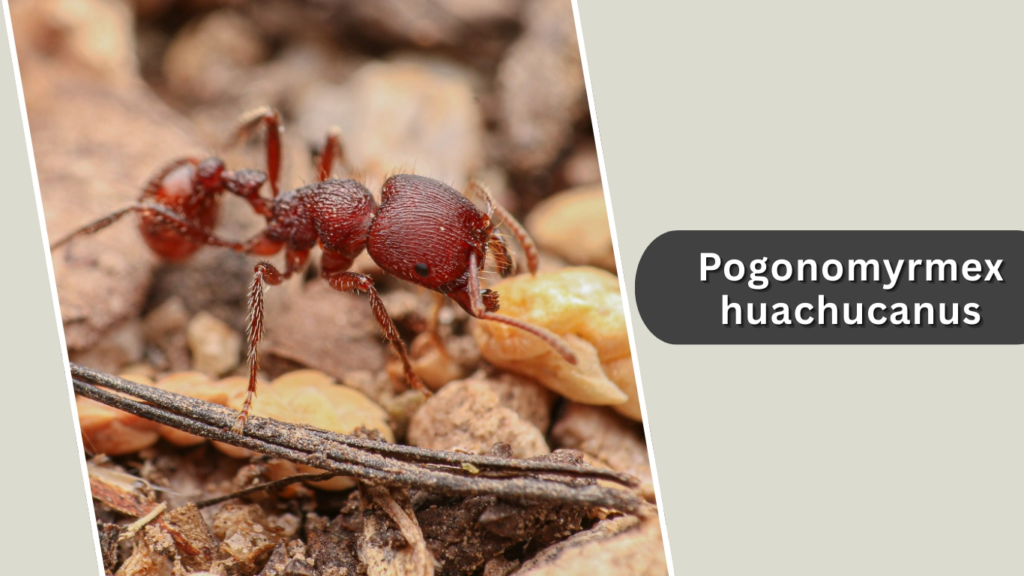
The Huachuca harvester ant (Pogonomyrmex huachucanus) is a localized species found mainly in the southwestern United States and northern Mexico, particularly near mountainous regions. Its preference for slightly cooler and elevated environments distinguishes it from many strictly desert-dwelling relatives.
Identification
- Medium-sized workers, 5–7 mm
- Reddish-brown to deep rust coloration
- Moderately sculptured head and mesosoma
- Distinct psammophore beneath the head
- Strong mandibles adapted for seed collection
Habitat
Pogonomyrmex huachucanus occupies foothills, open woodland edges, high desert grasslands, and rocky slopes. It prefers well-drained sandy or gravelly soils, building low mounded nests that blend naturally into rugged terrain. Colonies tend to occur in areas with moderate vegetation cover.
Behaviors
Workers forage in scattered, flexible patterns, adjusting activity to temperature and elevation-specific conditions. The species is moderately defensive, responding quickly to threats around the nest entrance. Soil excavation is frequent, helping maintain internal nest stability and airflow.
Diet and Lifecycle
Seeds form the majority of their diet, supplemented occasionally by small insects. Stored seeds in underground chambers ensure colony survival during seasonal scarcity. After nuptial flights, queens establish solitary founding nests, with populations expanding gradually as workers take over foraging and brood care.
18. Pogonomyrmex colei
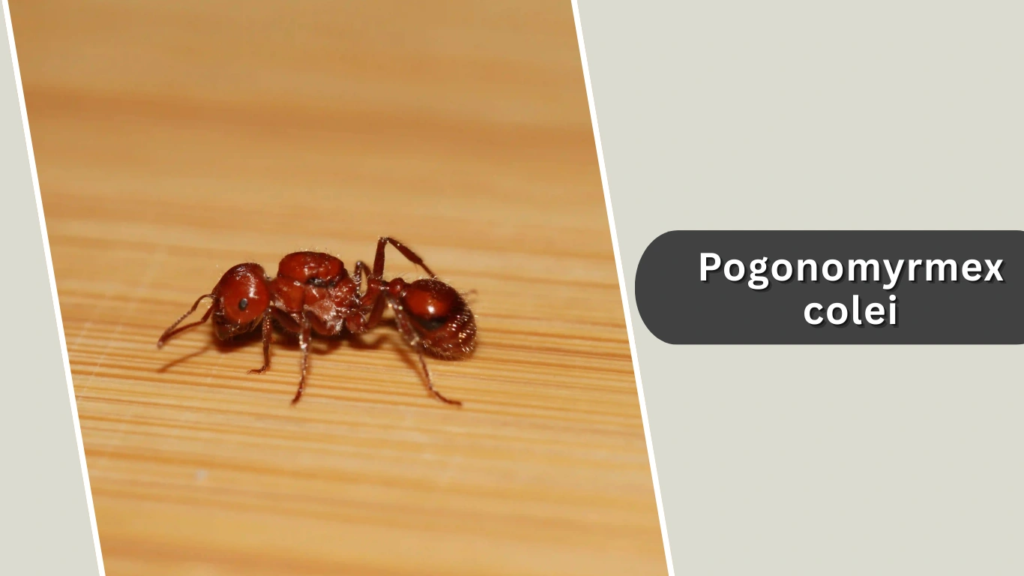
The Cole’s harvester ant (Pogonomyrmex colei) is a relatively uncommon species inhabiting dry, open environments in the southwestern United States. Its subtle appearance and discreet nesting habits allow it to blend naturally into sparsely vegetated landscapes.
Identification
- Medium-sized workers, 5–7 mm
- Reddish-brown coloration
- Light sculpturing on the head and mesosoma
- Noticeable psammophore beneath the head
- Strong mandibles used for processing seeds
Habitat
Pogonomyrmex colei inhabits arid plains, desert scrublands, and sandy flats, typically favoring loose, fine-textured soils that allow for efficient excavation. Nests are small and low, often barely rising above the ground surface. These nests rarely feature large cleared discs, helping colonies remain inconspicuous.
Behaviors
Workers forage in independent and widely scattered patterns, reflecting the patchy nature of seed availability in their habitats. The species displays moderate defense responses but is generally less aggressive than some other Pogonomyrmex. Regular nest excavation helps maintain internal temperature and protect brood chambers.
Diet and Lifecycle
Seeds constitute the majority of the diet, though workers may bring in small insects when available. Colonies store seeds in underground granaries to endure seasonal extremes. After mating flights, queens establish new nests alone, with gradual colony expansion as worker numbers increase.
19. Pogonomyrmex snellingi
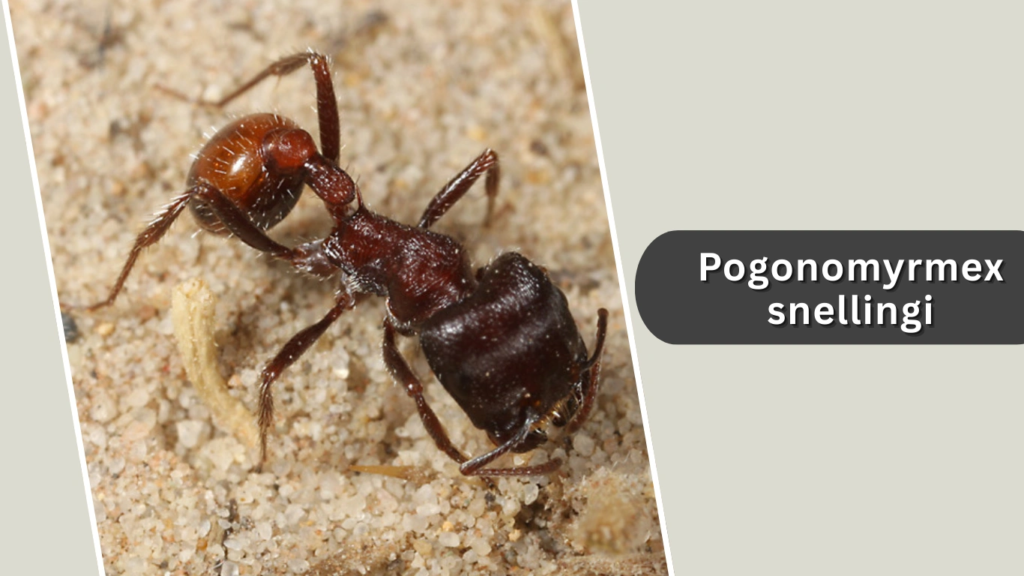
The Snelling’s harvester ant (Pogonomyrmex snellingi) is a rare and geographically limited species named in honor of entomologist Roy Snelling. It inhabits select arid regions and is adapted to conditions where seed resources are scattered and soil types vary widely.
Identification
- Medium-sized workers, 5–7 mm
- Reddish-brown to dark red coloration
- Moderate sculpturing on the head and mesosoma
- Well-developed psammophore beneath the head
- Strong mandibles for seed collection and processing
Habitat
Pogonomyrmex snellingi occupies dry basins, open desert flats, and scrublands, often where sandy, gravelly, or mixed soils provide good drainage and nesting potential. Nests are typically low, inconspicuous mounds with minimal surface disturbance, blending well with the natural terrain.
Behaviors
Workers forage in loose, scattered patterns, searching widely for seeds. Activity often peaks during cooler morning and evening periods. The species is moderately defensive and responds quickly when the nest is disturbed. Ongoing soil excavation maintains ventilation and internal nest stability.
Diet and Lifecycle
Seeds comprise most of the diet, though small insects may be collected occasionally. Colonies maintain stored seed reserves in subterranean chambers to survive seasonal scarcity. After nuptial flights, queens establish new colonies independently, with gradual population growth as workers assume specialized tasks.
20. Pogonomyrmex thetis
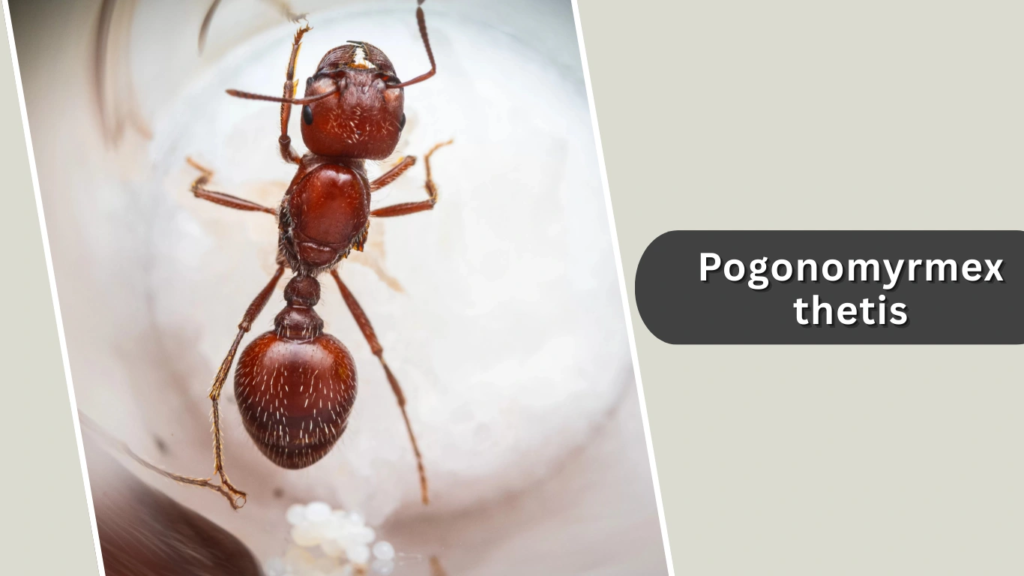
The Thetis harvester ant (Pogonomyrmex thetis) is a lesser-known species found in select arid regions of the southwestern United States and northern Mexico. Its adaptability to dry, open environments allows it to thrive where seed availability is limited and temperatures fluctuate drastically.
Identification
- Medium-sized workers, 5–7 mm
- Reddish-brown to dark rust coloration
- Moderately sculptured head and mesosoma
- Distinct psammophore beneath the head
- Strong mandibles specialized for handling seeds
Habitat
Pogonomyrmex thetis is typically found in desert scrublands, arid plains, and sandy flats. It favors well-drained, loose soils where nest construction is efficient. Colonies build small, subtle mounds that blend easily into sparsely vegetated terrain, helping them avoid predators and environmental extremes.
Behaviors
Workers forage individually or in loose clusters, often adjusting their activity based on temperature and seed availability. The species is moderately defensive and reacts swiftly when the nest is disturbed. Nest maintenance is frequent, allowing colonies to control internal humidity and airflow.
Diet and Lifecycle
Seeds dominate the diet, though workers may retrieve tiny insects or plant debris. Seed granaries inside the nest sustain the colony through harsh seasons. Following mating flights, queens establish new colonies alone. Growth is steady, with workers gradually taking over tasks such as foraging, brood care, and excavation.
21. Pogonomyrmex texanus
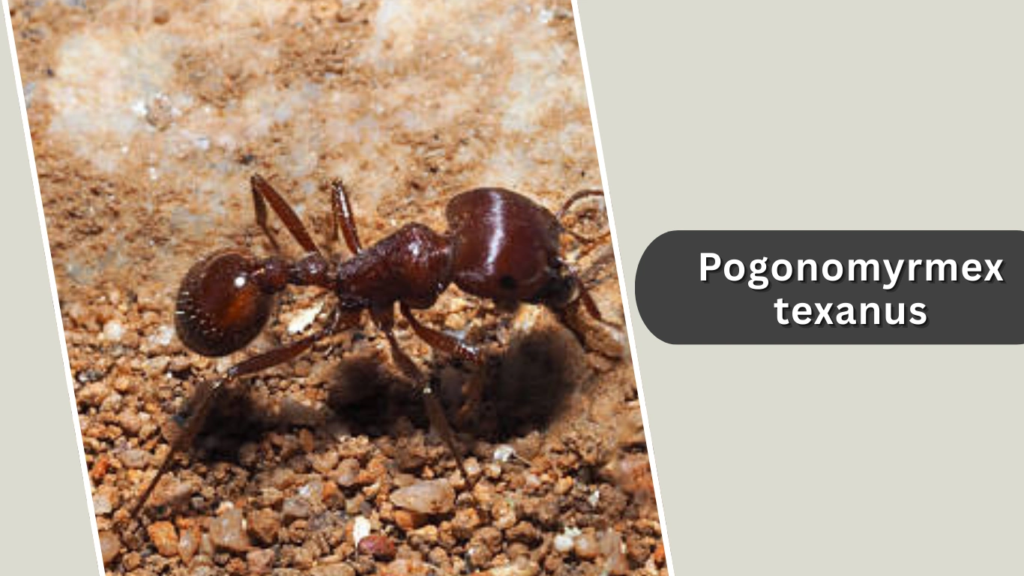
The Texas harvester ant (Pogonomyrmex texanus) is a widespread species across the southern United States, especially known for its large colonies and extensive seed-harvesting activity. It plays a key ecological role in managing plant communities and recycling soil nutrients.
Identification
- Medium to large workers, 6–8 mm
- Reddish-brown to rusty red coloration
- Moderately sculptured head and mesosoma
- Distinct psammophore beneath the head
- Robust mandibles designed for cracking seeds
Habitat
Pogonomyrmex texanus inhabits grasslands, prairies, deserts, and open plains, thriving in sandy, loamy, or compacted soils. Colonies often construct large, conspicuous mounds, sometimes surrounded by cleared discs of soil several feet across. These exposed sites maximize solar heating for the nest.
Behaviors
Workers forage in organized trails, often traveling long distances to collect seeds. The species is defensive and will sting readily when the colony is threatened. Nest maintenance is continual, with workers adjusting soil and debris to regulate nest temperature and protect brood chambers.
Diet and Lifecycle
Seeds form the core of the diet, though dead insects may supplement nutrition. Colonies store seeds in deep underground granaries that support workers and brood year-round. After nuptial flights, queens found new colonies independently. Mature colonies can persist for many years with stable worker populations.
22. Pogonomyrmex wheeleri
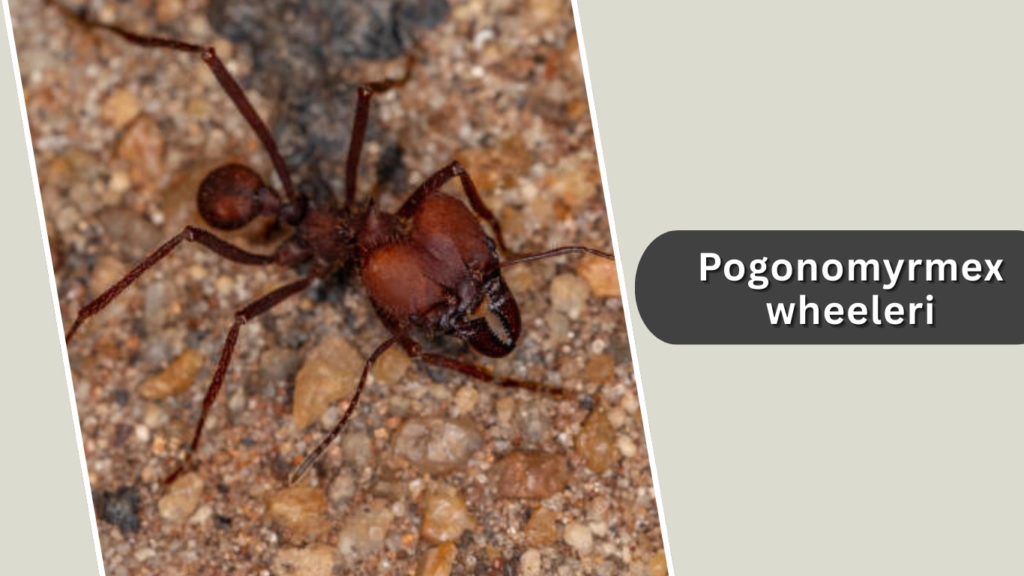
The Wheeler’s harvester ant (Pogonomyrmex wheeleri) is a desert-adapted species named in honor of the renowned myrmecologist William Morton Wheeler. It inhabits dry, open landscapes where it contributes to seed dispersal and soil aeration.
Identification
- Medium-sized workers, 5–7 mm
- Reddish-brown to deep rust coloration
- Moderately sculptured head and mesosoma
- Noticeable psammophore beneath the head
- Strong mandibles used for seed handling
Habitat
Pogonomyrmex wheeleri occurs in desert scrublands, arid plains, and sandy basins, preferring well-drained sandy or fine-gravel soils. Nests are low and subtle, often lacking prominent mounds. The species tends to position nests in exposed areas with ample sunlight for thermoregulation.
Behaviors
Workers forage in broad, dispersed patterns, adjusting activity to avoid extreme heat. They respond quickly to disturbances but are generally less aggressive than some related species. Soil excavation remains a continual activity to maintain stable nest conditions through seasonal changes.
Diet and Lifecycle
Seeds make up most of the diet, though small arthropod fragments may be included when available. Colonies store seeds in underground granaries to sustain brood during dry periods. After nuptial flights, queens establish new nests, and the colony gradually expands as worker numbers increase.
23. Pheidole xerophila
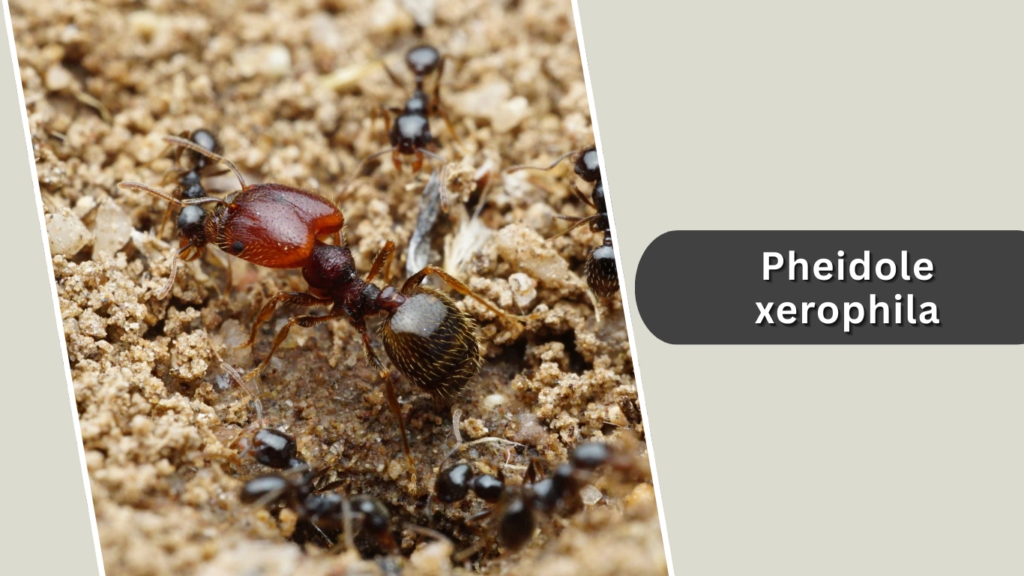
The xerophilous big-headed harvester ant (Pheidole xerophila) is an arid-adapted species often grouped with harvester ants due to its strong seed-gathering behavior. Known for distinct worker castes, it plays a functional role in dry ecosystems across the southwestern United States.
Identification
- Small to medium workers, 3–6 mm
- Major workers have enlarged heads with powerful mandibles
- Minor workers are slender with reddish-brown coloration
- Sparse body sculpturing
- Moderately hairy gaster and well-defined segmentation
Habitat
Pheidole xerophila inhabits arid plains, sandy scrublands, and desert margins, preferring loose, fine soils for ease of excavation. Nests are typically small crater-like openings with minimal soil accumulation. Colonies often occupy shaded or partially protected microhabitats compared to open-nesting Pogonomyrmex species.
Behaviors
The species uses a dual-caste foraging system: minor workers scout and gather small seeds, while majors crack larger seeds using their powerful jaws. Trails may be faint but consistent. Colonies defend themselves moderately when disturbed, with majors often positioned near nest entrances.
Diet and Lifecycle
Primarily seed-eaters, these ants also supplement their diet with occasional insects. Colonies store seeds in multiple small chambers rather than large granaries. After nuptial flights, queens establish new nests and produce the first generation of minor workers, followed later by majors as the colony matures.
24. Messor barbarus
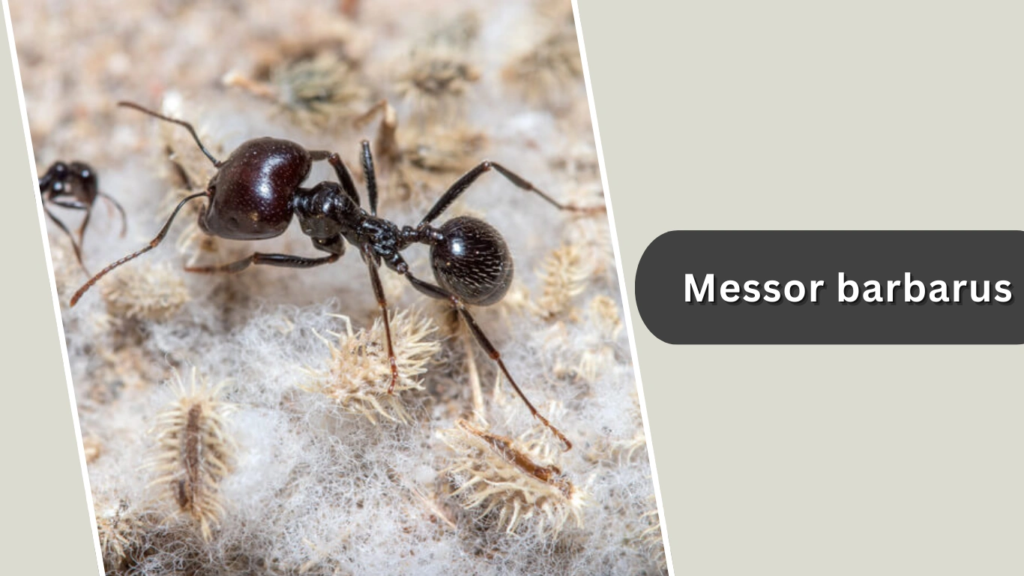
The red-headed harvester ant (Messor barbarus) is one of the most recognizable harvester ant species in Europe and North Africa. Known for its highly organized seed-harvesting system and polymorphic workers, it is a key player in grassland and Mediterranean ecosystems.
Identification
- Workers vary widely in size, 3–12 mm (strong polymorphism)
- Distinct red head with a darker brown or black gaster
- Majors possess very large, powerful mandibles
- Minors are slender with lighter sculpturing
- No psammophore, unlike many Pogonomyrmex species
Habitat
Messor barbarus inhabits Mediterranean grasslands, fields, scrublands, and dry slopes, thriving in sandy, clay, or loamy soils. Colonies construct extensive nests with visible entrance discs or mound structures. They often inhabit areas with seasonal drought but moderate winter rains.
Behaviors
This species displays complex caste-based division of labor. Minor workers gather seeds, intermediates transport them, and majors crack or grind them inside the nest. Foraging occurs along clear, organized trails. Colonies defend themselves vigorously when disturbed, especially majors stationed near entrances.
Diet and Lifecycle
Seeds are the primary diet, forming large underground stores called “ant granaries.” Workers also process seeds into granules to avoid germination inside the nest. New colonies begin when queens establish nests after autumn nuptial flights. Mature colonies can grow very large, lasting many years.
25. Messor pergandei
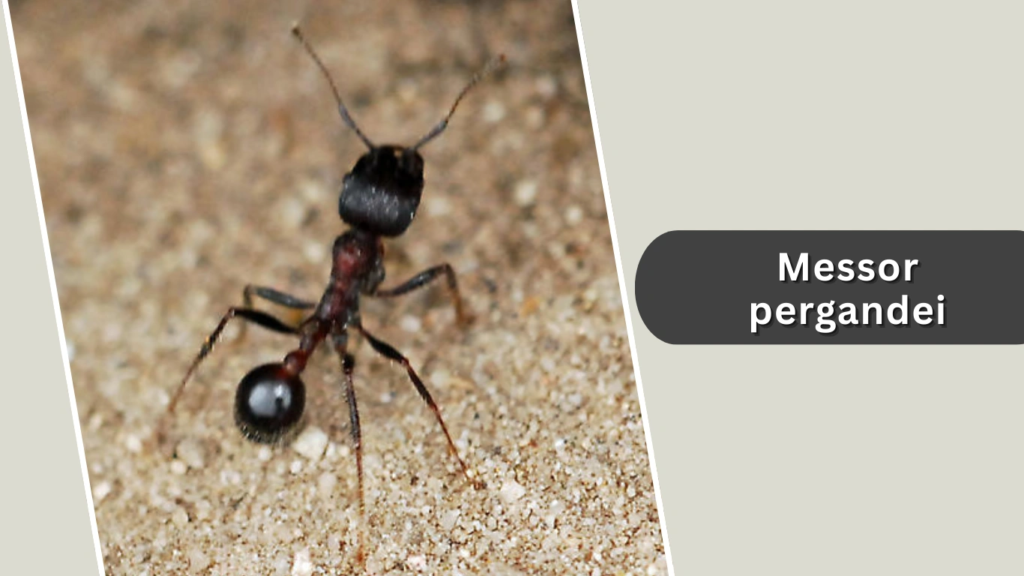
The Pergande’s harvester ant (Messor pergandei) is a widespread desert species found in the southwestern United States and northern Mexico. Known for its impressive underground granaries and complex worker caste system, it thrives in some of the hottest, driest habitats.
Identification
- Workers range from small to large, 3–9 mm
- Dark brown to black body coloration
- Majors have large, square-shaped heads with powerful mandibles
- Minors are slender and lightly sculptured
- No psammophore (unlike Pogonomyrmex species)
Habitat
Messor pergandei inhabits deserts, arid plains, sand dunes, and rocky flats, thriving in loose, sandy, or fine-gravel soils. Nests are often deep and expansive, featuring multiple entrances and large soil deposits. Colonies typically occur in fully exposed areas with intense sunlight.
Behaviors
This species employs a highly structured foraging system, with organized trails leading to seed-rich areas. Majors assist in transporting and breaking down large seeds. Workers are moderately defensive and can rapidly mobilize to protect the colony. Soil excavation is constant, leading to significant nest expansion over time.
Diet and Lifecycle
Seeds form the bulk of their diet, stored in large subterranean granaries to ensure survival during droughts and temperature extremes. Workers may supplement the diet with small insects. After nuptial flights, queens independently found new colonies. As the colony matures, worker polymorphism becomes more pronounced and nest size increases substantially.
FAQs
What do harvester ants primarily eat?
Harvester ants mainly consume seeds, which they collect and store in underground granaries. Many species also supplement their diet with small insects or plant material, but seeds remain the dominant and most critical food source for maintaining colony health and supporting brood development.
Are harvester ants dangerous to humans?
Most harvester ants can sting, and some species—like Pogonomyrmex maricopa—have extremely potent venom. While their stings are painful, they are rarely dangerous unless someone has a venom allergy. In general, harvester ants are defensive rather than aggressive and mainly sting when their nest is disturbed.
Where do harvester ants build their nests?
Harvester ants typically nest in open, sunny areas with well-drained soils such as sand, gravel, or loose loam. Many create low mounds or cleared discs around the entrance, which help regulate nest temperature. In deserts, nests may be subtle, blending into the surrounding terrain.
How long do harvester ant colonies live?
A harvester ant colony can persist for many years, often over a decade. Queens may live more than 15–20 years, while workers live several months to a year depending on species. Colony size and longevity increase as more workers take over specialized tasks like foraging and nest maintenance.
How do harvester ant colonies reproduce?
Reproduction occurs through nuptial flights, where winged males and females leave the nest to mate. Fertilized queens then shed their wings and establish new colonies independently. Once the first generation of workers emerges, the queen remains in the nest to lay eggs while workers expand and maintain the colony.
