

Army ants are among the most formidable predators in the insect world, known for their massive swarm raids, nomadic lifestyles, and highly coordinated colonies. Found across the Americas, Africa, and Asia, these ants play a crucial role in ecosystem balance by controlling insect populations. Their unique behaviors, powerful mandibles, and synchronized brood cycles make them one of the most fascinating ant groups to study in the wild.
1. Eciton burchellii

Eciton burchellii, often called the Amazonian army ant, is the most iconic and widely studied army ant species. Known for its massive swarm raids and highly organized social structure, it plays a crucial role in tropical ecosystems by influencing insect populations and providing resources for ant-following birds.
Identification
- Slender, elongated workers with distinct size variation
- Soldiers possess large, sickle-shaped mandibles
- Typically orange to dark brown in color
- Workers form dense, moving swarms when raiding
- Queens are extremely large compared to workers
Habitat
Eciton burchellii inhabits tropical rainforests and moist lowland regions throughout Central and South America. It does not build permanent nests; instead, colonies form temporary bivouacs made from interlocked worker bodies. These bivouacs shift locations frequently as the colony cycles between active raiding and brood-rearing phases.
Behaviors
This species is famous for its swarm raids, during which thousands of workers move across the forest floor capturing insects, spiders, and other small animals. The colony alternates between a nomadic phase, where it moves daily, and a statary phase, when the queen lays eggs and the colony becomes temporarily stationary. They communicate through pheromones and operate with remarkable coordination.
Diet and Lifecycle
Eciton burchellii primarily feeds on live prey, especially other arthropods captured during raids. The lifecycle follows a synchronized rhythm: during the statary phase, brood development occurs, and during the nomadic phase, the colony relocates frequently to support high food demands. Queens lay large batches of eggs, and colony sizes can reach hundreds of thousands of individuals.
2. Eciton hamatum

Eciton hamatum is a widespread Neotropical army ant recognized for its swift raiding columns and powerful soldiers. This species is known for climbing vegetation during hunts, allowing it to capture prey that many other army ants cannot reach.
Identification
- Workers show strong size variation, typical of army ant castes
- Soldiers have long, curved mandibles suited for slicing prey
- Body color ranges from reddish-brown to dark brown
- Foraging columns often move both on the ground and in low vegetation
- Queens are large and rarely seen outside the bivouac
Habitat
Eciton hamatum inhabits tropical rainforests, secondary forests, and humid woodland regions from Mexico to northern South America. Like most army ants, it does not build permanent nests. Colonies form temporary bivouacs made from worker bodies, usually located under logs, inside tree cavities, or beneath leaf litter.
Behaviors
This species is known for its bidirectional raiding columns, where workers flow in opposite directions along well-defined trails. Unlike many army ants, E. hamatum frequently raids above ground level, climbing shrubs and low branches to capture insects, larvae, and other arthropods. Colony cycles alternate between nomadic and stationary phases.
Diet and Lifecycle
The diet consists mainly of live arthropod prey, including caterpillars, spiders, and other ants. During the stationary phase, the queen lays large batches of eggs, and brood development is synchronized. In the nomadic phase, the colony moves frequently to find prey-rich areas. Colonies may number in the hundreds of thousands and operate with remarkable coordination.
3. Eciton mexicanum

Eciton mexicanum is a highly active army ant species native to Central America. Known for its fast-moving raids and flexible foraging strategies, it is an important predator in many tropical ecosystems.
Identification
- Workers show significant size variation, with distinct soldier and worker castes
- Soldiers have elongated heads and curved mandibles
- Typically reddish-brown to dark brown in color
- Foragers form dense, flowing columns during raids
- Queens are large and remain protected within the bivouac
Habitat
This species inhabits tropical forests, cloud forests, and moist woodlands from Mexico through Central America. Like other army ants, Eciton mexicanum does not construct permanent nests. Colonies form temporary bivouacs, often tucked beneath logs, inside tree hollows, or within leaf litter, moving frequently as part of their lifecycle.
Behaviors
Eciton mexicanum conducts rapid, coordinated raids across the forest floor, targeting a wide variety of arthropods. Their raiding behavior is highly organized, with clear inbound and outbound worker streams. Colonies alternate between nomadic and statary phases, shifting locations depending on brood development and food requirements.
Diet and Lifecycle
This species preys on live insects, spiders, and other small invertebrates, capturing them during swarm raids. The lifecycle is synchronized: the queen lays eggs in large batches during the statary phase, and as larvae grow, the colony becomes nomadic to meet increased food demands. Colonies can grow very large and live for many years under stable conditions.
4. Eciton drepanophorum

Eciton drepanophorum is a specialized Neotropical army ant known for its aggressive raiding behavior and well-structured foraging columns. Though less famous than E. burchellii, it plays a significant role as a top arthropod predator in rainforest ecosystems.
Identification
- Workers exhibit clear caste variation, including small workers and large-headed soldiers
- Soldiers possess long, curved, sickle-like mandibles
- Body coloration ranges from orange-brown to dark brown
- Raids form dense, directional columns across the forest floor
- Queens are extremely large and remain deep within the bivouac
Habitat
This species inhabits tropical rainforests, moist lowlands, and secondary forest environments from Central to northern South America. Colonies form temporary bivouacs rather than permanent nests, usually sheltering under logs, in soil cavities, or beneath leaf litter. They move frequently as part of their nomadic cycle.
Behaviors
Eciton drepanophorum is known for its high-intensity swarm raids, during which many thousands of workers search for arthropod prey. Raiding columns maintain strict organization, with outbound foragers and returning prey carriers moving in opposite lanes. Colonies alternate between nomadic and stationary phases depending on brood development.
Diet and Lifecycle
The species feeds primarily on live arthropod prey, including insects, spiders, and even other ants. As with other army ants, their lifecycle is synchronized: the queen lays large batches of eggs during the stationary phase, and the colony becomes nomadic when larvae need increased food intake. Colonies may reach very large sizes and persist for many years.
5. Eciton lucanoides
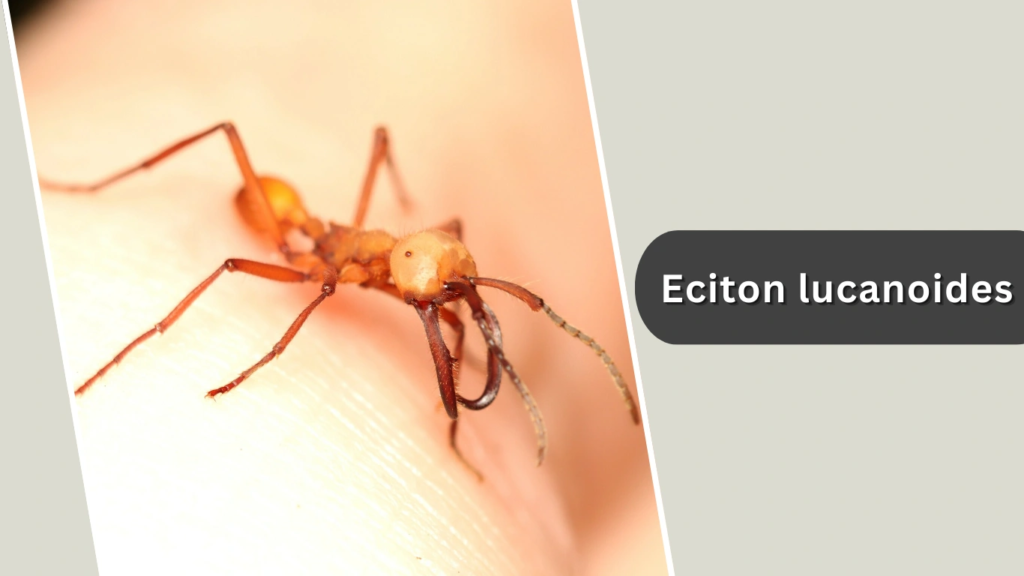
Eciton lucanoides is a lesser-known but ecologically important army ant found in Central and South American rainforests. Its highly organized raiding behavior and specialized soldier caste make it a formidable predator within its habitat.
Identification
- Workers display noticeable caste differentiation
- Soldiers have exceptionally large heads and long, curved mandibles
- Coloration ranges from yellowish-brown to dark brown
- Foraging columns are dense and fast-moving
- Queens are oversized and remain within the center of the bivouac
Habitat
This species inhabits tropical rainforests, humid lowlands, and densely vegetated forest floors. Like all true army ants, Eciton lucanoides forms temporary bivouacs rather than permanent nests, typically hiding under logs, in soil cavities, or beneath thick leaf litter. They shift locations frequently during their nomadic phase.
Behaviors
Eciton lucanoides organizes structured swarm raids that sweep through the forest, capturing arthropods of many kinds. Workers communicate using pheromone trails and operate with remarkable precision. Colonies follow a characteristic cycle, alternating between nomadic, roaming periods and stationary phases when brood development occurs.
Diet and Lifecycle
Their diet consists mainly of live arthropod prey, including insects, spiders, and soft-bodied invertebrates. The lifecycle is synchronized: during the stationary phase, the queen lays eggs, and brood development peaks. As larvae mature and food demand increases, the colony transitions to the nomadic phase, moving daily. Colonies may persist for many years in stable environments.
6. Dorylus nigricans
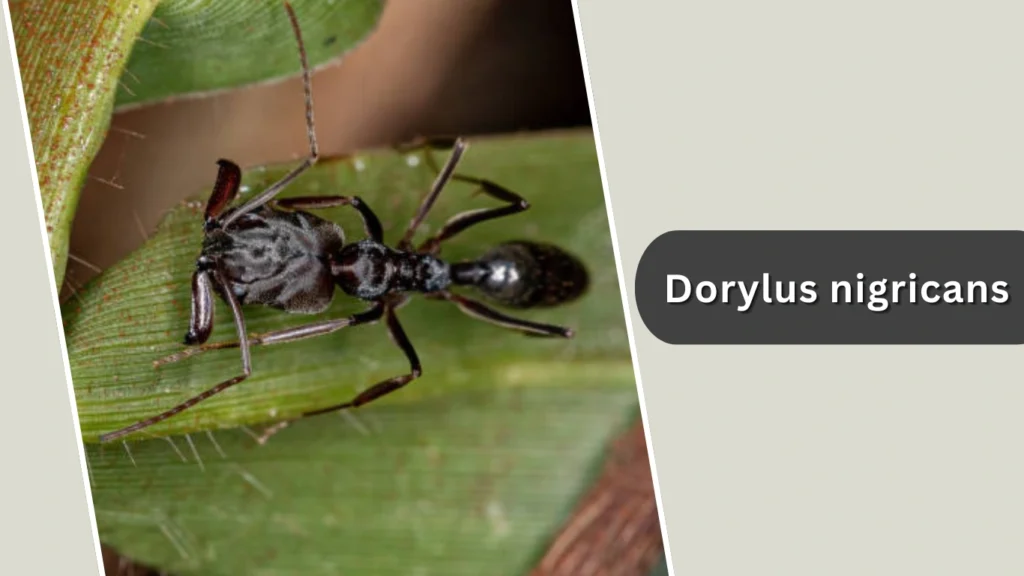
Dorylus nigricans is one of the best-known African army ants, famous for its massive swarm raids and powerful soldier caste. Often called “driver ants,” members of this species play a major ecological role as top invertebrate predators in African forests and savannas.
Identification
- Workers vary greatly in size, with extremely large-headed soldiers
- Soldiers feature strong, piercing mandibles used for defense and prey capture
- Typically dark brown to nearly black in color
- Raiding swarms form wide, fast-moving fronts
- Queens are among the largest of any ant species
Habitat
This species occurs throughout Central and East Africa, inhabiting forests, woodland areas, savannas, and agricultural zones. Colonies form temporary bivouacs in logs, underground spaces, or shaded areas. They do not construct permanent nests and relocate frequently depending on food availability and brood development.
Behaviors
Dorylus nigricans conduct large, sweeping swarm raids that can cover wide distances. Soldiers line the edges of the swarm to defend workers and overpower prey. Colonies alternate between nomadic and stationary phases, similar to New World army ants. Workers communicate through pheromone trails and respond rapidly to colony needs.
Diet and Lifecycle
These ants feed primarily on live prey, including insects, worms, small vertebrates, and even carrion. Their synchronized lifecycle involves a stationary phase when the queen lays thousands of eggs, followed by a nomadic phase to meet the nutritional demands of developing larvae. Colonies may reach populations of over 20 million ants, making them some of the largest ant societies in the world.
7. Dorylus wilverthi

Dorylus wilverthi is a powerful and aggressive African army ant species known for forming large raiding columns and producing intimidating soldier castes. It is especially influential in the ecosystems of Central and East Africa.
Identification
- Workers show extreme caste variation, including very large-headed soldiers
- Soldiers possess thick, curved mandibles built for cutting and defense
- Coloration is usually dark reddish-brown to nearly black
- Raiding swarms form broad, coordinated fronts
- Queens are enormous compared to average workers
Habitat
This species inhabits forests, woodland savannas, and moist lowland regions across Central Africa. Colonies do not build permanent nests; instead, they form temporary bivouacs made of interlocked workers. Bivouacs shift locations regularly, depending on food availability and brood cycles.
Behaviors
Dorylus wilverthi is known for its highly aggressive swarm raids, during which thousands of ants move in organized waves to subdue prey. Soldiers patrol the edges of the swarm to protect workers and assist in capturing larger prey. Colonies follow predictable nomadic and stationary cycles, synced with brood development.
Diet and Lifecycle
The species consumes live arthropods, larvae, worms, and occasionally small vertebrates. During the stationary phase, the queen lays a large batch of eggs. As larvae grow and demand more food, the colony shifts to the nomadic phase, moving frequently. Colonies can reach millions of individuals and may persist for many years.
8. Dorylus molestus

Dorylus molestus is a well-known East African army ant species famous for its massive underground colonies and intense surface raids. Highly adaptable and extremely aggressive when disturbed, it is one of the dominant predators in its ecosystem.
Identification
- Workers display extreme size variation, with huge, muscular soldiers
- Soldiers have powerful, sharply curved mandibles
- Typically dark brown to black in coloration
- Raiding formations appear as dense, flowing columns
- Queens are enormous and remain hidden deep within the bivouac
Habitat
This species inhabits savannas, forests, grasslands, and agricultural regions across East Africa. Colonies form temporary bivouacs in underground chambers, hollow logs, or shaded soil cavities. They do not build permanent nests and relocate these bivouacs frequently as part of their colony cycle.
Behaviors
Dorylus molestus conducts aggressive, coordinated raids, often emerging in massive columns that sweep across the ground in search of prey. Soldiers line the raiding edges to protect workers and subdue large prey. Colonies transition between nomadic and stationary phases depending on brood development and food demands.
Diet and Lifecycle
This species feeds on live prey, including insects, larvae, worms, and occasionally small vertebrates. Their lifecycle is tightly synchronized: queens lay huge batches of eggs during the stationary phase, and once larvae hatch and require more food, the colony enters the nomadic phase. Colonies may contain millions of individuals and persist for decades.
9. Dorylus laevigatus

Dorylus laevigatus is a unique Asian army ant species found throughout parts of Southeast Asia. Known for its subterranean lifestyle, it differs from many African driver ants by conducting most of its activities underground.
Identification
- Workers show strong caste variation, with enormous soldiers
- Soldiers possess smooth, shiny heads with powerful mandibles
- Body color ranges from reddish-brown to dark brown
- Foraging often occurs below the soil surface
- Raiding columns are less visible compared to African species
Habitat
This species inhabits tropical rainforests and moist lowland regions in Southeast Asia, including Malaysia, Indonesia, and surrounding areas. Colonies form underground bivouacs, often deep within soil tunnels or beneath roots. Their subterranean lifestyle makes them less frequently observed than many other army ants.
Behaviors
Dorylus laevigatus conducts subterranean swarm raids, navigating through soil to capture prey. When above-ground activity occurs, raids appear as narrow, fast-moving trails. Workers cooperate closely, and soldiers defend tunnels and raiding fronts. Like other army ants, the species alternates between nomadic and stationary phases.
Diet and Lifecycle
Their diet consists mainly of soil-dwelling arthropods, including insects, larvae, and worms. During the stationary phase, the queen lays a large batch of eggs, leading to synchronized brood development. As larvae grow and demand more food, the colony becomes nomadic. Colonies can grow extremely large, though their hidden lifestyle makes them challenging to study.
10. Dorylus orientalis

Dorylus orientalis is a widespread Asian army ant species recognized for its subterranean activity and powerful raiding behavior. Although less visible than African driver ants, it remains a dominant predator in many soil ecosystems.
Identification
- Workers show strong polymorphism, with extra-large soldiers
- Soldiers have broad, smooth heads with strong mandibles
- Usually reddish-brown to dark brown
- Most foraging takes place underground
- Above-ground raids appear as narrow, organized trails
Habitat
This species inhabits tropical forests, moist lowlands, and mountainous regions across Southeast Asia, including Thailand, Malaysia, and Indonesia. Colonies form temporary underground bivouacs, often deep in soil chambers. They regularly relocate these bivouacs as their prey availability and brood cycle change.
Behaviors
Dorylus orientalis conducts highly coordinated subterranean raids, targeting soil-dwelling prey. When above-ground raids occur, they are fast, narrow, and heavily guarded by soldiers. Colonies follow characteristic nomadic and statary phases, shifting locations to support brood development.
Diet and Lifecycle
This species feeds mainly on worms, insect larvae, and small arthropods found within soil habitats. As with other army ants, their lifecycle is synchronized: during the statary phase, the queen lays eggs, and the colony becomes more stationary. When larvae require greater food intake, the colony becomes nomadic, moving frequently to find richer hunting grounds.
11. Aenictus laeviceps

Aenictus laeviceps is a widespread Asian army ant species known for its swift ground raids and preference for preying on other ant species. It is highly efficient, forming compact but extremely active raiding columns.
Identification
- Workers are small and slender compared to Eciton and Dorylus species
- Lacks a soldier caste; workers are monomorphic but vary slightly in size
- Typically reddish-brown to orange
- Raiding trails appear as thin, fast-moving lines across the forest floor
- Queens are larger but rarely seen
Habitat
This species inhabits tropical forests, woodlands, plantations, and grasslands across Southeast and South Asia. Colonies form temporary bivouacs under leaf litter, logs, or soil cavities and relocate frequently, especially during active raiding periods.
Behaviors
Aenictus laeviceps is known for its high-speed raids, often targeting brood and workers of other ant colonies. Thousands of ants move in a narrow, coordinated column, quickly overwhelming prey. Colonies follow a nomadic cycle, shifting locations as brood development and food needs change.
Diet and Lifecycle
This species specializes in hunting other ants, particularly their larvae and pupae. The queen lays synchronized batches of eggs during the stationary phase. When larvae hatch and require more food, the colony enters its nomadic phase, moving daily. Colonies may persist for years and are highly adaptive to changing environments.
12. Aenictus gracilis

Aenictus gracilis is a slender, fast-moving Asian army ant species known for its specialized raids on other insects, particularly ant larvae. Its organized raiding columns and rapid movements make it a highly efficient predator.
Identification
- Workers are slender and monomorphic, with slight size variation
- No true soldier caste; all workers share similar body design
- Typically reddish-orange to light brown
- Raiding lines are narrow, fast, and highly coordinated
- Queens are larger but stay hidden within the bivouac
Habitat
This species inhabits tropical forests, disturbed woodland areas, and plantations across Southeast and South Asia. Colonies form temporary bivouacs under logs, inside soil cavities, or beneath dense leaf litter. They relocate often as part of their nomadic lifestyle.
Behaviors
Aenictus gracilis forms tight, rapid raiding columns, usually targeting other ants and soft-bodied insects. The species is known for its ability to overwhelm prey colonies quickly and retreat with large quantities of brood. It operates in a nomadic cycle that synchronizes with brood development.
Diet and Lifecycle
This species primarily feeds on ant brood, small insects, and larvae collected during raids. Colonies alternate between stationary phases—when the queen lays eggs—and nomadic phases, when workers move frequently to meet the nutritional needs of growing larvae. Colonies may remain stable for years in suitable environments.
13. Aenictus ceylonicus

Aenictus ceylonicus is one of the most widely distributed Asian army ant species, known for its rapid raids and strong preference for preying on other ants. Its adaptability allows it to thrive in a variety of tropical habitats.
Identification
- Workers are small, slender, and monomorphic with minor size variation
- No distinct soldier caste, typical of the Aenictus genus
- Usually reddish to reddish-brown in color
- Raiding trails appear as thin, fast-moving streams across the ground
- Queens are enlarged but rarely seen outside the bivouac
Habitat
This species thrives in tropical forests, plantations, gardens, and disturbed areas across South and Southeast Asia. Colonies form temporary bivouacs beneath leaf litter, logs, stones, or shallow soil cavities. They relocate frequently during their nomadic periods.
Behaviors
Aenictus ceylonicus conducts swift, coordinated raids that often target brood and workers of other ant species. Their raiding lines are narrow but densely packed with fast-moving workers. Communication relies heavily on pheromone trails, allowing the colony to respond instantly to changes in prey availability.
Diet and Lifecycle
This species primarily consumes ant larvae, pupae, and workers, though it may also take small insects. Colonies follow a synchronized cycle: during the stationary phase, the queen lays eggs; during the nomadic phase, the colony moves frequently to supply growing larvae with food. Colonies may survive for years under favorable conditions.
14. Aenictus binghami
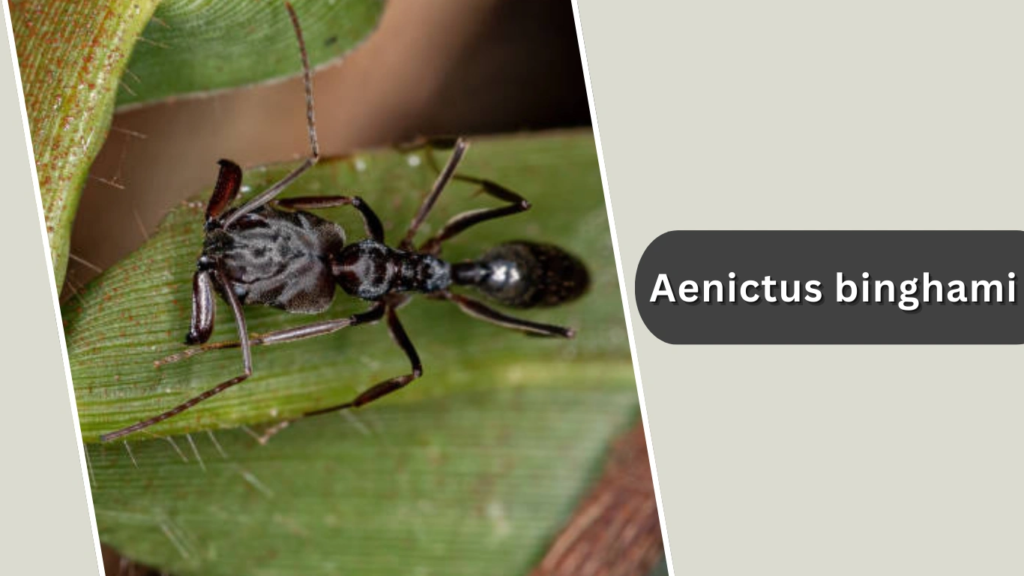
Aenictus binghami is a specialized Asian army ant species recognized for its swift raids and strong predatory focus on other ant colonies. Though less commonly encountered than some Aenictus species, it remains a key insect predator in its native range.
Identification
- Workers are small, slender, and largely monomorphic
- Coloration ranges from light reddish-brown to dark reddish-brown
- No dedicated soldier caste; workers share similar morphology
- Raiding trails are thin, fast-moving, and highly coordinated
- Queens are much larger but remain hidden within the bivouac
Habitat
This species inhabits tropical and subtropical forests, plantations, and woodland areas across Southeast Asia, including Myanmar, Thailand, and nearby regions. Colonies form temporary bivouacs under logs, stones, or leaf litter, relocating frequently as part of their nomadic behavior.
Behaviors
Aenictus binghami performs rapid, targeted raids, often attacking other ant nests to capture brood and workers. These raids are highly organized, with tight foraging lines and strong pheromone communication. The colony cycles between stationary and nomadic phases depending on brood development.
Diet and Lifecycle
This species feeds mainly on ant brood, including larvae and pupae, and occasionally small insects. The lifecycle is synchronized: during the stationary phase, the queen produces a batch of eggs, and during the nomadic phase, the colony moves often to satisfy the feeding needs of growing larvae. Colonies may persist for long periods in favorable environments.
15. Aenictus philippinensis
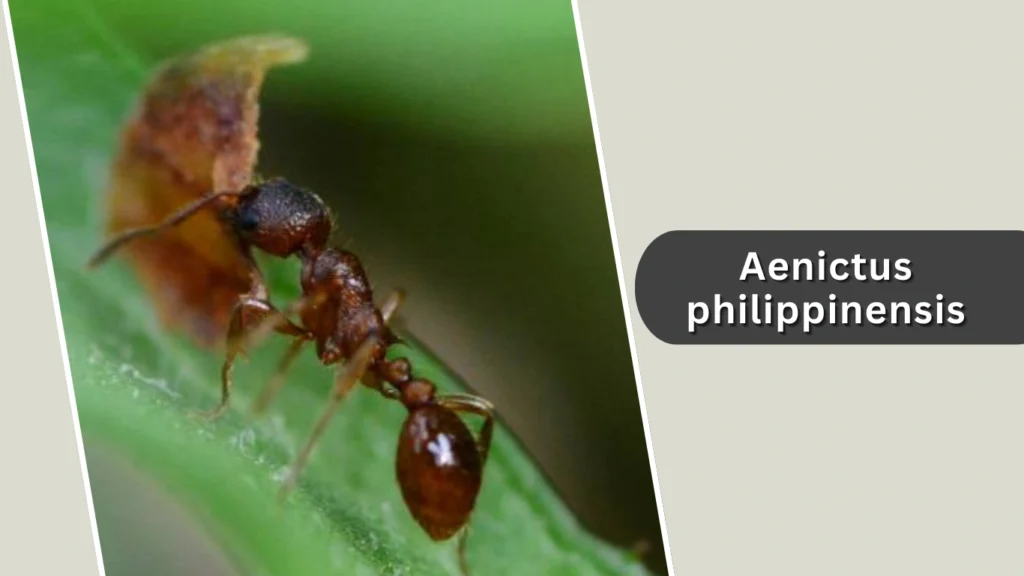
Aenictus philippinensis is a rare and localized army ant species native to the Philippines. Known for its agile raids and preference for preying on other ant species, it remains an important predator in its limited range.
Identification
- Small, slender monomorphic workers typical of the Aenictus genus
- Reddish to reddish-brown body coloration
- No true soldier caste; workers share similar morphology
- Raiding columns are narrow, fast, and highly coordinated
- Queens are larger but remain concealed within the bivouac
Habitat
This species is found in tropical rainforests, secondary forests, and moist woodland environments across the Philippines. Colonies create temporary bivouacs beneath logs, leaf litter, or shallow soil tunnels. They frequently relocate as part of their nomadic cycle.
Behaviors
Aenictus philippinensis engages in high-speed raids, often targeting other ant colonies for brood and workers. Their raiding trails are sharply defined and densely packed, allowing efficient collection of prey. Like all army ants, they alternate between nomadic and stationary phases.
Diet and Lifecycle
Its diet consists primarily of ant larvae, pupae, and small insects captured during raids. The lifecycle is synchronized: the queen lays eggs during the stationary phase, and once larvae hatch and require more food, the colony shifts to the nomadic phase. Colonies may persist for years under stable environmental conditions.
16. Neivamyrmex nigrescens
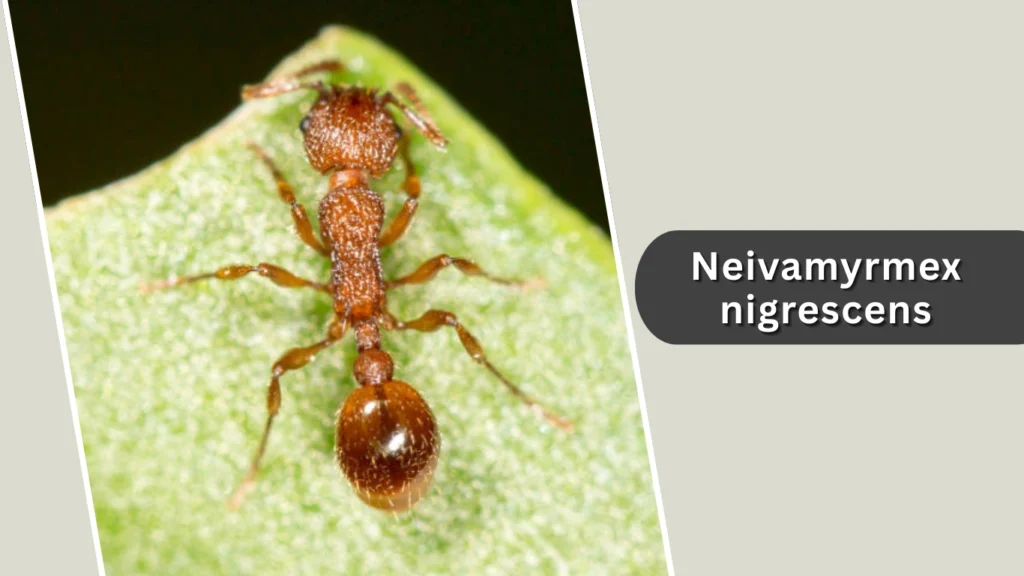
Neivamyrmex nigrescens is the most widespread army ant species in North America. Known for its nocturnal raids and preference for preying on other ants, it is one of the few army ants adapted to temperate environments.
Identification
- Small, slender workers with minor size variation
- No distinct soldier caste; workers are monomorphic
- Dark brown to black coloration
- Raiding lines are narrow and usually active at night
- Queens are larger but remain hidden within the bivouac
Habitat
This species inhabits grasslands, deserts, woodlands, and temperate forests across the United States, Mexico, and Central America. Colonies form temporary bivouacs in soil cavities, under rocks, or beneath logs. They relocate frequently as part of their nomadic cycle, especially during periods of intense foraging.
Behaviors
Neivamyrmex nigrescens is known for its nocturnal raids, which help reduce predation and heat exposure in open habitats. Raids primarily target other ant colonies, especially brood. Workers travel in thin, fast-moving lines, and colony movements synchronize with brood development.
Diet and Lifecycle
This species specializes in consuming ant brood, including larvae, pupae, and workers. Their lifecycle alternates between stationary phases—when the queen lays eggs—and nomadic phases, when the colony moves daily to secure enough food for growing larvae. Colonies may persist for several years in stable environments.
17. Neivamyrmex texanus
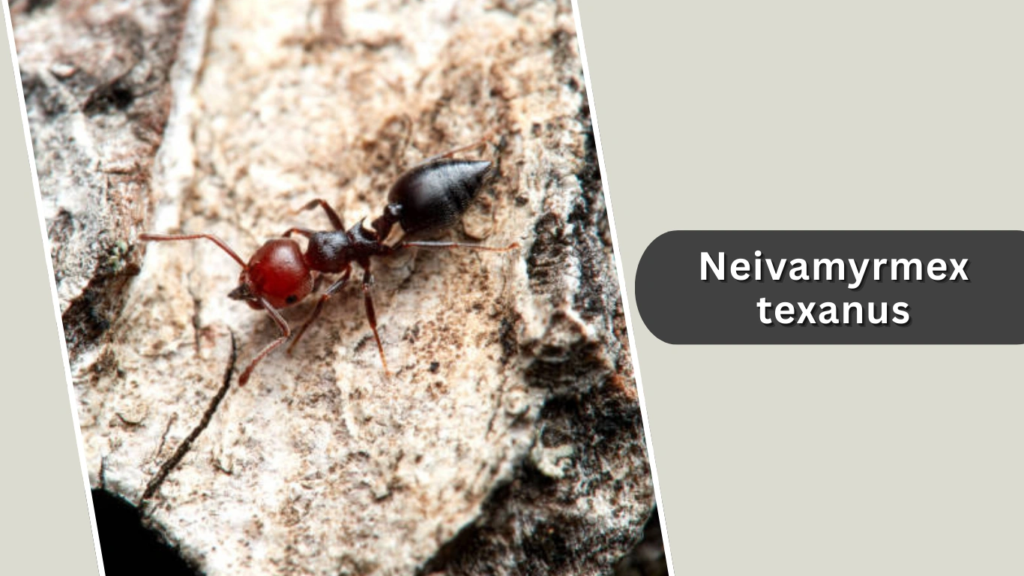
Neivamyrmex texanus is a North American army ant species known for its nomadic lifestyle and specialized predation on other ant colonies. It is commonly found in warm, open habitats where its fast-moving raids are frequently observed.
Identification
- Small, slender monomorphic workers with slight size variation
- No true soldier caste
- Typically reddish-brown to dark brown
- Raiding trails are narrow, quick, and highly organized
- Queens are larger but remain hidden within the bivouac
Habitat
This species inhabits grasslands, scrublands, deserts, and open woodlands across the southern United States and northern Mexico. Colonies form temporary bivouacs under rocks, logs, or within shallow soil cavities. They relocate frequently as part of their nomadic existence.
Behaviors
Neivamyrmex texanus conducts rapid raids primarily targeting other ants. These raids often occur during cooler hours, especially at dusk or at night. Workers form highly coordinated columns, and colony movement synchronizes with brood development, alternating between nomadic and stationary phases.
Diet and Lifecycle
This species feeds mainly on ant brood and workers, though it may also take small insects encountered during raids. The queen lays eggs during the stationary phase, and once larvae hatch and require more food, the colony transitions to the nomadic phase. Colonies can last for years in favorable conditions.
18. Neivamyrmex sumichrasti
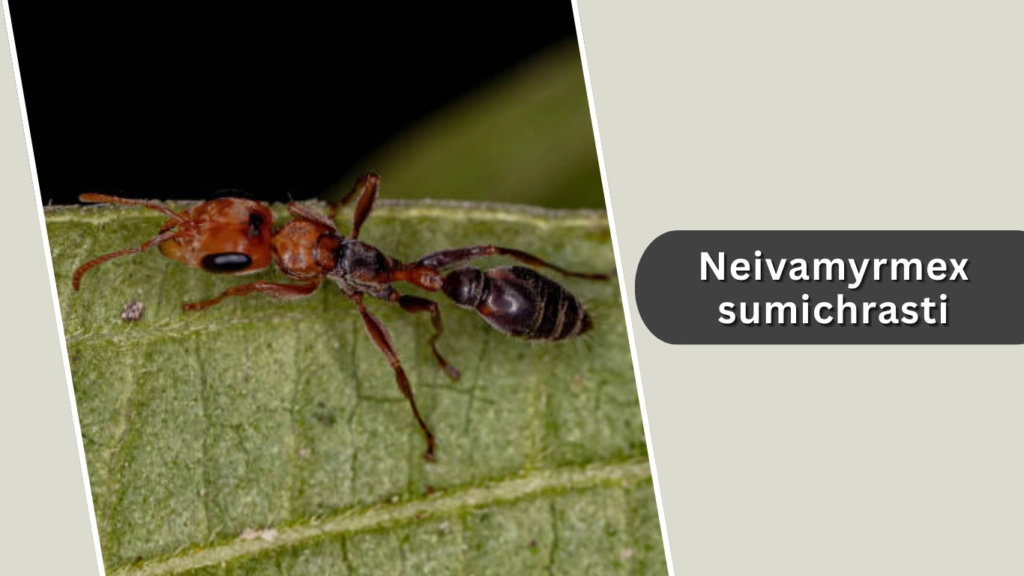
Neivamyrmex sumichrasti is a Neotropical army ant species known for its secretive lifestyle and specialized predation on other ants. It is most frequently encountered in leaf litter and soil habitats.
Identification
- Small, slender, monomorphic workers with subtle size variation
- Typically reddish-brown to dark brown in coloration
- No true soldier caste, characteristic of the genus
- Raiding trails are narrow and often hidden under leaf litter
- Queens are larger but stay concealed within the bivouac
Habitat
This species inhabits tropical forests, cloud forests, and moist woodland environments across Central America. Colonies form temporary bivouacs under logs, inside soil cavities, or beneath thick leaf litter. Movements occur frequently during their nomadic phase.
Behaviors
Neivamyrmex sumichrasti conducts stealthy raids, often hidden below the forest litter layer. They primarily target other ant colonies, collecting brood and workers. Raids are highly coordinated, with workers moving quickly through narrow, concealed trails.
Diet and Lifecycle
The species specializes in feeding on ant brood, along with occasional small insects. Colonies alternate between stationary phases—when the queen lays synchronized batches of eggs—and nomadic phases, when they move daily to meet the food demands of growing larvae. Colonies remain smaller than many tropical army ants but are stable and persistent.
19. Neivamyrmex minor
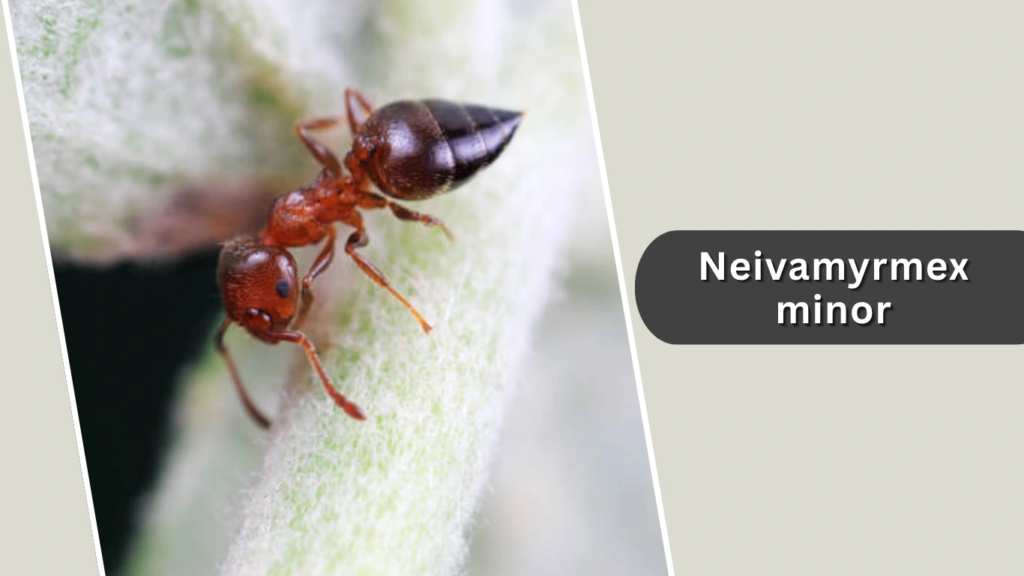
Neivamyrmex minor is a small and elusive army ant species found in Central and South America. Known for its discreet raiding behavior and highly specialized diet, it is most active within leaf litter and low vegetation layers.
Identification
- Small, slender monomorphic workers with slight size variation
- Reddish-brown to dark brown coloration
- No distinct soldier caste, typical of the genus
- Raiding trails are thin, fast, and often hidden beneath debris
- Queens are larger but remain within the bivouac
Habitat
This species inhabits tropical forests, cloud forests, and humid lowland regions, preferring dense leaf litter and shaded ground layers. Colonies form temporary bivouacs under logs, inside shallow soil cavities, or beneath thick organic debris. They relocate frequently as part of their nomadic cycle.
Behaviors
Neivamyrmex minor performs quiet, low-profile raids, primarily targeting other ants. Unlike some species that conduct large swarm raids, this species moves in narrow, stealthy columns that blend into the forest floor. Colony activity follows the typical army ant cycle of stationary and nomadic phases.
Diet and Lifecycle
The species focuses almost exclusively on ant brood, though it may occasionally take small invertebrates. Queens lay synchronized batches of eggs during the stationary phase. Once larvae hatch and food requirements increase, the colony becomes nomadic, moving daily to find prey. Colonies remain relatively small but are long-lived in stable environments.
20. Neivamyrmex macrodentatus
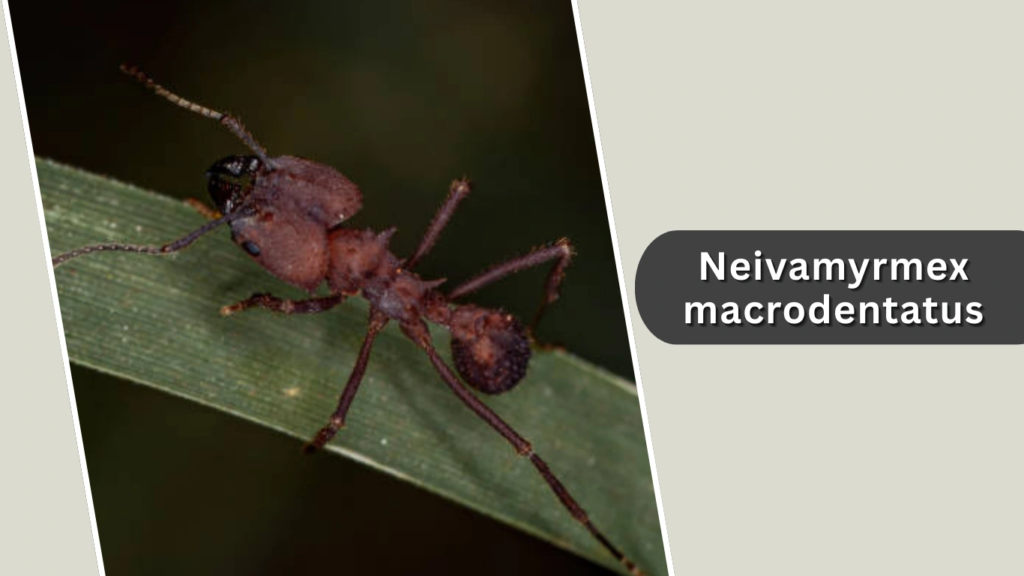
Neivamyrmex macrodentatus is a predatory army ant species native to Mexico and Central America. Known for its discreet hunting style and specialization on other ants, it is an important regulator of ant populations in its habitat.
Identification
- Small, slender, monomorphic workers with minor size variation
- Reddish-brown to dark brown coloration
- No true soldier caste
- Raiding trails are narrow, fast-moving, and often hidden in leaf litter
- Queens are larger but remain deep within the bivouac
Habitat
This species inhabits tropical forests, semi-evergreen woodlands, and humid lowland regions. Colonies form temporary bivouacs in shallow soil chambers, beneath logs, or under dense leaf litter. They relocate frequently during their nomadic phase as they track prey availability.
Behaviors
Neivamyrmex macrodentatus conducts stealthy, efficient raids mainly targeting other ant species. Workers move quickly through tight foraging lines, often concealed beneath debris. Raids occur both day and night, depending on environmental conditions. Colony movement follows the well-known nomadic–stationary cycle of army ants.
Diet and Lifecycle
The species specializes in collecting ant brood and workers, although small insects may also be taken. During the stationary phase, the queen lays a synchronized batch of eggs. As larvae grow and demand more food, the colony becomes nomadic. Colonies remain moderate in size but stable over long periods.
21. Labidus praedator

Labidus praedator is a prominent New World army ant species known for its large swarm raids and significant ecological influence in tropical forests. It is one of the most visible army ants in Central and South America.
Identification
- Workers range widely in size, with some larger workers approaching a pseudo-soldier role
- Typically dark brown to black
- Raiding swarms form wide, flowing fronts across the forest floor
- Trails are highly organized and heavily trafficked
- Queens are large but remain hidden within the bivouac
Habitat
This species inhabits tropical rainforests, cloud forests, and moist woodlands throughout Central and South America. Colonies form temporary bivouacs in soil cavities, under logs, or beneath leaf litter. They move frequently during nomadic phases to locate new prey-rich areas.
Behaviors
Labidus praedator conducts massive swarm raids, sweeping across the forest floor and capturing insects, spiders, and other small animals. Workers communicate through chemical trails and operate with exceptional coordination. Colony cycles alternate between stationary (brood-rearing) and nomadic (foraging-intensive) phases.
Diet and Lifecycle
These ants feed on live prey, including many insect species, larvae, and occasionally small vertebrates. Queens lay large batches of eggs during the stationary phase. When larvae hatch and require more food, the colony transitions to a nomadic phase, moving frequently. Colonies can contain hundreds of thousands of ants and persist for many years.
22. Labidus coecus
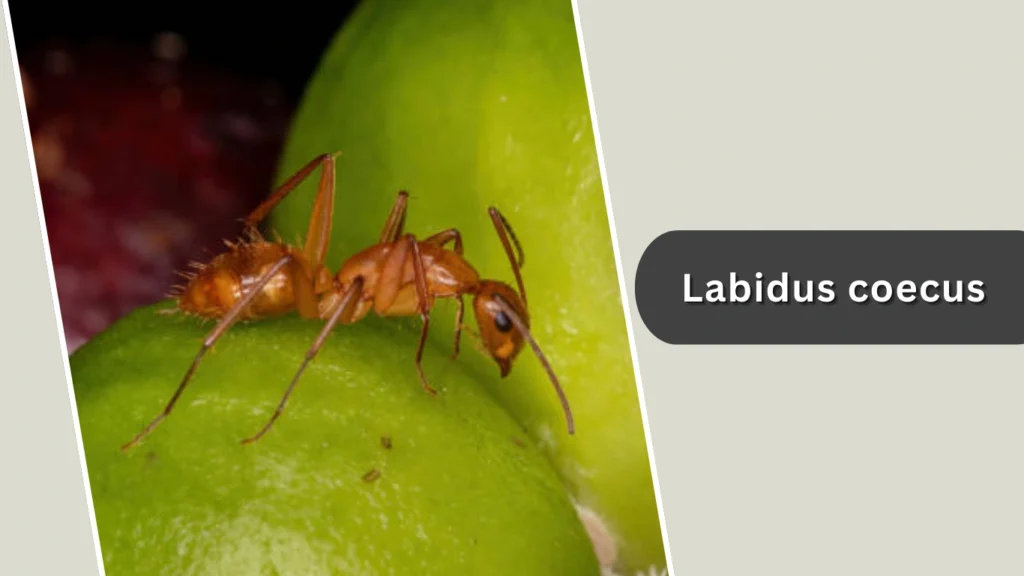
Labidus coecus is a widespread New World army ant species known for its mostly underground activity and stealthy foraging behavior. Though less visible than many army ants, it plays a major role in soil ecosystems.
Identification
- Workers are small, slender, and monomorphic
- Typically pale brown to dark brown in color
- No true soldier caste
- Foraging lines are usually hidden underground or beneath leaf litter
- Queens are larger and remain protected within the bivouac
Habitat
This species inhabits tropical rainforests, cloud forests, and moist, shaded environments throughout Central and South America. Colonies form temporary subterranean bivouacs, often in soil chambers or beneath rotting logs. Their movements follow typical nomadic and stationary cycles.
Behaviors
Labidus coecus conducts subterranean raids, navigating through soil and leaf litter to capture prey. Above-ground activity is limited, making this species challenging to observe. Raiding columns are narrow, swift, and tightly organized. Colony relocation occurs frequently during the nomadic phase.
Diet and Lifecycle
This species feeds primarily on soil-dwelling arthropods, including insects, larvae, and worms. Their lifecycle mirrors other army ants: queens lay synchronized batches of eggs during the stationary phase, and the colony becomes nomadic once larvae need increased food. Colonies can persist for long periods in stable habitats.
23. Centromyrmex feae

Centromyrmex feae is a unique army ant species known for its specialized lifestyle deep within soil and rotting wood. Unlike many army ants, it often preys on termites, making it an important predator in subterranean ecosystems.
Identification
- Workers are robust, with thick bodies compared to other army ants
- Typically dark brown to reddish-brown
- Monomorphic workers with slight size variation
- Raiding activity often occurs inside soil tunnels rather than open ground
- Queens are larger but rarely encountered
Habitat
This species inhabits tropical forests, moist woodlands, and decaying wood environments across Africa and parts of Asia. Colonies form underground or wood-based bivouacs, often inside rotting logs or deep soil chambers. They relocate as needed based on termite availability and brood cycles.
Behaviors
Centromyrmex feae conducts subterranean raids, targeting termite colonies and other soil-dwelling arthropods. Workers move through narrow tunnels, exhibiting coordinated, focused raiding behavior. Though not as visibly dramatic as swarm-raiding species, their hunting is highly specialized and efficient.
Diet and Lifecycle
This species primarily feeds on termites, especially their brood, but may also consume other soil insects. Colonies alternate between stationary phases, when the queen lays eggs, and nomadic phases, when workers relocate frequently. Colonies tend to be smaller than those of Dorylus or Eciton but remain stable in rich habitats.
24. Cheliomyrmex andicola
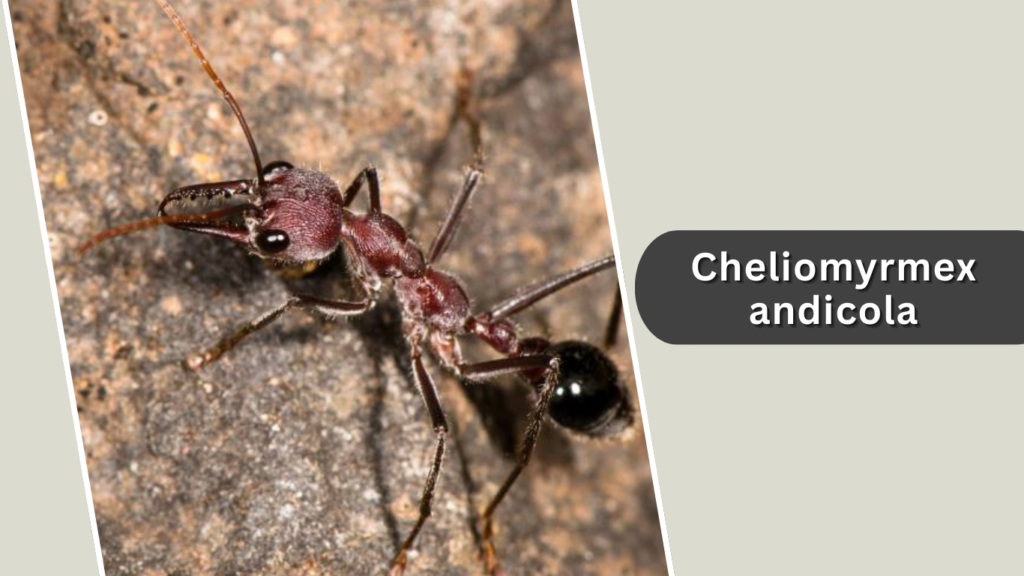
Cheliomyrmex andicola is a rare and distinctive New World army ant species, sometimes called the “rapacious ant.” Known for its powerful mandibles and aggressive predatory behavior, it is one of the most unusual members of the army ant lineage.
Identification
- Workers are larger and more robust than many other army ant species
- Soldiers possess extremely powerful, elongated mandibles
- Body coloration is typically dark brown to nearly black
- Raiding activity is intense, with compact hunting columns
- Queens are large and remain protected within the bivouac
Habitat
This species inhabits montane forests, cloud forests, and high-altitude tropical regions in Central and South America, particularly the Andes. Colonies form temporary bivouacs in soil cavities, under rocks, or within rotting wood. Their movements are less frequent but highly strategic.
Behaviors
Cheliomyrmex andicola conducts highly aggressive raids targeting a broad range of prey. Their hunting columns remain dense and focused, and soldiers use their powerful mandibles to subdue larger or heavily armored prey. Colony cycles include nomadic and stationary phases like other army ants.
Diet and Lifecycle
This species feeds on varied arthropod prey, including insects, larvae, and occasionally other ants. Their lifecycle is synchronized: queens lay eggs during the stationary phase, and nomadic activity increases as larvae require more food. Colonies are relatively small but extremely efficient predators.
25. Nomamyrmex esenbeckii
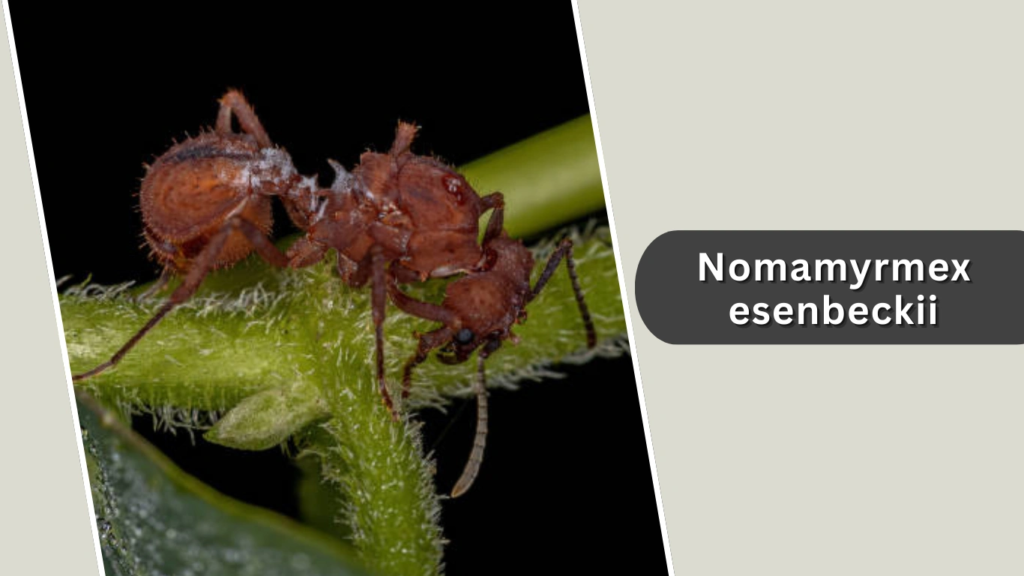
Nomamyrmex esenbeckii is one of the most powerful New World army ants, famous for its ability to raid and overpower large leafcutter ant colonies. It is a dominant predator in Neotropical ecosystems.
Identification
- Workers show notable size variation, with large-headed pseudo-soldier forms
- Typically dark brown to black in coloration
- Raiding trails are aggressive, fast-moving, and highly structured
- Workers are robust and capable of attacking heavily defended prey
- Queens are large and remain deep within the bivouac
Habitat
This species inhabits tropical rainforests, dry forests, and moist woodland regions across Central and South America. Colonies form temporary bivouacs underground, beneath logs, or within sheltered soil cavities. They relocate often, depending on prey availability and brood development.
Behaviors
Nomamyrmex esenbeckii conducts intense, targeted raids, especially on leafcutter ant nests (Atta and Acromyrmex). Few army ants can successfully attack these large colonies, but N. esenbeckii is specially adapted for such predation. Raids are highly coordinated, and workers operate with remarkable speed and precision.
Diet and Lifecycle
This species feeds on ant brood, workers, and other arthropods, with a strong specialization on leafcutter ants. Colonies alternate between stationary phases—when the queen lays eggs—and nomadic phases synchronized with larval development. Colonies may survive for many years and can grow quite large.
FAQs
1. What makes army ants different from other ants?
Army ants are unique because they do not build permanent nests. Instead, they form temporary bivouacs made of their own bodies. They also engage in swarm or column raids, hunting live prey in coordinated masses. Their colonies cycle between nomadic and stationary phases, synchronized with brood development.
2. Do army ants eat leaves or plants?
No. Unlike leafcutter ants, army ants are strict predators. They feed on live prey such as insects, spiders, larvae, and even other ants. Some species also take small vertebrates. Their diet depends on rapid, coordinated raids that capture large quantities of food.
3. How large can an army ant colony become?
Some army ant colonies, especially in the genera Dorylus and Eciton, can reach hundreds of thousands to over 20 million individuals. These massive colonies require constant hunting to sustain themselves, which is why army ants are almost always on the move.
4. Why do army ants migrate so often?
Army ants migrate due to their brood cycle. During the stationary phase, queens lay eggs and colonies remain in one location. When larvae hatch and require large amounts of food, the colony becomes nomadic, moving daily to find fresh prey. This cycle is essential for colony survival.
5. Are army ants dangerous to humans or pets?
Army ants rarely attack humans unless provoked or stepped on. However, the soldiers’ strong mandibles can deliver painful bites. Swarms can overwhelm small or immobile animals, but pets and humans can easily avoid them. They are generally more dangerous to insects and small vertebrates than to people.
