
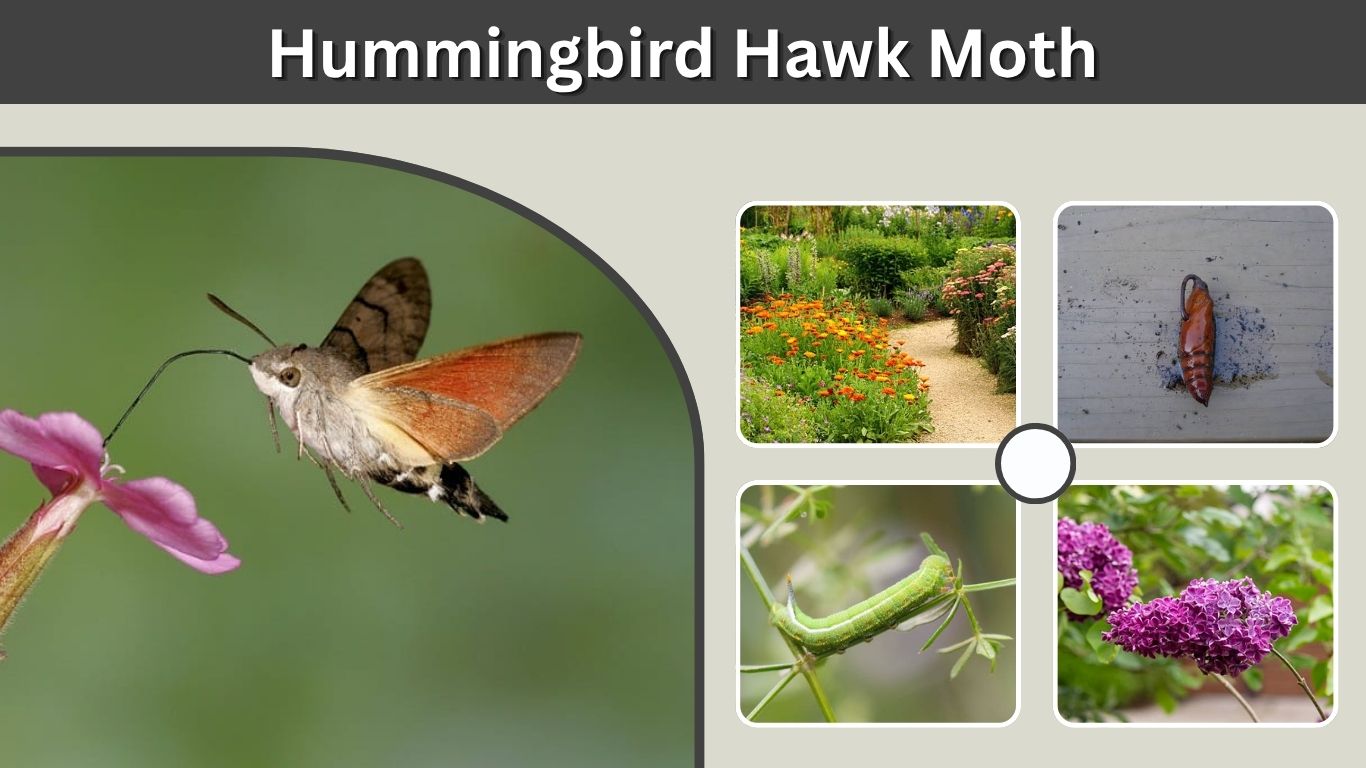
The hummingbird hawk moth (Macroglossum stellatarum) is one of the most remarkable day-flying moths, famous for hovering in front of flowers like a tiny hummingbird. Its rapid wings, long proboscis, orange hindwings, and quick movements make it easy to mistake for a bird at first glance. Found mainly across Europe, Africa, and Asia, this hawk moth visits gardens, meadows, and other flower-rich habitats. Below, you’ll learn about its size, caterpillar, diet, habitat, life cycle, distribution, behavior, and whether it can bite or sting.
What Does a Hummingbird Hawk Moth Look Like?
The hummingbird hawk moth has a compact, streamlined body built for fast, controlled flight. Its gray-brown forewings look relatively plain when resting, but its bright orange hindwings become obvious in flight. Black-and-white markings near the end of the abdomen and a fan-like tail further contribute to its hummingbird-like appearance.
Hummingbird Hawk Moth Identification
Key characteristics include:
- Scientific name: Macroglossum stellatarum
- Family: Sphingidae
- Grayish-brown head, thorax, and forewings
- Bright orange hindwings
- Black-and-white markings near the abdomen
- Thick, furry-looking body
- Long nectar-feeding proboscis
- Fast daytime flight
- Ability to hover in front of flowers
Its hovering behavior is often the easiest identification clue. Unlike many moths that land while feeding, this species can remain suspended in the air while extending its proboscis into a flower.
Hummingbird Hawk Moth Size
Despite looking surprisingly large when it flies past, the hummingbird hawk moth is much smaller than an actual hummingbird. The fast movement of its wings and thick body can make it appear larger than it really is, especially when it hovers close to flowers.
How Big Is a Hummingbird Hawk Moth?
Adults generally have a wingspan of about 40–50 mm, or roughly 1.6–2 inches, although measurements can vary somewhat among individuals.
Its relatively small size does not prevent it from being an impressive flier. The streamlined body, powerful wings, and ability to hover allow it to move quickly from flower to flower while remaining remarkably precise in flight.
Hummingbird Hawk Moth Caterpillar
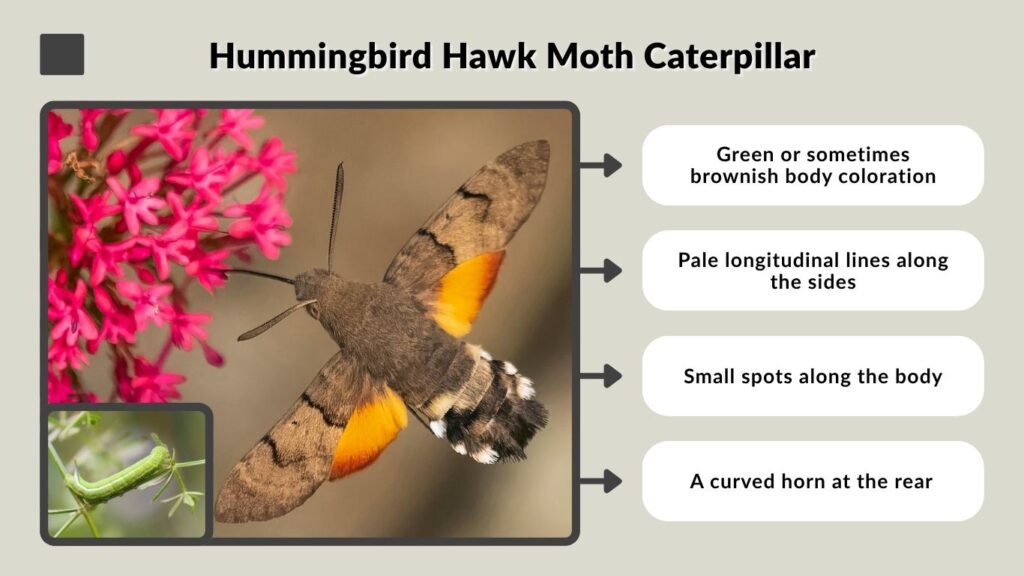
The hummingbird hawk moth caterpillar looks very different from the adult. Young larvae are small, but mature caterpillars become elongated and are usually green, although color can vary. Like many hawk moth caterpillars, they have a noticeable horn-like projection at the rear of the body.
Caterpillar Identification and Host Plants
Look for:
- Green or sometimes brownish body coloration
- Pale longitudinal lines along the sides
- Small spots along the body
- A curved horn at the rear
- A smooth, elongated hawk moth caterpillar shape
Bedstraws (Galium species) are among the principal host plants. Wild madder and other related plants may also be used.
The caterpillar feeds on the host plant’s leaves before eventually moving toward ground level to pupate.
Habitat and Distribution
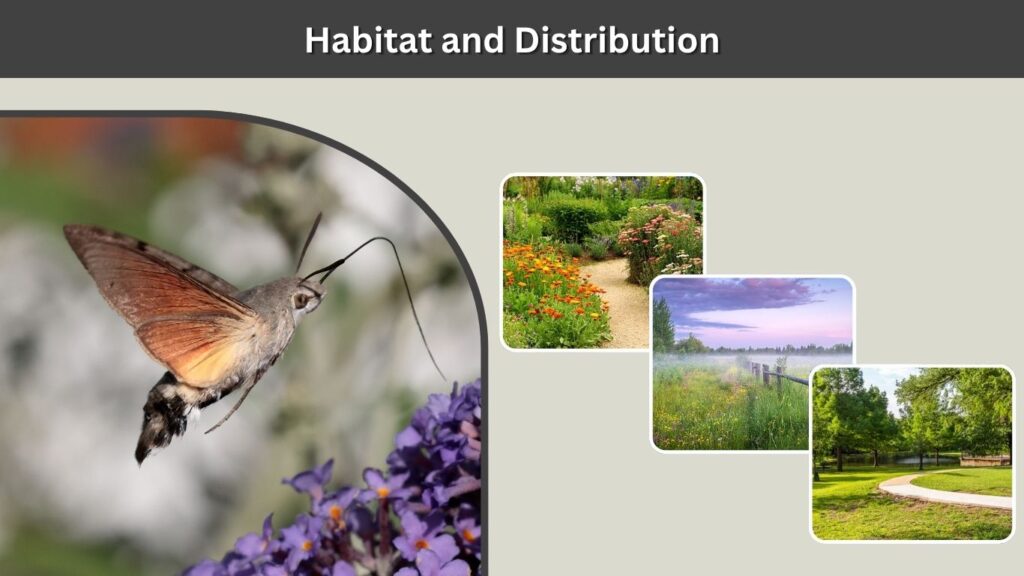
Hummingbird hawk moths prefer places with abundant flowers where adults can find enough nectar to support their energy-intensive flight. Gardens can be particularly attractive because flowering plants often provide concentrated and dependable food sources.
Where Do Hummingbird Hawk Moths Live?
Typical habitats include:
- Flower gardens
- Meadows
- Grasslands
- Woodland openings
- Coastal habitats
- Parks
- Farmland
- Urban green spaces
The true Macroglossum stellatarum has a broad Old World range covering Europe, parts of Africa, and Asia. It is also strongly migratory and can travel considerable distances.
In the UK, hummingbird hawk moths were historically well known as migrants, but warmer conditions have contributed to more frequent sightings and breeding. They are particularly noticeable in gardens during warmer months.
Hummingbird Hawk Moths in Texas, Ohio, and Other U.S. States
Searches for hummingbird hawk moths in Texas, Ohio, Colorado, Michigan, California, Florida, and other U.S. states are common. However, identification requires some caution.
Are Hummingbird Hawk Moths Found in North America?
The exact species Macroglossum stellatarum is not an established common North American moth. It is considered a rare vagrant there, with only exceptional records.
Many American insects described as “hummingbird moths” are actually related hawk moths, particularly species of Hemaris. For example, the hummingbird clearwing (Hemaris thysbe) occurs widely across eastern portions of the United States and Canada.
Therefore, a hovering moth spotted in Ohio, Michigan, Texas, Colorado, or another U.S. state should not automatically be identified as Macroglossum stellatarum. Clearwing moths and other sphinx moths can produce very similar hummingbird-like behavior.
What Does a Hummingbird Hawk Moth Eat?
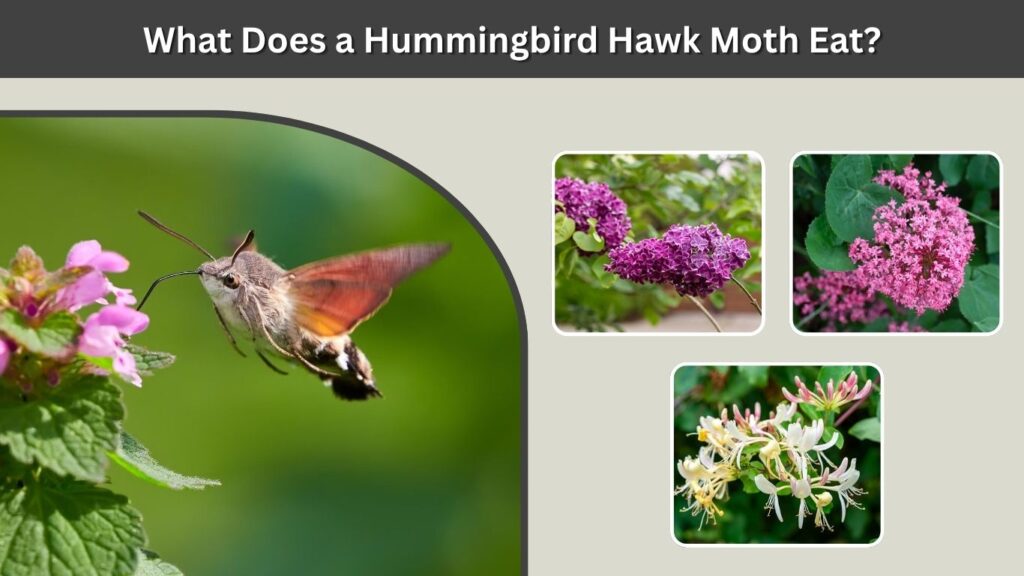
Adult hummingbird hawk moths need energy-rich nectar to support their extremely active flight. Their exceptionally long proboscis allows them to reach nectar hidden deep inside tubular flowers while hovering nearby.
Favorite Flowers and Diet
Adults commonly visit nectar-rich flowers such as:
- Buddleia
- Red valerian
- Honeysuckle
- Viper’s bugloss
- Aubrieta
- Salvia
- Other tubular, nectar-rich garden flowers
The Natural History Museum notes several of these plants among flowers regularly visited by the species.
Their flower-visiting behavior can also contribute to pollination as pollen is transferred while they move between blossoms.
Hummingbird Hawk Moth Life Cycle
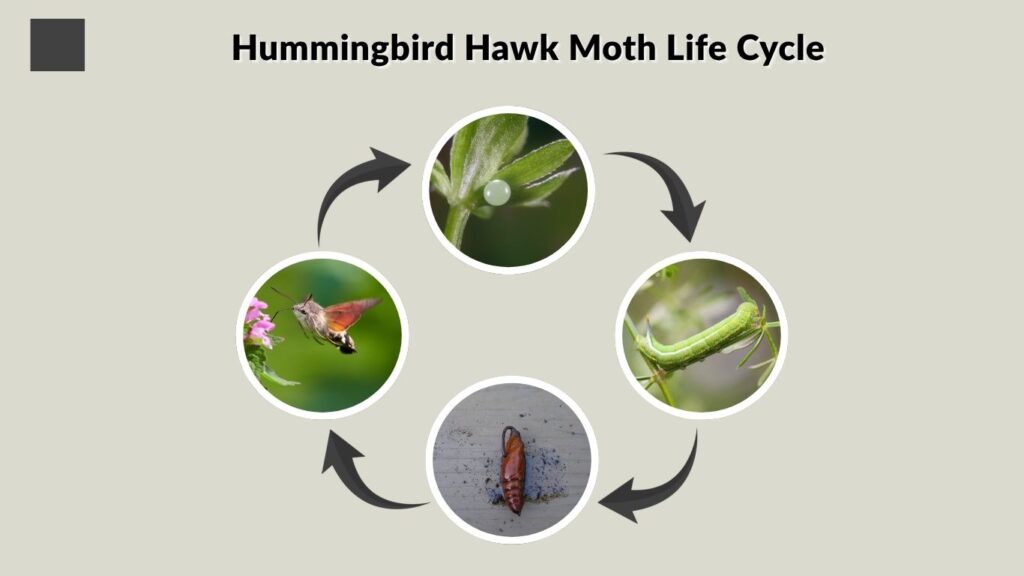
Like other moths, the hummingbird hawk moth passes through four major developmental stages: egg, caterpillar, pupa, and adult. Temperature, location, and season influence how quickly the stages progress and how many generations can develop.
From Egg to Adult Moth
Females place eggs individually on suitable larval host plants. Once hatched, the caterpillars spend their growing period feeding on vegetation such as bedstraw.
After becoming fully grown, the caterpillar moves downward and forms a relatively loose cocoon near the ground, among vegetation or leaf litter. Inside it, the insect changes into a pupa before emerging as an adult.
In suitable climates, more than one generation may occur during a warm season. Adults can also survive cooler periods under favorable conditions, so there is no single exact lifespan that applies to every hummingbird hawk moth.
Why Does It Fly Like a Hummingbird?
The moth’s name comes primarily from its extraordinary feeding behavior. Instead of settling onto each flower, it often stops in midair and holds its position with rapid wingbeats while drinking nectar.
Interesting Hummingbird Hawk Moth Facts
- It is active mainly during daylight.
- It can hover while feeding.
- Its long proboscis reaches deeply into tubular flowers.
- Orange hindwings become especially noticeable during flight.
- Its wings can appear blurred because they move so rapidly.
- It often flies quickly between flowers before suddenly stopping to hover.
- It belongs to the hawk moth family, Sphingidae.
- Its resemblance to a hummingbird is behavioral as well as visual.
Despite the similarity, a hummingbird hawk moth is entirely an insect and is not related to hummingbirds.
Does a Hummingbird Hawk Moth Bite or Sting?
Its large body and fast flight can look intimidating when the moth approaches closely, particularly if someone has never encountered one before. However, it poses essentially no threat to people.
Is the Hummingbird Hawk Moth Dangerous?
Hummingbird hawk moths do not have a defensive sting and are not aggressive toward humans. Their long proboscis is a feeding tube used to drink nectar rather than a stinger.
The caterpillar’s rear “horn” may also look threatening, but it is not a stinger. These moths are best regarded as harmless garden visitors and useful flower-visiting insects.
How to Attract Hummingbird Hawk Moths
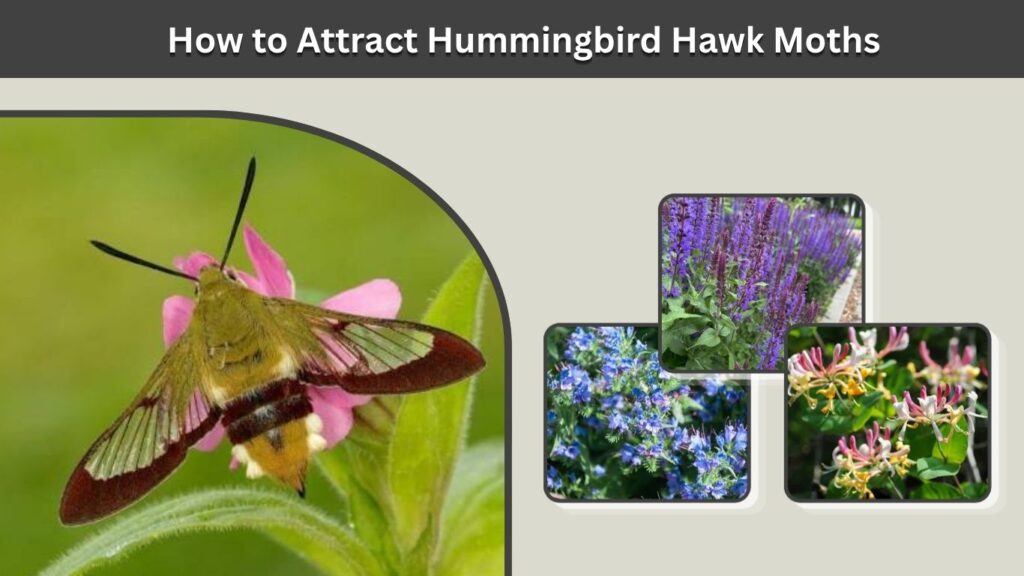
A flower-rich garden can increase the chances of attracting adults, particularly where the species naturally occurs. Providing nectar over a long flowering season gives these energetic moths more opportunities to feed.
Making Your Garden More Attractive
Try providing:
- Buddleia
- Red valerian
- Honeysuckle
- Salvia
- Viper’s bugloss
- Other nectar-rich tubular flowers
- Bedstraw or suitable caterpillar host plants
- Sunny, sheltered feeding areas
Avoiding unnecessary insecticide use can also help maintain a garden where moths and other pollinating insects can feed and reproduce.
FAQs
Is a hummingbird hawk moth rare?
Its abundance depends strongly on location and year. It can be common in parts of Europe and other areas within its established range, while sightings farther outside that range are unusual.
Is a hummingbird hawk moth the same as a hummingbird moth?
Not always. “Hummingbird moth” is a broad common name applied to several hovering hawk moths. Macroglossum stellatarum is the hummingbird hawk moth, while North American hummingbird moths commonly belong to the genus Hemaris.
Are green hummingbird hawk moths adults?
Usually, searches for a “green hummingbird hawk moth” may refer to its green caterpillar or to another hummingbird-like moth. Adult Macroglossum stellatarum is primarily gray-brown with orange hindwings.
How long is a hummingbird hawk moth’s proboscis?
The proboscis is notably long relative to the moth’s body and allows it to reach nectar without landing. The moth keeps it curled when not feeding and extends it toward flowers during hovering flight.
Why is the hummingbird hawk moth special?
Its combination of daytime activity, extremely agile flight, hovering ability, long proboscis, and hummingbird-like appearance makes it one of the most distinctive hawk moths. Watching one move rapidly between flowers can easily give the impression of a tiny bird rather than an insect.
