

Bees are some of nature’s most skilled engineers, and one of their greatest creations is honey. For humans, honey is a sweet treat with nutritional and medicinal value, but for bees, it is vital for survival. The process of making honey is complex, involving teamwork, biology, and remarkable natural design. From collecting nectar to sealing it safely in the hive, every step is carefully orchestrated. In this guide, we’ll explore exactly how bees make honey and why it matters.
Why Do Bees Make Honey?
Bees don’t make honey just to provide sweetness for humans—it is their essential food source. Nectar collected from flowers is transformed into honey, which serves as a long-term energy reserve. During cold months or when flowers are scarce, bees rely on stored honey to survive. Unlike nectar, which spoils quickly, honey’s low water content and natural enzymes make it stable and long-lasting. This evolutionary adaptation ensures that the colony has a reliable supply of nutrition all year round.
The Honey-Making Process: Step-by-Step

The journey from flower nectar to golden honey is a fascinating blend of biology and teamwork. Honey production involves multiple stages, each carried out by different groups of bees within the colony. Here’s how it happens:
1. Collecting Nectar
Worker bees, also called foragers, leave the hive in search of flowers. Using their long straw-like tongues (proboscis), they sip nectar and store it in a special organ called the honey stomach. This stomach is separate from their digestive one, ensuring the nectar remains unaltered until it returns to the hive.
2. Passing Nectar to House Bees
Once a forager returns, she transfers the nectar to a “house bee” through a process called trophallaxis—essentially mouth-to-mouth feeding. During this exchange, enzymes like invertase begin breaking down the nectar’s complex sugars into simpler ones such as glucose and fructose. This transformation makes the substance less likely to ferment.
3. Thickening the Nectar
At this stage, the nectar still contains about 70–80% water. Bees work to reduce this moisture by repeatedly regurgitating and spreading the liquid into thin layers within the comb cells. Other bees fan their wings to circulate air, speeding up evaporation until the liquid thickens into honey.
4. Storing and Sealing Honey
Once the nectar reaches about 18% water content, it officially becomes honey. Bees then store it in the honeycomb’s hexagonal cells. To keep it safe from moisture and contaminants, they cap the cell with a thin layer of beeswax—like sealing a jar.
This multi-step cycle is repeated thousands of times daily, allowing the colony to build a stockpile that sustains them throughout harsh seasons. Honey-making, therefore, is not just chemistry but also a stunning example of cooperative living.
How Do Bees Make Wax and Honeycomb?

Honeycomb is the perfect storage system for honey, and it is crafted entirely by the bees themselves. Worker bees between 12–20 days old develop special wax glands on their abdomen that secrete tiny flakes of wax. These wax scales are collected by other workers, chewed until soft, and then molded into the familiar hexagonal pattern of the comb.
The hexagon is not a random choice—it’s the most efficient geometric shape for storage. Hexagons fit together without gaps, use the least wax, and are strong enough to hold both honey and developing bee larvae. Each cell begins as a circle, but as bees warm the wax and press it together, the walls merge into precise hexagons.
Honeycomb serves multiple purposes: it stores honey, holds pollen, and provides nursery chambers for eggs and larvae. The bees’ ability to produce wax and construct combs demonstrates their remarkable engineering skills, creating a lightweight yet durable structure that can last for years.
How Do Bees Make a Hive?
A hive is more than just a shelter—it is a fully functioning city where thousands of bees live and work together. In the wild, honey bees often choose hollow tree trunks, rock crevices, or sheltered cavities as hive sites. Once a location is selected, the bees begin constructing combs using beeswax, attaching them securely to walls or branches.
Inside the hive, organization is key. The queen bee lays eggs in specially prepared brood cells, while workers build separate sections for storing honey and pollen. Each comb is arranged with precision: brood in the center, pollen around it, and honey stored at the top. This efficient design ensures easy access to food and space for raising young.
The hive’s survival depends on cooperation. Thousands of workers gather nectar, produce wax, and regulate temperature by fanning their wings. Guard bees protect the entrance, while foragers bring resources back. Together, this collective effort transforms the hive into a sustainable, self-sufficient home capable of thriving through changing seasons.
Types of Honey and Variations

Not all honey is the same—its flavor, color, and even properties depend on the flowers from which bees collect nectar. Some types are common worldwide, while others are rare and highly valued.
Manuka Honey
Produced in New Zealand from the nectar of the Manuka tree, this honey is prized for its strong antibacterial and medicinal qualities. It is darker, thicker, and more expensive than typical honey.
Mad Honey
In parts of Turkey and Nepal, bees gather nectar from rhododendron flowers containing grayanotoxins. The result is “mad honey,” which has psychoactive effects and has been used in traditional medicine, though it can be dangerous in high amounts.
Black, Purple, and Red Honeys
Unusual honeys sometimes appear in regions with unique plants or environmental factors. For example, purple honey occurs in the southeastern U.S. and is still a mystery to scientists, while black and red honeys are linked to rare flower sources.
Floral and Seasonal Variations
Common varieties include clover, acacia, wildflower, and buckwheat honey. The type of flowers available in a season influences flavor—light honeys are mild and sweet, while darker honeys are richer and more robust.
These differences make honey not just a food, but a reflection of local ecosystems and plant diversity.
Vulture Bees and Their Unusual “Honey”
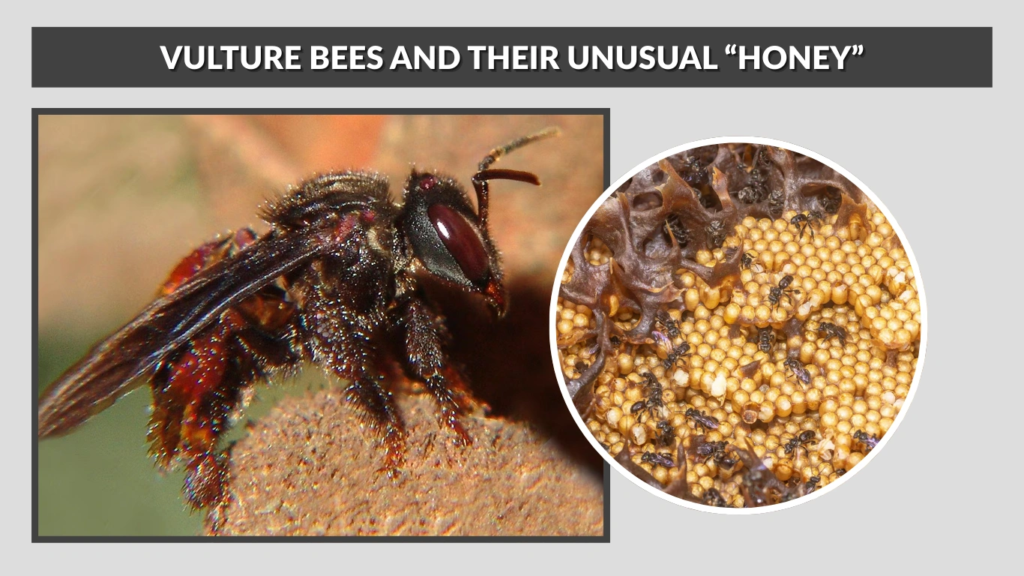
While most bees rely on nectar, vulture bees have evolved a very different—and surprising—diet. Found in Central and South America, these stingless bees feed on carrion instead of flowers. Rather than collecting nectar, they gather flesh from dead animals and bring it back to the hive.
Inside their bodies, special gut microbes help break down the meat into a substance rich in amino acids. This is then regurgitated and stored in comb cells, much like regular honey. The end product is a honey-like paste that nourishes the colony, though it is not sweet and is unsuitable for human consumption.
This adaptation shows how flexible and resourceful bees can be, adjusting to different environments. By producing a meat-based honey substitute, vulture bees demonstrate an extraordinary example of survival beyond the floral world.
Time and Effort in Honey Production
The creation of honey is a time-intensive process that requires the effort of thousands of bees working in harmony. The speed and amount of honey production depend on factors like flower availability, climate, and the size of the colony.
How Long Does It Take Bees to Make Honey?
Turning nectar into honey can take days or even weeks. Once nectar is collected, it must be processed, evaporated, and sealed. During peak flowering seasons, hives work at full capacity, but in colder months, production slows or stops entirely.
How Much Honey Do Bees Make?
An average hive of 20,000–60,000 bees may produce between 30 to 60 pounds (14–27 kg) of honey in a year. However, a single worker bee contributes only about one-twelfth of a teaspoon of honey in her lifetime. To make just one pound of honey, bees must visit about two million flowers and fly more than 50,000 miles collectively.
The Scale of Cooperation
This staggering effort highlights why honey is so precious. No individual bee can create honey alone—it takes the combined work of thousands, each fulfilling a specific role in the cycle.
Honey in Human Context
Honey has been valued by humans for thousands of years, not only as a sweetener but also as a medicine and cultural symbol. Ancient Egyptians used honey in offerings to the gods, embalming practices, and wound healing. In Ayurveda and traditional Chinese medicine, honey has long been prescribed for digestion, immunity, and overall wellness.
In modern times, honey remains popular as a natural sweetener in food and beverages. It is also used in skincare products for its moisturizing and antibacterial qualities. Beyond its practical uses, honey carries symbolic meaning—representing prosperity, health, and even spiritual nourishment in different cultures.
By transforming simple nectar into honey, bees provide a resource that bridges ecosystems and human civilization. Every jar is a product of both nature’s design and the tireless cooperation of bees.
FAQ
Do bees make honey from pollen?
No, bees make honey from nectar, not pollen. Pollen is used mainly as a protein source for young bees, stored as “bee bread” to feed larvae. Nectar is the sugary liquid transformed into honey.
How do bees make honey sweet?
Bees add enzymes to nectar that break down complex sugars into simple ones, mainly glucose and fructose. This process, along with evaporation, gives honey its sweet taste and long-lasting quality.
Do bumblebees make honey?
Bumblebees do produce a small amount of honey-like substance, but only enough to feed their colony. Unlike honey bees, they don’t store large reserves, so humans cannot harvest it in meaningful amounts.
Do scientists fully understand honey-making?
Yes, scientists have studied bee biology and hive behavior extensively. While honey-making is well understood, some mysteries remain—like why certain regions produce rare honeys in unusual colors.
How many bees are needed to make a jar of honey?
It takes thousands of bees working together to produce just one pound of honey. Each bee makes only about a twelfth of a teaspoon in its lifetime, so a jar represents the life’s work of an entire colony.
