

The common sawfly is a general term for several small, wasp-like insects known for their leaf-chewing larvae. These pests are found worldwide and can damage a wide range of trees, shrubs, and crops, including pines, roses, and gooseberries. Although harmless to humans, sawflies can cause serious plant defoliation if left unchecked. Understanding how to identify and manage these insects is essential for maintaining healthy gardens and forests.
What Is a Common Sawfly?

Sawflies belong to the wasp family Tenthredinidae within the order Hymenoptera, which also includes bees and ants. The name “sawfly” comes from the saw-like ovipositor that females use to cut slits into leaves where they deposit eggs.
Unlike true flies, sawflies have two pairs of wings and do not sting. Their larvae, which resemble caterpillars, are the primary cause of damage, feeding heavily on foliage during spring and summer.
Common Names and Classification
- Common name: Sawfly
- Scientific classification:
- Kingdom: Animalia
- Order: Hymenoptera
- Suborder: Symphyta
- Family: Tenthredinidae
- Kingdom: Animalia
- Related species include pine sawflies, gooseberry sawflies, and rose sawflies, all sharing similar feeding behavior.
Identification

Common Sawfly Eggs
Female sawflies lay their eggs along leaf veins or edges. The eggs are small, oval, and slightly translucent, appearing like tiny blisters on the leaf surface. They usually hatch within one to two weeks. Because the eggs are well hidden within the leaf tissue, early infestations often go unnoticed until larvae appear.
Common Sawfly Larvae
Common sawfly larvae are the main feeding stage and closely resemble caterpillars.
- Appearance: Smooth, soft-bodied, and cylindrical with green, yellow, or black coloring.
- Size: Up to 2.5 cm (1 inch) long.
- Legs: More than six pairs of prolegs (caterpillars have five or fewer).
- Feeding habits: They chew through leaf tissue, leaving behind skeletonized or translucent foliage.
They often feed in groups, quickly stripping leaves from branches, especially in young plants.
Common Sawfly Caterpillar vs True Caterpillar
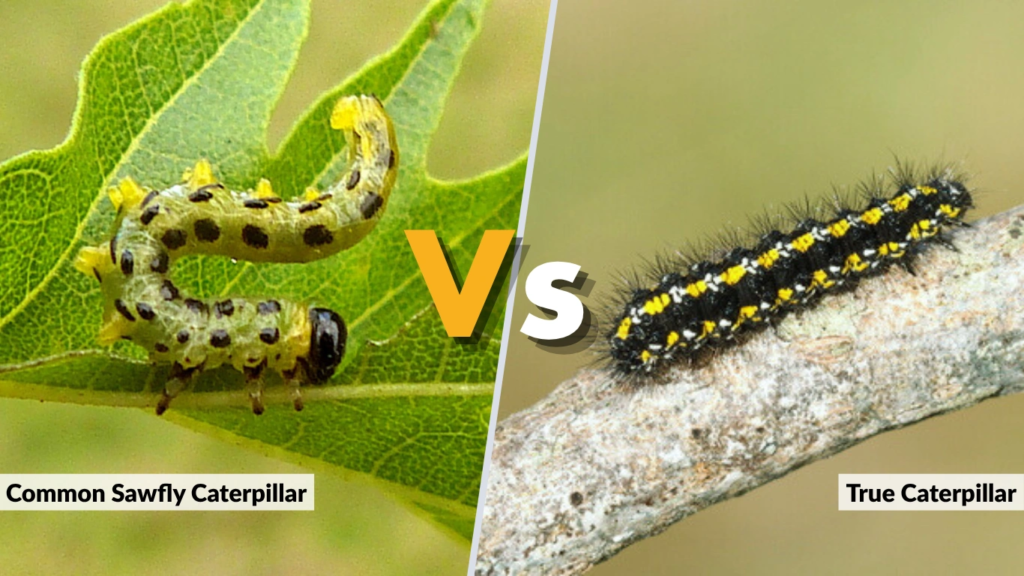
| Feature | Common Sawfly Larva | True Caterpillar |
| Prolegs | 6 or more pairs | 5 or fewer pairs |
| Movement | Smooth crawling | Loops or arches while moving |
| Family | Wasp (Symphyta) | Moth/Butterfly (Lepidoptera) |
| Diet | Skeletonizes leaves | Chews irregular holes |
| Bt Effectiveness | Ineffective | Effective |
Common Sawfly Adult
Adult sawflies resemble small, thick-bodied flies or wasps but do not sting.
- Color: Black, brown, or metallic green.
- Wings: Transparent with visible veins.
- Length: 6–10 mm on average.
- Behavior: Adults are short-lived and focused on reproduction, emerging in spring to lay eggs on host plants.
Common Sawfly Species

Common Pine Sawfly (Diprion pini)
This species primarily infests pine trees.
- Larvae: Green with dark spots and a black head.
- Damage: Feed on pine needles, often defoliating trees from the top down.
- Distribution: Found throughout Europe, North America, and Asia.
- Control: Early pruning, insecticidal soap, or neem oil treatments.
Common Gooseberry Sawfly (Nematus ribesii)
One of the most destructive sawflies affecting gooseberries and currants.
- Larvae: Pale green, feeding in large groups.
- Damage: Can completely defoliate bushes in days, affecting fruit yield.
- Control: Regular monitoring, handpicking, or natural insecticides such as neem oil.
Other Common Species
- Rose Sawfly: Skeletonizes rose leaves in spring.
- Birch Sawfly: Feeds on birch foliage, common in cool regions.
- Redheaded Pine Sawfly: Recognized by its reddish head and yellow body, a serious pest of pine forests.
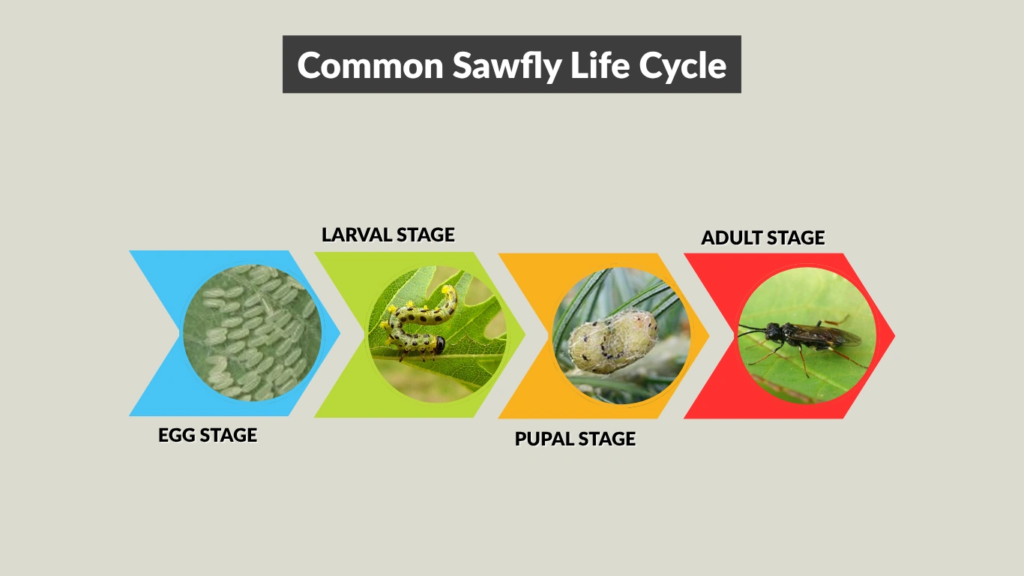
Common Sawfly Life Cycle
Stages of Development
The life cycle of sawflies follows a four-stage process:
- Egg Stage: Eggs laid in leaves during spring or early summer.
- Larval Stage: Larvae feed for two to four weeks, causing visible damage.
- Pupal Stage: Mature larvae drop to the ground to pupate in soil or tree bark.
- Adult Stage: Adults emerge the following year to begin the cycle again.
Seasonal Activity
Most common sawfly species have one or two generations per year depending on climate. In warmer regions, multiple waves may occur from May through August, while cooler climates typically see a single infestation period during summer.
Habitat and Behavior
Common sawflies thrive in temperate and forested regions across the world. They prefer deciduous and coniferous trees as host plants but also attack ornamental shrubs and garden crops. You can often find them in gardens, woodlands, orchards, and nurseries where foliage is abundant.
The larvae feed mostly during the daytime, often in clusters. This group feeding behavior allows them to defoliate plants quickly. Once fully grown, they drop to the soil to pupate, forming small cocoons among leaf litter or beneath the surface. Adults emerge in spring or early summer, repeating the cycle.
Because sawflies overwinter as pupae, garden debris and fallen leaves are key hiding places. Maintaining a clean garden is one of the best ways to disrupt their habitat and reduce infestations.
Control and Treatment

Manual and Physical Control
Manual removal is the easiest and safest way to control small infestations. Inspect plants regularly in spring and summer, especially the undersides of leaves where larvae gather.
- Handpick larvae and crush or drop them into soapy water.
- Prune infested branches and destroy them to prevent larvae from maturing.
- Rake and discard fallen leaves in autumn to eliminate overwintering cocoons.
- High-pressure water spray can also knock larvae off foliage on larger trees.
Regular inspection and early action can prevent sawflies from spreading to nearby plants.
Natural and Organic Control
Organic methods are effective for home gardens and environmentally friendly.
- Neem oil: Interferes with the larvae’s feeding and development. Spray both leaf surfaces every 7–10 days during infestations.
- Insecticidal soap: Works best on young larvae; reapply after rain or irrigation.
- Diatomaceous earth: Dust on leaves and soil to deter larvae and reduce feeding.
- Encourage predators: Birds, ladybugs, and parasitic wasps naturally reduce sawfly populations. Plant nectar-rich flowers such as marigolds and yarrow to attract these allies.
Avoid broad-spectrum pesticides that could harm beneficial insects.
Chemical Control
For severe infestations, chemical insecticides may be necessary. Choose products labeled specifically for sawfly larvae, as standard caterpillar insecticides like Bt (Bacillus thuringiensis) are ineffective.
Effective active ingredients include:
- Spinosad – organic-derived and safe for most beneficial insects.
- Pyrethrin or Permethrin – fast-acting contact insecticides.
- Carbaryl (Sevin) – powerful but should be used sparingly.
Apply insecticides when larvae are small and actively feeding. Thoroughly cover both sides of the leaves for maximum effectiveness. Avoid spraying during midday or when pollinators are active.
Prevention and Management
- Regular Inspection: Check susceptible plants weekly in spring and summer.
- Clean Garden Beds: Remove fallen leaves and debris where pupae overwinter.
- Balanced Fertilization: Avoid overusing nitrogen fertilizers that promote soft growth, which attracts sawflies.
- Crop Rotation: Alternate host plants to prevent sawfly buildup in soil.
- Mulching and Soil Turning: Turning soil in fall exposes pupae to cold and predators.
Healthy, well-maintained plants are naturally more resistant to sawfly attacks.
FAQs
What is the common name of the sawfly?
The common name “sawfly” refers to several leaf-eating insects in the wasp family Tenthredinidae. Each species is often identified by its host plant, such as pine sawfly or gooseberry sawfly.
What do common sawfly larvae look like?
Sawfly larvae resemble caterpillars but are usually green, yellow, or black with six or more pairs of legs. They move smoothly without arching their bodies and are often seen feeding in groups on leaf undersides.
What plants do common sawflies attack most often?
Common sawflies feed on a variety of trees and shrubs, including pines, birches, gooseberries, currants, roses, and other deciduous plants. Each sawfly species tends to specialize in a specific host plant.
Does Bt kill sawfly larvae?
No, Bacillus thuringiensis (Bt) only affects caterpillars of butterflies and moths. Sawflies are wasp relatives, so Bt is ineffective. Instead, use neem oil, spinosad, or insecticidal soap for natural control.
How can you naturally control sawflies in your garden?
Encourage natural predators like birds, ladybugs, and parasitic wasps. Spray neem oil or insecticidal soap regularly, handpick larvae, and remove garden debris in autumn to break their life cycle naturally.
