

Bumble bees and carpenter bees are often mistaken for one another because of their large size, buzzing flight, and similar coloring. Yet, these two insects behave very differently in nature and around homes. While bumble bees are gentle, fuzzy pollinators essential for gardens, carpenter bees are solitary wood-boring insects that can cause costly damage. Learning their differences helps homeowners protect wooden structures while appreciating the role both species play in ecosystems.
Bumble Bees vs Carpenter Bees: Quick Comparison

| Feature | Bumble Bees | Carpenter Bees |
| Appearance | Fuzzy, round body with yellow and black stripes | Smooth, shiny black abdomen with little hair |
| Size | 0.6 – 1 inch | 1 – 1.2 inches (slightly larger) |
| Nesting Habits | Underground burrows, abandoned rodent holes, or grassy areas | Bore into untreated wood, creating round entry holes and tunnels |
| Colony Size | Small colonies (50–200 bees) | Solitary, though multiple females may nest in the same structure |
| Behavior | Gentle, rarely aggressive unless nest disturbed | Males hover aggressively (but don’t sting); females sting if provoked |
| Sting | Females sting multiple times; smooth stingers | Only females sting, rarely used; males cannot sting |
| Pollination Role | Excellent pollinators; use “buzz pollination” for crops | Pollinate flowers but less efficient, sometimes nectar-rob |
| Damage | No property damage | Can weaken decks, siding, fences, and attract woodpeckers |
| Life Cycle | Annual colonies; only new queens survive winter | Reuse and expand tunnels year after year; recurring problem |
1. Physical Appearance

Size Comparison
Both bees are large compared to honeybees, but carpenter bees are often slightly bigger. Bumble bees usually measure 0.6 to 1 inch, while carpenter bees can reach 1 to 1.2 inches. Their size alone isn’t enough to identify them, but combined with other features, it becomes clearer.
Key Features
- Bumble bees: Recognized by their fuzzy, rounded bodies covered with dense yellow and black hair. Their abdomens appear hairy, giving them a soft look.
- Carpenter bees: Characterized by their shiny, black, hairless abdomens. From above, this smooth sheen is the most obvious clue that you’re looking at a carpenter bee.
So, if you see a large bee with a bald black belly, it’s almost certainly a carpenter bee rather than a bumble bee.
2. Nesting Habits

Bumble Bee Nesting
Bumble bees typically nest in the ground, often using abandoned rodent burrows, compost piles, or grassy areas. Some may also build nests in thick vegetation or under sheds. Their colonies are small, averaging 50 to 200 bees, much smaller than honeybee hives.
Carpenter Bee Nesting
Carpenter bees are notorious for their wood-boring behavior. They create perfectly round holes in untreated or weathered wood, such as decks, railings, and siding. Inside, they carve tunnels where females lay eggs. Unlike bumble bees, carpenter bees are solitary—each female makes her own nest, though multiple bees may share the same wooden structure.
This difference in nesting is critical: bumble bees help gardens thrive, while carpenter bees may compromise wooden structures.
3. Behavior and Aggression

Bumble Bees
Bumble bees are generally gentle and non-aggressive. They focus on foraging and will only sting if their nest is disturbed or if they feel threatened. Even then, they usually give a warning by buzzing loudly before stinging. Most gardeners welcome bumble bees, as their presence indicates healthy pollination.
Carpenter Bees
Carpenter bees act more aggressively around humans, but much of it is bluff behavior. The male carpenter bee, which cannot sting, hovers near people and buzzes loudly, often scaring intruders away. The female carpenter bee can sting, but she rarely does unless directly handled or provoked.
In short, bumble bees are less likely to bother you, while carpenter bees may appear confrontational—though males are harmless.
4. Pollination Role

Bumble Bees as Pollinators
Bumble bees are exceptional pollinators. They perform a special technique called buzz pollination, where they vibrate flowers to release pollen. This is especially important for crops like tomatoes, peppers, and blueberries. Their large size allows them to carry more pollen between plants, making them essential for both gardens and agriculture.
Carpenter Bees as Pollinators
Carpenter bees also pollinate flowers while feeding on nectar. However, they are often considered less efficient than bumble bees. Some species even engage in nectar robbing, where they cut into the side of a flower to access nectar without pollinating it. Despite this, they still contribute to plant reproduction, just not as reliably as bumble bees.
This distinction highlights why most gardeners prefer bumble bees but often view carpenter bees as pests—especially when wood damage is added to the equation.
5. Sting and Defense

Bumble Bee Sting
Bumble bees are not aggressive, but they can sting multiple times if threatened. Unlike honeybees, their stingers are smooth and do not detach. A sting usually causes sharp pain, redness, and mild swelling. Most people experience only temporary discomfort, though allergic individuals may need medical attention.
Carpenter Bee Sting
Only female carpenter bees have stingers, while males are stingless. Stings are rare, since females sting only when handled or directly provoked. If a sting does occur, symptoms are similar to a bumble bee sting: pain, redness, and swelling.
Key takeaway: Bumble bees sting more readily if their nest is disturbed, while carpenter bee stings are uncommon but possible.
6. Damage and Risks
Structural Damage
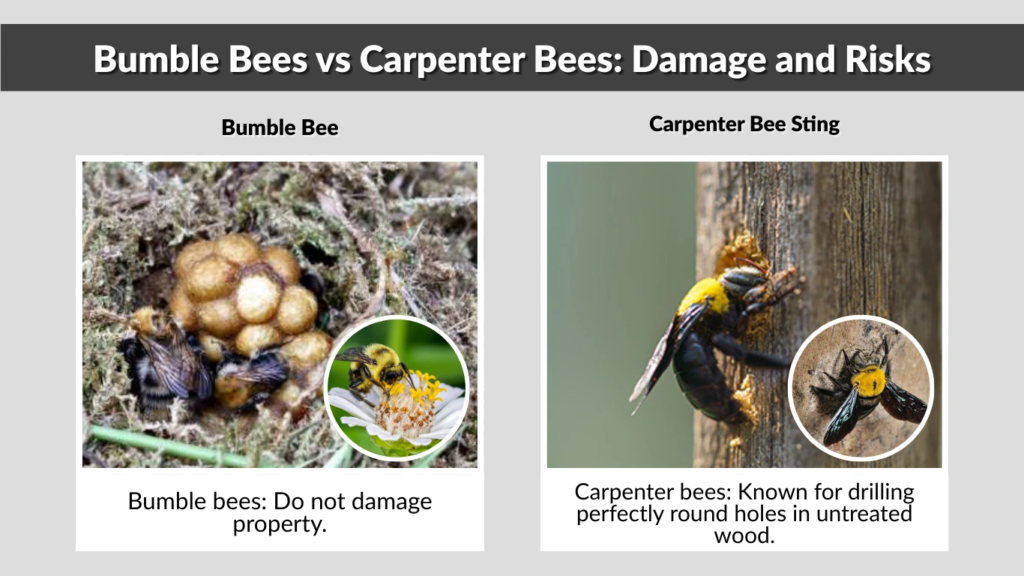
- Bumble bees: Do not damage property. Their ground nests are temporary and leave little trace once abandoned.
- Carpenter bees: Known for drilling perfectly round holes in untreated wood. Over time, these holes extend into tunnels, weakening decks, siding, fences, and beams. Multiple generations often reuse the same holes, causing progressive damage.
Human Risks
- Bumble bees: The primary risk is their sting, which is typically mild unless a person is allergic.
- Carpenter bees: While stings are uncommon, the real danger lies in property destruction. Additionally, carpenter bee larvae attract woodpeckers, which cause even more extensive wood damage while searching for food.
7. Life Cycle and Longevity

Bumble Bee Life Cycle
Bumble bees live in annual colonies. In late summer, most of the colony dies off, leaving only new queens to hibernate through winter. The queens emerge in spring to start new colonies. This short cycle means bumble bee nests are temporary and rarely reused.
Carpenter Bee Life Cycle
Carpenter bees live longer and more independently. Females bore tunnels into wood, lay eggs, and seal them inside with food supplies. New adults emerge later in the season, often reusing or expanding the same tunnels year after year. This behavior makes carpenter bee infestations a recurring problem if not addressed.
Conclusion
By recognizing these seven key differences—appearance, nesting habits, behavior, pollination role, sting, damage, and life cycle—you can quickly identify which bee you’re dealing with. This knowledge helps you decide whether to welcome them as garden allies or take action to protect your property.
FAQs
1. How can I quickly tell a carpenter bee from a bumble bee?
Look at the abdomen. A carpenter bee has a smooth, shiny black belly, while a bumble bee’s abdomen is fuzzy and striped.
2. Do both bumble bees and carpenter bees sting?
Yes, but differently. Bumble bees can sting multiple times, while only female carpenter bees sting, and they rarely do.
3. Which bee causes more damage to homes?
Carpenter bees are the real culprits. They bore into wood, creating tunnels that weaken structures over time. Bumble bees do not damage homes.
4. Are carpenter bees beneficial despite being pests?
Yes. While they damage wood, they also pollinate flowers. They are less efficient than bumble bees but still contribute to ecosystems.
5. Can bumble bees and carpenter bees live in the same area?
Absolutely. Both can inhabit the same yard—bumble bees in the ground and carpenter bees in wooden structures. Their presence is common in gardens and backyards.
