

Africanized honey bees, often called “killer bees,” are hybrids of African and European subspecies of the western honey bee. They are almost identical in appearance to the gentler bees many people are familiar with, yet they have become infamous for their defensive behavior and rapid spread across the Americas. These bees can provide honey and play a role in pollination, but their unpredictable nature makes them a challenge for both people and ecosystems.
What Are Africanized Honey Bees?
This hybrid was first created in South America when scientists attempted to breed bees that could thrive in tropical climates while still producing steady amounts of honey. The resulting offspring inherited resilience from African bees and the foraging skills of European bees. Unfortunately, they also developed a heightened response to threats, which has made them more aggressive than either parent group.
Despite their reputation, they are not a different species. They are simply a mixture of traits from two types of honey bee. Their sting is no stronger than that of their European relatives, but because they attack in greater numbers, the effects can be much more dangerous.
Origin and Spread

Hybridization in Brazil
The story begins in the 1950s, when researchers in Brazil imported African bees to cross with European varieties. The goal was to increase honey yields under hot, humid conditions. A few years later, several colonies escaped into the wild. This event marked the start of a rapid expansion that scientists could not contain.
Expansion Through the Americas
Within decades, these hybrids had spread through much of South America. Their ability to swarm frequently and establish new nests helped them move quickly through different landscapes. By the 1980s, they had already colonized parts of Central America, creating concern about how far they might continue to travel north.
Arrival in the United States
In 1990, the first established population was confirmed in Texas. From there, they spread to Arizona, California, New Mexico, and Florida. Today, they are found in many southern states, though cold winters limit their ability to move farther north. Maps of their range show them clustered around warmer regions, where conditions support year-round activity.
Physical Description and Identification

Visually, Africanized honey bees look almost the same as European bees. They share the same golden-brown coloring and banded abdomen. Their size is slightly smaller on average, but the difference is so subtle that it requires measurements in a laboratory to detect.
For this reason, physical identification in the field is nearly impossible. Beekeepers and researchers often rely on behavioral cues instead. Colonies that react quickly to disturbances and send out large numbers of defenders are far more likely to be Africanized. In practice, aggression is a clearer sign than appearance.
Habitat and Range
These bees thrive in warm climates and are far less tolerant of cold conditions. Their spread has been shaped by this preference, which explains why they dominate in southern regions but rarely survive in northern states.
They are also adaptable when it comes to nesting. Unlike European bees, which prefer enclosed tree hollows, Africanized bees will set up hives in a wide variety of places. This includes ground cavities, building walls, sheds, and utility boxes. Their flexibility brings them into closer contact with people, increasing the chances of conflict.
Behavior and Characteristics

Defensive Behavior
The most striking trait of Africanized bees is their defense strategy. When disturbed, they react faster and in greater numbers than European bees. Entire swarms may chase a threat for hundreds of yards, stinging repeatedly. This intensity is why they are considered more dangerous, even though their venom is not stronger.
Swarming Habits
They reproduce quickly through frequent swarming. Instead of a single large hive, they often split into several smaller groups. This increases their ability to colonize new areas but reduces the stability of each colony, leading to inconsistent honey yields.
Nesting Choices
Their willingness to nest in exposed or unconventional spaces sets them apart. Colonies may be found in open areas, inside structures, or underground. This adaptability ensures survival in diverse environments but also raises safety concerns in urban settings.
Do Africanized Bees Make Honey?
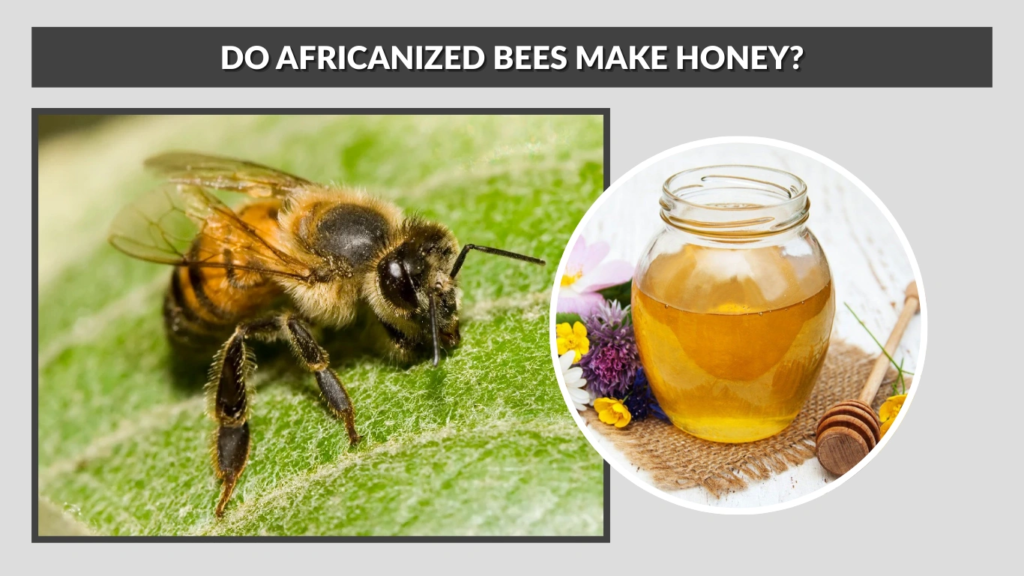
Yes, these bees do produce honey, and it is chemically the same as that made by European bees. The difference lies in how much is available for harvest. Because colonies split so often, they do not grow as large, and their surplus honey is usually smaller.
For beekeepers, this presents a challenge. Harvesting honey from Africanized colonies is riskier, and the effort often outweighs the reward. While the honey itself is perfectly safe, the aggressive nature of the colony makes production difficult to manage.
Diet and Life Cycle

Diet and Food Sources
Like other honey bees, they feed on nectar for energy and pollen for protein. They also rely on stored honey during dry seasons or cooler months. This diet makes them effective pollinators for many plants, contributing to local agriculture despite their reputation.
Life Cycle Stages
The development process mirrors that of European honey bees.
- Egg: Laid by the queen in wax cells.
- Larva and Pupa: Fed royal jelly at first, then pollen and honey until they mature.
- Adult Bee: Emerges as a worker, drone, or queen depending on diet and role.
Reproductive Strategies
Where they differ is in reproduction. Africanized colonies swarm more often, sending out large groups to start new nests. This allows them to expand quickly across regions but also means fewer resources stay in the original hive, leading to smaller reserves of honey.
Africanized vs. European Honey Bees

Although Africanized and European honey bees look nearly the same, their behavior and colony dynamics differ greatly. The table below highlights the most important comparisons:
| Feature | Africanized Honey Bees | European Honey Bees |
| Appearance | Nearly identical to European bees; slightly smaller on average | Golden-brown with black bands; slightly larger |
| Aggression | Highly defensive; attack in large numbers and chase threats long distances | Generally calm; limited defensive response |
| Colony Stability | Frequent swarming leads to smaller, less stable colonies | Larger, more stable colonies with fewer swarms |
| Honey Production | Produce honey, but less surplus due to frequent colony division | Consistent honey production with surplus for harvesting |
| Nesting Habits | Flexible; nest in trees, ground, walls, or open areas | Prefer enclosed tree hollows or managed hives |
| Range | Thrive in warmer climates; limited by cold weather | More adaptable to cooler regions; wider global range |
Risks and Dangers
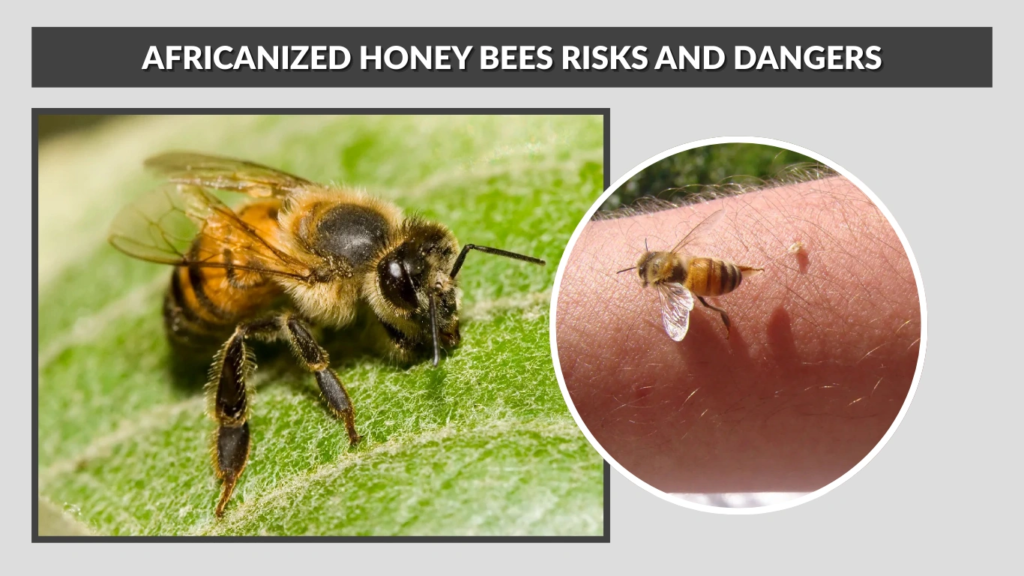
Human Risks
Africanized honey bees have earned the nickname “killer bees” because of their defensive responses. Their sting is no stronger than that of European bees, but the sheer number of attackers can be overwhelming. People who accidentally disturb a colony may face dozens or even hundreds of stings, which can be dangerous, particularly for those allergic to bee venom.
Animal Risks
Pets and livestock are also vulnerable. Animals grazing near ground nests or resting close to hidden colonies may provoke an attack without realizing it. Unlike humans, animals often cannot escape quickly, which makes them more likely to be harmed during a mass sting event.
Public Safety
Encounters with Africanized bees tend to occur in populated areas where nests have been built in walls, sheds, or utility boxes. The combination of aggressive defense and proximity to humans increases the chances of accidents, especially in southern regions where they are well established.
Impact on Ecosystem and Environment

Africanized honey bees are considered invasive in the Americas. Their rapid spread and frequent swarming give them an advantage over European bees, which often lose territory and resources as a result. This competition can reduce populations of gentler colonies that farmers and beekeepers depend on.
At the same time, Africanized bees remain effective pollinators. They contribute to the reproduction of many flowering plants and crops, supporting local ecosystems and agriculture. However, their dominance may disrupt ecological balance by limiting diversity among pollinators. The challenge lies in the fact that they both help and harm, depending on the perspective.
Human Impact and Challenges
The arrival of Africanized honey bees has brought mixed results for communities and agriculture. They pollinate crops, ensuring food production continues, but they also create difficulties for people working with bees.
For beekeepers, the biggest problem is management. Colonies are smaller, more aggressive, and less predictable, reducing both safety and honey yield. For communities, accidental encounters create safety concerns, leading to the need for professional removal services. Farmers may also see economic effects, as reliable honey production becomes harder to maintain in regions dominated by these hybrids.
Control and Management Methods

Beekeeping Practices
One strategy for managing Africanized bees is replacing queens with European ones. This helps reduce aggression in the colony, though it must be done carefully and repeatedly to maintain calmer traits.
Removal and Relocation
In urban areas, professional removal services handle wild colonies found in walls, sheds, or trees. Attempting removal without training can be dangerous, since even small disturbances can provoke a defensive response.
Public Awareness
Education plays an important role in control. Teaching communities how to recognize potential nests, avoid provoking colonies, and respond safely to encounters helps reduce accidents. In areas where these bees are common, awareness campaigns often focus on outdoor safety and responsible reporting of nests.
Africanized Honey Bee Facts (Quick Reference)
- Introduced in Brazil during the 1950s.
- Spread rapidly through South and Central America, reaching Texas in 1990.
- Almost identical in appearance to European bees, with behavior as the main difference.
- Known for aggressive defense and frequent swarming.
- Produce honey, though less consistently than European colonies.
FAQ
Do Africanized bees produce more honey?
No. Frequent swarming makes their colonies smaller and less stable, so honey production is generally lower than European bees.
How can you tell Africanized bees from European honey bees?
They look nearly the same, so visual identification isn’t reliable. Their aggressive response to disturbances is a stronger indicator, though genetic testing is the only sure method.
Are Africanized honey bees really dangerous?
Yes, but mainly because of their group attacks. A single sting is no more harmful than that of a regular honey bee, but mass stings can be life-threatening.
Where are Africanized honey bees found today?
They are established in South America, Central America, and southern parts of the United States, especially Texas, Arizona, New Mexico, California, and Florida.
Do Africanized bees still make honey?
Yes. Their honey is identical in quality to that of European bees, but colonies do not produce large reserves, and managing them safely is difficult.
