
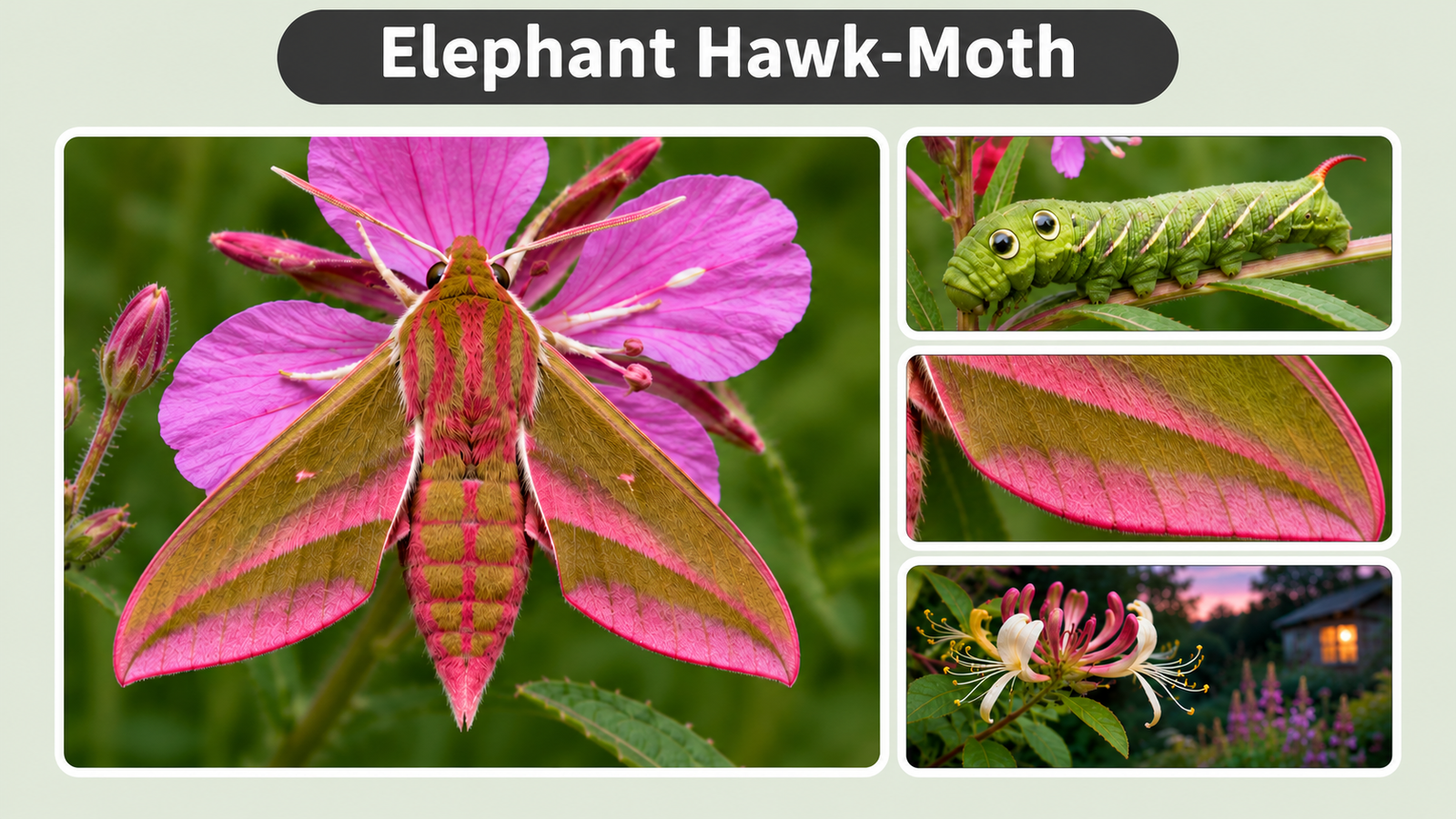
The elephant hawk-moth (Deilephila elpenor) is a striking pink-and-olive moth found across much of Europe and parts of Asia. Its name comes from the caterpillar, whose large head and trunk-like front end resemble an elephant’s trunk. Both stages are distinctive: adults visit flowers after dark, while the caterpillars feed on plants such as willowherb and bedstraw. This guide explains how to identify the elephant hawk-moth, where it lives, what its caterpillar eats, and what happens through its life cycle.
Elephant Hawk-Moth at a Glance
This hawk-moth belongs to the family Sphingidae, a group known for strong fliers and streamlined bodies. The adult’s bright colors can make it look tropical, but it occurs in temperate regions too. Its caterpillar changes in appearance as it grows, so identification clues differ between young and mature larvae.
| Feature | Description |
|---|---|
| Scientific name | Deilephila elpenor |
| Family | Sphingidae |
| Adult appearance | Olive-green and pink patterned wings and body |
| Caterpillar appearance | Green or brown, with large false eyespots and a small tail horn |
| Main food plants | Willowherbs, bedstraws, and other plants |
| Adult activity | Mainly at night |
| Winter stage | Pupa |
What Does an Elephant Hawk-Moth Look Like?
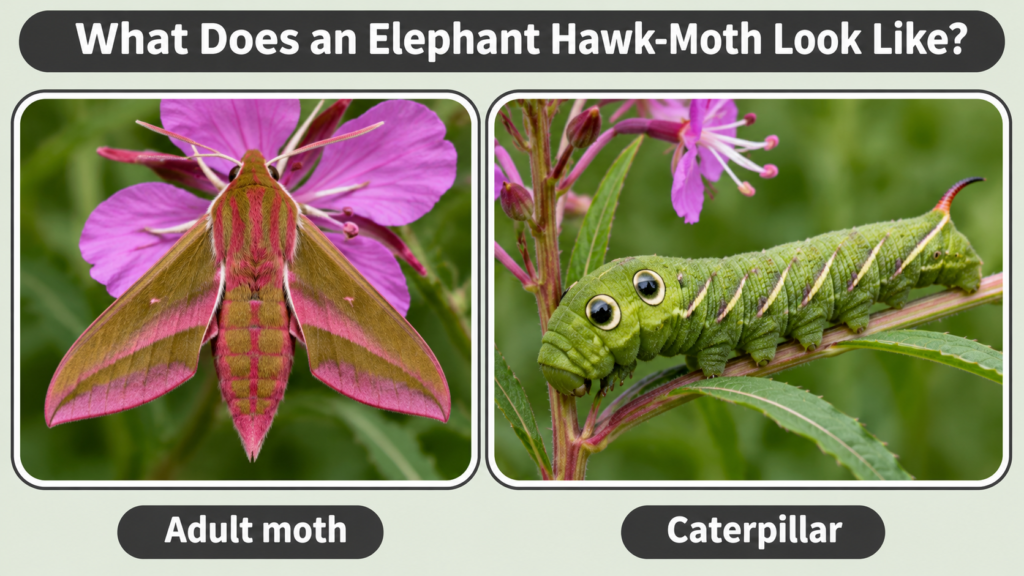
The elephant hawk-moth is one of the easiest British moths to recognize because of its bold pink and olive pattern. The caterpillar is less immediately obvious, especially when it is small, but its eyespots and unusual body shape help distinguish it from many other larvae.
Adult moth identification
An adult elephant hawk-moth has olive-green forewings marked with pink or rose-colored bands. Its hindwings are mostly pink and black, and its thick body carries similar olive and pink coloring. The wingspan is usually around 45 to 60 millimeters, although size varies.
The moth rests during the day among leaves or other sheltered vegetation, where its colors can help it blend into flowers and foliage. At night it flies in search of nectar and may visit honeysuckle, evening primrose, and other fragrant flowers. It can also be attracted to outdoor lights, so a moth near a porch light may be an elephant hawk-moth.
Caterpillar identification
Young elephant hawk-moth caterpillars are usually dark and may look quite different from the mature larvae. As they grow, they often become green or brown, with a large head end, a pair of prominent eye-like markings near the front, and a small curved horn at the rear. The eyespots are false markings, not actual eyes.
When disturbed, the caterpillar can retract its head and front segments, making the front of its body appear enlarged. The eye-like spots may make it look like a small snake or other threatening animal. This defensive display, along with its unusual shape, explains why people often search for elephant hawk-moth caterpillar pictures when trying to identify one.
Why Is It Called an Elephant Hawk-Moth?
The name refers to the caterpillar rather than the adult moth. Its head can pull back into a swollen-looking front section, while the body narrows behind it, creating a shape that some people compare to an elephant’s trunk. Its horn-like tail adds to the striking outline, but it is not a stinger.
Where Do Elephant Hawk-Moths Live?
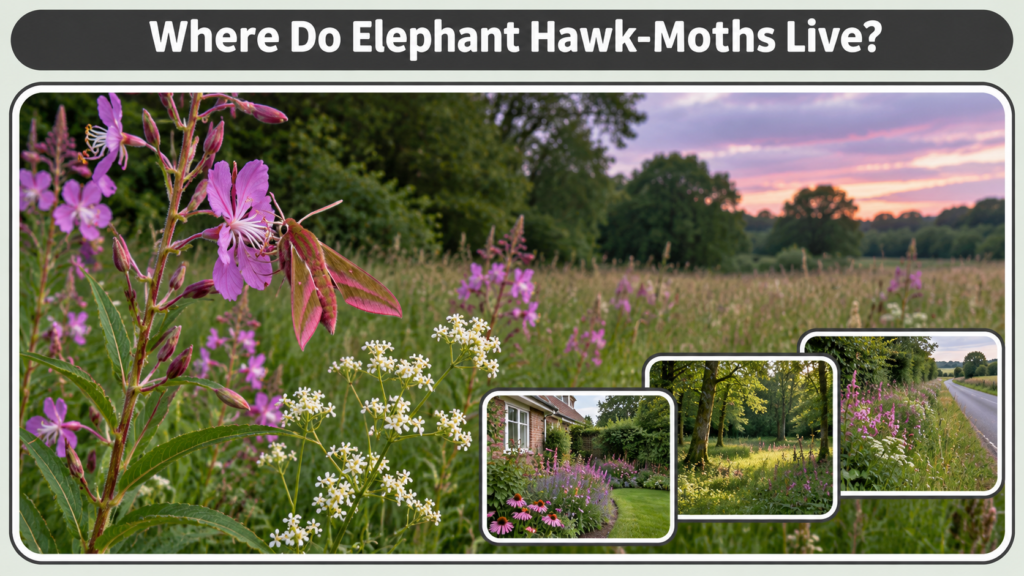
Elephant hawk-moths occur across much of Europe and extend into parts of Asia. They are common in Britain and can be found in gardens, parks, woodland edges, grassland, and other places where their food plants grow. The species is adaptable and can use both wild habitats and suburban gardens.
Garden and wild habitats
The moth is often associated with damp or fertile places where willowherbs and bedstraws grow, including riverbanks, meadows, woodland clearings, and road verges. It may also appear in gardens, especially where flowering plants and suitable caterpillar food are available. Adults need nectar sources, while larvae need leafy plants on which to feed.
A neat flower bed is not the only place to look. The caterpillars can be on garden fuchsia, willowherb, or other host plants and may leave them when ready to pupate. In late summer, a large caterpillar crossing a path or patio may be an elephant hawk-moth larva searching for a sheltered spot.
When are they active?
Adult moths are generally seen from late spring into summer, with the main flight period often falling between May and July in Britain. The exact dates vary with region, weather, and elevation. Caterpillars are more often noticed in late summer, when they are large enough to spot and may be moving away from their food plants.
What Do Elephant Hawk-Moth Caterpillars Eat?
Elephant hawk-moth caterpillars feed on a range of plants, with willowherbs and bedstraws among their best-known food sources. Rosebay willowherb is a common host, and the larvae may also use other willowherb species. In gardens, they can feed on fuchsia. The range of host plants lets the species live in different habitats.
Feeding behavior
The caterpillars often feed at night and rest along stems or among foliage during the day. A mature larva may leave its food plant and travel to loose soil or another sheltered place for pupation. If you find one away from its host plant, it may be wandering rather than feeding.
Elephant Hawk-Moth Life Cycle
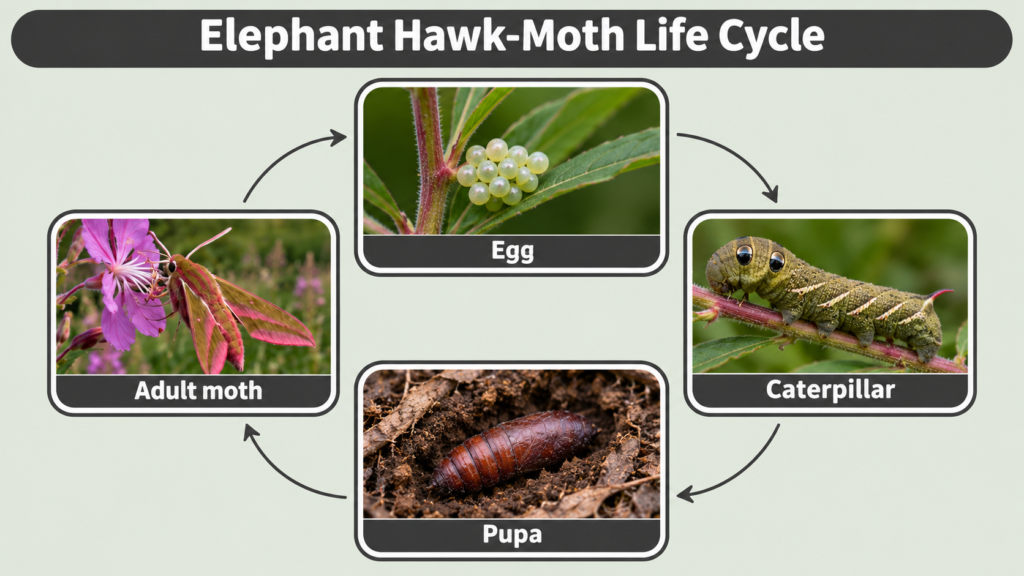
The elephant hawk-moth develops through four stages: egg, caterpillar, pupa, and adult. In Britain, it usually has one generation annually. The caterpillar grows during summer and early autumn, then pupates and spends winter in that stage before the adult emerges the following year.
Eggs and caterpillars
After mating, the female lays eggs on or near suitable food plants. The eggs hatch into small larvae that begin feeding on leaves. Young caterpillars are often dark and less conspicuous than older ones. As they grow, they shed their skins several times and develop the large false eyespots that make mature larvae so recognizable.
Pupation and winter
When fully grown, the caterpillar leaves its host plant and searches for a protected place to pupate. It may burrow into loose soil or settle among debris near the ground, then form a pupa. It remains in this stage through winter, so avoid disturbing soil and leaf litter near places where caterpillars have been seen.
Adult emergence
The adult emerges in late spring or summer. After its wings dry, it flies, feeds on nectar, mates, and lays eggs. The adult stage is brief compared with the months spent as a caterpillar and pupa.
Are Elephant Hawk-Moths or Caterpillars Poisonous?
Elephant hawk-moths and their caterpillars are not poisonous to people and do not sting. The tail horn on the caterpillar can look alarming, but it is not a weapon. The eyespots are a visual defense that may startle a predator when the larva draws in its head.
It is still best to observe the caterpillar without handling it. Handling can injure a soft-bodied larva, and other hairy or spiny caterpillars may be irritating or harmful. If one is on a walkway, let it move along if safe, or use a leaf or small container to guide it gently onto nearby vegetation without touching it directly.
Elephant Hawk-Moth vs. Small Elephant Hawk-Moth
The small elephant hawk-moth (Deilephila porcellus) is a close relative and can be confused with the elephant hawk-moth. Both have pink and olive colors, but the small elephant hawk-moth is noticeably smaller and often has brighter, more extensive pink coloring. Comparing size, wing pattern, and the shape of the markings helps tell them apart.
Caterpillars can also be difficult to distinguish from a quick glance. Record the location and host plant, and photograph the whole larva from the side. If you are unsure, avoid stating a definite identification based on color alone.
How to Attract Elephant Hawk-Moths to a Garden
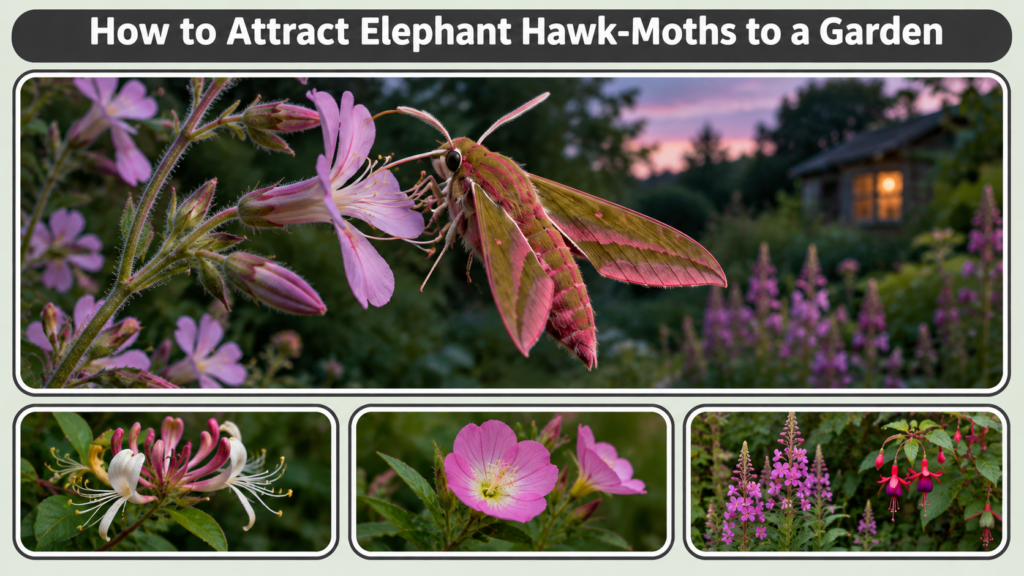
A garden can support the moth by providing both nectar for adults and food plants for caterpillars. Because adults are active at night, fragrant flowers that release scent after dusk can be especially useful.
- Grow nectar-rich flowers, including honeysuckle or evening primrose.
- Keep willowherb, bedstraw, or other suitable larval food plants in a contained wild area.
- Avoid using broad-spectrum insecticides on plants where caterpillars may feed.
- Leave some sheltered ground cover and leaf litter through winter.
- Check plants before pruning or clearing vegetation in late summer.
A garden does not need to be completely wild. Even a small patch with host plants and a few night-scented flowers can provide useful resources.
Frequently Asked Questions
Do elephant hawk-moths fly during the day?
They are mainly nocturnal and usually fly after dusk. During the day, adults rest among leaves or other sheltered vegetation, though they may be disturbed and briefly take flight.
What does an elephant hawk-moth caterpillar turn into?
It becomes the adult elephant hawk-moth, Deilephila elpenor. After feeding and growing, it pupates near the ground and typically remains a pupa through winter.
Why does the caterpillar have big eyes?
The large markings are false eyespots, not real eyes. When threatened, the larva can retract its head and make these spots more visible, which may startle a predator.
Can elephant hawk-moth caterpillars eat fuchsia?
Yes. Fuchsia can be a food plant for the caterpillar, especially in gardens. Willowherbs and bedstraws are also commonly used.
What should I do if I find one in my garden?
Observe it without handling it. If it is feeding, leave the plant undisturbed where possible. If it is crossing a path, allow it to move or gently guide it to nearby vegetation.
