
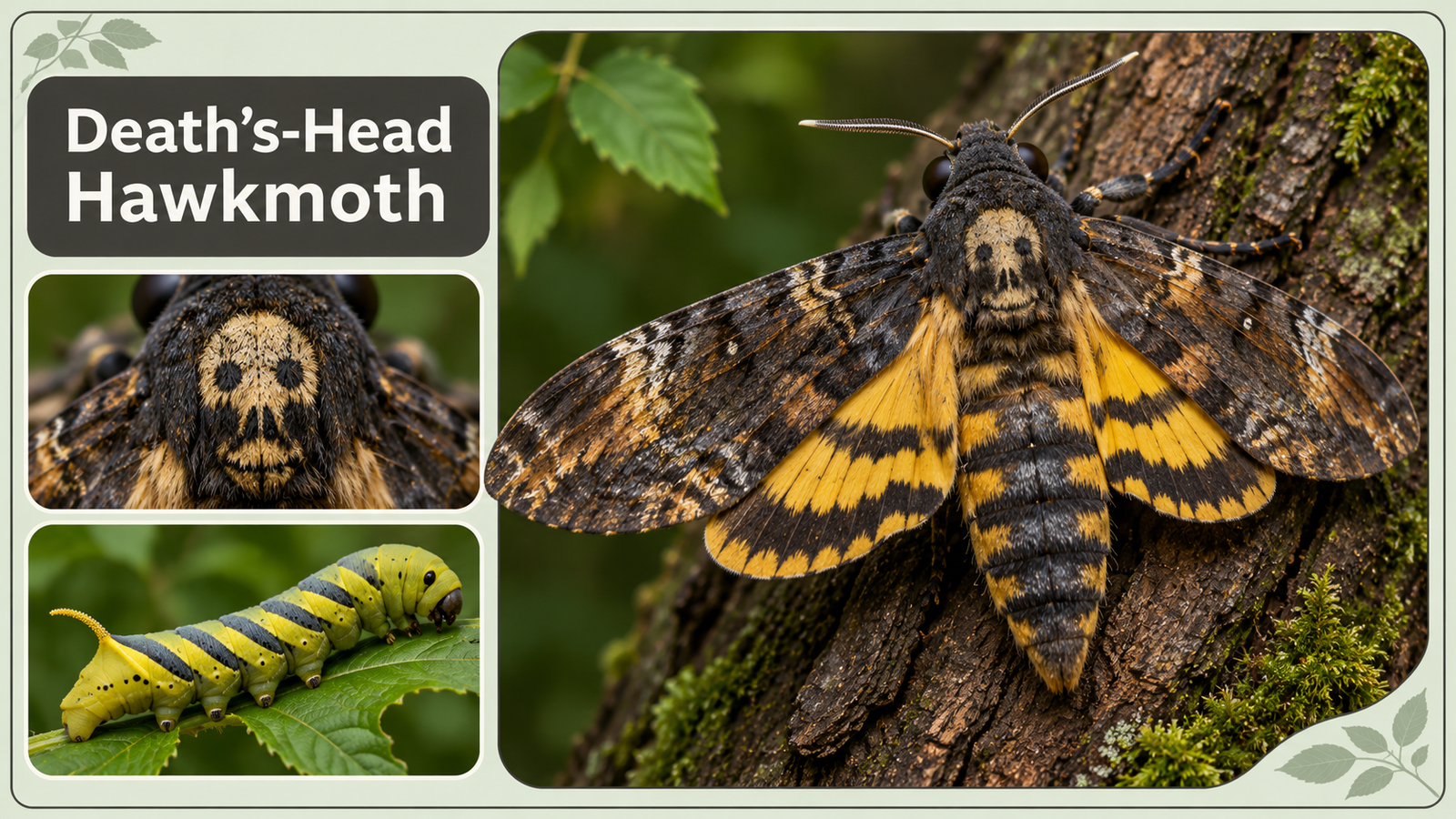
The death’s-head hawkmoth is a large, striking moth recognized by the pale skull-like marking on its thorax. Its dark forewings, yellow-and-black abdomen, unusual squeak, and visits to honeybee hives have made it famous in folklore and natural history. The name usually refers to Acherontia atropos, though it is also used for two related species. Here’s how to identify this moth, understand its life cycle, and separate real behavior from legend.
What Is a Death’s-Head Hawkmoth?
A death’s-head hawkmoth is a member of the hawkmoth family Sphingidae and the genus Acherontia. The common name refers to a skull-like pattern on the back of the moth’s thorax. The best-known species is Acherontia atropos, also called the African death’s-head hawkmoth. The genus also includes A. styx and A. lachesis, so the common name can refer to more than one species.
Where does it live?
Acherontia atropos is native to parts of Africa and surrounding regions and occurs across areas of Europe and the Middle East. It is a strong flyer and can migrate into cooler parts of Europe, where adults and caterpillars may be seen seasonally. In South Asia, including Bangladesh, the related Acherontia styx is recorded, so the exact species behind a local sighting can depend on location.
Why is it called a death’s-head moth?
The pale marking on the thorax resembles a small human skull, while the dark forewings and banded abdomen add to its dramatic appearance. The scientific name Acherontia atropos also draws on Greek mythology: Acheron is associated with the underworld, and Atropos is one of the Fates. These names and markings helped inspire stories that the moth was an omen of death, but those beliefs are folklore, not biology.
How to Identify a Death’s-Head Hawkmoth
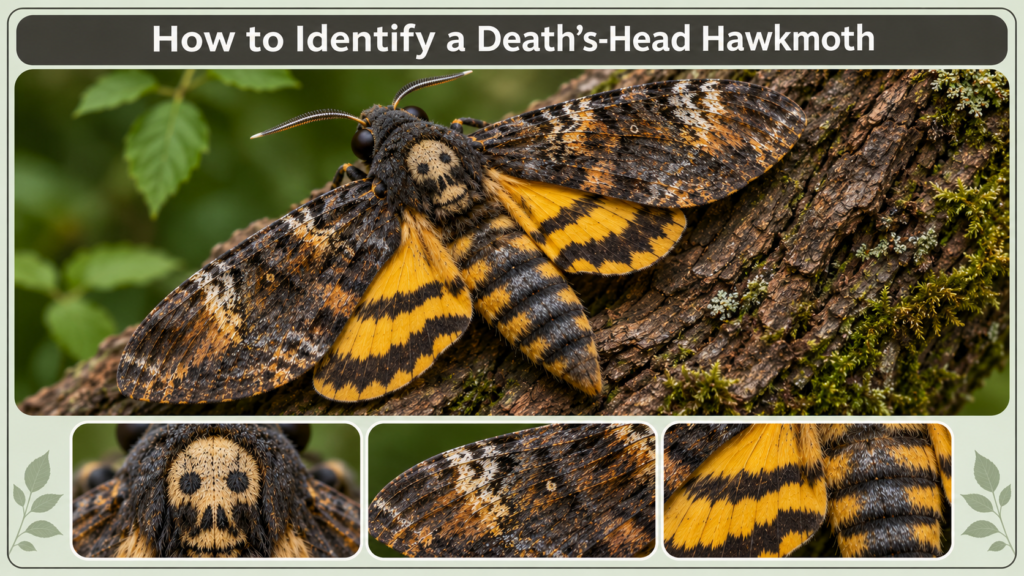
An adult is unusually large and heavy-bodied, with a wingspan that can approach 12 centimeters in A. atropos. Its forewings are dark brown with mottled tan markings, while the hindwings and abdomen show strong yellow and black patterns. The skull-like mark sits on the thorax, between the head and abdomen. The mark can vary in clarity, so use the overall pattern rather than expecting a perfectly drawn skull.
Adult identification features
- Thorax: Dark brown with a pale, skull-like marking.
- Forewings: Long, dark, and mottled with lighter brown or tan areas.
- Hindwings: Yellow-orange with dark bands, most visible when the moth opens its wings.
- Abdomen: Thick and striped with dark and yellow tones.
- Body shape: Robust and streamlined, typical of a powerful-flying hawkmoth.
- Behavior: Usually active at night and often attracted to lights.
A resting moth may keep its bright hindwings hidden beneath the forewings. The skull marking can also look faint on a worn specimen, so the combination of size, wing pattern, and body shape is more reliable than one feature alone.
How to identify the caterpillar
The caterpillar is large and may grow longer than 10 centimeters. Its color varies: some are green or yellow with blue diagonal stripes, while others are brown with paler stripes. A curved tail horn projects from the rear. The horn looks conspicuous but is not a sting. Caterpillars often feed at night and may be found on plants in the nightshade family, including potato, but they also use other host plants.
What Does a Death’s-Head Hawkmoth Eat?
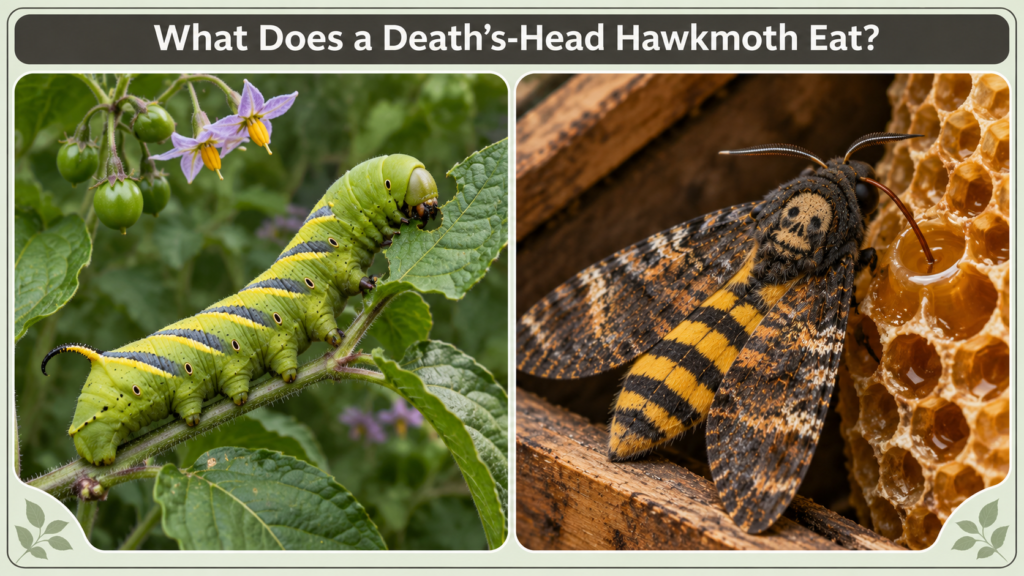
The caterpillars feed on leaves, especially those of plants in the nightshade family. Potato is a well-known host, but the moth can use a broader range of plants, and preferred food plants vary by region. A mature caterpillar eventually stops feeding and enters the soil to pupate.
Adult death’s-head hawkmoths are unusual because they enter honeybee colonies and feed on stored honey. Their short, sturdy proboscis can pierce capped honey cells. They have several adaptations that help them move through a hive, including a tough body and chemical cues that reduce recognition by honeybees. The moths are famous for honey theft, but they may also visit flowers or feed on other sugary sources.
Why Does the Moth Make a Squeaking Sound?
When disturbed or handled, an adult death’s-head hawkmoth can produce a short, high-pitched squeak. It draws air in and pushes it back out through its mouthparts, making an internal structure vibrate. The sound is unusual for a moth and may startle a predator long enough for the insect to escape.
Stories sometimes claim the squeak imitates the sound of a queen honeybee and calms workers in a hive. The moth does squeak in hive settings, but the idea that it deliberately mimics queen piping is not firmly established. It is safer to describe the sound as a defensive behavior with a studied physical mechanism, rather than assume a specific role in honeybee communication.
Death’s-Head Hawkmoth Life Cycle
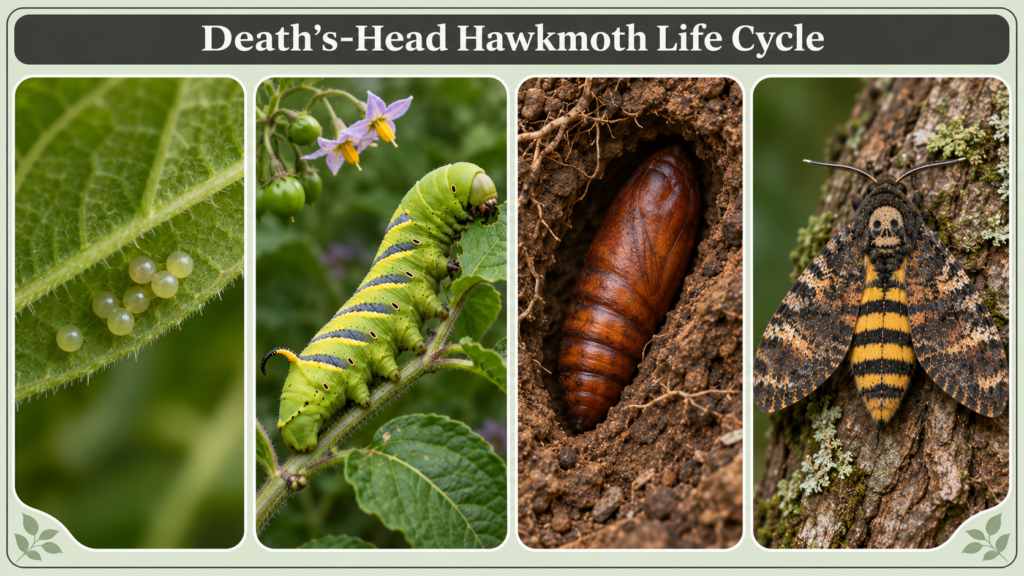
Like other moths, a death’s-head hawkmoth develops through four stages: egg, caterpillar, pupa, and adult. The female lays eggs on suitable host plants. Caterpillars hatch, feed, and pass through several growth stages before they are ready to pupate. The timing varies with climate and region, especially because A. atropos can migrate and may not overwinter successfully in colder parts of its range.
From caterpillar to adult
When mature, the caterpillar leaves its food plant and burrows into loose soil. It forms a chamber underground and changes into a smooth, brown pupa. After the pupal period, an adult moth emerges, expands its wings, and waits for them to dry before flying. In warmer parts of its range, the species may have more than one brood in a year; cooler regions may see seasonal immigrant adults and fewer successful local generations.
How long does it live?
There is no single lifespan that applies everywhere because development depends on temperature, food availability, and season. The egg, caterpillar, and pupa stages together take much longer than the adult stage. Adult moths focus on feeding, finding mates, and laying eggs, and their active period is comparatively short. A moth appearing in a cool northern region may be a migrant rather than part of a population that lives there year-round.
Is the Death’s-Head Hawkmoth Dangerous?
No. The adult moth is not venomous, does not sting, and is not dangerous to people. Its skull-like marking, large size, and squeak can seem alarming, but these are not signs that it can harm a person. The caterpillar’s tail horn is also harmless. If you find one, observe it without grabbing its wings or squeezing its body, since handling can damage the moth’s delicate scales and legs.
The species can affect beekeeping because adults may take honey from hives. That is a concern for managed colonies, not a threat to people. The moth is also an important part of natural ecosystems, and caterpillars are eaten by predators. In gardens, a few caterpillars generally do not mean that an entire crop is at risk; identify the insect before considering any pest-control response.
Frequently Asked Questions
Is the death’s-head hawkmoth poisonous?
No. The adult is not poisonous or venomous, and it does not sting. Its dramatic skull marking and squeaking sound may seem threatening, but they do not indicate danger to people. The caterpillar’s tail horn is not a stinger. Avoid handling the moth because its wings and body can be easily damaged.
Why does the death’s-head hawkmoth have a skull on its back?
The skull-like shape is a natural pattern on the moth’s thorax. It is not a real skull, and the moth does not use it to attack or poison predators. The marking, combined with dark wings and yellow-black stripes, inspired folklore and the species’ common name.
What does a death’s-head hawkmoth caterpillar look like?
It is a large caterpillar with a curved tail horn at its rear. Color varies among individuals and can include green or yellow bodies with blue diagonal stripes, or brown bodies with paler markings. The horn may look like a stinger, but it is not used to sting people.
Does the death’s-head hawkmoth really steal honey?
Yes. Adult moths can enter honeybee hives and feed on stored honey. Their stout proboscis can pierce capped honey cells, and their body chemistry and structure help them move through the colony. The moth’s squeak is real, but claims that it reliably imitates a queen bee are not proven.
What should I do if I find one?
Leave it undisturbed if it is resting safely. If it is indoors, gently guide it toward an open window or place it outside without touching its wings. Photograph it from a short distance if you want help identifying it, and note your location because several related species share the common name.
