
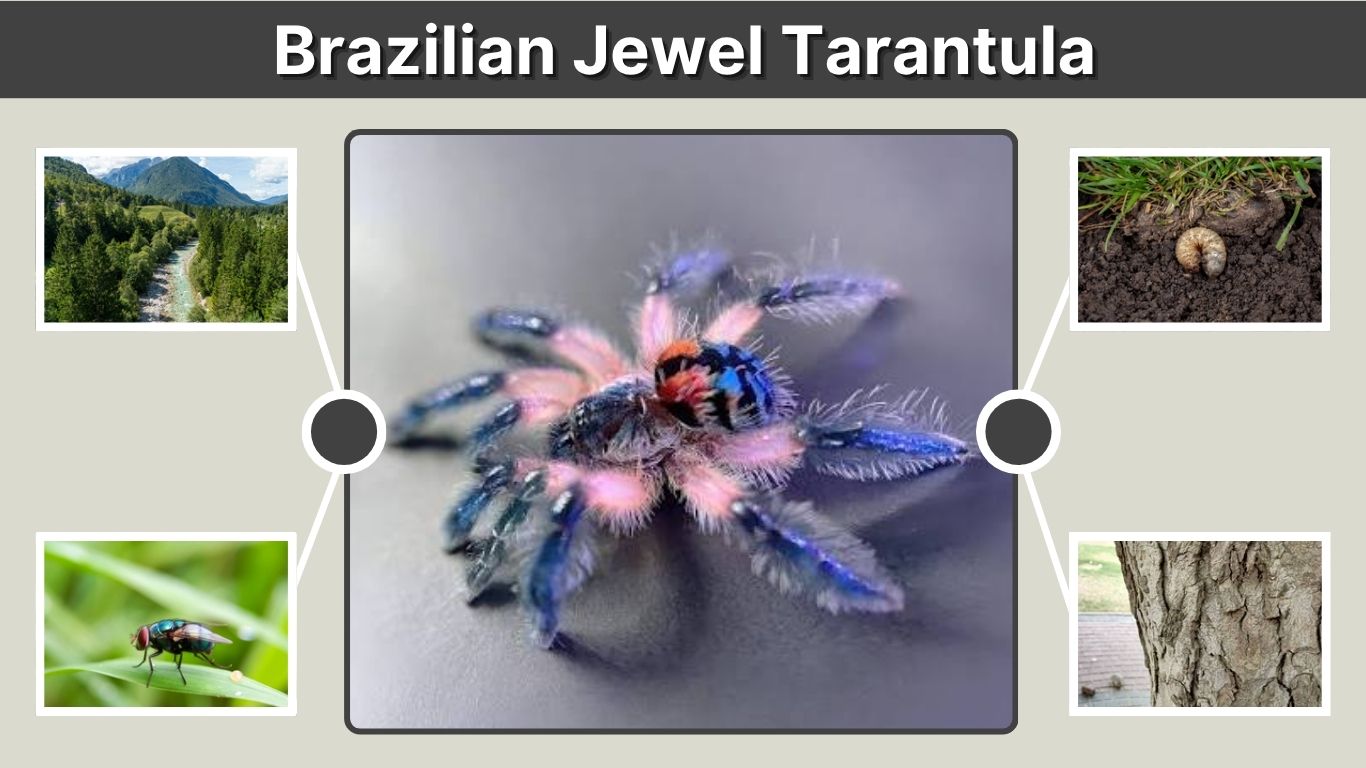
The Brazilian jewel tarantula (Typhochlaena seladonia) is a tiny, brilliantly colored tarantula native to Brazil’s Atlantic Forest. Famous for its metallic green, blue, pink, yellow, and black coloration, this species looks very different from the large brown tarantulas most people recognize. It is also unusual because it lives on trees and constructs a camouflaged trapdoor retreat from silk and pieces of bark. Although highly desirable among enthusiasts, its small size and specialized husbandry make it better suited to experienced tarantula keepers.
What Is a Brazilian Jewel Tarantula?
The Brazilian jewel tarantula belongs to the family Theraphosidae and is scientifically known as Typhochlaena seladonia. The World Spider Catalog currently recognizes this as the accepted scientific name and records its distribution in Brazil. Its dazzling coloration, dwarf size, and unusual tree-dwelling lifestyle make it one of the most distinctive tarantulas.
Identification
A Brazilian jewel tarantula can be recognized by several characteristics:
- Small, compact body
- Metallic green or blue areas
- Pink and reddish markings
- Yellowish or cream-colored spots
- Dark abdomen with colorful patterning
- Eight relatively short legs
- Dense covering of fine setae
- Bright, jewel-like appearance
Its colors involve both pigments and structural properties of its hairs, helping create the metallic appearance for which the spider is famous.
Why Is It Called a Jewel Tarantula?
The name comes from its extraordinary coloration. Under suitable lighting, its greens, blues, pinks, reds, and yellows can appear almost iridescent.
Unlike tarantulas that are predominantly brown, gray, or black, T. seladonia has a highly patterned appearance reminiscent of a colorful gemstone.
Brazilian Jewel Tarantula Size
Despite its spectacular appearance, this is a dwarf tarantula rather than a giant species. Adult females are commonly reported in captivity at roughly 1.5–2.5 inches in diagonal leg span, with males generally somewhat smaller. Scientific descriptions also confirm that the species has a notably small body compared with many other tarantulas.
How Big Does a Brazilian Jewel Tarantula Get?
A fully grown Brazilian jewel tarantula generally remains around 2 inches across, although individuals vary.
This makes it dramatically smaller than huge species such as Goliath birdeaters, which may reach several times its leg span.
Its small dimensions should not lead keepers to underestimate it, however. Juveniles in particular can be tiny, delicate, and challenging to manage.
Brazilian Jewel Tarantula Habitat
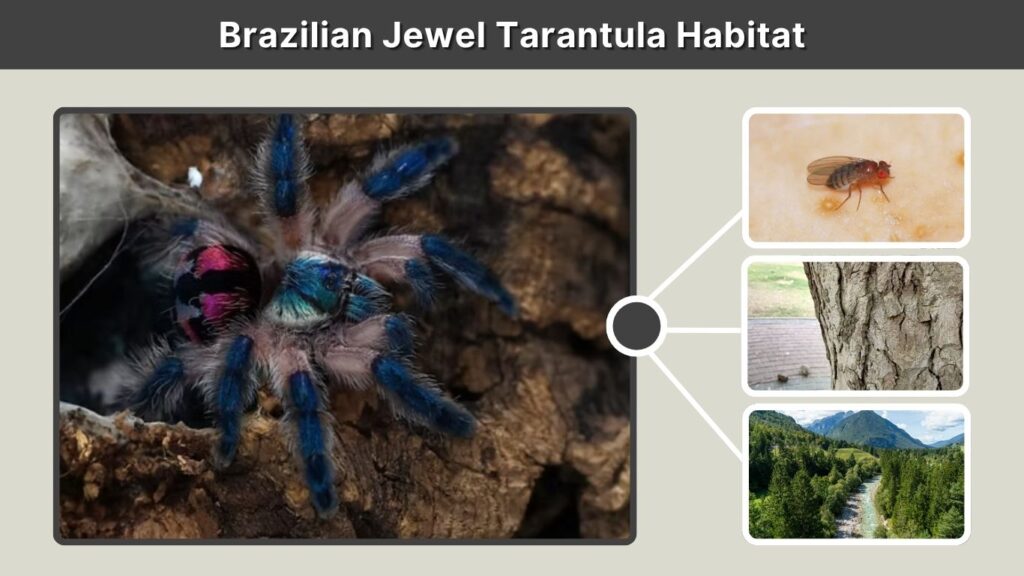
The Brazilian jewel tarantula is native to the Atlantic rainforest of northeastern Brazil, particularly Bahia and Sergipe. Field observations have found specimens on vegetation, beneath tree bark, and above ground on tree surfaces. The species is therefore considered primarily arboreal rather than a ground-burrowing tarantula.
Life in the Trees
Brazilian jewel tarantulas use bark, cracks, and other small spaces as shelter.
Instead of simply spinning a large exposed web, they construct highly concealed retreats attached to tree surfaces. This behavior provides protection while giving the spider a secure position from which to detect approaching prey.
Brazilian Jewel Tarantula Trapdoor
One of the most remarkable features of Typhochlaena seladonia is its arboreal trapdoor behavior. Researchers observed an immature individual using silk and small pieces of bark to construct a hinged, cup-like retreat. One side could be opened from inside, allowing the spider to remain hidden and suddenly capture prey that approached the entrance.
How the Trapdoor Works
The tarantula incorporates materials from its surroundings into the shelter, making it difficult to distinguish from normal tree bark.
Once inside, it may spend most of its time concealed. Prey approaching or touching the retreat creates vibrations that alert the spider.
It can then rapidly seize its food and retreat behind the protective door.
Brazilian Jewel Tarantula Enclosure
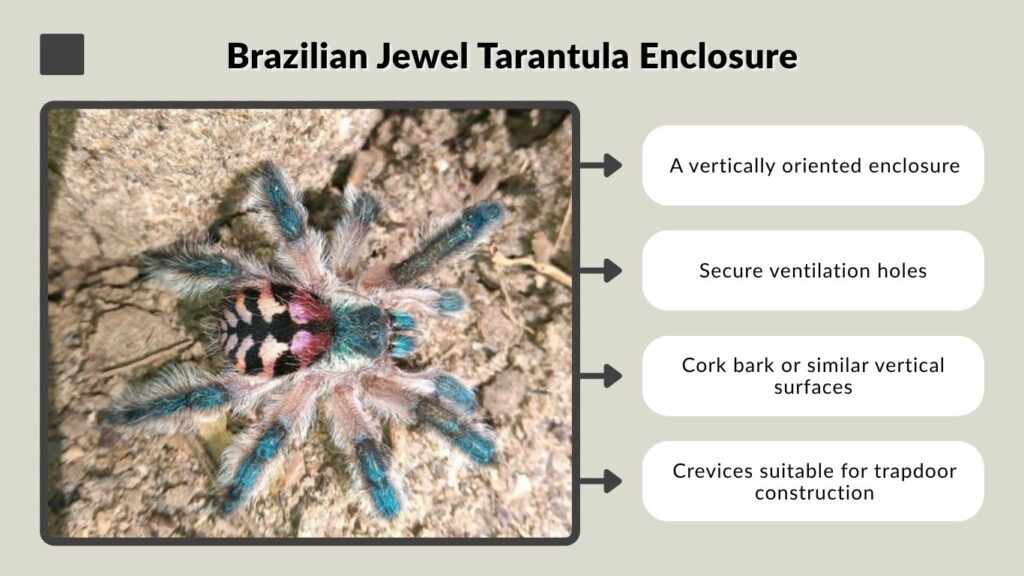
Captive housing should reflect the spider’s natural tree-dwelling lifestyle. Vertical structures and suitable locations for constructing a retreat are especially important. Because the species is small, the enclosure does not need to be enormous, but it must be secure and provide good airflow without allowing tiny spiderlings to escape.
Basic Enclosure Requirements
A suitable setup should provide:
- A vertically oriented enclosure
- Secure ventilation holes
- Cork bark or similar vertical surfaces
- Crevices suitable for trapdoor construction
- Appropriate tropical substrate
- Leaf litter, moss, or small bark pieces
- Access to clean water
- Good cross-ventilation
- Secure openings to prevent escape
Keepers often provide bark with natural depressions or small openings because these encourage the tarantula to establish its characteristic shelter.
Temperature and Moisture
The species comes from warm, humid Atlantic rainforest habitat. In captivity, experienced keepers commonly maintain it in warm room-temperature conditions while providing moderate moisture and strong ventilation rather than keeping the enclosure constantly soaked.
Stagnant, excessively wet conditions should be avoided. A clean water source and carefully controlled moisture are more useful than trying to keep every surface permanently wet.
What Does a Brazilian Jewel Tarantula Eat?
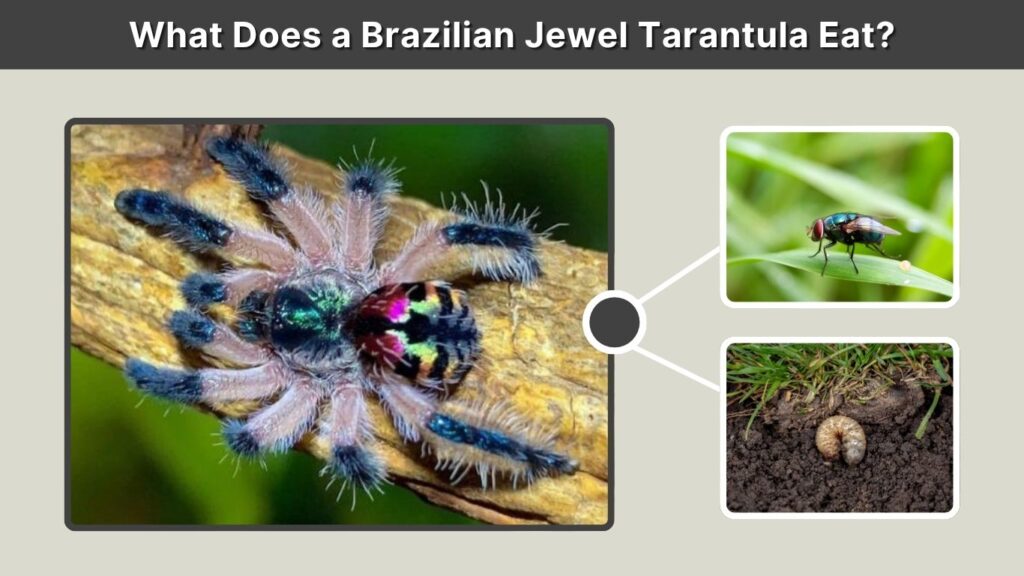
Brazilian jewel tarantulas are predators. Field and captive observations show them feeding on small invertebrates, including flies and beetle larvae. Their trapdoor lifestyle allows them to remain concealed until suitable prey comes within striking distance.
Common Captive Foods
Depending on the tarantula’s size, appropriate foods may include:
- Flightless fruit flies for tiny spiderlings
- Pinhead crickets
- Small roach nymphs
- Small crickets
- Other appropriately sized feeder insects
Prey should be scaled to the spider’s size. Spiderlings are exceptionally small, so oversized insects may be inappropriate or potentially dangerous.
Feeding Behavior
Once a Brazilian jewel tarantula has completed its retreat, it may rarely emerge completely to hunt.
Instead, it can wait near the entrance and attack prey that walks close enough to trigger vibrations.
A spider approaching a molt may seal its retreat and temporarily refuse food. Uneaten prey should not be left to disturb a molting tarantula.
Brazilian Jewel Tarantula Lifespan
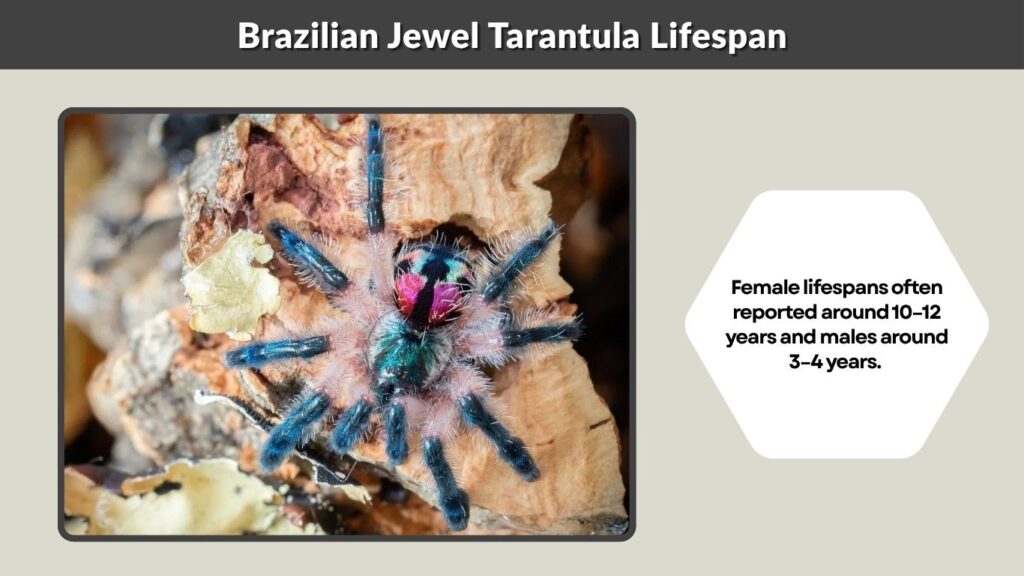
Exact lifespan data from long-term scientific field studies are limited. Captive-care sources generally estimate that females can live substantially longer than males, with female lifespans often reported around 10–12 years and males around 3–4 years. These figures should be treated as husbandry estimates rather than guaranteed lifespans.
Growth and Molting
Like all tarantulas, Brazilian jewels must molt to grow.
Before molting, the spider may become inactive and stop accepting food. It may remain sealed inside its retreat until the process is complete.
The new exoskeleton and fangs are soft immediately afterward, so prey should not be offered until the spider has sufficiently hardened.
Brazilian Jewel Tarantula Male vs. Female
Adult males and females can show visible differences. Scientific observations found particularly noticeable sexual differences in the coloration of the femora, with females displaying pink coloration that differed from mature males. Females also generally become somewhat larger and survive much longer in captivity.
Female Brazilian Jewel Tarantula
Females are especially desirable among keepers because of their longer expected lifespan.
Determining sex accurately when the spider is young can be difficult. Examination of a molt is generally more dependable than relying solely on body shape or coloration.
Is the Brazilian Jewel Tarantula Venomous?
Yes. The Brazilian jewel tarantula is a true tarantula and possesses venom for subduing prey. However, detailed clinical information about bites from this particular species is limited, so its venom should not be casually characterized as harmless.
Bite and Safety
A keeper should avoid:
- Deliberately handling the spider
- Forcing it from its retreat
- Touching it during a molt
- Allowing children to handle it
- Working in an open area where it can escape
The spider’s small size does not make unnecessary handling advisable. It is better appreciated as a display animal whose natural behavior can be observed inside a secure enclosure.
Brazilian Jewel Tarantula Price and Pet Care
Brazilian jewel tarantulas are considered desirable in the exotic-pet hobby because of their coloration, unusual behavior, and limited availability. Prices can vary considerably according to size, sex, breeder availability, country, and whether the animal was captive bred.
Is It a Good Pet?
This species is fascinating but generally better for experienced keepers.
Its tiny spiderlings, specialized trapdoor behavior, sensitivity to enclosure conditions, and ability to disappear inside a well-camouflaged shelter can make care more challenging than with common beginner tarantulas.
Anyone purchasing one should prioritize responsibly captive-bred animals and verify applicable wildlife and ownership regulations.
FAQs
1. How big does a Brazilian jewel tarantula get?
Adults are small for tarantulas, commonly reaching roughly 1.5–2.5 inches in diagonal leg span, with females generally larger than males.
2. How long does a Brazilian jewel tarantula live?
Captive-care estimates commonly place females around 10–12 years and males around 3–4 years, although individual lifespans can vary.
3. Is a Brazilian jewel tarantula poisonous?
It is more accurately described as venomous, not poisonous. It uses venom delivered through its fangs to subdue prey.
4. Where does the Brazilian jewel tarantula live?
Typhochlaena seladonia is native to Brazil and has been recorded from the Atlantic rainforest regions of Bahia and Sergipe.
5. Why does the Brazilian jewel tarantula make a trapdoor?
Its silk-and-bark trapdoor provides camouflage and protection while creating an effective hiding place from which the tarantula can ambush passing prey.
