
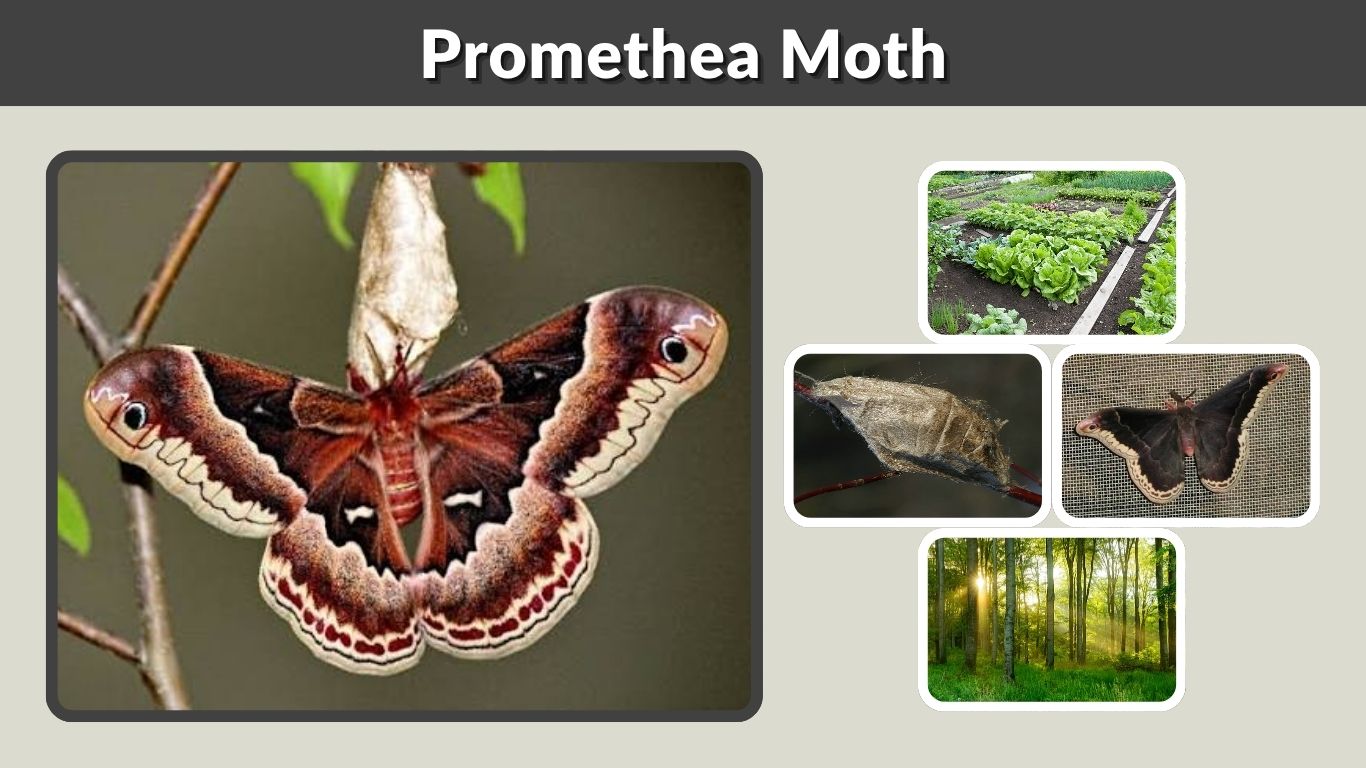
The Promethea moth (Callosamia promethea) is a large North American silk moth known for its dramatic male and female color differences. Males are usually dark brown to nearly black, while females are reddish brown with pale markings. Like other giant silk moths, adults do not feed and live mainly to reproduce. Their caterpillars eat the leaves of several trees and shrubs before forming tough silk cocoons. This guide covers identification, caterpillars, cocoons, host plants, life cycle, range, size, and male-versus-female differences.
What Is a Promethea Moth?
The Promethea moth is a member of the giant silk moth family, Saturniidae. It is also commonly called the Promethea silkmoth or spicebush silkmoth. Adults are large-bodied moths with broad wings, while the larvae are colorful caterpillars that feed on woody plants. Their appearance changes dramatically between the caterpillar, pupa, and adult stages.
Promethea Moth Identification
Typical adult characteristics include:
- Wingspan of roughly 3 to 4 inches
- Broad, rounded wings
- Thick, furry-looking body
- Pale or cream-colored wing borders
- Distinctive eye-like markings near wing tips
- Strong differences between male and female coloration
- Large, feathery antennae, especially in males
Males are generally darker than females and can sometimes resemble large dark butterflies when flying during the daytime.
Promethea Moth Size
Adult Promethea moths usually measure around 3 to 4 inches across the wings, making them among the larger moths in their range. Females often appear heavier-bodied because their abdomens contain eggs.
Their impressive size and broad wings make them easy to notice when resting on vegetation, tree trunks, walls, or outdoor structures.
Male vs Female Promethea Moth
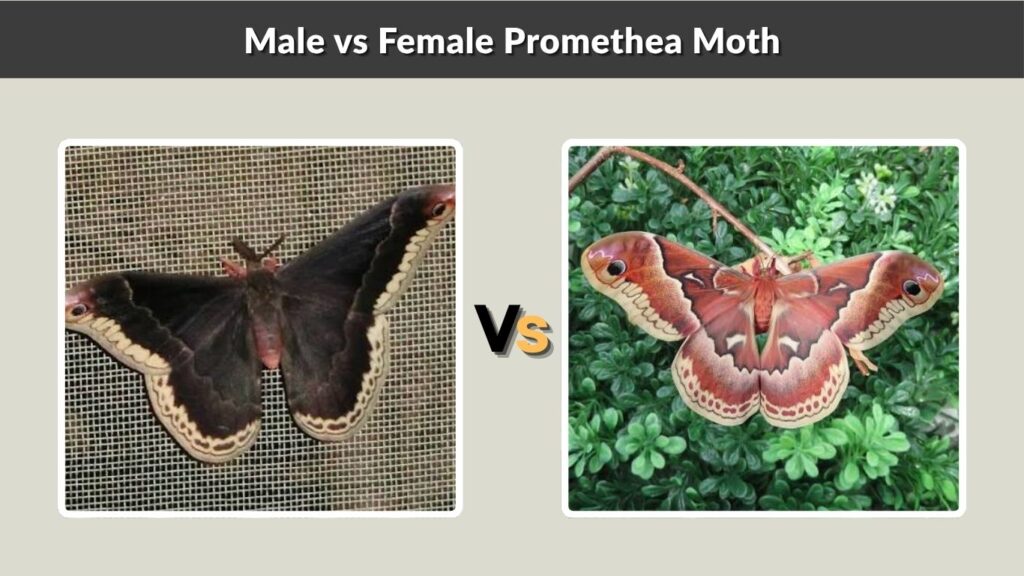
Promethea moths show unusually strong sexual dimorphism, meaning males and females look noticeably different. This is one of the easiest ways to identify the species. Males are usually much darker and often fly during daylight, while females tend to be reddish brown and are more active later in the day or at night.
Male Promethea Moth
Male Promethea moths usually have:
- Dark brown to nearly black wings
- Pale borders along the wings
- Large, feathery antennae
- Narrower abdomen than females
- Strong daytime flight behavior
- Fast and active movement while searching for females
The male’s large antennae are designed to detect pheromones released by females over considerable distances.
Female Promethea Moth
Females are noticeably different in appearance. They are generally reddish brown or rusty colored and may resemble some other giant silk moths at first glance.
Their bodies are heavier, and their antennae are less feathery than those of males. After mating, females search for suitable host plants where they can deposit eggs.
Promethea Moth Caterpillar
Promethea moth caterpillars pass through several growth stages called instars. Young larvae look quite different from mature caterpillars. As they grow, they become larger, greener, and more distinctive, eventually developing brightly colored knobs or tubercles near the front and rear portions of their bodies.
Promethea Moth Caterpillar Identification
Mature caterpillars often have:
- Bright green bodies
- Smooth-looking skin
- Four reddish or orange projections near the front
- A yellow projection near the rear
- Small dark spots along the body
- Thick, cylindrical shape
- Length of roughly 2 to 3 inches when mature
These colorful projections may look threatening, but Promethea moth caterpillars are not regarded as dangerous stinging caterpillars.
Promethea Moth Caterpillar Food
The caterpillars feed on leaves from a variety of trees and shrubs, including:
- Spicebush
- Sassafras
- Tulip tree
- Wild cherry
- Ash
- Magnolia
- Sweetbay
- Lilac
- Bayberry
- Several other woody plants
Diet preferences can vary by region. Caterpillars typically remain on or near the plant where the female originally placed her eggs.
Promethea Moth Cocoon and Pupa
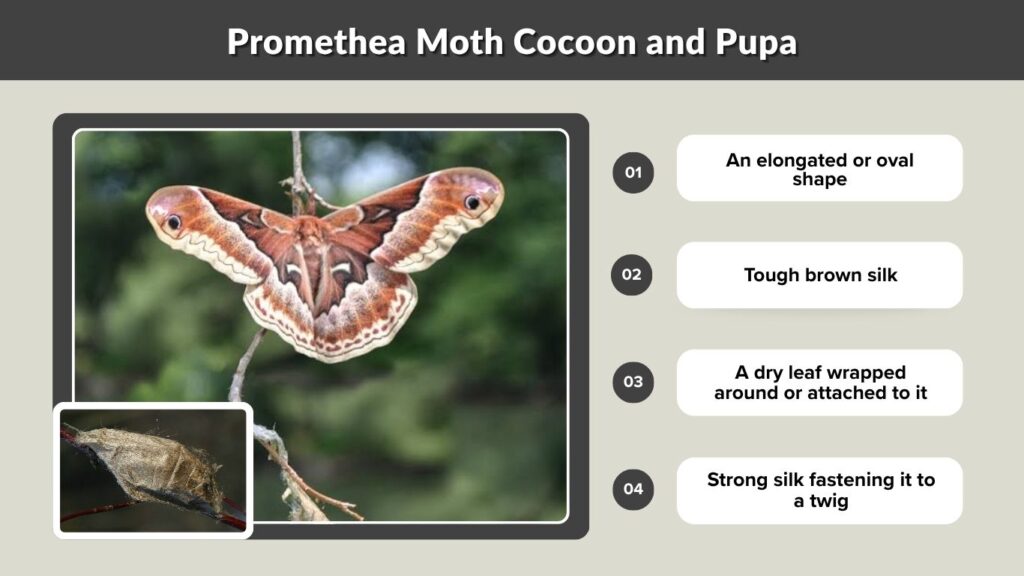
The Promethea moth cocoon is particularly interesting because the caterpillar often incorporates a living leaf into its construction. Before pupating, the larva secures the leaf to a branch with strong silk and then wraps itself inside. Even after the leaf dries and falls from the tree, the silk attachment may keep the cocoon hanging securely.
What Does a Promethea Moth Cocoon Look Like?
A Promethea moth cocoon usually has:
- An elongated or oval shape
- Tough brown silk
- A dry leaf wrapped around or attached to it
- Strong silk fastening it to a twig
- A firm texture surrounding the pupa
- Excellent camouflage among dead leaves
These cocoons are particularly noticeable during winter after surrounding foliage has fallen.
When Do Promethea Moths Emerge?
Adult emergence depends on climate and location. In many northern areas, the moth spends winter inside the cocoon and emerges during late spring or early summer.
Warmer regions may support a longer season and sometimes additional generations. Once the adult emerges, it expands its wings and waits for them to harden before flying.
Promethea Moth Life Cycle
The Promethea moth undergoes complete metamorphosis, passing through egg, larva, pupa, and adult stages. Most feeding and physical growth occur during the caterpillar stage. Adults have greatly reduced mouthparts and do not consume food, so their brief adult lives are devoted almost entirely to finding mates and producing the next generation.
Life Cycle Stages
The cycle follows these stages:
- Egg: Female lays eggs on suitable host plants.
- Larva: Caterpillars hatch and begin eating leaves.
- Instars: Larvae molt several times while increasing in size.
- Cocoon: Mature caterpillar spins a tough silk cocoon.
- Pupa: Transformation occurs safely inside the cocoon.
- Adult: The moth emerges, mates, and reproduces.
Eggs generally hatch after a relatively short development period during warm weather.
Promethea Moth Lifespan
Adult Promethea moths usually live only for a short period, often around one to two weeks. Because they do not eat, they depend entirely on energy stored during the caterpillar stage.
Females spend their adult lives attracting males, mating, and laying eggs. Males devote much of their time to locating receptive females.
What Do Promethea Moths Eat?
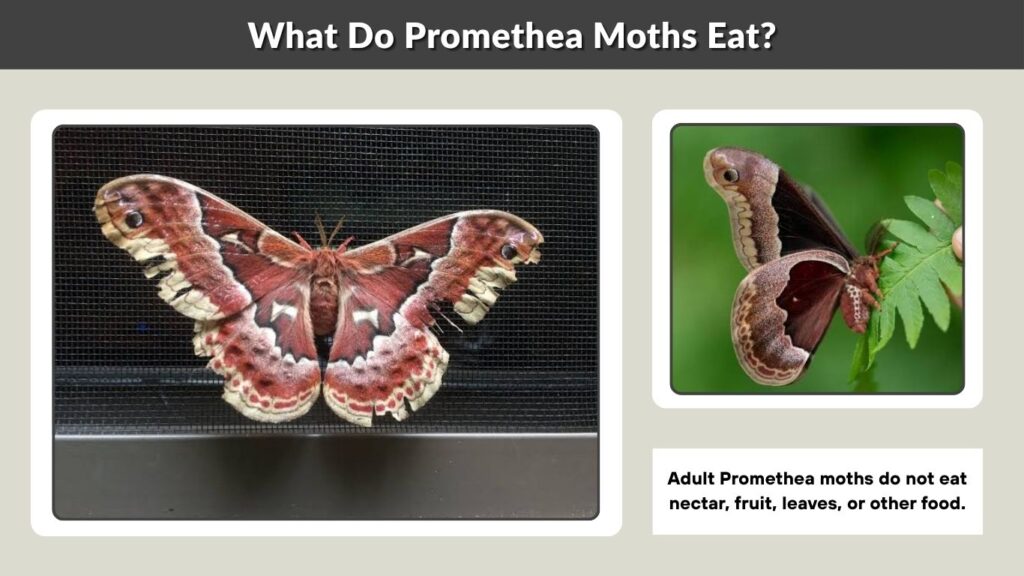
The answer depends on the stage of life. Promethea caterpillars eat plenty of plant foliage, but adult moths do not feed. This is typical of many large Saturniidae moths. Their adult mouthparts are nonfunctional, so all the energy needed for flight and reproduction comes from reserves accumulated while they were caterpillars.
Adult Promethea Moth Diet
Adult Promethea moths do not eat nectar, fruit, leaves, or other food. Their digestive and mouth structures are not designed for regular feeding.
This explains their short adult lifespan. Once their stored energy is exhausted, the moths die naturally after completing reproduction.
Promethea Moth Range and Habitat
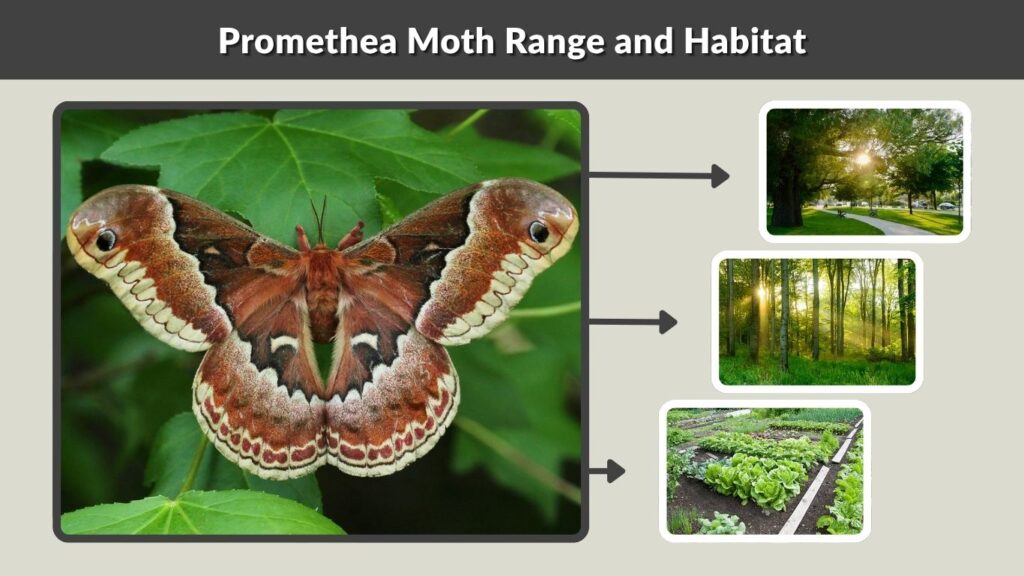
Promethea moths occur mainly across eastern North America. They are associated with deciduous forests, woodland edges, parks, suburban landscapes, and gardens where suitable caterpillar host plants grow. They can also occur around cities and towns when native trees and shrubs provide enough food for developing larvae.
Where Are Promethea Moths Found?
They may be encountered in:
- Eastern United States
- Parts of southern Canada
- Deciduous forests
- Woodland edges
- Parks
- Gardens
- Suburban neighborhoods
- Areas containing spicebush and other host plants
They are reported from states such as Ohio, Michigan, New Jersey, and many other parts of the eastern United States, as well as portions of Ontario.
FAQs
1. Is a Promethea moth rare?
Promethea moths are not generally considered extremely rare, but adults can be difficult to notice because they live for only a short period. Their abundance also varies with habitat quality, host plant availability, climate, and geographic region.
2. What do Promethea moth caterpillars eat?
Promethea caterpillars eat leaves from several woody plants, including spicebush, sassafras, tulip tree, wild cherry, ash, magnolia, lilac, and bayberry. Their preferred host plant may differ depending on the local population.
3. Do adult Promethea moths eat?
No. Adult Promethea moths have reduced, nonfunctional mouthparts and do not feed. They rely on energy stored during the caterpillar stage to fly, find mates, reproduce, and lay eggs.
4. How can you tell a male from a female Promethea moth?
Males are usually dark brown to nearly black and have very large feathery antennae. Females are typically reddish brown and have heavier abdomens. Males are also unusual among giant silk moths because they commonly fly during daylight.
5. How long do Promethea moths live?
The adult stage generally lasts only about one to two weeks. However, the complete life cycle is much longer because the moth spends considerable time as an egg, caterpillar, and pupa, sometimes overwintering inside its cocoon.
