
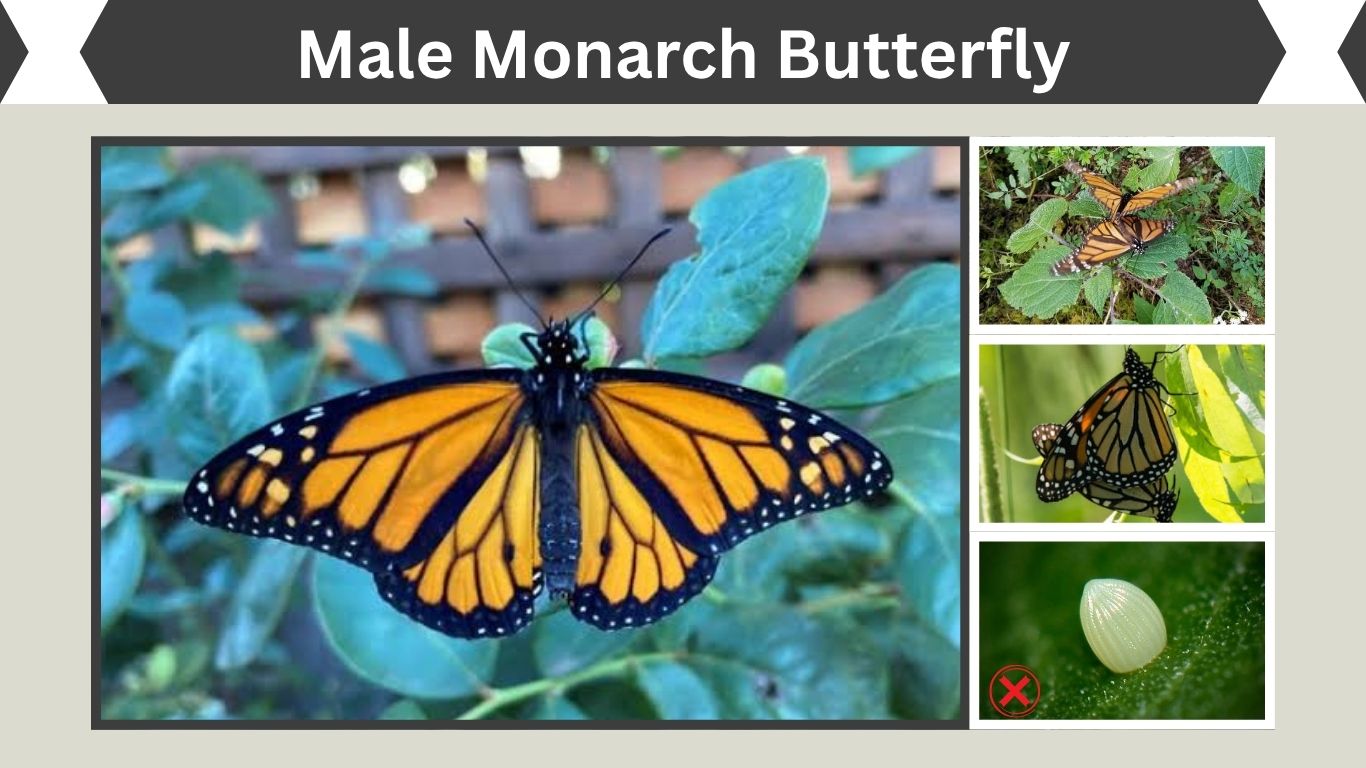
A male monarch butterfly can be identified by two small black spots on its hindwings and relatively thin black wing veins. Although male and female monarchs share the same bright orange-and-black pattern, several visible differences make it possible to tell them apart. These differences are easiest to see when the butterfly’s wings are fully open. Learning the markings, body features, and behavior of male monarchs can help butterfly watchers identify them confidently.
What Does a Male Monarch Butterfly Look Like?
Male monarch butterflies have vivid orange wings crossed by black veins and surrounded by a thick black border containing small white spots. Their overall appearance is very similar to that of females, but males possess a distinctive marking that females lack.
The clearest male characteristic is a black spot on each hindwing. These spots are scent-scale patches associated with courtship and are often called androconial spots.
Main Male Monarch Butterfly Markings
A male monarch usually has the following features:
- One black spot on each hindwing
- Narrower black veins across the wings
- A slightly slimmer abdomen
- Bright orange wing panels
- Black borders with two rows of white spots
- A wingspan generally measuring about 3.5 to 4 inches
The black hindwing spots are visible from above when the wings are open. Depending on the viewing angle, they may also be faintly visible through the underside of the wings.
Male vs Female Monarch Butterfly
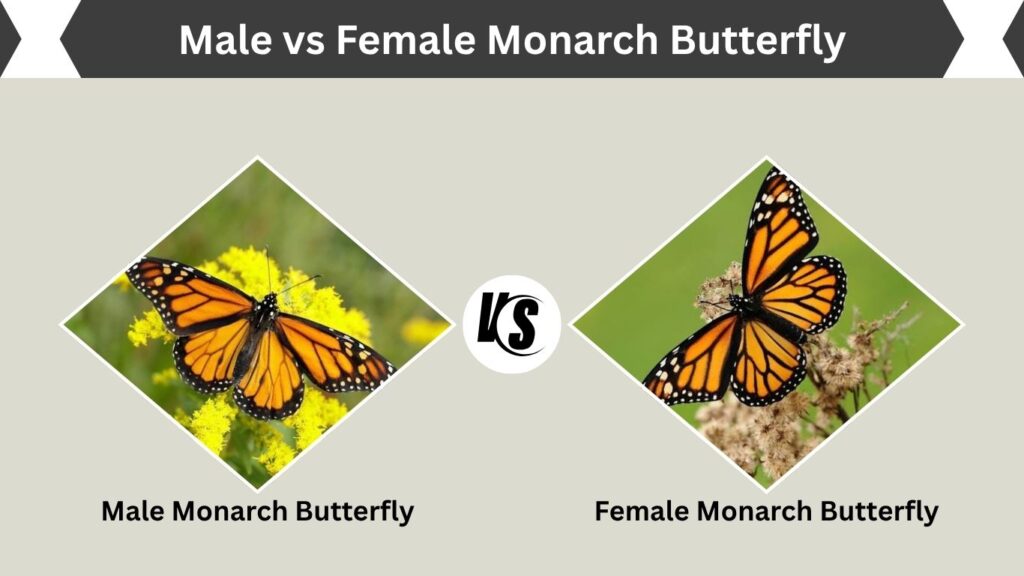
The easiest way to identify a monarch’s sex is to examine its hindwings and wing veins. Males have two visible black spots, while females do not. Female monarchs generally have thicker and darker veins.
| Feature | Male Monarch Butterfly | Female Monarch Butterfly |
|---|---|---|
| Hindwing spots | One black spot on each hindwing | No black scent spots |
| Wing veins | Relatively thin | Thicker and darker |
| Abdomen | Often slimmer | Frequently broader |
| Overall appearance | May look slightly brighter | May look slightly darker |
| Egg laying | Cannot lay eggs | Lays eggs on milkweed |
| Reproductive role | Produces sperm and mates | Mates and produces eggs |
Wing markings are much more dependable than size or color. Individual butterflies vary, and lighting can make one monarch appear brighter or darker than another.
How to Tell a Male From a Female Monarch Butterfly
To tell whether a monarch is male or female, wait until it opens its wings and look at the lower pair, known as the hindwings. A male will display one round or oval black spot on a vein of each hindwing.
Look for the Two Black Spots
The paired black spots are the most reliable visible signs of a male monarch. Each spot is located near the center of the hindwing along a black vein.
Females completely lack these specialized markings. A dark patch caused by damage, shadow, or overlapping scales should not be mistaken for a male scent spot. True male spots normally appear in matching positions on both hindwings.
Examine the Black Wing Veins
Male monarchs usually have thinner black veins. This allows more orange to show between the veins and may give the male a brighter or less heavily marked appearance.
Females have noticeably broader veins, especially when viewed beside a male. Their wings may consequently look darker or more strongly outlined.
Observe the Abdomen Carefully
A male’s abdomen may appear relatively narrow and straight. A female’s abdomen can look fuller, particularly when she is carrying mature eggs.
However, abdomen size is not always reliable. Feeding, body position, age, and viewing angle can change how the abdomen appears. The wing spots remain the best identification feature.
What Are the Black Spots on a Male Monarch?
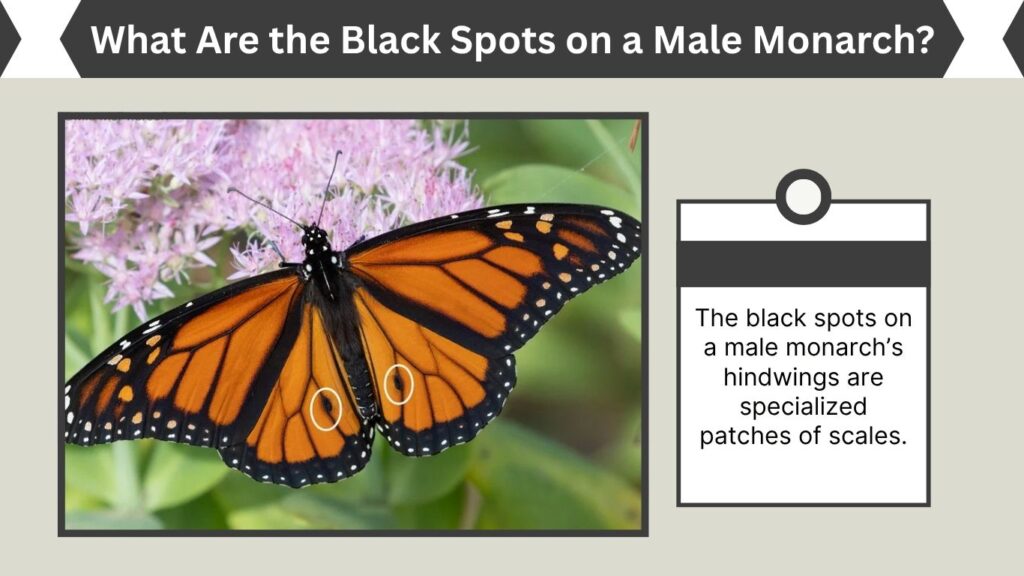
The black spots on a male monarch’s hindwings are specialized patches of scales. In many butterflies, structures of this kind help release chemical signals used during courtship.
Although the monarch’s courtship process also relies heavily on flight, contact, and other cues, the spots remain an important sexual characteristic. They are not eyes, injuries, parasites, or signs of disease.
A healthy male normally has one spot on each hindwing. The spots may vary slightly in size and visibility, especially in worn or older butterflies whose wing scales have faded.
Do Male and Female Monarch Butterflies Look the Same?
Male and female monarch butterflies share the same basic coloration, wing shape, and warning pattern. Both have orange wings, black veins, black borders, and white border spots. From a distance, they can look almost identical.
The differences become clear during close observation. Males have black hindwing spots and thinner veins, while females lack the spots and have heavier black venation.
Young, freshly emerged monarchs often have especially vivid colors. Older butterflies of either sex may appear faded, scratched, or partially transparent because wing scales gradually wear away.
Male Monarch Butterfly Behavior

Male monarchs spend much of their adult lives searching for food and potential mates. They drink nectar from flowers to obtain the energy needed for flight, migration, and reproduction.
Searching for Females
Males may patrol areas where monarchs gather, particularly sunny fields, gardens, and locations containing abundant nectar plants. They sometimes approach or chase other monarchs to determine whether they are receptive females.
A male may follow a female in flight and attempt to bring her toward the ground during courtship. Not every attempt results in successful mating.
Perching and Chasing
Male monarchs may perch on vegetation and watch for passing butterflies. They can chase other males or unrelated butterfly species, although this behavior does not necessarily mean they are defending a permanent territory.
Their activity depends on temperature, sunlight, wind, nectar availability, and the presence of other monarchs.
Feeding on Nectar
Like female monarchs, males feed primarily on flower nectar as adults. Popular nectar sources include goldenrod, asters, blazing star, coneflowers, milkweed flowers, and many other native flowering plants.
Milkweed is essential for monarch caterpillars, but adult males can drink from many different flower species.
Male Monarch Butterfly Mating
During mating, the male transfers sperm and nutrients to the female in a reproductive package known as a spermatophore. The pair may remain connected for several hours.
Females can mate more than once during their lives. The nutrients received during mating may support egg production and reproductive activity.
Male monarch butterflies do not automatically die after mating. A healthy male may mate multiple times, although reproduction uses energy and can contribute to physical wear.
Do Male Monarch Butterflies Lay Eggs?
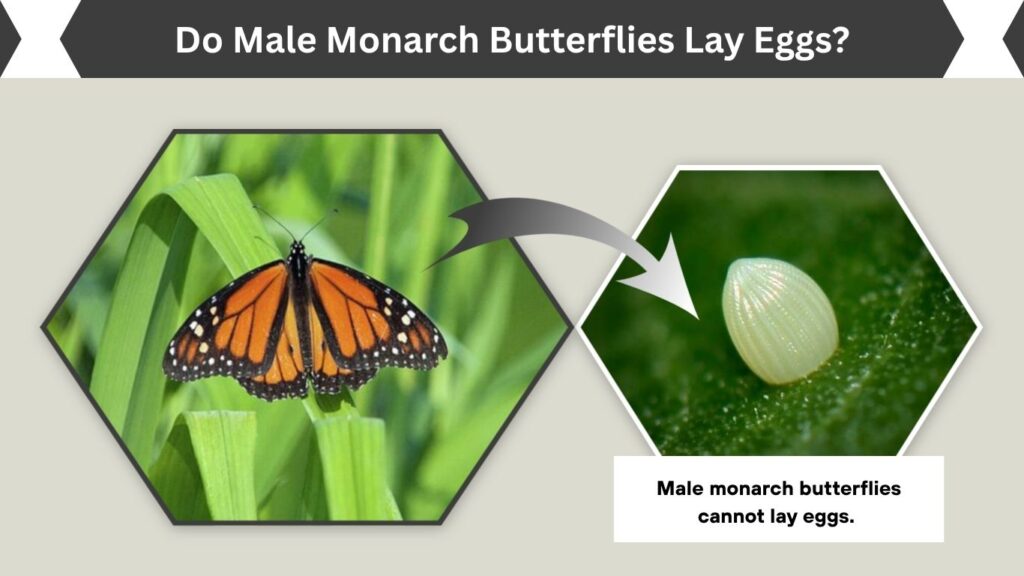
Male monarch butterflies cannot lay eggs. Only females possess the reproductive organs required to produce and deposit eggs.
After mating, a female searches for suitable milkweed plants. She usually places individual eggs on the underside of milkweed leaves, flower buds, or tender plant growth. Milkweed is necessary because newly hatched monarch caterpillars depend on it for food.
A monarch observed closely inspecting milkweed and touching the plant with the end of its abdomen is likely a female preparing to lay an egg.
Are Male Monarch Butterflies Larger Than Females?
Male and female monarch butterflies overlap considerably in size. Males may sometimes have slightly larger wings, while females may have broader abdomens, but size alone is not a dependable method of identification.
Food availability during the caterpillar stage, temperature, genetics, seasonal generation, and environmental conditions can all affect adult size.
A small male and a large female are both normal. Checking the black hindwing spots and the thickness of the wing veins provides a much more accurate answer.
Are Male Monarch Butterflies Territorial?
Male monarchs can behave aggressively toward other butterflies, especially when searching for mates. They may chase, bump, or briefly grapple with other monarchs in the air.
However, they are not usually considered strongly territorial in the same way as some other butterfly species. Their behavior is more accurately described as patrolling, perching, mate searching, and competing.
These encounters may look like fighting, but they are generally brief and do not usually cause serious injury.
Male Monarch Butterfly Identification Tips
A clear identification is easiest when the monarch is resting with its wings spread. Observers should avoid handling the butterfly unnecessarily because touching its wings can remove delicate scales.
Use binoculars, a camera zoom, or close observation from a respectful distance. Look for the two symmetrical hindwing spots first. Then check whether the black veins appear thin or heavy.
| Observation | Likely Identification |
|---|---|
| Two black hindwing spots and thin veins | Male |
| No hindwing spots and thick veins | Female |
| Butterfly placing eggs on milkweed | Female |
| Spots unclear because wings are closed | Sex cannot be confirmed |
| One irregular dark mark only | Possibly damage, not a male spot |
FAQs
What is a male monarch butterfly called?
A male monarch butterfly is simply called a male monarch. There is no widely used special term for the male. Both males and females belong to the same species, Danaus plexippus, and share the familiar orange, black, and white warning coloration.
How can you quickly identify a male monarch butterfly?
Look for one black spot on each hindwing when the butterfly opens its wings. These paired spots are the easiest male identification marks. Males also tend to have thinner black wing veins than females, but vein thickness is best used as a secondary clue.
Do male monarch butterflies have black spots?
Yes. A male has two specialized black spots, with one located on each hindwing. These are patches of modified scales associated with reproduction. Female monarchs do not have them, making the paired spots the most reliable visual difference between the sexes.
Do male monarch butterflies die after mating?
Male monarch butterflies do not normally die immediately after mating. A male may survive and mate again, depending on his age, condition, energy reserves, and environmental risks. Like other monarchs, males eventually die from aging, weather, predators, disease, or exhaustion.
Can male monarch butterflies lay eggs?
No. Male monarch butterflies cannot produce or lay eggs. Their reproductive role is to mate and transfer sperm to females. After mating, the female searches for milkweed plants and lays her eggs individually on suitable leaves, buds, or other tender plant parts.
