
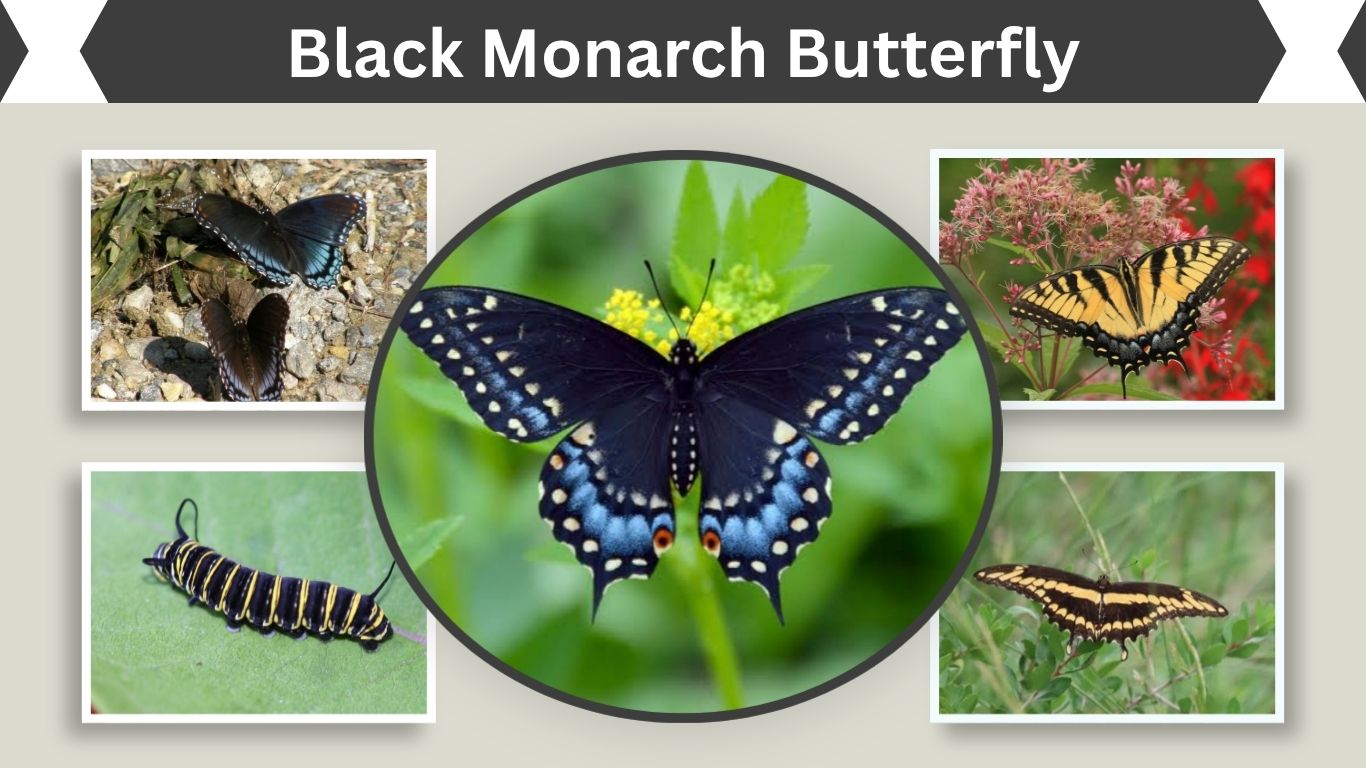
A black monarch butterfly may refer to a normal monarch with unusually dark wings, a female monarch with heavy black veins, a butterfly that resembles a monarch, or simply black monarch artwork used in tattoos and designs. True monarch butterflies are not completely black. Adult monarchs normally have orange or orange-brown wings crossed by black veins, surrounded by broad black borders with white spots. Lighting, wing wear, individual variation, disease, and species confusion can all make a butterfly appear much darker than expected.
Are There Black Monarch Butterflies?
There is no separate species commonly recognized as an all-black monarch butterfly. The monarch, scientifically known as Danaus plexippus, normally has orange wings with black veins and borders. Some individuals appear darker than others, but a healthy adult monarch should still show orange or brownish-orange areas on its wings.
A butterfly may be described as a black monarch because:
- It is a dark female monarch.
- Its wings are closed or poorly lit.
- The orange scales are faded or damaged.
- It is photographed against a dark background.
- It is another dark butterfly mistaken for a monarch.
- It is a stylized tattoo, drawing, or digital design.
An apparently all-black butterfly is more likely to be another species than a natural monarch color form.
What Does a Real Monarch Butterfly Look Like?
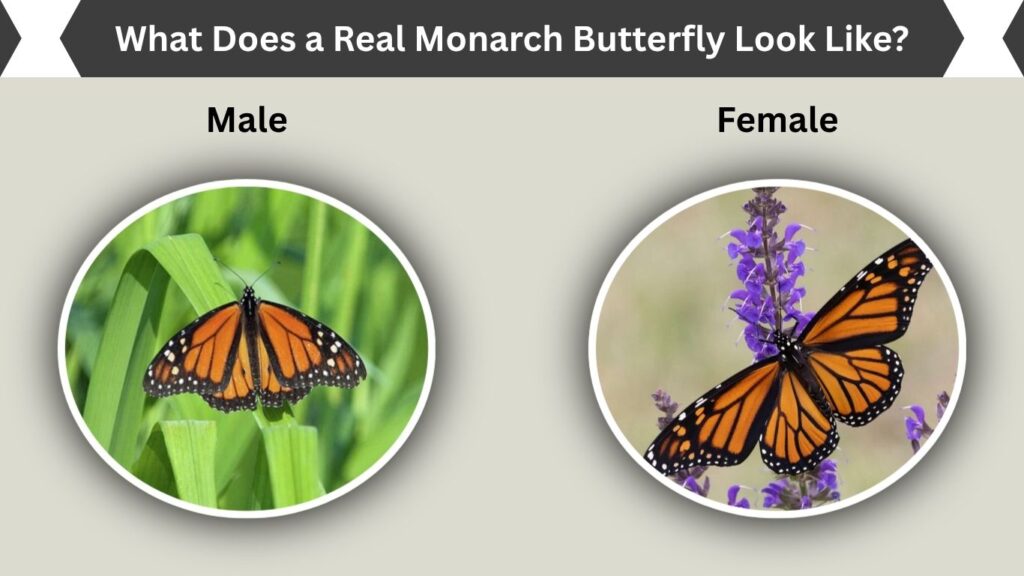
Adult monarchs are large butterflies with bright orange or orange-brown wings. Strong black veins divide the wings into several sections, while black outer borders contain rows of white spots.
The body is mainly black with small white markings. This black, orange, and white combination makes the monarch one of North America’s most recognizable butterflies.
Male Monarch
Male monarchs tend to be brighter orange and have thinner black wing veins. Each hindwing has a small black scent-scale patch that looks like a round or oval spot.
These black spots are not signs of disease or damage. They are normal features used to distinguish males from females.
Female Monarch
Female monarchs often look darker because their black wing veins are wider and more heavily defined. Their orange areas may also appear more brownish or muted.
A dark female seen in shade can therefore be mistaken for a “black monarch butterfly.” Females lack the distinct black scent patches found on male hindwings.
| Feature | Male monarch | Female monarch |
|---|---|---|
| Overall color | Usually brighter orange | Often darker orange-brown |
| Black veins | Narrower | Wider and more noticeable |
| Hindwing spots | One dark scent patch per hindwing | No scent patches |
| Overall appearance | Lighter and brighter | Heavier black pattern |
Can Monarch Butterflies Be Completely Black?
A healthy adult monarch is not normally completely black. Even dark females retain visible orange or brown-orange wing panels.
A monarch can appear nearly black when:
- It is viewed in deep shade.
- Its wings are folded.
- The underside is facing the observer.
- The photograph is underexposed.
- Its wings are wet.
- Wing scales are damaged.
- The butterfly has died or begun decomposing.
Very dark coloration may also result from developmental problems, but this should not be treated as a normal color variety without expert identification.
Black and Blue Monarch Butterfly
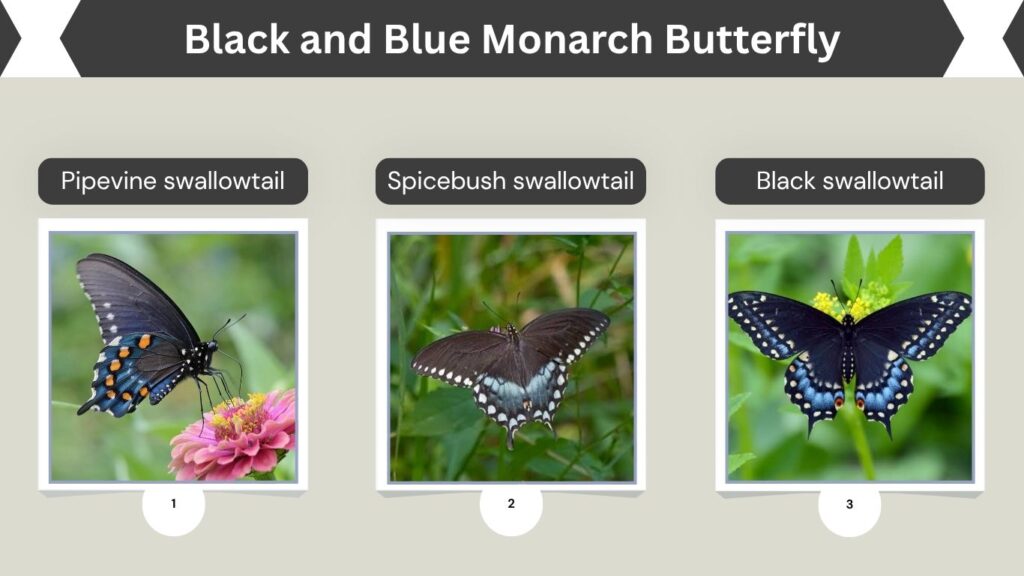
A black and blue butterfly is generally not a monarch. Monarchs do not naturally have bright blue wing panels.
Several butterflies with blue-black wings may be casually mislabeled as blue monarchs, especially in photographs, artwork, tattoos, and online product listings. Possible candidates include:
- Pipevine swallowtail
- Spicebush swallowtail
- Black swallowtail
- Red-spotted purple
- Great Mormon
- Blue tiger butterfly
- Common crow butterfly
Black swallowtails and pipevine swallowtails can show blue or blue-green iridescence on their hindwings. Their wing shapes are noticeably different from monarch wings, and most swallowtails have tail-like projections.
Swallowtail vs. Monarch
A swallowtail usually has broader hindwings, curved outer margins, and tails or tail-like points. Monarch hindwings are rounded and lack tails.
Blue-black swallowtails may also display orange, red, yellow, or cream-colored spots. Although the colors can loosely resemble monarch markings, the overall pattern and wing structure are different.
Black and White Monarch Butterfly
True monarch butterflies are not naturally black and white. The term usually describes:
- A monochrome photograph
- A tattoo design
- Clip art or line art
- A coloring page
- A faded or edited image
- Another butterfly species
Monarchs do have white spots in their black wing borders and on the black body. However, their large central wing sections are normally orange.
A living butterfly with mainly black and white wings may be a white admiral, zebra swallowtail, paper kite, tree nymph, or another unrelated species.
Black and Yellow Monarch Butterfly
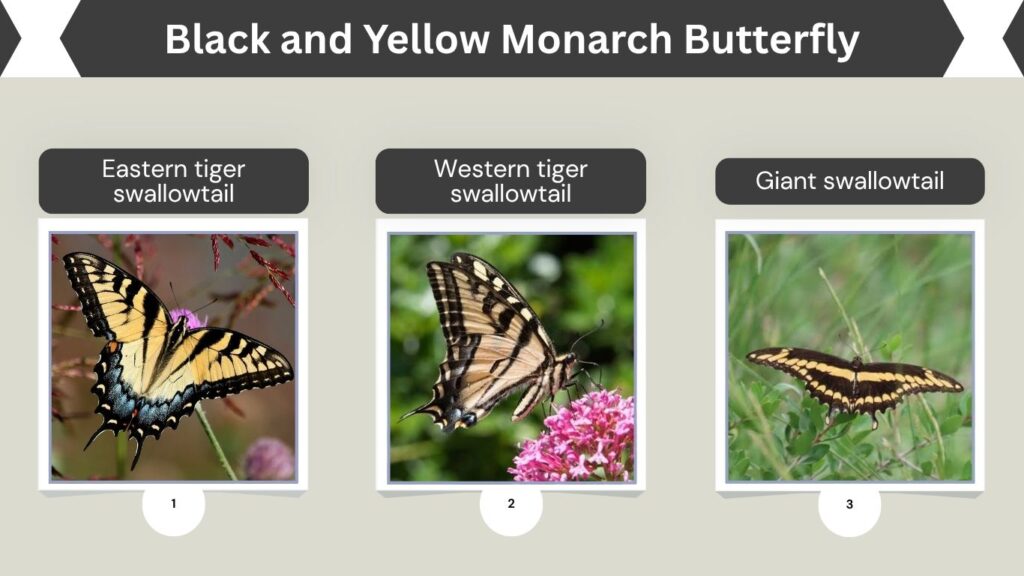
Monarchs may sometimes appear yellow-orange under bright light, but they are not normally described as yellow-and-black butterflies. A strongly yellow butterfly is likely to be a different species.
Common yellow-and-black butterflies include:
- Eastern tiger swallowtail
- Western tiger swallowtail
- Giant swallowtail
- Anise swallowtail
- Zebra swallowtail
- Clouded yellow
- Southern dogface
Tiger swallowtails are especially likely to be confused with monarchs by casual observers. They have yellow wings marked by black stripes, while monarchs have orange wings divided by branching black veins.
A swallowtail’s hindwing tails provide one of the easiest identification clues.
Orange and Black Butterflies That Are Not Monarchs
Several butterflies resemble monarchs because they share orange-and-black warning coloration.
Viceroy Butterfly
The viceroy is one of the best-known monarch look-alikes. Its wings are orange with black veins and white-spotted borders.
The easiest distinction is the black line crossing each hindwing. Monarchs do not have this horizontal line. Viceroys are also generally smaller, although size alone is not reliable.
Queen Butterfly
Queen butterflies are close relatives of monarchs. They are usually darker, with rich brown, reddish-brown, or dark orange wings.
The wing veins are less strongly outlined than those of monarchs, and the forewings have white spots. Queens can appear almost chocolate-colored, making them a possible source of “black monarch” sightings. The U.S. Fish and Wildlife Service identifies queens, soldiers, and viceroys as similar species that may be confused with monarchs.
Soldier Butterfly
Soldier butterflies are brownish orange with thin black veins and spotted black borders. They resemble queens and monarchs but are often darker near the wing bases.
Painted Lady
Painted ladies are orange, black, brown, and white. They are smaller than monarchs and have more complex mottled patterns.
Their hindwings contain several small eyespots rather than the monarch’s broad orange panels and strong black vein network.
| Butterfly | Main identification clue |
|---|---|
| Monarch | Orange panels, strong black veins, white-spotted borders |
| Viceroy | Black horizontal line across each hindwing |
| Queen | Dark reddish-brown wings with fewer bold veins |
| Soldier | Brown-orange color and thinner veins |
| Painted lady | Mottled pattern and small hindwing eyespots |
| Tiger swallowtail | Yellow-and-black wings with hindwing tails |
Why Are Monarch Butterflies Orange and Black?
The monarch’s bright orange-and-black coloration acts as a warning signal. Monarch caterpillars consume milkweed and store some of the plant’s defensive chemicals in their bodies.
These compounds can make caterpillars and adult butterflies unpleasant or harmful to certain predators. The bold coloration warns potential attackers that the butterfly may not be suitable food. However, this defense is incomplete, and monarchs can still be eaten by some predators.
Black wing veins also form part of the monarch’s normal structural pattern. They should not be interpreted as discoloration or disease.
Why Is a Monarch Chrysalis Turning Black?
A darkening chrysalis can be normal or concerning, depending on its appearance and timing.
Shortly before a healthy monarch emerges, the chrysalis becomes very dark. The developing butterfly’s black, orange, and white wing pattern becomes visible through the covering. This normally occurs near the end of the pupal period and is followed by emergence.
A healthy chrysalis close to emergence may show:
- A clearly recognizable wing pattern
- Symmetrical darkening
- Orange and black markings
- A smooth, intact surface
- Emergence within approximately a day
A uniformly black, soft, leaking, misshapen, or foul-smelling chrysalis may be dead, infected, or parasitized. A dark chrysalis that remains unchanged for several days may also indicate a problem. Monarch Joint Venture notes that abnormal darkening can be associated with disease or parasitism.
What Is “Black Death” in Monarch Caterpillars?
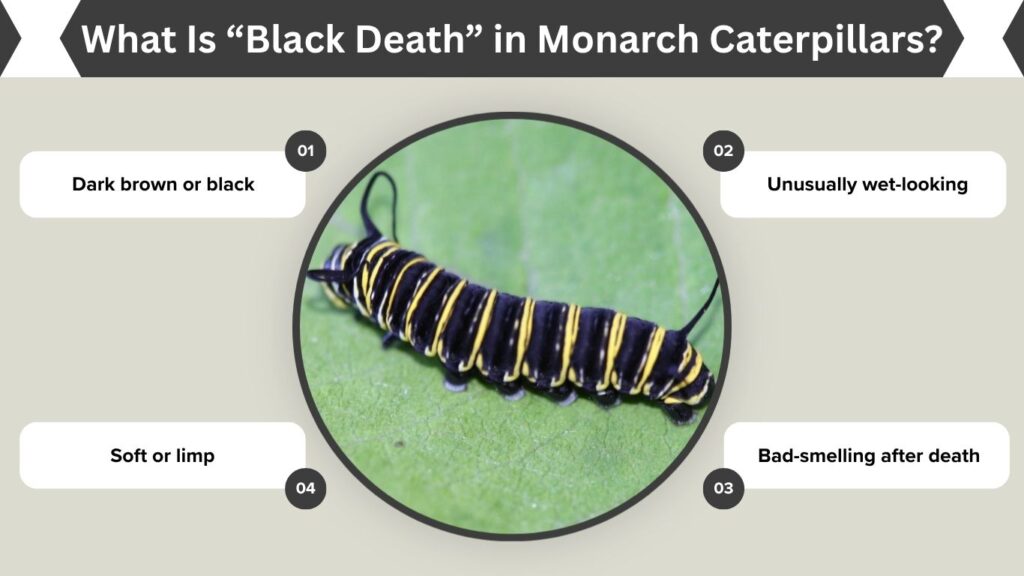
“Black death” is an informal term used when monarch caterpillars become unusually dark or black because of illness. It is not a normal black monarch color variation.
Affected caterpillars may become:
- Dark brown or black
- Soft or limp
- Inactive
- Unable to feed
- Unusually wet-looking
- Bad-smelling after death
Several bacterial or viral infections can produce similar symptoms. Diseased caterpillars should be separated from healthy ones, and rearing containers should be cleaned carefully to reduce contamination.
Black Swallow-Wort and Monarch Butterflies
Black swallow-wort is a plant that can create problems for monarch reproduction. It belongs to the same broader plant family as milkweed and may attract egg-laying females.
However, monarch caterpillars generally cannot develop successfully on black swallow-wort. A female may mistake the plant for a suitable host, leaving larvae with inadequate food.
This plant should not be confused with a black-colored monarch butterfly. Gardeners supporting monarchs should grow appropriate native milkweed species rather than relying on plants that merely resemble milkweed.
Do Monarch Butterflies Like Black-Eyed Susans?
Adult monarchs may drink nectar from black-eyed Susans when the flowers are accessible and producing nectar. These yellow flowers can contribute to a butterfly garden, particularly when planted with other species that bloom at different times.
Black-eyed Susans do not feed monarch caterpillars. Caterpillars require milkweed, while adult monarchs use a much wider range of nectar flowers.
A useful garden should therefore contain both native milkweed and diverse nectar plants.
Black Monarch Butterfly Meaning
A black monarch butterfly in tattoos, artwork, jewelry, or spiritual symbolism is usually an artistic concept rather than a scientifically distinct butterfly.
Common symbolic interpretations include:
- Personal transformation
- Survival after hardship
- Mystery
- Grief and remembrance
- Rebirth
- Independence
- Major life changes
- Strength during uncertainty
These meanings are cultural and personal rather than biological facts. A black-and-blue monarch may symbolize calmness, freedom, intuition, or emotional change, while black-and-white imagery may represent contrast, balance, memory, or simplicity.
Black Monarch Butterfly Tattoo Ideas
Black monarch tattoos often retain the monarch’s recognizable vein pattern while removing the orange color. Popular styles include:
- Fine-line black monarch
- Realistic black-and-gray monarch
- Small minimalist outline
- Monarch with flowers
- Half-butterfly, half-skull design
- Geometric monarch
- Monarch with blue highlights
- Symmetrical sternum tattoo
- Memorial monarch tattoo
- Monarch silhouette
A realistic tattoo should include the monarch’s rounded, tailless wings, branching black veins, and white-spotted outer borders.
FAQs
Is there a naturally all-black monarch butterfly?
A healthy monarch is not normally all black. Monarchs have orange or orange-brown wings with black veins, borders, and white spots. A completely black butterfly is probably another species, an unusually lit photograph, or an artistic design.
Why does my monarch butterfly look very dark?
It may be a female, as females often have wider black veins and darker orange-brown wings. Shade, folded wings, age, wetness, damage, or photography can also make a monarch appear darker than normal.
Is a black-and-blue butterfly a monarch?
Probably not. Monarchs do not naturally have bright blue wing panels. Black-and-blue butterflies are more likely to be swallowtails, red-spotted purples, blue tigers, crows, or another dark iridescent species.
How can I identify a monarch look-alike?
Check the hindwings and vein pattern. A viceroy has a black horizontal line across each hindwing. Swallowtails often have tails, while queens are darker brown with fewer strongly outlined veins.
Is a black monarch chrysalis dead?
Not necessarily. A chrysalis normally darkens immediately before the adult emerges, and its orange-and-black wings become visible. A uniformly black, soft, leaking, misshapen, or unchanged chrysalis may instead be diseased or dead.
