
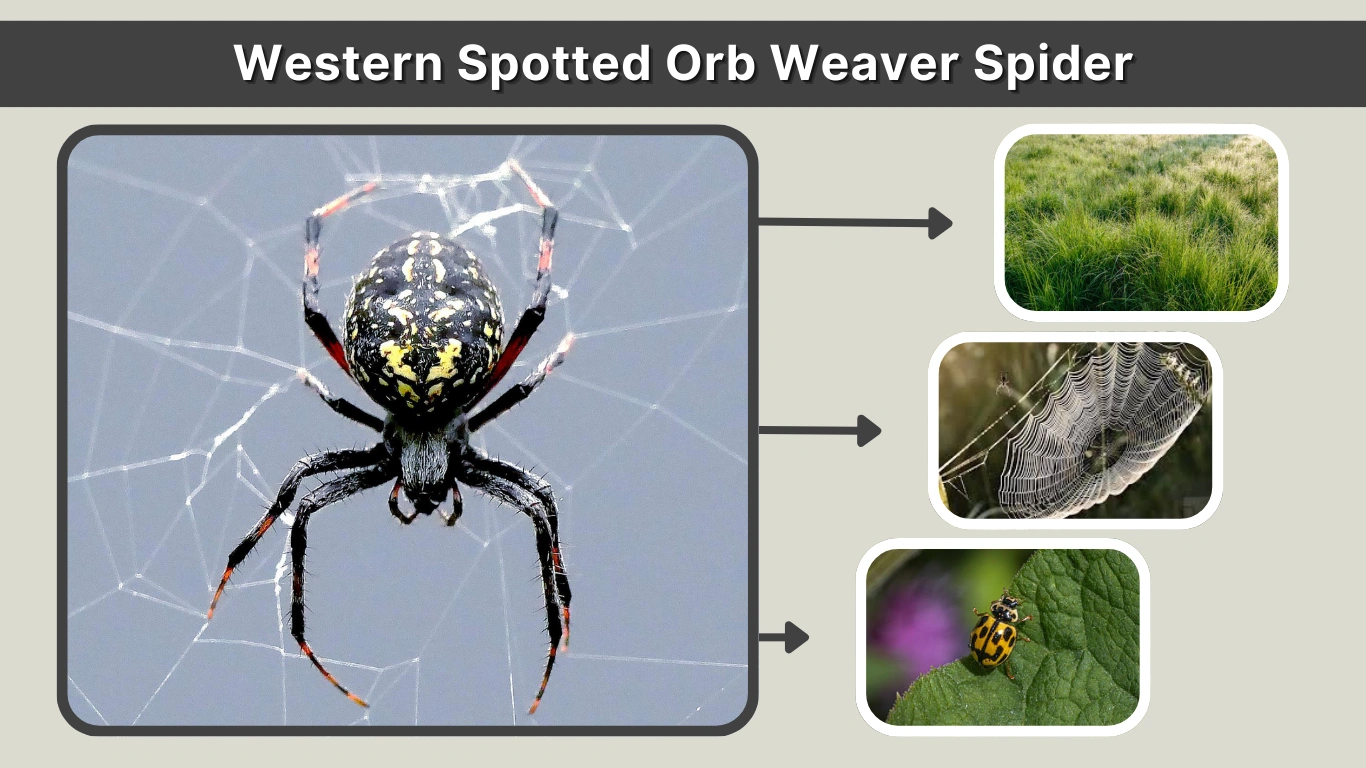
The western spotted orb weaver spider is a distinctive orb-weaving species commonly found across western North America. Known for the spotted patterns on its abdomen and its neatly constructed circular webs, this spider is often seen in gardens, woodlands, and open landscapes during the warmer months. Although its appearance may seem intimidating, the western spotted orb weaver is harmless to humans and plays an important role in controlling insect populations. Its adaptability, web-building skill, and unique markings make it an interesting spider to observe.
Western Spotted Orb Weaver Spider Classification and Background
Scientific Classification
The western spotted orb weaver spider belongs to the orb-weaver group, a family of spiders recognized for their symmetrical, wheel-shaped webs. These spiders rely on silk engineering rather than speed or strong venom to capture prey. Their classification reflects an evolutionary focus on web-based hunting, which allows them to thrive in a wide range of environments.
Origin of the Common and Scientific Names
The name “western spotted orb weaver” comes from the spotted or mottled markings found on the spider’s abdomen. These spots can vary in size and contrast, giving each individual a slightly different appearance. The name also reflects the spider’s primary distribution across western regions of North America.
Western Spotted Orb Weaver Spider Size and Body Structure
Western spotted orb weaver spiders are medium-sized orb weavers. Adult females are noticeably larger than males, typically measuring between 8 and 15 millimeters in body length. Males are smaller and slimmer, which often makes them less noticeable in or near the web.
The spider’s body features a rounded abdomen supported by relatively sturdy legs. This body structure is well suited for maintaining balance at the center of the web and for quickly responding to vibrations caused by trapped prey. The legs are adapted for sensing movement along silk threads, allowing the spider to react efficiently.
Sexual dimorphism is common in this species. Females are responsible for web construction and prey capture, while males tend to remain on the outer edges of the web or nearby vegetation.
Western Spotted Orb Weaver Spider Coloration and Markings
Coloration in the western spotted orb weaver spider can vary depending on age, environment, and individual genetics. Common colors include shades of brown, gray, tan, or muted orange. The abdomen typically displays light or dark spots that contrast with the background color, creating a speckled or mottled appearance.
These spotted patterns help provide camouflage among leaves, bark, and natural debris. In some individuals, the spots appear faint, while in others they are more pronounced. Seasonal changes and lighting conditions can also affect how bold the markings appear.
The legs are usually banded or uniformly colored, adding to the spider’s overall ability to blend into its surroundings when resting in the web.
How to Identify a Western Spotted Orb Weaver Spider
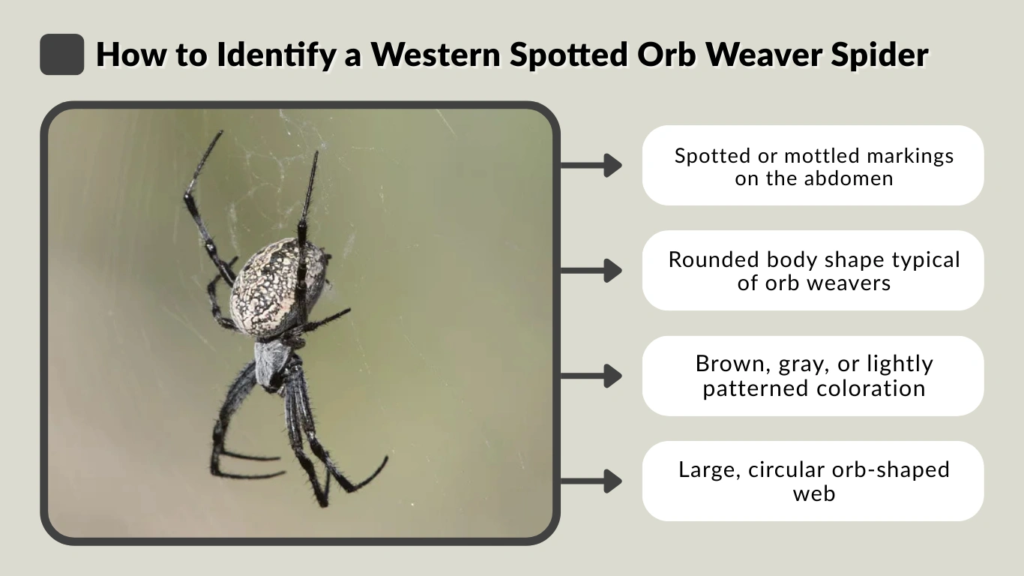
You can identify a western spotted orb weaver spider by the following features:
- Spotted or mottled markings on the abdomen
- Rounded body shape typical of orb weavers
- Brown, gray, or lightly patterned coloration
- Large, circular orb-shaped web
- Spider resting at the center or slightly off-center of the web
Western Spotted Orb Weaver Spider Habitat and Range
Typical Living Environments
Western spotted orb weaver spiders are commonly found in gardens, forest edges, open woodlands, and desert-adjacent areas. They prefer locations with stable structures for web attachment and a steady supply of flying insects. Shrubs, tall grasses, fences, and outdoor structures often serve as ideal web sites.
These spiders adapt well to both natural and semi-urban environments, making them frequent visitors to backyards and parks.
Geographic Distribution
This species is primarily found in western North America, including parts of the United States and southern Canada. Its ability to tolerate a range of climates and habitats has allowed it to establish stable populations across diverse regions.
Western Spotted Orb Weaver Spider Web Structure
The web of the western spotted orb weaver spider is a classic orb-shaped design, built to efficiently capture flying insects. Webs are typically medium to large in size and are placed at heights that intersect common insect flight paths.
Strong radial threads form the web’s framework, while sticky spiral threads trap prey upon contact. The spider usually monitors the web from the center, responding quickly to vibrations. Webs are often repaired or rebuilt as needed, especially after weather-related damage.
Western Spotted Orb Weaver Spider Behavior
Web-Building Patterns
Western spotted orb weaver spiders usually build or repair their webs during the evening or nighttime hours. Constructing webs at this time reduces interference and ensures the web is ready when flying insects become active. If a web is damaged by wind, rain, or passing animals, the spider often repairs the affected areas rather than rebuilding the entire structure.
Feeding and Resting Behavior
After completing the web, the spider typically waits at the center or slightly off to the side, remaining motionless for long periods. When prey becomes trapped, vibrations along the silk alert the spider immediately. The spider then rushes toward the insect, wraps it in silk, and immobilizes it before feeding.
What the Western Spotted Orb Weaver Spider Eats
The western spotted orb weaver spider feeds primarily on flying insects that become entangled in its web, including:
- Flies and mosquitoes
- Moths and butterflies
- Small flying beetles
- Occasional wasps or bees
This broad diet allows the spider to thrive in a wide range of environments, particularly during seasons with high insect activity.
Western Spotted Orb Weaver Spider Reproduction and Life Cycle
Mating typically occurs in late summer. Male spiders carefully approach females to avoid being mistaken for prey. After successful mating, the female produces one or more egg sacs, which are hidden in protected locations such as under leaves, bark, or nearby structures.
Each egg sac contains hundreds of eggs. Spiderlings hatch but remain inside the sac during colder months. In spring, they emerge and disperse to establish their own territories. Most adult spiders die before winter, completing a single-year life cycle.
Natural Enemies of the Western Spotted Orb Weaver Spider
Despite their effective webs, western spotted orb weaver spiders face several natural threats:
- Birds that remove spiders from their webs
- Parasitic wasps that attack egg sacs
- Strong winds and heavy rainfall
- Human disturbance in gardens and outdoor areas
Camouflage and strategic web placement help reduce predation, but survival rates remain relatively low.
Western Spotted Orb Weaver Spider and Humans
Western spotted orb weaver spiders are not aggressive and rarely bite humans. When bites occur, they are usually mild and cause minor redness or irritation. These spiders prefer to retreat rather than defend themselves when disturbed.
They are beneficial to humans because they help control insect populations naturally. Their presence in gardens and outdoor spaces often indicates a healthy local ecosystem, and many people choose to leave their webs undisturbed.
FAQs
Is the western spotted orb weaver spider dangerous to humans?
The western spotted orb weaver spider is not considered dangerous. It is shy and non-aggressive, and bites are rare. If a bite does occur, it typically results in mild irritation similar to a small insect bite.
How can you identify a western spotted orb weaver spider?
This spider can be identified by its rounded body, spotted abdominal markings, and large circular orb web. It is commonly seen resting at the center of its web in gardens, woodlands, and open areas.
Where are western spotted orb weaver spiders most commonly found?
Western spotted orb weaver spiders are found primarily in western North America. They inhabit gardens, forest edges, parks, and desert-adjacent areas where flying insects are abundant.
When are western spotted orb weaver spiders most active?
They are most active during late summer and early fall. Web building usually occurs in the evening, while feeding activity peaks during times when flying insects are most abundant.
Does the western spotted orb weaver spider rebuild its web often?
Western spotted orb weaver spiders regularly repair their webs and may rebuild them entirely if damaged. Web construction usually takes place at night to ensure the web is effective during the following day.
