
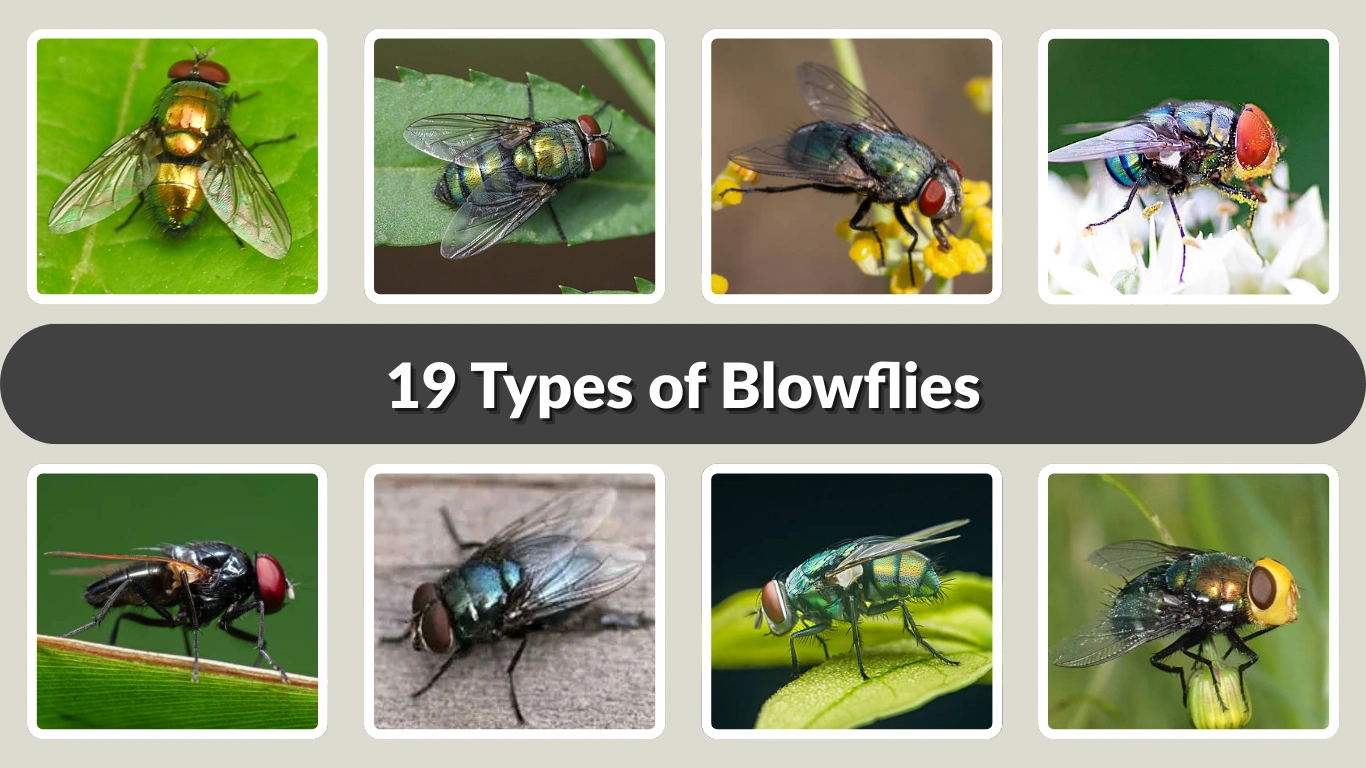
Blowflies are brightly colored, fast-breeding insects commonly found near decaying organic matter. They play essential roles in decomposition, ecology, and even forensic investigations. While some species are harmless, others can be major pests or medically significant. This guide explores 19 different types of blowflies, their defining traits, behaviors, and life cycles. Understanding these species helps identify them in nature, manage infestations, and recognize their ecological importance.
1. Bluebottle Fly
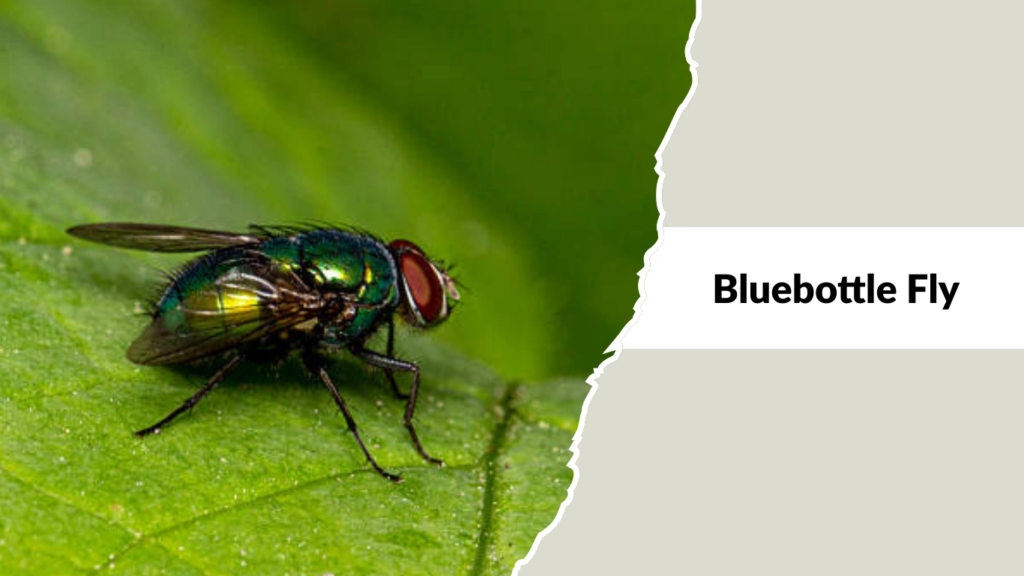
The Bluebottle Fly is one of the most recognizable blowflies, known for its metallic blue body and loud buzzing. Often found near decaying matter, it plays an important ecological role but can also become a household nuisance.
Identification
- Metallic blue or blue-green body
- Red eyes with clear segmentation
- Black legs with fine bristles
- Distinctive loud buzzing when flying
- Wings held slightly apart when at rest
Habitat
Bluebottle flies thrive in environments rich in organic material. They are commonly found in urban areas, farmland, woodland edges, and anywhere with decaying matter. They frequently enter homes seeking food sources or places to lay eggs.
Behaviors
These flies are strong fliers, often attracted to carrion, garbage, pet waste, and rotting food. They are among the first insects to locate dead animals, making them important in forensic studies. Bluebottles are also attracted to flowers, feeding on nectar when available.
Diet and Lifecycle
Adult bluebottle flies feed on sugary substances, nectar, and protein-rich decaying material. Females lay eggs on carrion or waste, where larvae (maggots) develop. The lifecycle—from egg to adult—can complete in as little as 2–3 weeks depending on temperature and food availability.
2. Greenbottle Fly
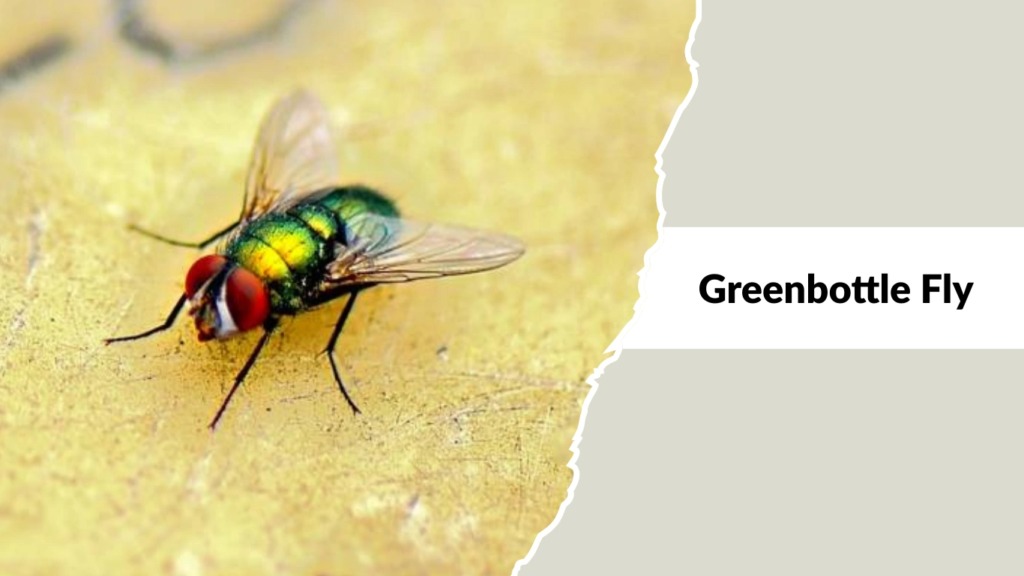
The Greenbottle Fly is a brightly colored blowfly known for its metallic green sheen. Common around decaying organic matter, it plays a major role in decomposition and is frequently used in forensic entomology.
Identification
- Metallic green body with golden or blue reflections
- Bright red compound eyes
- Clear wings with light brown veins
- Slightly smaller and slimmer than bluebottle flies
- Fast, darting flight patterns
Habitat
Greenbottle flies are found in urban areas, forests, farms, and anywhere with decaying material. They prefer moist environments for egg-laying and often gather around trash bins, carcasses, compost piles, and animal waste.
Behaviors
These flies are highly attracted to carrion and decomposing matter, arriving quickly after a host dies. They also visit flowers for nectar, helping with incidental pollination. Greenbottles are active during warm daylight hours and often gather in sunny outdoor areas.
Diet and Lifecycle
Adults feed on nectar, rotting meat, and other decaying organic substances. Females lay eggs on moist carrion or waste, where maggots develop rapidly. The full lifecycle—from egg to adult—typically takes 2–3 weeks, but may shorten in hotter climates.
3. Black Blowfly
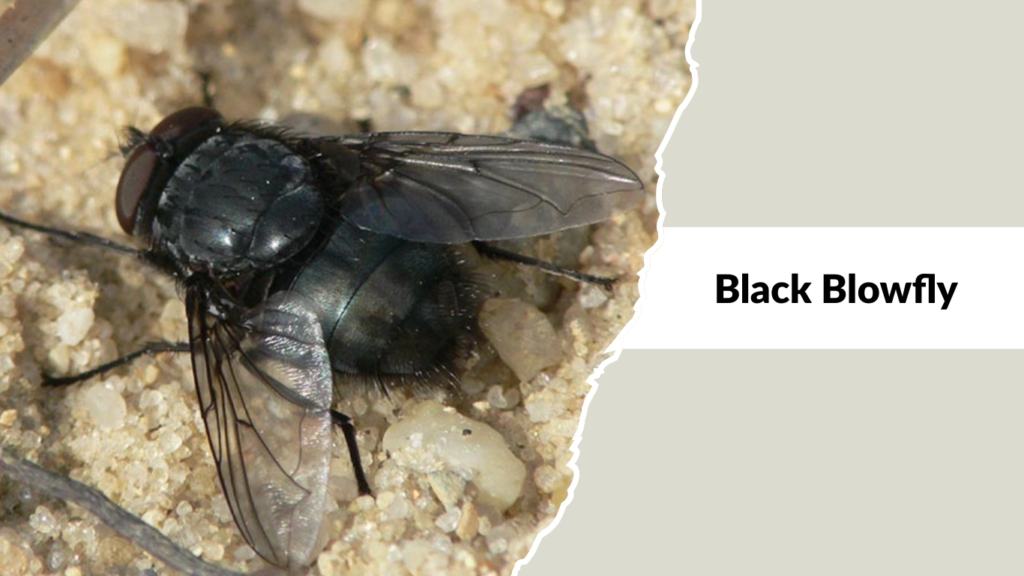
The Black Blowfly is a dark-colored species recognized for its robust body and preference for cooler environments. It is commonly associated with decaying organic matter and often appears early in the decomposition process.
Identification
- Matte to glossy black body
- Large reddish-brown compound eyes
- Thick, sturdy thorax with fine hairs
- Transparent wings with slightly darkened tips
- Larger and heavier-looking than many metallic blowflies
Habitat
Black blowflies thrive in cooler climates and shaded outdoor environments. They are frequently found in woodlands, gardens, farms, and near animal remains. Indoors, they may appear around garbage or decaying food sources.
Behaviors
These flies are strong fliers and are often among the first insects to locate carcasses. Their activity level increases in mild temperatures rather than extreme heat. Black blowflies are also known for their attraction to animal wounds, where they may lay eggs.
Diet and Lifecycle
Adult black blowflies feed on decaying organic material, nectar, and fluids from carrion. Females lay clusters of eggs on carcasses, wounds, or waste. Larvae feed aggressively and develop into pupae before emerging as adults. The full lifecycle typically spans 2–4 weeks depending on temperature.
4. Bronze Bottle Fly
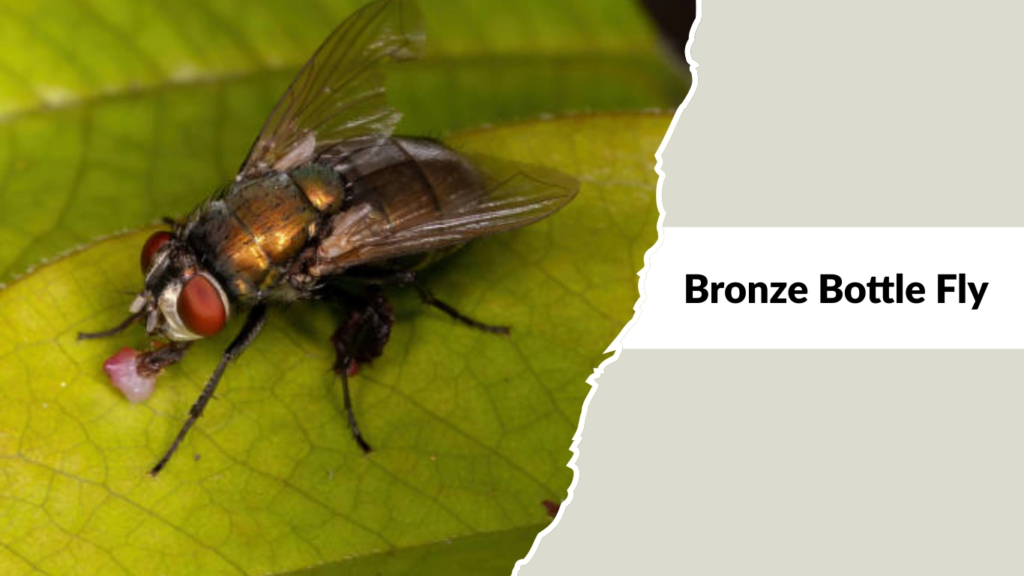
The Bronze Bottle Fly is a blowfly species noted for its metallic bronze or copper-colored sheen. It is frequently found around decaying matter but is less commonly encountered than green or blue bottle flies.
Identification
- Metallic bronze, copper, or golden-brown body
- Red to reddish-orange compound eyes
- Slightly elongated abdomen with fine hairs
- Clear wings with light brown venation
- Medium-sized, similar in shape to other bottle flies
Habitat
Bronze bottle flies inhabit forests, grasslands, farms, and suburban areas. They prefer warm environments rich in decaying organic materials. They are commonly found near carcasses, compost piles, garbage sites, and animal manure.
Behaviors
These flies are strong, agile fliers and quickly detect dead animals for egg-laying. They are also attracted to fermenting plant material. Adults sometimes visit flowers for nectar and moisture. Their presence is often used as a biological indicator in forensic investigations.
Diet and Lifecycle
Adult bronze bottle flies feed on nectar, rotting meat, and decomposing organic fluids. Females lay eggs on carrion or damp waste. Larvae develop rapidly, passing through several instars before pupating in soil or nearby debris. The entire lifecycle typically completes in 2–3 weeks in warm weather.
5. Common Green Bottle Fly (Lucilia sericata)
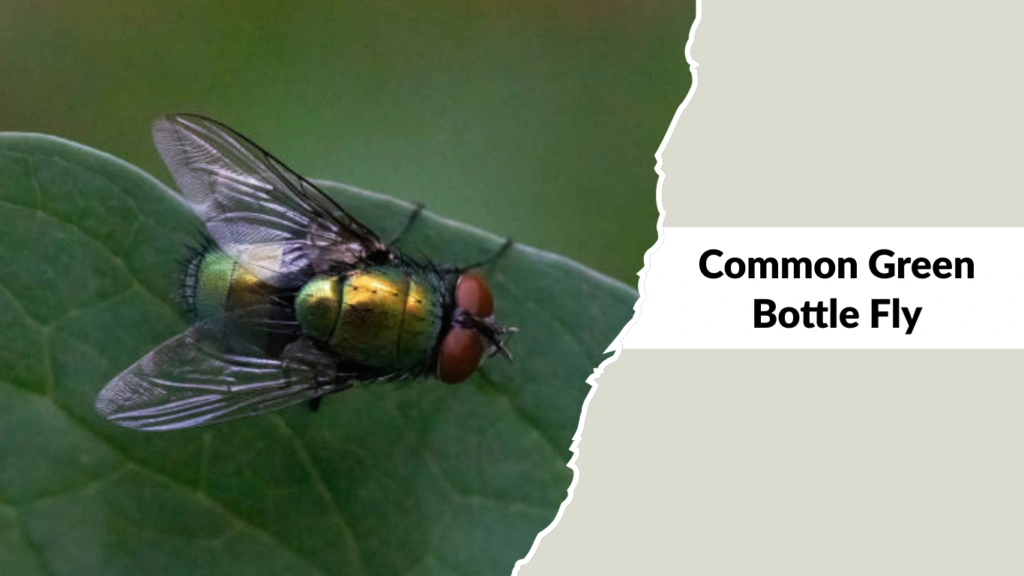
The Common Green Bottle Fly is one of the most well-known blowfly species, famous for its metallic green color and widespread presence. It plays a major role in decomposition and is frequently used in forensic casework.
Identification
- Bright metallic green body with gold or blue hues
- Ruby-red compound eyes
- Clear wings with slightly brownish veins
- Medium-sized, slender relative to bluebottle flies
- Distinct reflective shine under sunlight
Habitat
This species is abundant in urban areas, farmland, forest edges, and anywhere with decaying organic matter. It often gathers around garbage bins, carcasses, compost heaps, and animal waste. Indoors, it appears near food scraps or poorly sealed trash.
Behaviors
Common green bottle flies are quick to locate animal remains, arriving very early in the decomposition process. They also visit flowers for nectar and are active during warm daytime hours. This species is used in maggot therapy due to its larvae’s ability to consume dead tissue selectively.
Diet and Lifecycle
Adults feed on nectar, sugary substances, and decomposing organic fluids. Females lay eggs on moist carrion, wounds, or waste. Larvae develop rapidly and pupate in nearby soil or shelter. The lifecycle is temperature-dependent but often completes within 2–3 weeks.
6. Hairy Maggot Blowfly (Chrysomya rufifacies)
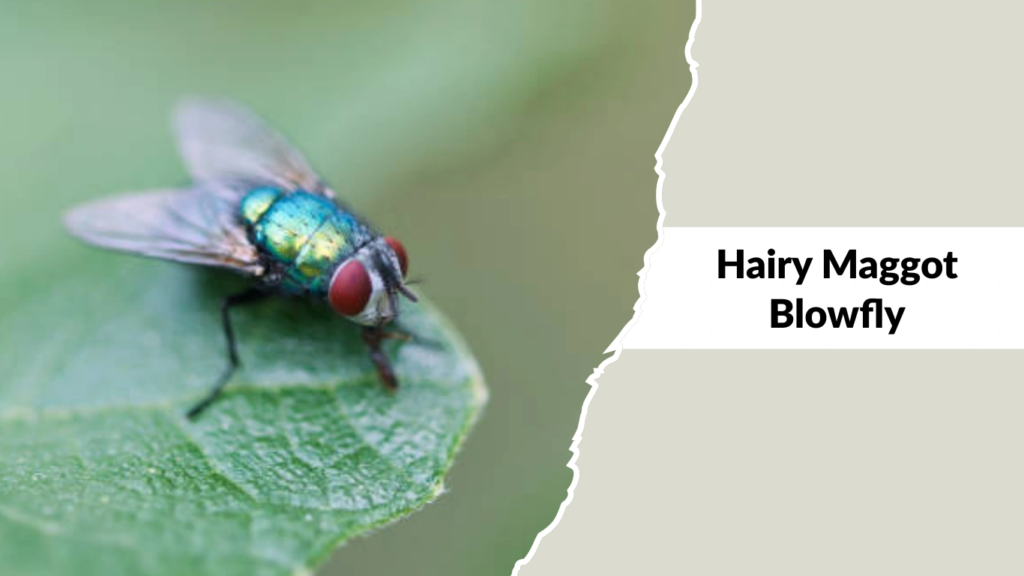
The Hairy Maggot Blowfly is a distinctive species known for its aggressive larvae covered in tiny spines. This species is common in warm climates and is important in forensic studies due to its rapid arrival at carcasses.
Identification
- Metallic blue-green or blue body
- Orange to reddish face area
- Clear wings with slightly darkened edges
- Larvae have noticeable spines (“hairy maggots”)
- Medium to large in size compared to other blowflies
Habitat
Hairy maggot blowflies prefer warm, humid regions and are often found in tropical and subtropical environments. They inhabit forest edges, urban areas, farms, and anywhere with decomposing organic matter. They rapidly appear around carcasses and garbage dumps.
Behaviors
This species is highly competitive, especially in the larval stage. Its larvae are often predatory, feeding on other maggots when food is scarce. Adults are strong fliers, quickly locating carrion for egg-laying, and they remain active in hot daylight conditions.
Diet and Lifecycle
Adult flies feed on decomposing organic fluids, nectar, and waste. Females lay eggs on carcasses, where larvae develop quickly. The larvae often consume both decaying tissue and competing maggots. After feeding, they drop to the soil to pupate. The lifecycle commonly completes in 2–3 weeks.
7. Oriental Latrine Fly (Chrysomya megacephala)
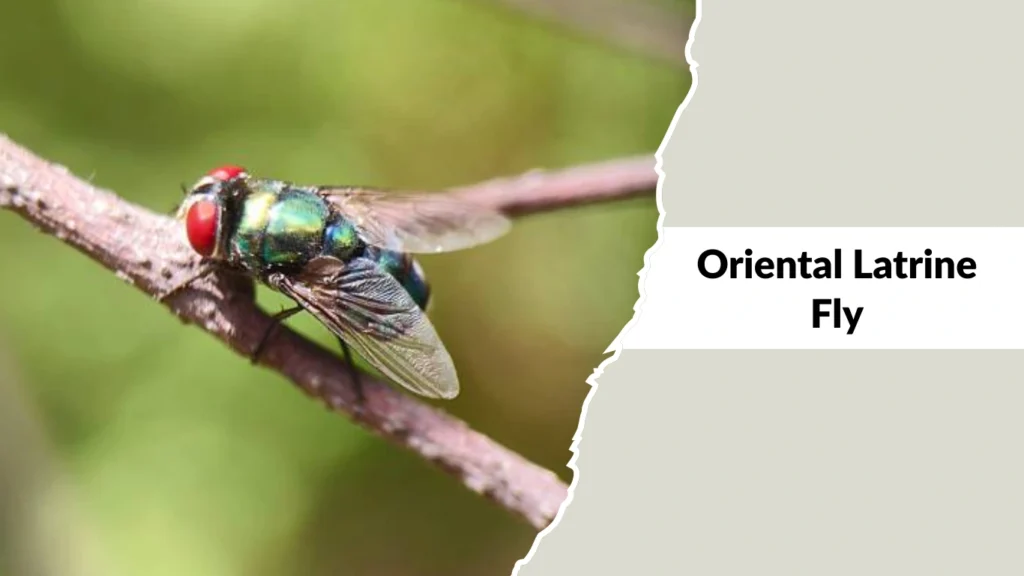
The Oriental Latrine Fly is a widespread blowfly species recognized for its association with human settlements and waste areas. It is a significant forensic and medical species due to its rapid reproduction and strong attraction to decaying matter.
Identification
- Metallic green or blue-green body
- Large, prominent reddish-brown eyes
- Broad head with a noticeable facial profile
- Clear wings with faint brown veins
- Medium-sized with a robust build
Habitat
This species thrives in warm, humid climates and is extremely common in urban and rural environments. It prefers areas with abundant organic waste—latrines, garbage sites, animal pens, and decomposing remains. It often enters homes in search of food sources.
Behaviors
Oriental latrine flies are strong, fast fliers and quickly gather around feces, carcasses, and household waste. They are considered public health pests because they can mechanically transmit pathogens. Their rapid arrival at decomposition sites makes them valuable in forensic investigations.
Diet and Lifecycle
Adult flies feed on decaying organic fluids, human waste, and occasionally nectar. Females lay eggs on moist waste, carrion, or feces. Larvae develop rapidly in nutrient-rich material and later pupate in surrounding soil or dry substrate. The lifecycle can complete in as little as 10–14 days in hot climates.
8. Australian Sheep Blowfly (Lucilia cuprina)
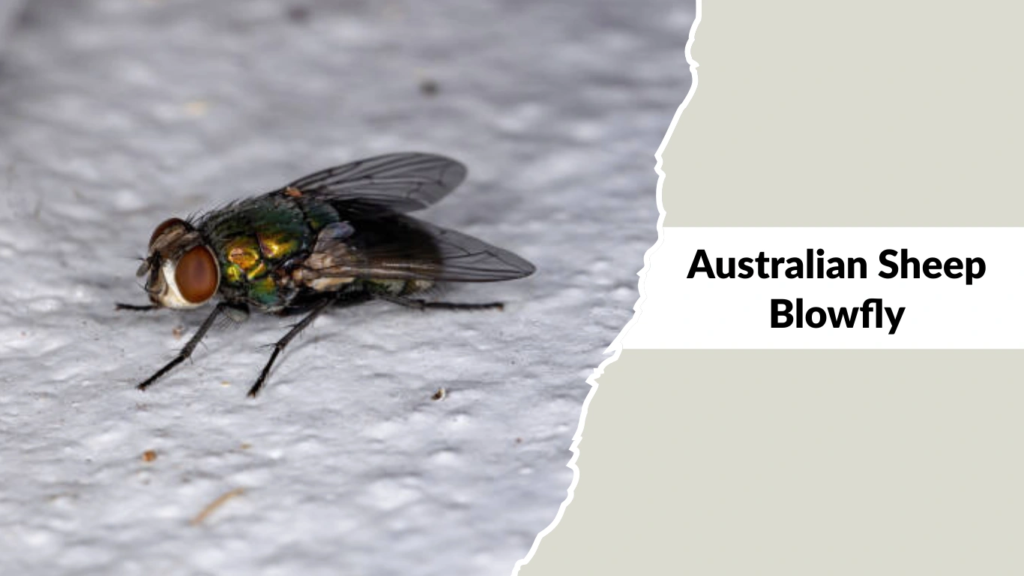
The Australian Sheep Blowfly is a major parasitic species known for causing flystrike in sheep. Its strong preference for wounds and moist fleece makes it economically significant in livestock industries.
Identification
- Metallic bronze-green or copper-green body
- Reddish to orange compound eyes
- Slightly rounded abdomen with fine hairs
- Clear wings with pale brown venation
- Smaller and slimmer than many other Lucilia species
Habitat
This species is common in warm, dry regions but thrives where sheep or livestock are present. It is frequently found in pastures, farms, shearing sheds, garbage areas, and around animal manure. It prefers environments where moisture and organic material accumulate in wool or wounds.
Behaviors
Australian sheep blowflies are attracted to sheep with soiled fleece or open wounds. Females lay eggs directly on damp, contaminated wool, where larvae can cause severe tissue damage (flystrike). Adults are active during warm daylight hours and respond rapidly to odors from wounds or decay.
Diet and Lifecycle
Adults feed on nectar, decomposing fluids, and protein-rich waste. Females lay eggs on sheep, carcasses, or waste. Larvae feed aggressively on tissue, then drop to the soil to pupate. Under ideal conditions, the lifecycle may complete in 2–3 weeks, contributing to rapid population growth.
9. Screwworm Fly (Cochliomyia hominivorax)
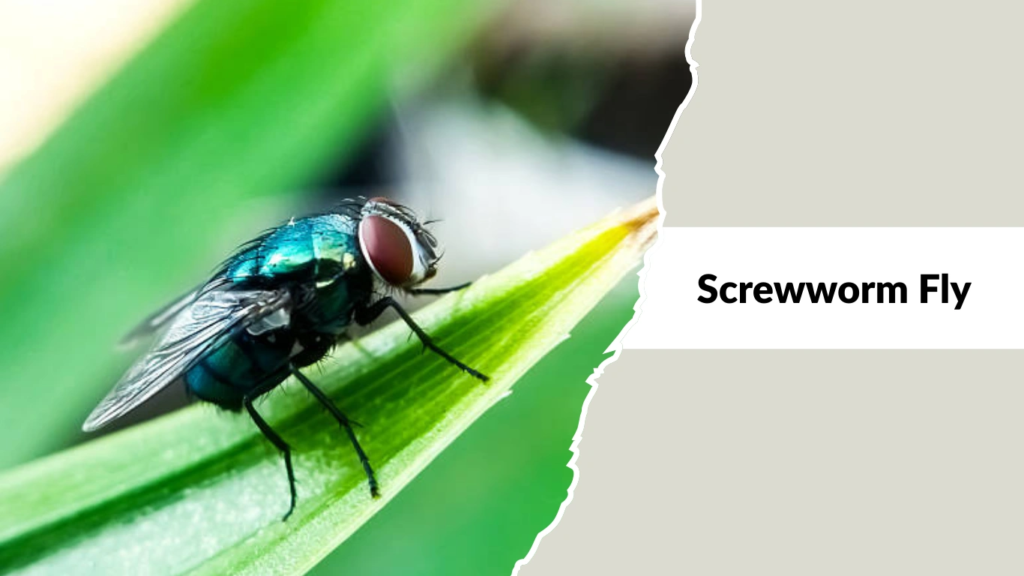
The Screwworm Fly is a notorious parasitic blowfly species known for its larvae that invade and feed on the living tissue of warm-blooded animals. It is one of the most medically significant blowflies in the world.
Identification
- Metallic blue-green or blue body
- Reddish-orange eyes
- Distinct dark stripes on the thorax
- Clear wings with slightly smoky tips
- Larvae have a “screw-like” tapered shape
Habitat
Screwworm flies thrive in warm tropical and subtropical climates. They are commonly found near livestock facilities, wildlife areas, farms, and regions with open wounds on animals. They avoid cooler climates and are most active in regions with high humidity and heat.
Behaviors
Female screwworm flies are highly specialized for parasitism. They seek out open wounds on animals—including humans—to lay their eggs. Larvae burrow into living tissue, causing severe damage. Adults are strong fliers and may travel long distances in search of suitable hosts.
Diet and Lifecycle
Adults feed on nectar and decaying organic liquids, but larvae feed exclusively on living tissue. Eggs hatch quickly, and larvae burrow deeper as they grow. After feeding, they drop to the ground to pupate. The full lifecycle can be completed in 2–3 weeks. This species is targeted by sterile male release programs to prevent outbreaks.
10. Secondary Screwworm Fly (Cochliomyia macellaria)
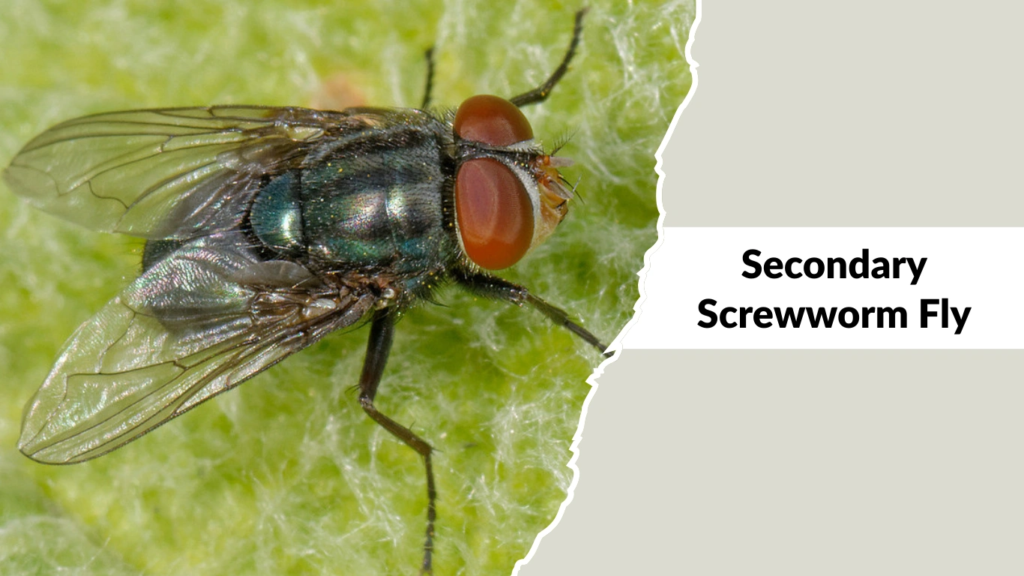
The Secondary Screwworm Fly is a blowfly species closely related to the primary screwworm but less harmful because its larvae feed mainly on dead rather than living tissue. It still plays an important role in decomposition and forensic studies.
Identification
- Metallic green to bluish-green body
- Bright red or orange eyes
- Three distinct dark thoracic stripes
- Clear wings with pale venation
- Larvae smooth and tapered, unlike the hooked primary screwworm larvae
Habitat
Secondary screwworm flies inhabit warm regions, including forests, grasslands, farms, and urban environments. They are frequently found near dead animals, garbage piles, and moist decaying organic material. They often appear early during decomposition.
Behaviors
These flies are strong fliers with a keen ability to detect carrion. They typically avoid laying eggs on living hosts, preferring dead tissue. Adults are active during warm daylight hours and are attracted to both natural and human-related waste sources.
Diet and Lifecycle
Adults feed on nectar, decomposing fluids, and sugary substances. Females lay eggs on carcasses or open wounds containing dead tissue. Larvae feed on decaying flesh, helping break it down, and later drop to soil for pupation. Their lifecycle is fast, often finishing in 2–3 weeks depending on temperature.
11. Red-tailed Flesh Fly (Sarcophaga haemorrhoidalis)
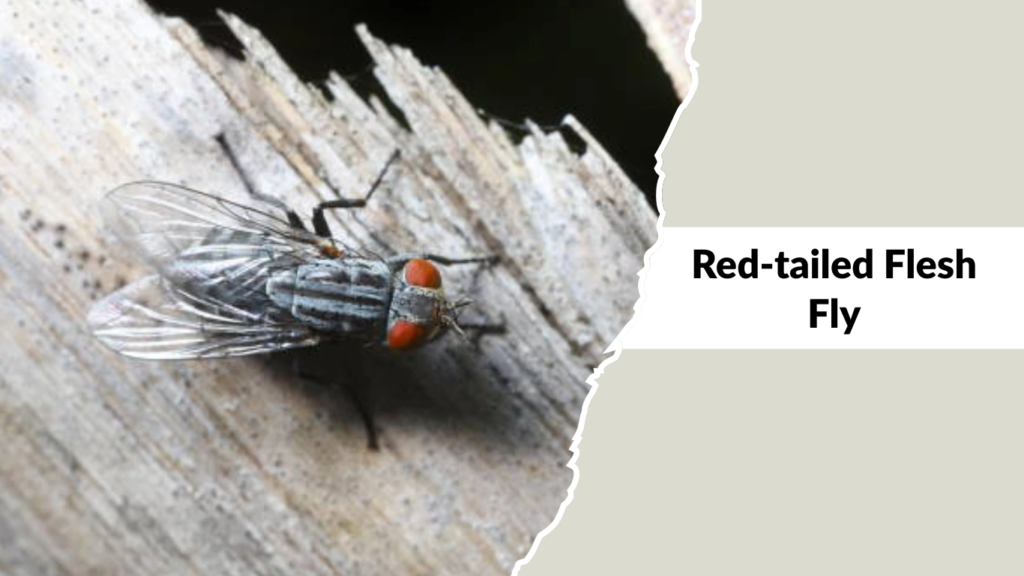
The Red-tailed Flesh Fly is a distinctive species recognized for its gray, striped body and characteristic red-tipped abdomen. Though technically a flesh fly, it is often grouped with blowflies due to similar ecological roles.
Identification
- Gray body with black longitudinal thoracic stripes
- Large red compound eyes
- Abdomen with a noticeable red tip (“red-tailed”)
- Clear wings with prominent dark veins
- Robust, medium-to-large body shape
Habitat
This species occupies a variety of environments, including forests, grasslands, farms, and urban areas. It is frequently found near carcasses, garbage sites, and animal enclosures. Indoors, it may appear around decaying food or poorly sealed waste.
Behaviors
Red-tailed flesh flies are active daytime fliers with strong attraction to carrion. Unlike many blowflies, females do not lay eggs but instead deposit live larvae directly onto carrion or decaying organic matter. This gives them a reproductive advantage by skipping the egg stage.
Diet and Lifecycle
Adults feed on sugary liquids, decaying organic fluids, and sometimes nectar. Females deposit live larvae (larviposition) onto carrion, wounds, or waste. Larvae feed on decaying tissue, then pupate in nearby soil or debris. The lifecycle typically completes within 2–3 weeks.
12. Yellow-haired Blowfly (Calliphora vicina)
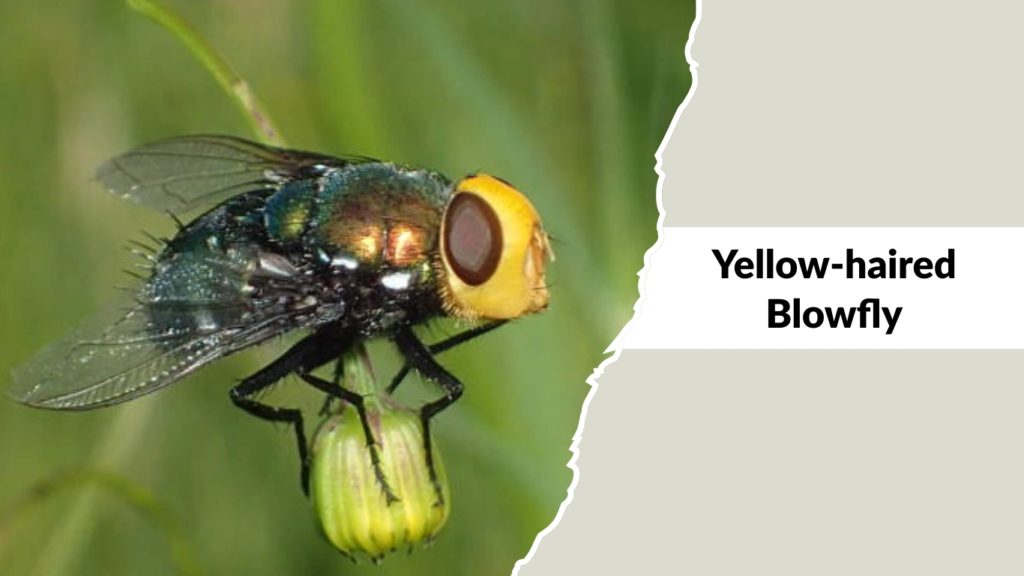
The Yellow-haired Blowfly is a common cool-weather blowfly species recognized by the yellow or orange hairs on its thorax. It is frequently seen in early spring and late autumn when many other blowflies are less active.
Identification
- Metallic blue or blue-purple body
- Thorax covered in yellow or orange hairs
- Large reddish-brown compound eyes
- Clear wings with slightly darkened veins
- Medium to large size, typical of Calliphora species
Habitat
This species prefers cooler climates and is abundant in temperate regions. It inhabits forests, suburban areas, farmland, and urban environments. Indoors, it may appear around windows in cooler months as it seeks warmth.
Behaviors
Yellow-haired blowflies remain active at lower temperatures than many other blowfly species. They often enter homes during cooler seasons. They are among the early arrivers to carcasses, making them valuable in forensic investigations involving colder climates.
Diet and Lifecycle
Adults feed on nectar, decomposing organic fluids, and sugary substances. Females lay eggs on carrion or waste, especially in shaded or cool locations. Larvae develop through several stages before pupating in nearby soil. The lifecycle typically spans 2–4 weeks, depending on temperature.
13. Greenbottle Blowfly (Lucilia illustris)
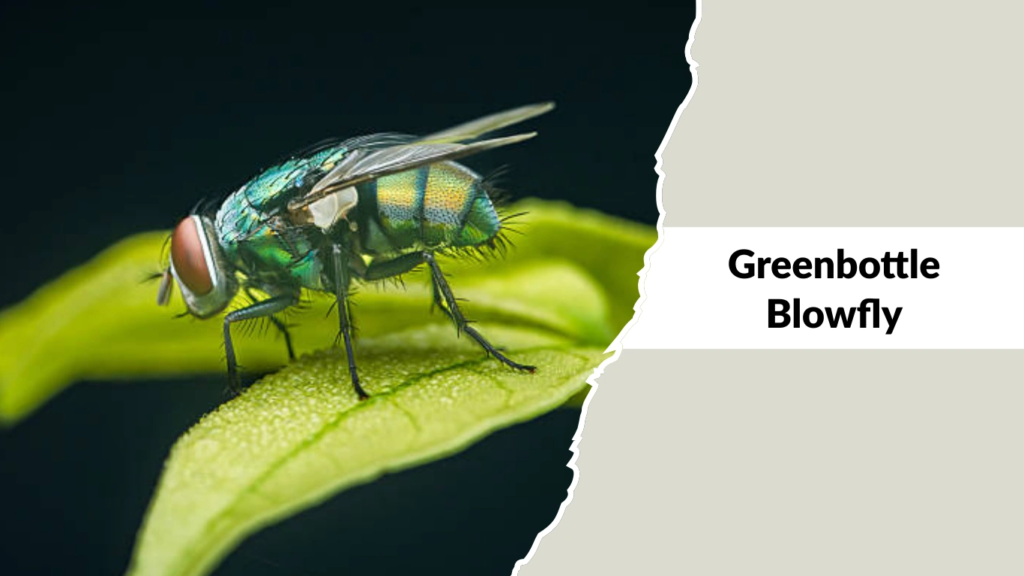
The Greenbottle Blowfly is a metallic green species commonly found in temperate regions. It is an early colonizer of carcasses and plays an important role in forensic entomology and natural decomposition.
Identification
- Bright metallic green body with blue or bronze reflections
- Large reddish eyes typical of Lucilia species
- Clear wings with light brown veins
- Slightly broader body than Lucilia sericata
- Medium-sized and highly reflective in sunlight
Habitat
Greenbottle blowflies inhabit woodlands, fields, suburban gardens, farms, and urban areas. They are especially common in cooler temperate climates. They appear around carcasses, compost heaps, and garbage areas, and may enter homes in search of food sources.
Behaviors
These flies are strong and agile fliers. They are among the first insects to detect animal remains, making them valuable for estimating postmortem intervals. Adults also visit flowers for nectar, contributing lightly to pollination. Activity peaks during warm daylight hours.
Diet and Lifecycle
Adults consume nectar, decomposing fluids, and protein-rich waste. Females lay eggs on carcasses, moist organic debris, and animal waste. Larvae feed on decaying tissue and develop rapidly before pupating in nearby soil or vegetation. The full lifecycle typically completes in 2–3 weeks.
14. Northern Blowfly (Calliphora terraenovae)
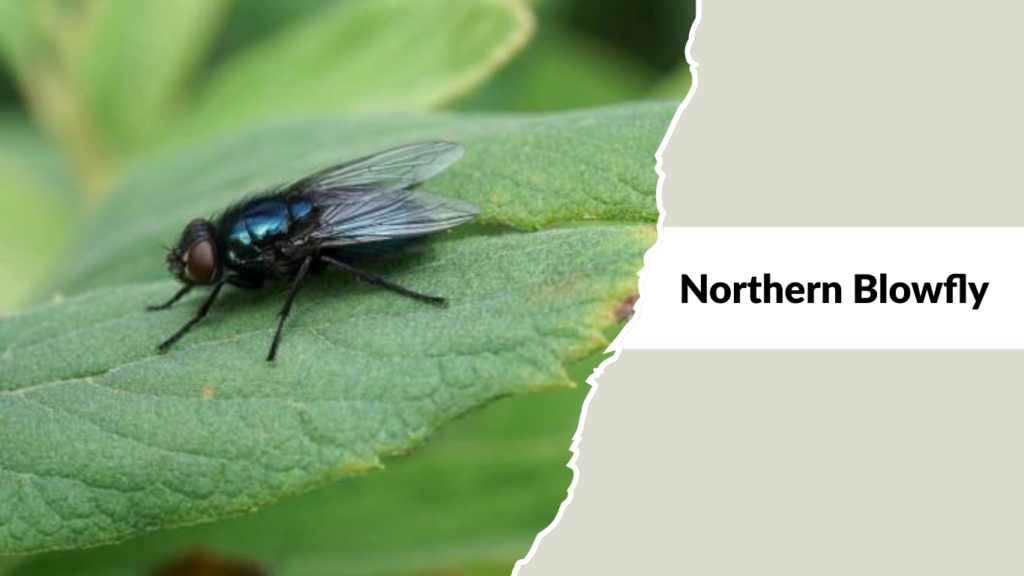
The Northern Blowfly is a cool-climate species commonly found in northern regions. Known for its robust build and metallic coloration, it is frequently encountered early in the decomposition timeline.
Identification
- Metallic blue to blue-purple body
- Thorax with dark stripes and fine hairs
- Large reddish-brown eyes
- Clear wings with slightly smoky veins
- Medium to large, similar to other Calliphora species
Habitat
Northern blowflies thrive in cool and temperate climates. They are often found in forests, suburban areas, farmland, and high-latitude regions. Indoors, they may appear around windows or waste areas, especially in cooler seasons.
Behaviors
These flies are active at lower temperatures than many other blowfly species. They frequently colonize carcasses early, even in cold weather, making them valuable in forensic entomology. They fly steadily and are highly responsive to odors from decay.
Diet and Lifecycle
Adults feed on nectar, decaying organic fluids, and sugary materials. Females deposit eggs on carcasses or waste, especially in cool, shaded environments. Larvae develop through several instars before pupating in soil or debris. The lifecycle typically lasts 2–4 weeks depending on temperature.
15. Black Blowfly (Phormia regina)
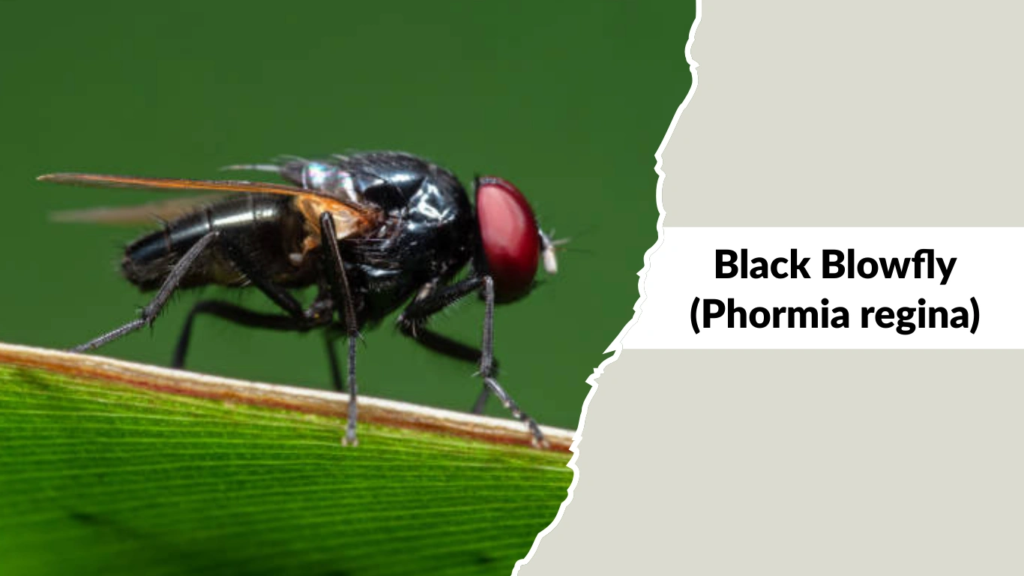
The Black Blowfly, also known as the “regal blowfly,” is a widespread species frequently used in forensic entomology due to its predictable colonization patterns. It has a dark, metallic body and thrives in cooler conditions.
Identification
- Metallic black, blue-black, or greenish-black body
- Red to reddish-brown compound eyes
- Clear wings with slightly smoky veins
- Sturdy thorax with fine bristles
- Medium-sized and glossy in appearance
Habitat
Black blowflies prefer temperate and cooler climates. They are found in forests, cities, farms, and rural areas—anywhere with access to carrion or decomposing organic material. Indoors, they appear near trash, animal waste, or food scraps.
Behaviors
Phormia regina is one of the first species to arrive at carcasses and is highly important in postmortem interval studies. It is a strong, fast flier and readily enters human structures. Adults are active during daylight and respond quickly to decay odors.
Diet and Lifecycle
Adults feed on nectar, decaying tissue liquids, and sugary substances. Females lay eggs on carcasses, feces, or moist organic matter. Larvae grow rapidly, then drop to soil to pupate. The full lifecycle is temperature-dependent but typically completes in 2–3 weeks.
16. Cluster Blowfly (Calliphora vomitoria)
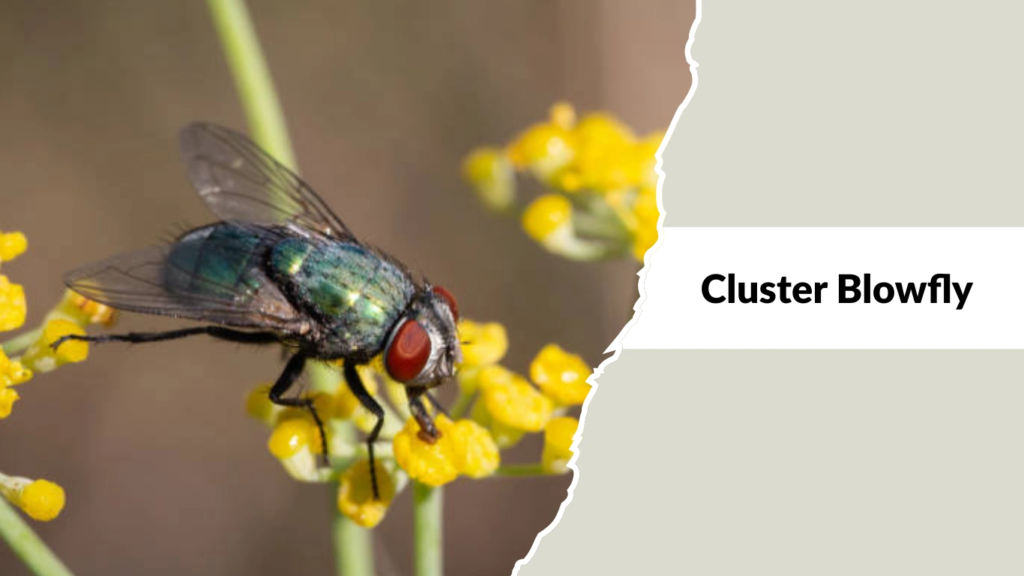
The Cluster Blowfly is a large, striking species known for its deep metallic blue body and tendency to gather in large groups inside buildings during colder months.
Identification
- Metallic dark blue or violet-blue abdomen
- Thorax with grayish stripes and dense bristles
- Large reddish-brown eyes
- Clear wings with strong, visible veins
- Larger and more robust than many other blowflies
Habitat
Cluster blowflies thrive in temperate regions and are common around forests, fields, farms, and suburban areas. During autumn and winter, they often enter attics, wall voids, and upper rooms of houses in large groups to overwinter.
Behaviors
Named for their clustering behavior, these flies gather in big groups inside warm buildings during cold seasons. They are strong fliers and early colonizers of carcasses. Outdoors, they are active during warm daylight hours and frequently rest on walls or vegetation.
Diet and Lifecycle
Adults feed on nectar, decomposing organic fluids, and sugary materials. Females lay eggs on carrion, where larvae feed before pupating in soil. The lifecycle typically takes 2–4 weeks depending on temperature. Overwintering adults resume activity in spring.
17. Eastern Blowfly (Chrysomya putoria)
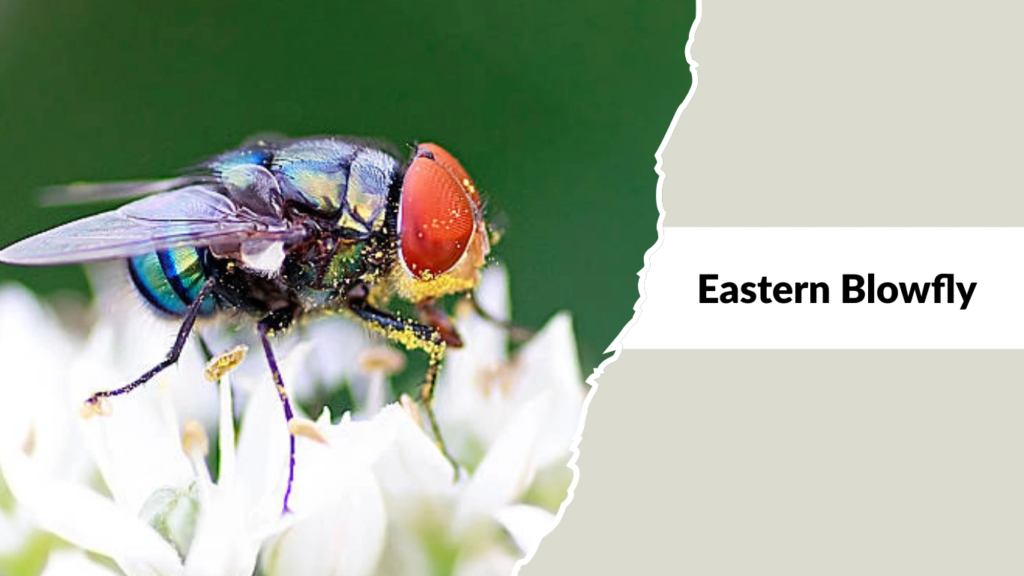
The Eastern Blowfly is a widespread species often associated with human settlements and livestock areas. It has a shiny body and strong attraction to decaying materials and waste.
Identification
- Metallic green to blue-green body
- Large reddish-brown eyes
- Slightly broader thorax compared to some Chrysomya species
- Clear wings with pale venation
- Medium-sized, with a smooth reflective sheen
Habitat
Eastern blowflies inhabit warm, humid regions and thrive in tropical and subtropical climates. They are common around garbage sites, animal pens, markets, rural farms, and areas with abundant organic waste. They readily enter homes in search of food sources.
Behaviors
These flies are rapid responders to carcasses and waste, making them strong competitors in decomposition environments. They also visit flowers for nectar but spend most of their activity around decaying matter. Adults fly quickly and remain active during hot daylight conditions.
Diet and Lifecycle
Adults consume nectar, decomposing fluids, and protein-rich waste. Females lay eggs on carcasses, feces, or damp organic materials. Larvae develop quickly and pupate in surrounding soil or debris. The life cycle may complete in as little as 12–18 days in warm climates.
18. Cuckoo Blowfly (Chrysomya bezziana)
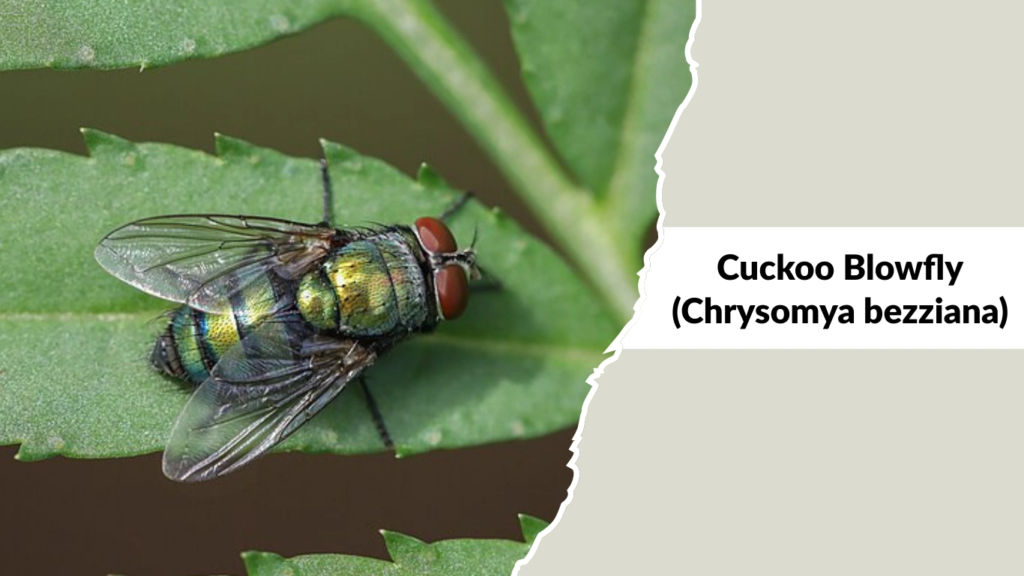
The Cuckoo Blowfly is a highly significant parasitic blowfly known for causing severe myiasis in animals and humans. Its larvae feed on living tissue, making it one of the most dangerous blowfly species.
Identification
- Metallic green to blue-green body
- Reddish-orange compound eyes
- Distinct dark bands on the thorax
- Clear wings with pale veins
- Larvae are tapered and robust, adapted for burrowing into tissue
Habitat
Cuckoo blowflies thrive in warm tropical and subtropical regions. They are commonly found near livestock farms, villages, forests, and areas where animals may sustain open wounds. They avoid cooler climates and are most active in warm, humid environments.
Behaviors
Females aggressively seek out open wounds on warm-blooded animals. They lay eggs directly on the edges of wounds or soiled fur. Larvae burrow into living tissue, causing painful and sometimes fatal infestations. Adults are strong fliers and highly responsive to odors of blood or decay.
Diet and Lifecycle
Adults feed on nectar and decompose organic fluids. Larvae are obligate parasites and feed on healthy tissue. After feeding, larvae drop to the ground to pupate. The full lifecycle is typically completed in 2–3 weeks in warm conditions. This species is a major target of veterinary control programs.
19. Gold Bottle Fly (Lucilia sericata var.)
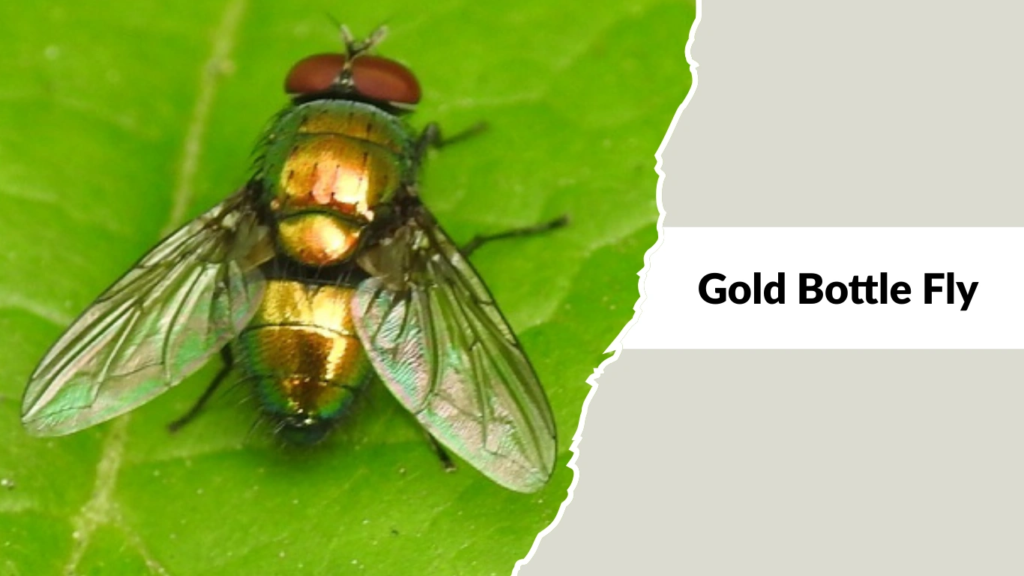
The Gold Bottle Fly is a color variant of the common greenbottle species, recognized for its golden or bronze-tinted metallic sheen. Although similar to Lucilia sericata, its coloration sets it apart in the field.
Identification
- Metallic green body with golden or bronze highlights
- Reddish compound eyes
- Slim, reflective abdomen
- Clear wings with light venation
- Medium-sized with a bright, glossy appearance
Habitat
Gold bottle flies are found in urban, suburban, and rural environments. They prefer warm areas rich in organic waste, including garbage bins, compost, carcasses, and animal waste. Indoors, they may appear around food scraps or moist organic material.
Behaviors
These flies are early colonizers of carcasses and highly responsive to the smell of decay. They are active during warm daylight hours and often visit flowers for nectar. Their behavior closely mirrors Lucilia sericata, making them important in decomposition studies.
Diet and Lifecycle
Adults feed on nectar, sugary fluids, and decomposing organic liquids. Females lay eggs on carrion or moist waste, where larvae develop quickly. After feeding, larvae pupate in nearby soil or debris. The full lifecycle typically completes within 2–3 weeks.
FAQs
What attracts blowflies the most?
Blowflies are primarily attracted to decaying organic matter such as carcasses, garbage, feces, and rotting food. They also respond strongly to moisture and protein-rich odors. Some species are additionally drawn to open wounds on animals, making them significant in both medical and veterinary contexts.
Are blowflies dangerous to humans?
Most blowflies are not harmful to humans directly, but some species can transmit bacteria through contact with food or surfaces. Parasitic species like screwworm flies and Chrysomya bezziana can infest living tissue, posing serious medical risks. Proper sanitation greatly reduces blowfly-related concerns.
Why are blowflies important in forensic science?
Blowflies are often the first insects to arrive at a dead body, and their predictable lifecycle helps estimate time of death. Different species colonize remains at different stages, allowing forensic entomologists to analyze the age of larvae or pupae to determine the postmortem interval.
How long is the typical blowfly lifecycle?
The blowfly lifecycle usually takes 2–3 weeks but can be shorter in warm climates. It includes egg, larval, pupal, and adult stages. Temperature, humidity, and food availability significantly affect development speed, with some species completing their cycle in as little as 10 days.
How can blowfly infestations be prevented?
Preventing blowflies involves reducing access to food sources: sealing garbage, disposing of carcasses promptly, cleaning pet waste, and maintaining good sanitation. Using screens on windows and keeping indoor areas dry also helps limit their entry and breeding opportunities.
