
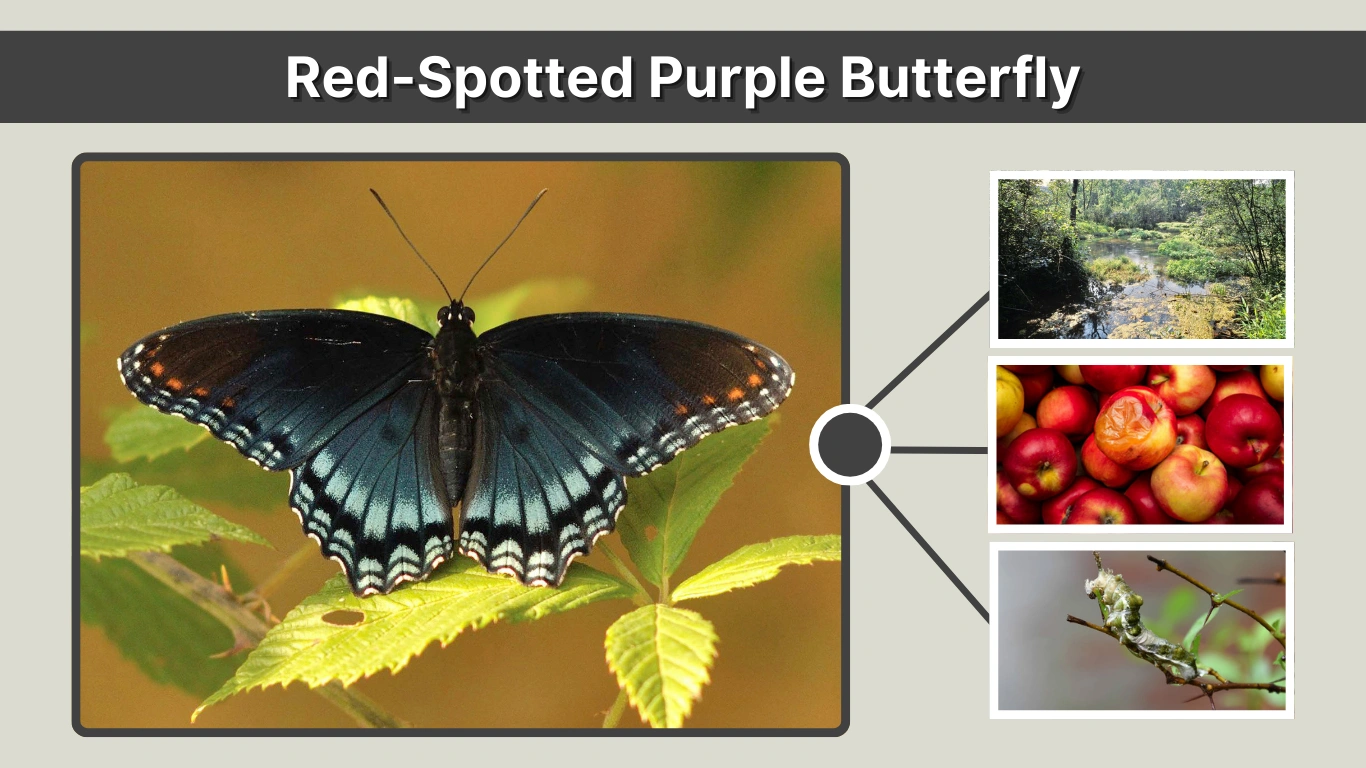
The red-spotted purple butterfly (Limenitis arthemis astyanax) is one of North America’s most striking woodland butterflies. Known for its iridescent blue wings, reddish marginal spots, and masterful mimicry of swallowtails, it is widely distributed across the eastern United States. This guide explores how to identify the species, its life cycle, host plants, habitat preferences, symbolism, fun facts, and how to tell males from females. You’ll also learn where to find them in states such as Florida, Ohio, Illinois, Michigan, Maryland, Pennsylvania, and Wisconsin.
Identification

- Iridescent blue-green upperwings with scattered red spots
- Absence of tail extensions—often confused with swallowtails but not a true swallowtail
- Wingspan generally 3–4 inches
- Underside warm brown with orange crescents
- Caterpillars mimic bird droppings for camouflage
- Eggs are pale green and laid singly on host leaves
These features help distinguish the red-spotted purple from related lookalikes, including the white admiral and banded purple.
Overview of the Red-Spotted Purple Butterfly
The red-spotted purple is part of the Limenitis arthemis complex, which includes both the white admiral and several regional forms. In the northeastern U.S. and Canada, the white admiral displays a bold white wing band; farther south, that band disappears, giving rise to the red-spotted purple form. This evolutionary shift is not random—southern populations mimic the poisonous pipevine swallowtail to deter predators. As a result, the butterfly’s dark, iridescent appearance has become iconic.
Despite its exotic look, the species is not considered rare across much of its range. In many states—such as Ohio, Maryland, and North Carolina—it is one of the more frequently observed woodland butterflies. Some local populations fluctuate, however, depending on host tree availability and woodland health.
Habitat
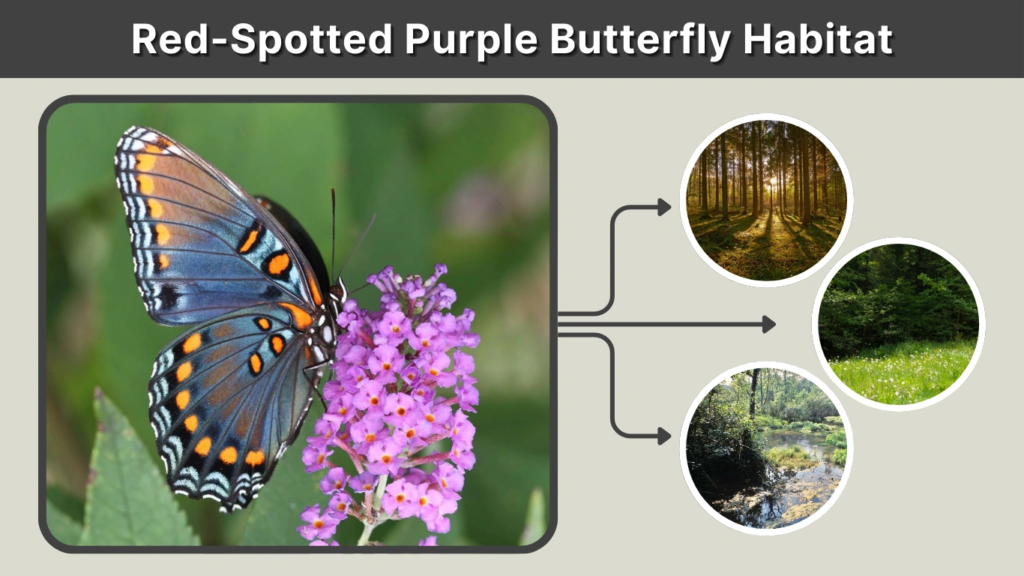
Red-spotted purple butterflies prefer shady woodlands, forest edges, riparian corridors, and suburban areas with host trees. They thrive in environments where wild cherry and willow trees are abundant. Adults often rest in dappled sunlight and fly low, weaving elegantly through understory vegetation. You’ll rarely find them in wide-open grasslands or treeless neighborhoods, but they adapt easily to mixed habitats where fruiting trees or sap flows are present.
They are also drawn to moist ground, mud puddles, and overripe fruit. These areas provide essential minerals, amino acids, and sugars needed for energy and reproduction.
Range & Distribution
The red-spotted purple’s range is broad, covering most of the eastern United States. Its western limit approaches the Great Plains, while its northern extent stretches into southern Canada. The butterfly is particularly abundant in the Midwest, Appalachians, Southeast, and Mid-Atlantic.
- Florida: Found statewide, especially in wooded parks and suburban edges.
- Illinois & Wisconsin: Common in forests, oak savannas, and river corridors.
- Maryland & Pennsylvania: Frequently seen in mixed hardwood forests; thrives near black cherry stands.
- Michigan & Ohio: Present throughout summer, especially near lakeshore woodlands and orchards.
Although widespread, sightings may vary year to year based on rainfall, tree diseases, and temperature patterns.
Host Plants
| Life Stage | Primary Host Plants | Notes |
| Caterpillar | Black cherry (Prunus serotina), chokecherry, willow, poplar, aspen, serviceberry | Eggs laid singly along leaf tips |
| Adult Feeding | Rotting fruit, sap flows, carrion, dung, occasional nectar | Adults rarely visit flowers |
Host plants are essential for breeding—without cherry and willow species, the butterfly will not lay eggs. Gardeners seeking to attract red-spotted purple butterflies should prioritize planting black cherry, chokecherry, or willow to support larvae.
Life Cycle
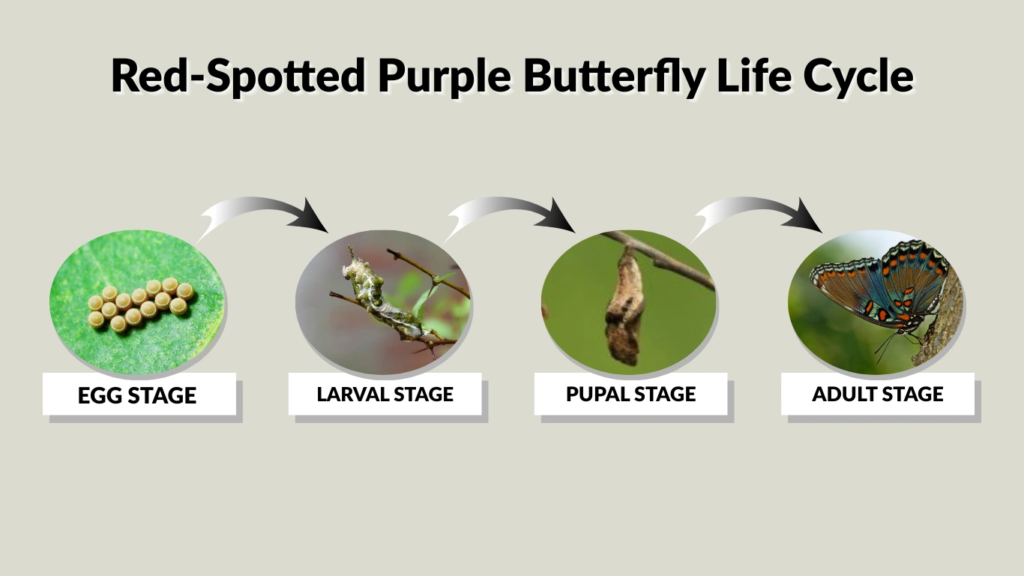
The red-spotted purple butterfly undergoes a complete metamorphic cycle: egg, larva, chrysalis, and adult. Females lay single eggs on the edges of host leaves, choosing mid-canopy foliage to protect them from predators. Eggs hatch in several days, producing caterpillars that immediately begin feeding on tender leaf tissue.
Larvae pass through multiple instars, gradually transforming from bird-dropping mimics into spined green-brown caterpillars with distinctive saddle marks. In late summer, some caterpillars form a chrysalis and emerge the same season; others overwinter in folded leaf shelters called hibernacula, resuming development in spring.
The chrysalis stage is cryptic—angular, brown, and shaped like a broken twig. Pupation lasts one to two weeks depending on temperature. Adults emerge with fresh iridescence and begin seeking mates within days. Their average lifespan ranges from several weeks to two months, though weather and predation greatly influence survival.
Red-spotted purple butterflies reproduce sexually, with males perching or patrolling territories to locate receptive females. Courtship involves short chases and aerial displays. Females lay dozens to hundreds of eggs over their lifetime.
Behavior
Adults are agile fliers, often gliding low to the ground in shady environments. Unlike many butterflies, they show a strong preference for rotting fruit, tree sap, mineral-rich mud, and decaying organic matter rather than nectar. This diet contributes to their adaptability in woodlands where flowering plants may be limited.
A notable behavior is Batesian mimicry—their resemblance to the toxic pipevine swallowtail helps deter predators. Birds learn to avoid the swallowtail’s coloration and avoid the harmless red-spotted purple as well.
Male vs. Female
Although males and females look similar at first glance, subtle differences help distinguish them:
| Feature | Male | Female |
| Coloration | More vivid blue iridescence | Slightly duller, darker tone |
| Size | Generally smaller | Noticeably larger wingspan |
| Behavior | Territorial; patrols flight paths | More secretive; focuses on host plant search |
| Wing Shape | Narrower and slightly pointed | Broader with rounder edges |
Females spend more time examining trees for egg-laying, while males guard sunny perches or chase intruders. These behavioral cues are often easier to observe than physical ones.
Caterpillar Section
The red-spotted purple caterpillar is famous for its unusual appearance. In early instars, it perfectly resembles a bird dropping—an effective strategy that reduces predation. As it matures, the larva develops olive-green and chestnut coloring with several spines and a raised saddle-like hump.
Caterpillars feed exclusively on host plant leaves, especially black cherry, chokecherry, and willows. They often rest along leaf midribs, holding still for hours at a time. When threatened, they hunch and become motionless, relying on camouflage rather than fleeing.
Late-season caterpillars create hibernacula by folding and silk-tying leaf fragments. These shelters remain attached through winter, protecting the larva from cold temperatures. In spring, the caterpillar resumes feeding before pupating.
Chrysalis Section
The chrysalis is angular, mottled brown or green, and shaped like a dried twig with a slight metallic sheen. This camouflage allows it to blend effortlessly with the forest understory. Attached by a silk girdle and stem (cremaster), the chrysalis stage lasts 10–14 days in warm weather.
Overwintering individuals remain as larvae rather than pupae; however, mid-summer broods frequently pupate and emerge the same season. Chrysalis predation is low thanks to their excellent disguise, one reason the species remains widespread.
Food & Diet
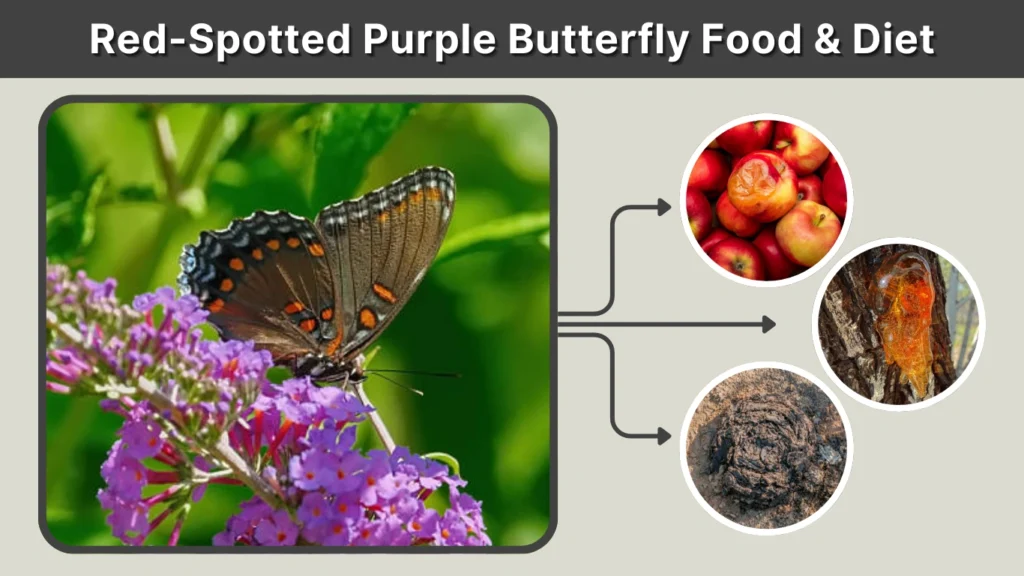
Adult red-spotted purple butterflies drink from unusual food sources compared to nectar-loving species. They favor rotting fruit, tree sap, carrion, dung, and mineral-rich mud puddles. Sap flows from injured trees are particularly attractive in late summer.
Because nectar is not a primary food source, they seldom visit garden flowers. Instead, they are more likely to appear near orchards, compost piles, fruiting shrubs, or forests where sap weeps naturally.
Caterpillars feed only on the leaves of host trees, making cherry and willow species essential for their growth.
Comparison With Similar Species
Red-Spotted Purple vs. White Admiral
| Feature | Red-Spotted Purple | White Admiral |
| Wing Pattern | No white band | Bold white band across wings |
| Color | Dark, iridescent blue | Black with contrasting white |
| Range | Eastern & southern U.S. | Northern U.S. & Canada |
| Mimicry | Mimics pipevine swallowtail | Non-mimetic form |
These differences stem from environmental pressures: southern populations mimic toxic swallowtails, whereas northern populations do not.
Red-Spotted Purple vs. Diana Fritillary
The Diana fritillary is larger, with broad orange or deep blue wings depending on sex. While both species exhibit iridescence, the Diana lacks the red marginal spots and has a more sweeping flight pattern. It also inhabits different geographic regions—primarily the southern Appalachians—making misidentification unlikely.
Banded Purple vs. Red-Spotted Purple
The banded purple (a variation related to the white admiral) features partial white banding and is more common in northern regions. Red-spotted purples, by contrast, display uninterrupted iridescent wings without bold markings.
Attracting Red-Spotted Purple Butterflies
To draw these butterflies to your yard, focus on host plants rather than flowers:
- Plant black cherry, chokecherry, willow, serviceberry, or aspen
- Provide fallen fruit or fruit feeders
- Maintain shaded, wooded edges
- Avoid pesticides that contaminate foliage
- Leave some leaf litter and natural debris for caterpillar shelters
Even small suburban yards can attract them if a single cherry or willow tree is present.
Meaning, Symbolism & Spiritual Interpretation
The red-spotted purple butterfly holds rich symbolic meaning across cultures. Its dramatic transformation and deceptive appearance represent resilience, intuition, and the ability to thrive through adaptation. Its mimicry suggests messages of strategic thinking and self-protection—reminding observers that power can come from subtlety rather than aggression.
In spiritual symbolism, the butterfly often signifies emotional renewal, guidance during transitions, and clarity after confusion. Many people choose the red-spotted purple as a tattoo design to symbolize transformation, inner strength, or survival through adversity.
Fun Facts
- It is not poisonous, but predators avoid it due to its mimicry of the toxic pipevine swallowtail.
- Adults often land on hikers or cars to drink minerals.
- Caterpillars overwinter inside leaf shelters.
- They rarely visit flowers despite being butterflies.
- Males spend much of the day patrolling territories.
- Their iridescence changes hues depending on sunlight angle.
Are Red-Spotted Purple Butterflies Rare?
Throughout their range, red-spotted purples are generally common, though local rarity occurs if cherry trees decline. Urban expansion can reduce habitat, but they adapt well to suburban areas. Some people perceive them as rare because they spend much of their time in shaded woodlands and only occasionally visit open spaces.
FAQs
How long does a red-spotted purple butterfly live?
Adults typically live 2–6 weeks, though cooler temperatures may extend their lifespan. Overwintering occurs in the larval stage, not the adult stage.
Are red-spotted purple butterflies poisonous?
No. They are harmless but protected by mimicry—birds mistake them for the toxic pipevine swallowtail.
Where can I find red-spotted purple butterflies in Pennsylvania?
Look for them in mixed hardwood forests, state parks, suburban edges, and near cherry or willow trees from late spring through early fall.
Do red-spotted purple butterflies reproduce sexually or asexually?
They reproduce sexually. Males locate females through patrolling, and fertilized females lay eggs singly on host leaves.
What attracts red-spotted purple butterflies to yards?
Host plants, rotting fruit, sap flows, damp soil, and wooded edges are the strongest attractants. Planting cherries or willows is the most effective strategy.
