

On warm summer nights, June bugs fill the air with their loud buzzing and erratic flight. They crash into porch lights, windows, and sometimes even people, leading many to wonder if they can fly properly at all. Despite their clumsy movements, June bugs are strong nocturnal fliers with unique flight mechanics and strange light-attraction behavior.
Can June Bugs Fly?
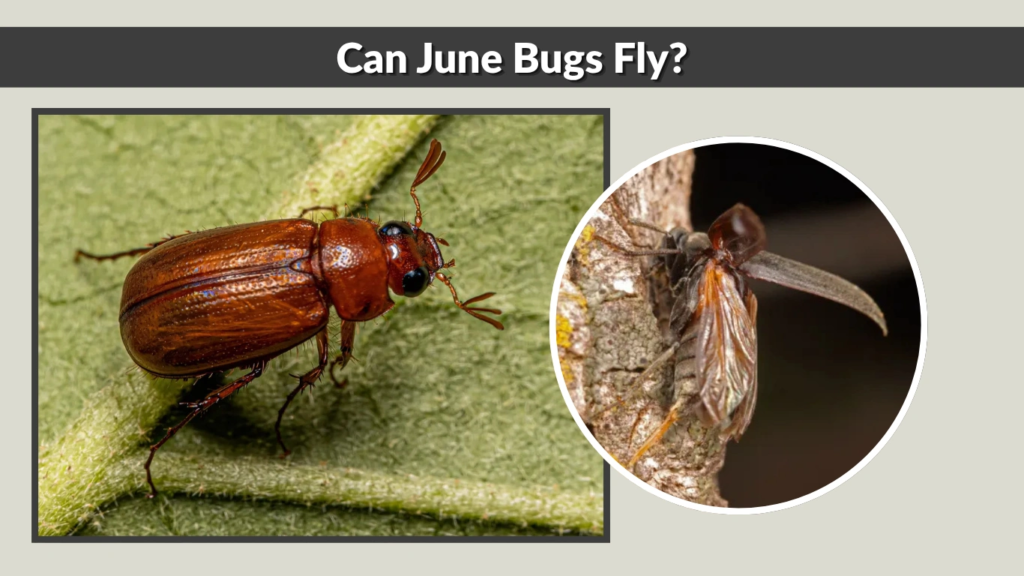
The Truth About Their Flight Ability
Yes, June bugs can fly — though not very gracefully. Like all beetles, they possess two pairs of wings. The outer pair, called elytra, acts as a hard shell that protects their delicate inner wings when not in use. When ready to fly, June bugs lift the elytra upward and unfold the transparent inner wings beneath.
However, their bodies are much heavier than most beetles of similar size. This weight imbalance limits their stability in flight, causing them to wobble and crash frequently. While they can cover short distances, they struggle with direction and precision.
When Do They Start Flying?
Adult June bugs emerge from the soil in late spring and early summer, typically from May through July. They are most active during warm, humid evenings. Males take to the air more frequently, flying in search of females to mate with. Females, on the other hand, remain closer to the ground, spending more time laying eggs in soft soil.
Once airborne, June bugs fly low — rarely more than a few feet above ground — and are quickly drawn toward sources of light.
How Do June Bugs Fly?
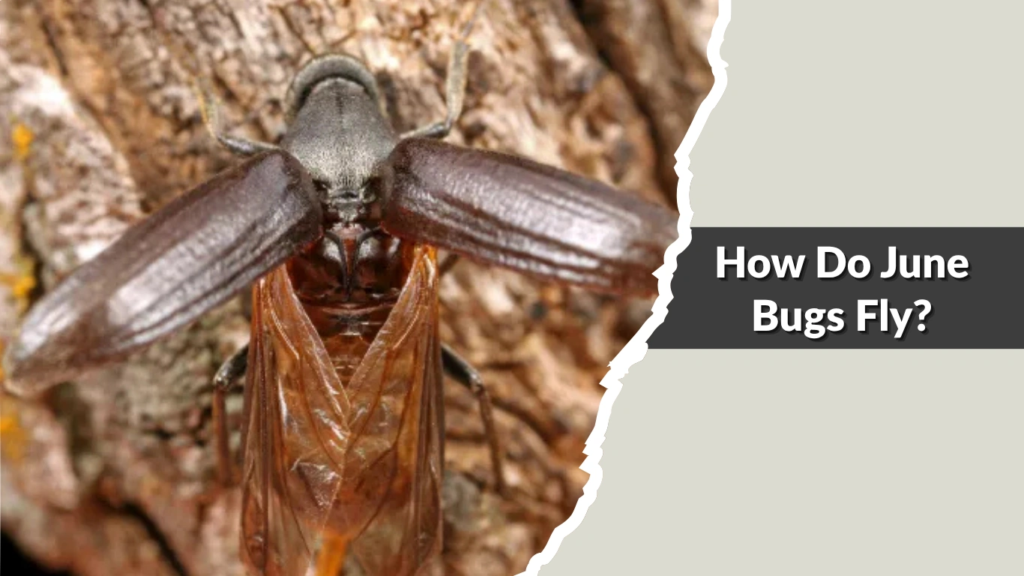
Structure and Function of Their Wings
The June bug’s flight system is both fascinating and flawed. Their elytra (outer shell) must be lifted high before the inner flight wings can beat. Because these protective covers don’t fold back completely, they create drag — slowing the beetle down.
The inner wings flap at a relatively slow pace compared to other insects, limiting lift. Combined with their heavy exoskeleton and large abdomen, this creates a low lift-to-weight ratio. In short, they can fly — but not efficiently.
Flight Patterns and Sounds
June bugs are known for their distinct buzzing or droning sound. This noise comes from rapid wing vibrations pushing against air resistance. Their flight path is rarely straight. Instead, they move in circular or looping patterns, colliding with objects in their way.
You’ll often see them swarming around trees, lights, or fences — their erratic movements giving the illusion of chaos. The buzzing stops abruptly when they land or fall to the ground, which happens frequently due to poor balance.
| Feature | Description |
| Wing Type | Two pairs (outer shell and inner flight wings) |
| Sound | Buzzing or droning noise during flight |
| Speed | 1–2 miles per hour |
| Flight Duration | Usually under 5 minutes |
| Flying Height | 3–15 feet above ground |
Why Are June Bugs So Bad at Flying?
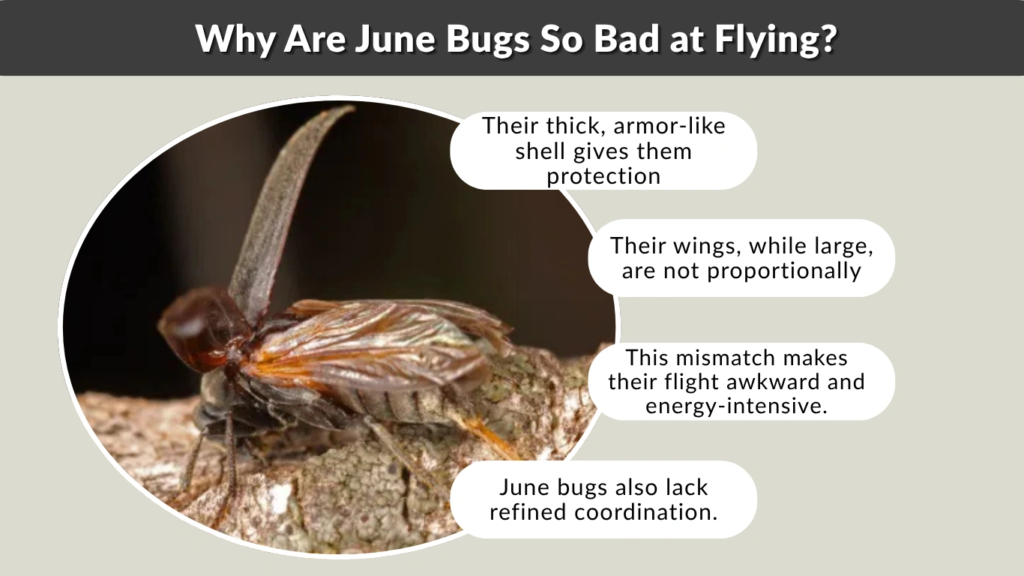
Body Weight vs Wing Strength
One of the main reasons June bugs fly so poorly is their body structure. Their thick, armor-like shell gives them protection but adds significant weight. Their wings, while large, are not proportionally strong enough to handle the load. This mismatch makes their flight awkward and energy-intensive.
Smaller beetles, like ladybugs, have a higher lift-to-weight ratio, allowing them to fly with greater precision. In contrast, June bugs rely on brute force rather than agility, flapping continuously just to stay in the air.
Lack of Coordination
June bugs also lack refined coordination. Their nervous system controls wing movement, but not with the precision of lighter insects. This poor motor control makes it difficult for them to stabilize midair or adjust quickly when obstacles appear.
When they land, they often tumble onto their backs and struggle to flip over — another sign of limited coordination. While this clumsiness seems comical, it’s actually an adaptation trade-off: they evolved for digging and feeding underground as larvae, not for graceful flight.
Why Do June Bugs Fly Toward Lights and People?
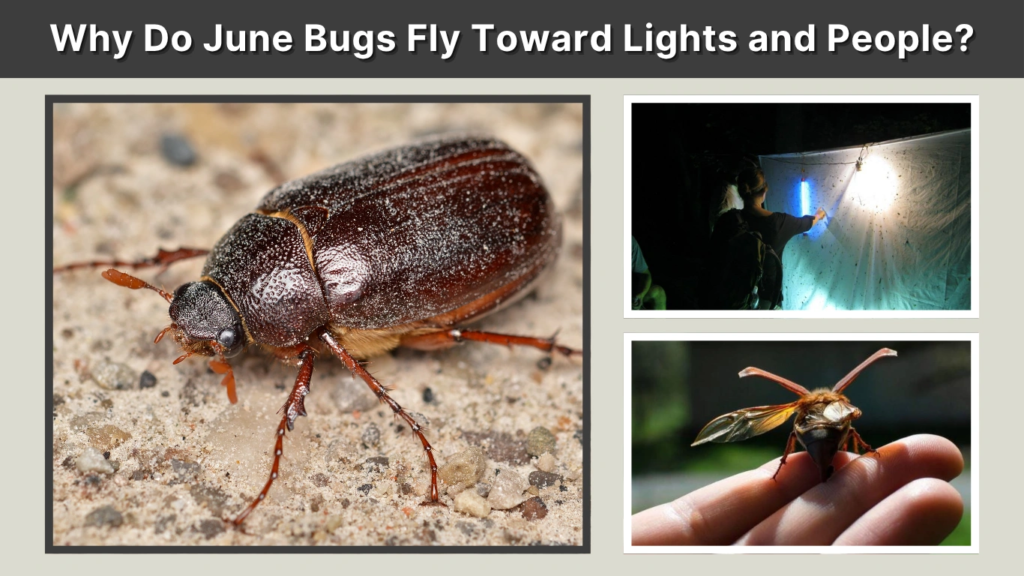
Phototaxis: Attraction to Light
June bugs are nocturnal and navigate naturally by the moon and stars. Scientists believe they maintain a fixed angle to a distant light source to orient themselves. However, artificial lights are much closer and brighter, confusing their navigation system.
When a porch light or window replaces the moon as a reference point, they spiral endlessly toward it, crashing into bulbs and walls. This behavior, called positive phototaxis, explains why they swarm around light sources every summer evening.
Why They Fly at People
June bugs are not aggressive — they don’t attack or bite. When they seem to “fly at you,” they’re simply disoriented. Standing near a bright light or moving in front of a reflective surface (like glasses, jewelry, or a phone screen) can attract them unintentionally.
Their poor control and limited vision make it impossible for them to navigate smoothly around moving objects — so when one buzzes your face, it’s usually by accident, not design.
When and Where Do June Bugs Fly?
Time of Activity
June bugs are primarily nocturnal. Their flight begins at dusk and continues into the night, peaking between 9 p.m. and midnight. Warm, humid evenings are their favorite time to fly, as heat and moisture help loosen their wing joints and allow easier movement.
During the day, they stay hidden beneath soil, leaves, or grass to avoid predators and dry air. You’ll often find them resting motionless on the ground or clinging to walls near outdoor lights.
Day vs. Night Flyers
Not all June bugs fly only at night. The green June beetle (Cotinis nitida) is a daytime flyer that buzzes loudly around fruit trees, compost piles, and gardens. In contrast, the brown June bug (Phyllophaga spp.) prefers the dark, flying under the cover of night to search for mates.
This difference in timing helps reduce competition for food and habitat. It also explains why some people see shiny green beetles during the day while others hear dull brown ones buzzing around lights at night.
Ideal Flight Conditions
June bugs are fair-weather fliers. They rarely take off during heavy rain or windy conditions since their wings can easily get damaged by moisture or strong gusts. The perfect flight conditions are warm temperatures between 70°F and 85°F, calm air, and moderate humidity. When the weather cools in late summer, flight activity decreases as adults die off after mating and laying eggs.
How High and How Fast Can June Bugs Fly?

Flight Range and Height
June bugs are low-level fliers. Most stay within 3 to 15 feet above ground, which keeps them close to plants and lights. They navigate around trees, fences, and shrubs while searching for food and mates.
Though they can climb to higher levels, their weak wings make sustained altitude flight difficult. You’ll seldom see them near tall streetlights or rooftops — they prefer short hops from one object to another.
Speed and Endurance
Despite their weight, June bugs can reach speeds of about 1 to 2 miles per hour. Their flight is short and energy-intensive, lasting only a few minutes at a time. Males, which spend nights flying in search of females, are more active and cover greater distances than females.
After each flight, they rest to recover energy, often landing clumsily on the ground or in nearby vegetation before taking off again.
| Flight Characteristic | Description |
| Typical Height | 3 – 15 feet above ground |
| Speed | 1 – 2 mph |
| Duration | Few minutes per flight |
| Active Time | Dusk – Midnight |
| Flight Efficiency | Poor; easily disoriented |
Do Flying June Bugs Bite or Sting?
Completely Harmless Flyers
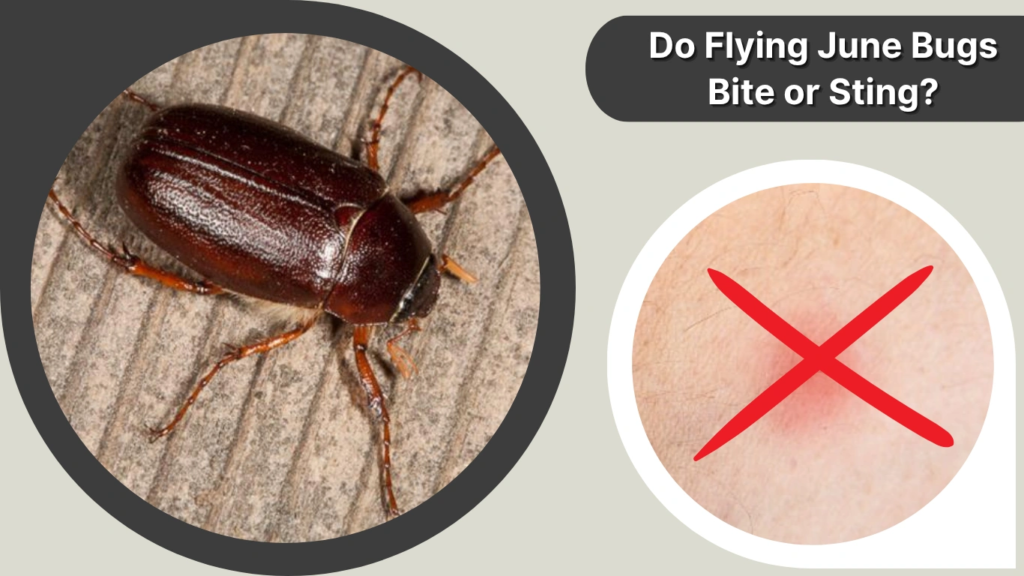
Despite their size and noisy flight, June bugs are harmless. They cannot bite, sting, or inject venom. Their mouthparts are designed to chew vegetation, not flesh. If a June bug collides with you, it’s simply an accident caused by poor vision.
They also pose no risk to pets — though cats and dogs may chase or even eat them out of curiosity. At worst, swallowing a few June bugs might cause mild stomach irritation in animals but no serious harm.
Common Misconceptions
Because of their clumsy flight, some people assume June bugs are aggressive. In reality, they have no interest in humans. Their awkward movements are purely mechanical, not intentional. Unlike mosquitoes or wasps, June bugs have no reason to approach people except by mistake.
How to Get Rid of Flying June Bugs
Reduce Light Attraction
The simplest way to deter June bugs is by reducing outdoor lighting. Replace white or blue-tinted bulbs with yellow “bug lights,” which emit wavelengths less visible to them. Turn off porch or patio lights when not needed, and close curtains to block indoor glow from attracting bugs to windows.
Eliminate Breeding Grounds
Since adult June bugs come from soil-dwelling larvae called grubs, controlling larvae is key.
- Keep lawns trimmed and aerated.
- Avoid over-watering, since damp soil attracts females to lay eggs.
- Apply beneficial nematodes or grub-control treatments in late summer to destroy larvae before winter.
Use Physical Barriers
If June bugs frequently enter through open doors or windows, install fine-mesh screens and seal cracks around light fixtures. Outdoor light traps placed away from the house can lure them safely away from living areas.
Fun Facts About Flying June Bugs
Green June Beetles and Daytime Buzzing
Green June beetles are larger, louder, and much better fliers than their brown relatives. They fly during daylight, often startling gardeners with their deep humming sound. Unlike brown June bugs, they feed on overripe fruit, nectar, and decaying organic matter.
These beetles are sometimes mistaken for Japanese beetles, but they are gentler fliers and less destructive to plants.
The Curtiss “June Bug” Airplane
In 1908, aviation pioneer Glenn Curtiss named one of his early aircraft the June Bug after the insect. The plane earned its nickname due to its unsteady but successful flight. On July 4, 1908, Curtiss piloted it nearly one mile — a record-setting achievement for American aviation at the time. The name captured the same spirit of persistence that defines the real June bug’s awkward yet determined flight.
FAQs
Can June bugs fly straight?
Rarely. Their heavy bodies and small wings make them unstable in the air, leading to erratic, looping flight paths.
Why do June bugs fly into lights?
They navigate by keeping a steady angle to the moon. Artificial lights confuse this instinct, making them circle and collide with bulbs and windows.
Do June bugs fly during the day?
Most brown June bugs fly at night, but green June beetles are daytime flyers often seen around fruit trees and compost piles.
Why do June bugs fly at people?
They don’t attack — their poor eyesight and attraction to reflected light cause accidental collisions with nearby humans.
Can Venus flytraps eat June bugs?
Technically yes, but June bugs are too large for most traps. Venus flytraps typically feed on smaller insects like ants, spiders, or flies.
