

In 2020, the world’s attention turned toward a terrifying insect nicknamed the “murder hornet.” Officially known as the Asian giant hornet (Vespa mandarinia), this species quickly became a source of fear, especially when sightings were reported in the United States. Among its subspecies is the Japanese giant hornet (Vespa mandarinia japonica), often called the “Japanese murder hornet.”
What Are Japanese Murder Hornets?

Origin of the Name
The term “Japanese murder hornet” is not scientific. It emerged from media reports that exaggerated the hornet’s danger to humans. In Japan, they are simply called “ōsuzumebachi,” which translates to “giant sparrow bee.” Their fearsome reputation comes less from human fatalities and more from their brutal efficiency in attacking honeybee hives.
Scientific Classification
The Japanese hornet is a subspecies of the Asian giant hornet. Its full name is Vespa mandarinia japonica, and it belongs to the wasp family Vespidae. This makes it closely related to yellowjackets, paper wasps, and other hornets. While nearly identical to the broader Asian giant hornet species, the Japanese variant is specifically adapted to the environments of Japan.
Same or Different?
So, are Japanese hornets and murder hornets the same? The answer is yes—with nuance. “Murder hornet” is a sensational nickname for the Asian giant hornet, which includes the Japanese subspecies. That means Japanese hornets are indeed murder hornets, though not all murder hornets are Japanese. This distinction is often lost in popular discussions, leading to confusion.
Appearance and Size

General Appearance
Japanese hornets are impossible to miss once spotted. They have a massive orange-yellow head, large dark eyes, and strong mandibles capable of tearing apart prey. Their bodies are robust, with bold yellow-orange and black stripes across the abdomen. Their wings are long and brownish, giving them a wingspan of up to 3 inches.
Japanese Murder Hornet Size
Workers typically measure 1.5 to 2 inches long, while queens can exceed 2 inches, making them the largest hornets in the world. Their intimidating size is often compared to that of a human thumb. In comparison, a honeybee is only about 0.5 inches long, and even the European hornet rarely surpasses 1.5 inches.
Identification Tips
To identify a Japanese hornet, look for three features:
- A large orange head wider than the thorax.
- A sturdy striped abdomen with alternating yellow-orange and black bands.
- A deep, low-pitched buzzing sound much louder than bees or wasps.
These traits make them stand out clearly from cicada killers, European hornets, or other large wasps often mistaken for them.
Sting and Its Dangers
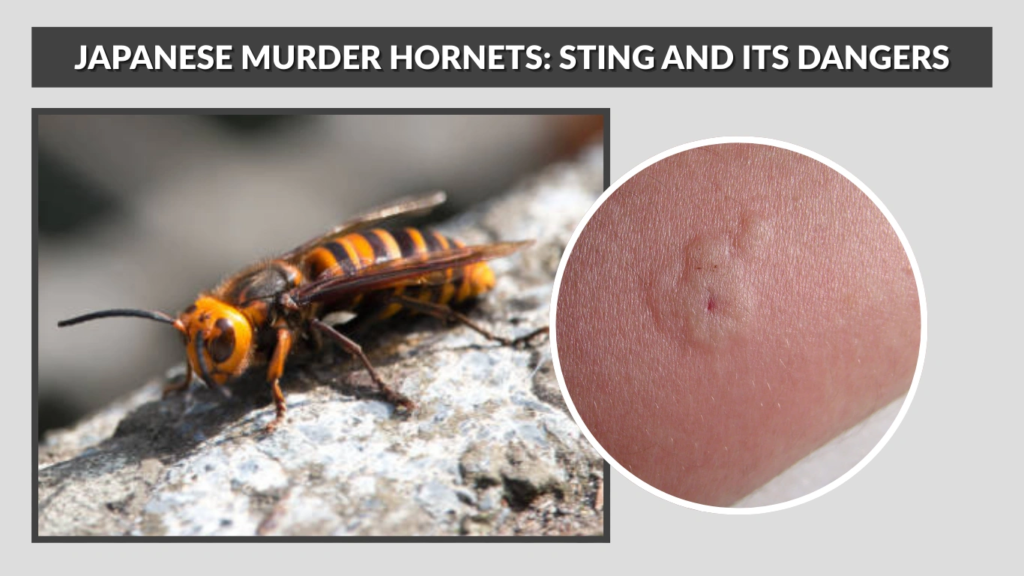
Sting Anatomy
The Japanese hornet’s stinger is around 6 millimeters long, significantly larger than most hornets. Unlike honeybees, they can sting multiple times without losing their stinger. Their venom contains neurotoxins and enzymes that cause tissue damage, spreading pain and inflammation.
Effects on Humans
A sting from a Japanese hornet is described as one of the most painful insect stings in the world. Victims report a hot, burning sensation that can last for hours. While a single sting is unlikely to kill a healthy adult, multiple stings can be dangerous. In Japan, a small number of fatalities occur each year, usually due to allergic reactions or repeated stings.
Treatment After a Sting

If stung, immediate action helps reduce complications:
- Move to safety – leave the area to prevent further stings.
- Clean the wound – wash with soap and water to prevent infection.
- Apply ice – reduce swelling and numb pain.
- Take antihistamines – ease itching or allergic reactions.
- Seek medical help – especially if symptoms include difficulty breathing, dizziness, or swelling of the throat.
The real danger lies not just in individual stings, but in the potential for multiple attacks if a nest is disturbed.
Habitat and Distribution
Native Range
Japanese hornets are native to Japan, thriving in temperate climates with plenty of forest cover. They prefer low mountains, rural landscapes, and wooded areas where prey like bees and other insects are abundant. Unlike some wasps, they are rarely found in urban centers.
Japanese Hornets in the U.S.
When “murder hornets” were detected in Washington state, many wondered if Japanese hornets had invaded North America. The truth is slightly different: the hornets detected were Asian giant hornets, closely related but not necessarily the Japanese subspecies. So far, Japanese giant hornets are not established in the U.S., though confusion in terminology has fueled misconceptions.
Nesting and Lifecycle
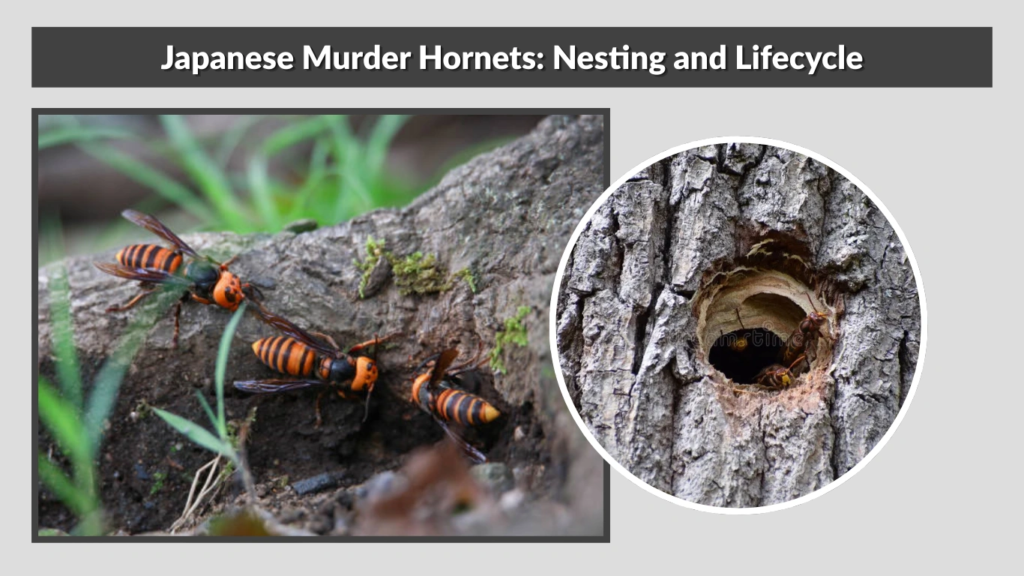
Nesting Habits
Japanese hornet queens build nests in spring, often underground in abandoned rodent burrows or inside tree hollows. These nests are concealed, unlike paper wasp nests, making them harder to spot. A mature nest can house several hundred hornets, all working together to defend the colony.
Lifecycle Stages
- Queen Emergence (Spring): After hibernating through winter, fertilized queens search for nest sites.
- Nest Building (Early Summer): The queen lays her first eggs, which hatch into workers.
- Colony Growth (Summer): Workers take over foraging and nest construction while the queen focuses on laying eggs.
- Reproduction (Fall): New queens and males are produced; males die after mating.
- Decline (Winter): The colony collapses, and only mated queens survive to restart the cycle.
This seasonal rhythm ensures their survival and explains their population peaks during late summer and early fall—the period when human encounters are most common.
Japanese Hornets vs Other Insects

Japanese Hornet vs Cicada Killer
Cicada killers are large wasps found in North America that are often mistaken for murder hornets. However, cicada killers are solitary and rarely aggressive toward humans. They primarily prey on cicadas, while Japanese hornets hunt a wider range of insects, including honeybees.
Japanese Hornet vs European Hornet
European hornets, found in both Europe and North America, are smaller than Japanese hornets and less aggressive. While their stings can be painful, they pose less risk to humans. Japanese hornets, in contrast, are colony defenders and will attack in large numbers if threatened.
Japanese Hornet vs Asian Giant Hornet (Other Subspecies)
The Japanese hornet is essentially a regional variant of the Asian giant hornet. Physically and behaviorally, they are nearly identical, but adapted to the Japanese climate and environment. This close relationship is why terms like “Japanese hornet” and “murder hornet” are often used interchangeably in news reports.
Japanese Honey Bees vs Murder Hornets

| Aspect | Japanese Honey Bees | European Honey Bees | Murder Hornets |
| Predator-Prey Interaction | Targeted by hornets but evolved defenses | Highly vulnerable to hornet attacks | Primary predator of honeybees |
| Defense Strategy | Form a “heat ball” around hornet scouts, raising temperature to lethal levels | No coordinated defense; bees are killed quickly | Use mandibles to decapitate bees and overwhelm colonies |
| Outcome of Attack | Often successful in killing scout hornets, preventing larger invasions | Colonies usually destroyed when attacked | Can wipe out an entire hive in hours |
| Survival Advantage | Adapted through evolution to coexist with hornets | Lacks adaptation, making them easy targets | Apex insect predator with little resistance outside Asia |
| Ecological Impact | Balance maintained in Japan due to bee defenses | Severe threat in new regions, endangering pollination | Disrupts ecosystems and agriculture where introduced |
Human Interaction in Japan
Coexistence and Risks
In rural Japan, encounters with giant hornets are not uncommon. Hikers, farmers, and forestry workers are advised to be cautious during late summer and fall, when colonies are largest and most defensive. Local governments sometimes post warning signs in areas known for hornet activity.
Cultural Aspects
Interestingly, Japanese hornets are not viewed only as pests. In some regions, they are eaten as food. Larvae and pupae are considered delicacies, often cooked with rice or deep-fried. Adults are sometimes used to make “hornet liquor,” where hornets are drowned in alcohol to infuse the drink with their essence. This unusual culinary tradition highlights the different cultural perceptions compared to the fear-driven narrative in the West.
Public Perception
While Japanese people respect the danger of hornets, they generally approach them with caution rather than panic. This contrasts with global media coverage, where “murder hornet” stories often emphasized human fatalities and sensationalized risks. In Japan, the hornet is seen more as a powerful force of nature than an apocalyptic threat.
Myths, Memes, and Media
Internet Fascination
The phrase “Japanese murder hornet” spread widely in 2020, inspiring memes, videos, and exaggerated stories. Images comparing hornets to action movie villains or describing them as “bee-eating monsters” became viral. Social media fueled the perception that hornets were spreading rapidly, even in places where they had never been seen.
Common Myths
One common myth is that Japanese hornets have photographic memory or advanced intelligence. In reality, while they are effective hunters, their behavior is instinct-driven rather than uniquely intelligent. Another myth is that they actively seek out humans; in truth, they only attack when threatened or provoked near their nests.
Global Panic
When sightings were confirmed in Washington state, headlines quickly spread worldwide. The phrase “murder hornet invasion” appeared in major newspapers, sparking widespread fear. However, entomologists stressed that the real danger was to honeybees, not humans. Despite the panic, eradication efforts contained the situation, preventing widespread establishment in the U.S.
Safety and Prevention
Identifying Japanese Hornets
Recognizing hornets correctly is the first step to safety. Their size, orange head, and low buzzing sound set them apart from other wasps. Mistaking cicada killers or European hornets for Japanese murder hornets often leads to unnecessary fear.
How to Stay Safe
If you encounter a hornet, remain calm and back away slowly. Avoid swatting, as sudden movements can provoke an attack. Never approach or disturb a nest. In Japan, professionals handle nest removals using protective suits and specialized equipment.
What to Do if Attacked
If multiple hornets begin stinging, run to shelter as quickly as possible. Cover your head and face to reduce risk, as hornets tend to target these areas. Once safe, seek medical attention if you experience severe pain, swelling, or allergic reactions.
Myths vs Reality
Exaggerations
Media often portray Japanese hornets as killers of humans, when in fact fatalities are rare and usually linked to allergies. The majority of people stung suffer pain and swelling but recover without lasting harm.
Real Dangers
The true ecological danger lies in their attacks on honeybees. If Japanese hornets were to spread unchecked outside Asia, they could devastate agriculture by reducing pollination. This makes them more of an agricultural threat than a human health risk.
