
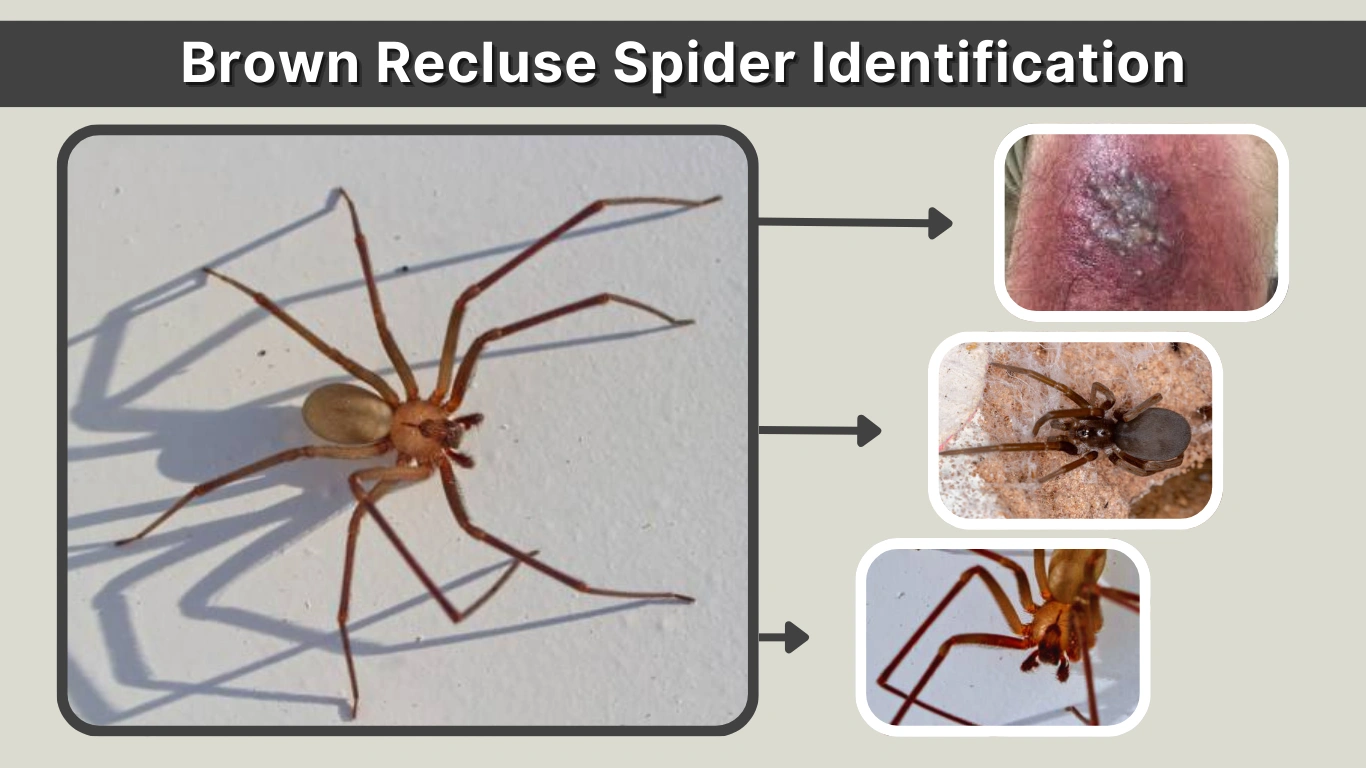
Correctly identifying a brown recluse spider is more difficult than most people expect. These spiders are widely feared, frequently blamed for bites, and often misidentified. In reality, confirmed brown recluse sightings are relatively uncommon, and many spiders assumed to be brown recluses turn out to be harmless species. Misidentification can lead to unnecessary panic, improper pest control decisions, and even incorrect medical diagnoses. This guide focuses on helping readers identify a brown recluse accurately by using reliable, step-by-step criteria rather than myths or assumptions.
The goal is not to create fear, but to give readers confidence. By understanding where brown recluses live and how they truly look, most people can rule them out quickly and correctly.
What Is a Brown Recluse Spider?
The brown recluse is a small, ground-dwelling spider best known for its reclusive behavior and medically significant venom. Despite its reputation, it is not aggressive and rarely bites unless pressed against skin. Brown recluses prefer dark, undisturbed environments and typically avoid human contact.
One reason they are so often misidentified is their plain appearance. Unlike brightly patterned or hairy spiders, brown recluses are subtle and understated, which causes people to label many “plain brown spiders” as recluses when they are not.
Geographic Range: The First and Most Important Filter
Geographic location is the single most important factor in identifying a brown recluse spider. These spiders have a limited and well-documented range. They are native primarily to the south-central United States, including parts of the Midwest and lower Mississippi Valley.
If you live far outside this region, the likelihood that a spider you found is a brown recluse is extremely low. While isolated cases occur due to accidental transport (such as in moving boxes or shipments), established populations outside their native range are rare.
Many reported brown recluse sightings in coastal states, the Northeast, the Pacific Northwest, and much of Canada are later disproven. In these areas, similar-looking spiders are far more common and are almost always the real culprit. Before examining physical traits, location alone can eliminate the possibility in a majority of cases.
Physical Characteristics: Key Identification Features
Body Size and Shape
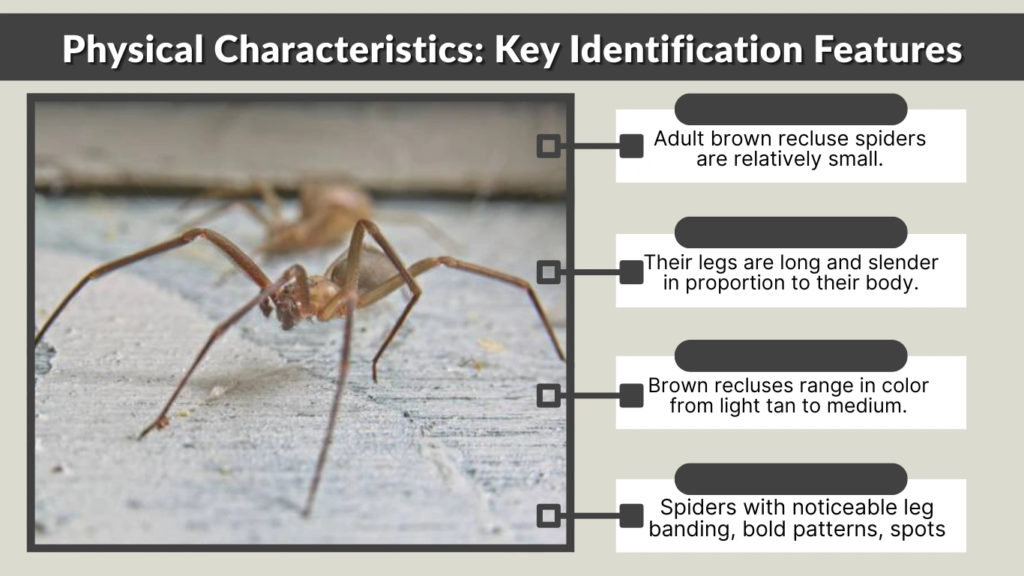
Adult brown recluse spiders are relatively small. The body length (not including legs) is usually about the size of a dime or smaller. They have a flat, oval-shaped body rather than a bulky or rounded one. Their legs are long and slender in proportion to their body, giving them a delicate appearance.
Size should never be used as the sole identifying feature. Many harmless spiders fall into the same size range, and juveniles of larger species are often mistaken for adult brown recluses.
Coloration
Brown recluses range in color from light tan to medium or dark brown. Their coloration is generally uniform, meaning the body and legs are mostly the same shade without stripes, bands, or contrasting markings.
Spiders with noticeable leg banding, bold patterns, spots, or multiple colors are not brown recluses. However, lighting conditions can alter perception. Shadows, yellow indoor lighting, or camera flash can make a spider appear darker or differently colored than it truly is, which is why color alone is unreliable.
The “Violin” Marking: What It Really Means
The violin-shaped marking on the back of the spider is the most well-known feature associated with brown recluses, but it is also the most misunderstood. When present, the marking appears on the top of the cephalothorax (the front body section), with the “neck” of the violin pointing toward the abdomen.
Not all brown recluses have a clearly visible violin, especially juveniles or darker individuals. At the same time, many non-recluse spiders have markings that can look violin-like at a glance. Dust, shadows, or body posture can also create false impressions.
Because of this, the violin marking should be considered supporting evidence only, never proof by itself.
Eye Arrangement: The Most Reliable Physical Identifier
The most dependable way to identify a brown recluse spider is by its eyes. Unlike most spiders, which have eight eyes, brown recluses have six eyes arranged in three pairs. These pairs form a curved or semicircular pattern on the front of the head.
This feature is far more reliable than color or markings. Very few common house spiders share this eye configuration. Observing eye arrangement usually requires close inspection, good lighting, and magnification, and should be done without touching the spider.
If the spider clearly has eight eyes, it is not a brown recluse.
Legs and Hair: Subtle but Important Clues
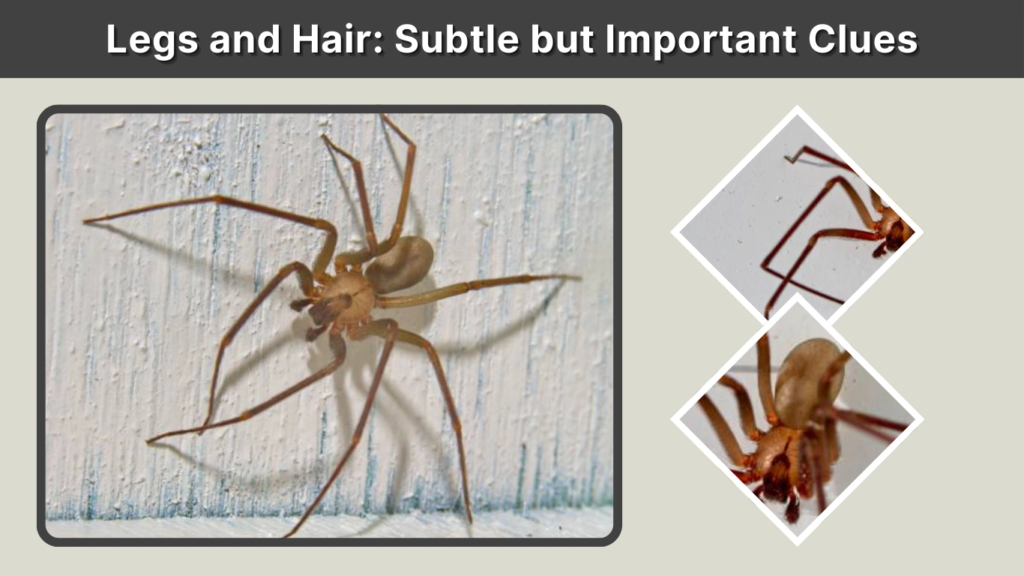
Brown recluse legs are smooth and lack prominent spines. They may have fine, short hairs, but they do not appear fuzzy or bristly. The legs are usually the same color as the body and do not have stripes or bands.
Spiders with thick leg spines, heavy hair, or contrasting leg patterns can be ruled out. These traits are common in wolf spiders, grass spiders, and other species frequently mistaken for brown recluses.
Behavior Traits That Support Identification
While physical features are the foundation of identification, behavior can provide useful supporting clues. Behavior alone is not definitive, but when combined with location and anatomy, it helps confirm or eliminate the possibility of a brown recluse.
Movement and Activity Patterns
Brown recluse spiders are primarily nocturnal. They are most active at night and typically hide during the day. Their movement is slow and deliberate rather than fast or erratic. If disturbed, they usually try to retreat rather than run aggressively or stand their ground.
They are not jumpers and do not chase prey. Spiders that move very quickly, jump, or actively pursue insects are almost never brown recluses.
Web and Hiding Behavior
Brown recluses do build webs, but their webs are not used to catch prey. Instead, they are irregular, messy, and often hidden in undisturbed areas. These webs are usually found in places such as storage boxes, closets, basements, attics, behind furniture, or inside rarely used shoes and clothing.
Seeing a spider wandering across a wall or floor does not automatically indicate an infestation. Brown recluses often roam at night while hunting and may be encountered singly rather than in large numbers.
Common Spiders Mistaken for Brown Recluses
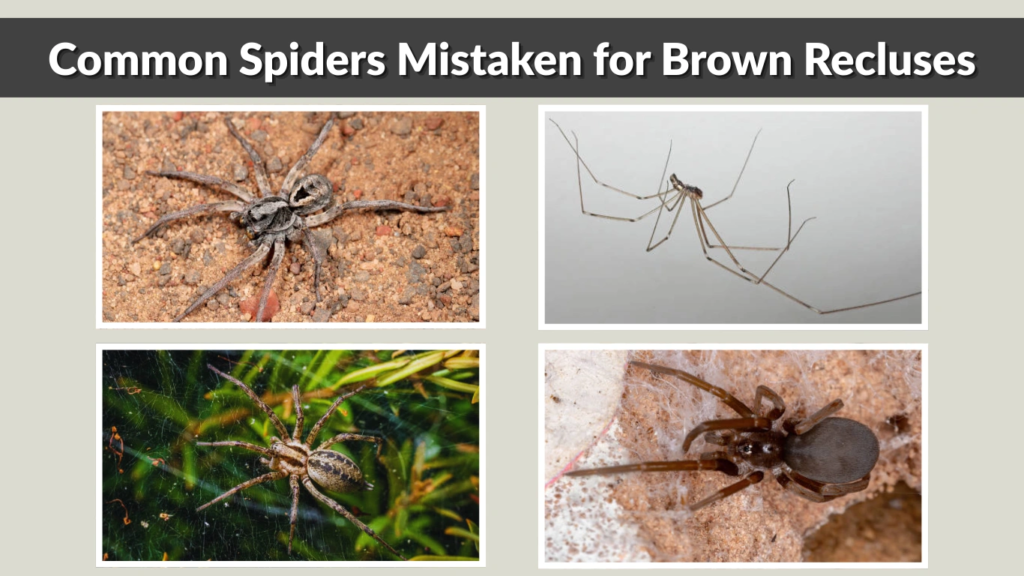
Misidentification is extremely common. Several harmless spiders share similar size or color but differ in key traits.
Wolf Spiders
Wolf spiders are one of the most frequent misidentifications. They are usually larger, hairier, and have thick legs with visible spines. Their eye arrangement includes eight eyes, often with two large forward-facing eyes that are easy to spot. They are active hunters and move quickly, which contrasts with the brown recluse’s behavior.
Cellar Spiders (Daddy Longlegs)
Cellar spiders have very long, thin legs and a small, rounded body. Their fragile appearance and web-building habits make them easy to distinguish once closely observed. They are completely harmless and do not resemble brown recluses beyond basic coloration.
Grass Spiders
Grass spiders are often mistaken for brown recluses indoors. However, they have visible spinnerets at the end of the abdomen, distinct striping, and eight eyes. Their webs are funnel-shaped and much more structured than recluse webs.
Southern House Spiders
Southern house spiders are similar in color but have a bulkier body, thicker legs, and different eye arrangement. Males are more often mistaken for brown recluses, but they lack the correct eye pattern and body proportions.
Brown Recluse vs. Other Spiders: Quick Comparison
When comparing spiders, focus on three traits:
- Eye count: six eyes in three pairs
- Leg texture: smooth, without heavy spines
- Color consistency: uniform, no bands or stripes
If even one of these does not match, the spider is not a brown recluse.
Identifying a Brown Recluse Bite vs. Other Skin Conditions

Brown recluse bites are often overdiagnosed. Many skin lesions attributed to spider bites are actually infections, allergic reactions, or other medical conditions. Confirmed brown recluse bites are relatively rare and often go unnoticed at first.
When symptoms do occur, they may include mild pain, redness, and swelling that develops slowly. Severe reactions are uncommon and usually involve tissue damage over time rather than immediate dramatic symptoms.
A bite diagnosis should never be based solely on the appearance of a wound without seeing and identifying the spider.
How to Confirm Identification Safely
Never handle a suspected brown recluse directly. If the spider must be contained, use a clear container and a stiff piece of paper to trap it safely. This allows for observation without risk.
Clear, close-up photographs—especially of the eyes and body—are often sufficient for expert identification. Local extension services, entomologists, or pest control professionals trained in spider identification can provide confirmation.
What to Do If You Think You Found One
Do not panic. Finding a single spider does not automatically mean there is a problem. Reduce clutter, seal cracks, shake out stored clothing, and limit access to dark hiding spaces.
Professional pest control is usually only necessary if multiple confirmed brown recluses are found over time. Preventive measures and monitoring are often sufficient.
