
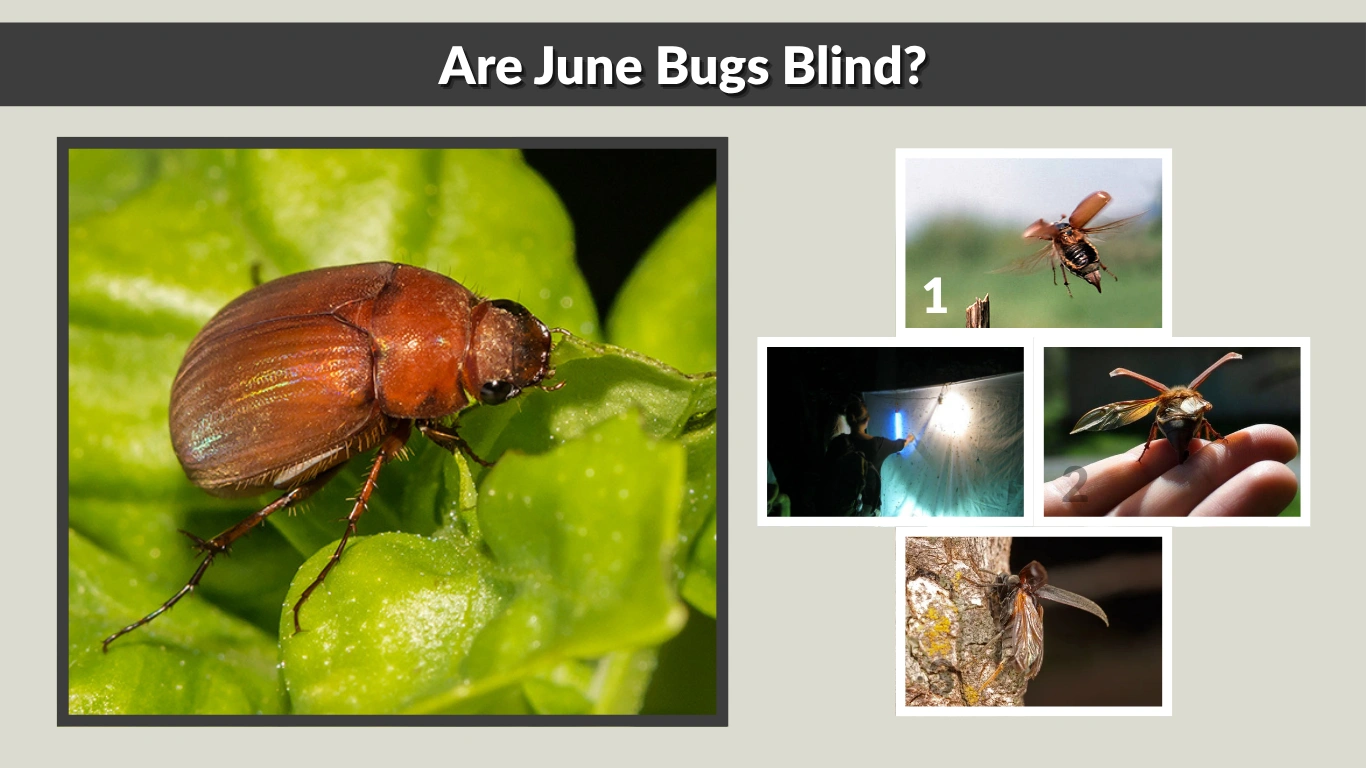
Every summer, people notice June bugs crashing into walls, lights, and even their own heads. Their clumsy flight and obsession with porch lamps have sparked a popular belief that June bugs are blind. But are they really? The truth is more fascinating — June bugs can see, but their eyes are built very differently from ours. Understanding how they perceive the world helps explain why they act so strangely at night.
The Myth of the Blind June Bug
Why People Think June Bugs Are Blind
The myth likely began because of their odd nighttime behavior. On warm evenings, June bugs emerge suddenly, buzzing loudly as they collide with windows or circle around bright bulbs. Their awkward movements give the impression of blindness. They often cling to screens or fall to the ground, only to start flying again in random directions.
To humans, this looks like pure confusion — and it is, in a way. June bugs aren’t navigating by sight the same way we do. Their erratic flight comes from how they process light, not from a lack of vision.
The Truth Behind the Myth
June bugs are not blind at all. In fact, they have compound eyes, like many other beetles and insects. These eyes contain hundreds of tiny lenses called ommatidia, each capturing a small piece of the visual field. Combined, they create a mosaic-like image that allows the bug to detect movement and light but not fine details.
Their vision works well in dim natural light, but when they encounter bright artificial lights, their navigation instincts malfunction. This is why they appear to “attack” porch lamps — they aren’t blind, just disoriented.
Understanding June Bug Vision
Structure of Their Eyes
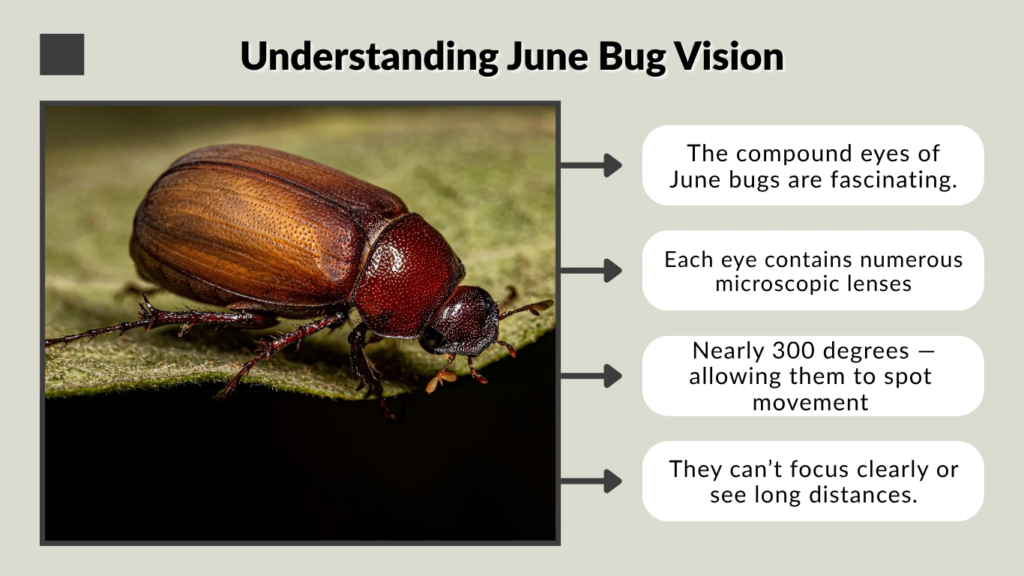
The compound eyes of June bugs are fascinating. Each eye contains numerous microscopic lenses that detect changes in brightness and motion. This structure gives them a wide field of vision — nearly 300 degrees — allowing them to spot movement from multiple directions. However, they can’t focus clearly or see long distances. What they perceive is more like shifting patches of light and shadow.
This explains why June bugs fly so unpredictably. When they detect sudden light or movement, their instinct is to follow it. Unfortunately, streetlights and porch bulbs mimic natural light cues, causing their internal compass to spin out of control.
How June Bugs See the World
To a June bug, the world is a soft blur of brightness and contrast. They rely more on detecting light intensity than on recognizing colors or shapes. Studies suggest they can see ultraviolet light and faint moonlight but are almost “blinded” by strong artificial light.
At night, their navigation system depends on keeping a steady angle to the moon. Artificial lights nearby create multiple light sources, tricking them into flying in endless circles. This makes them look clumsy — but in truth, they’re just lost in a world that’s too bright.
Why June Bugs Fly Toward Lights
The Phototaxis Phenomenon
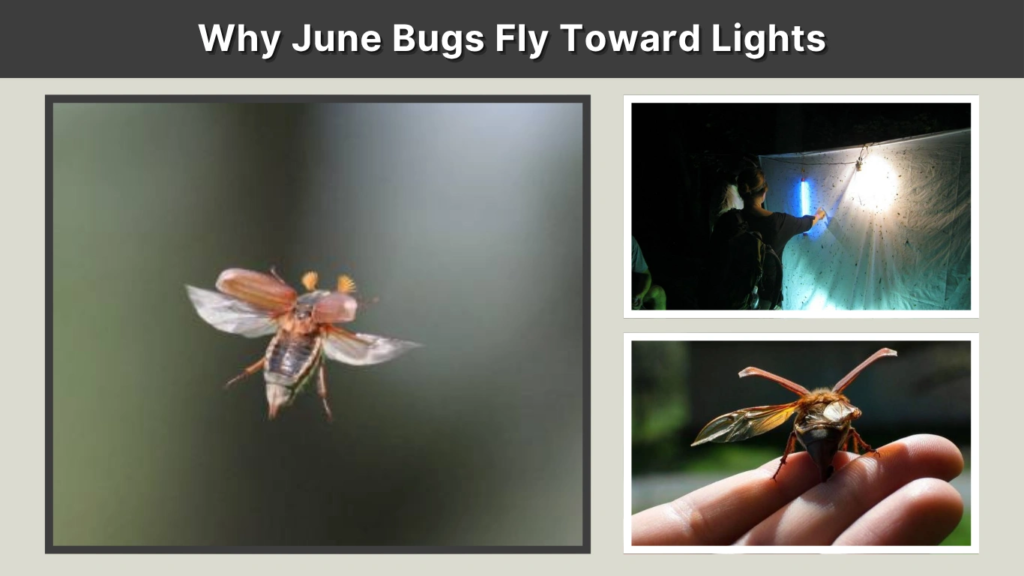
Like many nocturnal insects, June bugs exhibit positive phototaxis — a natural attraction to light. For millions of years, they’ve used the moon to orient themselves during flight. When humans introduced artificial lighting, it disrupted that ancient instinct.
Instead of keeping a straight path guided by the distant moon, a nearby bulb overwhelms their senses. They attempt to maintain a fixed angle to the light, causing them to spiral closer and closer until they crash into it.
Behavioral Consequences
This attraction to light explains their nighttime chaos. They bump into walls, windows, and people simply because their depth perception is poor and their navigation system can’t handle multiple light sources.
Outdoor lights, glass surfaces, and reflective objects all confuse them further. To reduce unwanted encounters, switch to yellow “bug lights,” which emit wavelengths less visible to June bugs. Keeping lights dim or off during peak activity (May through July) can also minimize their presence.
Green vs Brown June Bugs: Are They Both “Blind”?
Green June Bugs (Cotinis nitida)
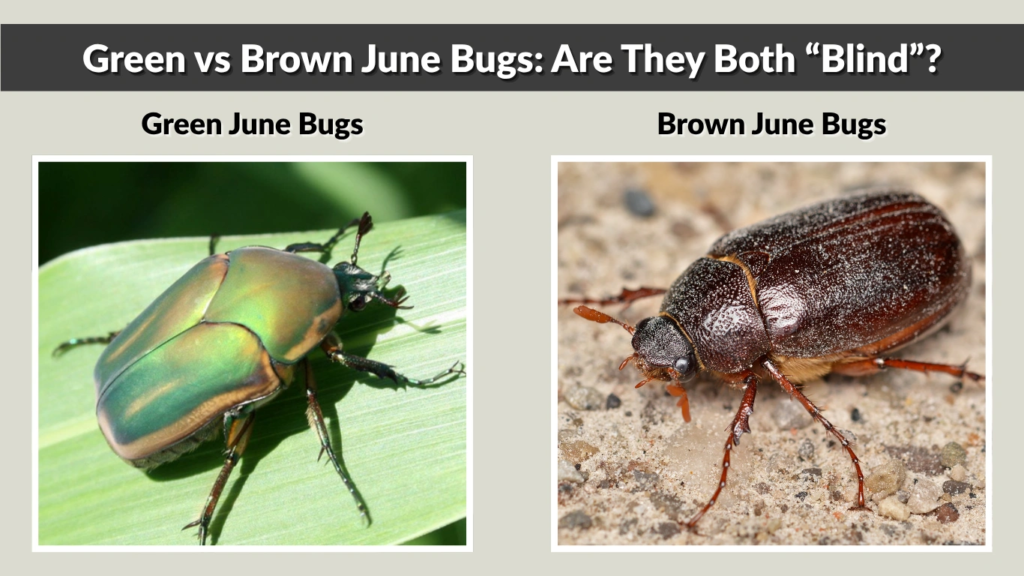
The bright, metallic green June bug is a daytime flier and one of the few beetle species comfortable in sunlight. Its eyes are adapted to handle stronger light levels, giving it better control and smoother flight. Because it’s active during the day, the green June bug relies more on vision than its brown cousin, which is nocturnal.
Brown June Bugs (Phyllophaga spp.)
The brown June bug, often seen in the southern and western United States, is active only at night. Its eyes are sensitive to low light and well-suited for dim moonlit skies. However, when exposed to bright or artificial light, their visual system becomes overwhelmed, making them appear “blind.” Their flight becomes disoriented, and they often collide with walls or people.
Comparative Table
| Feature | Green June Bug | Brown June Bug |
| Activity Time | Daytime | Nighttime |
| Eye Adaptation | Bright light | Low light |
| Flight Style | Smooth | Clumsy |
| Attraction to Light | Low | High |
The contrast between these two species reveals that June bugs aren’t blind — they’re just specialized for different lighting conditions. Green June bugs thrive in daylight, while brown ones rely on darkness, where their sensitive eyes function best.
Are June Bugs Deaf Too?
The Myth of Being “Blind and Deaf”
Many people assume June bugs are both blind and deaf because they rarely react to loud noises or approaching humans. In truth, they simply lack ears as we know them. Their bodies are not built for sound detection the way mammals or even crickets’ bodies are. Instead, they rely on vibrations and air movements to interpret their surroundings.
The myth of being “deaf” probably comes from their sluggish reaction time. When startled, a June bug often freezes or falls instead of flying away. This behavior is not from deafness or blindness — it’s a defense mechanism called thanatosis, or playing dead, which protects them from predators.
How They Actually Sense Their Environment
June bugs possess fine sensory hairs and receptors along their bodies and legs that pick up vibrations. These help them detect footsteps, air currents, and even the flutter of wings nearby. Their antennae are equally important — they contain chemical sensors that help them locate food, mates, and pheromone trails.
While they can’t “hear” sounds like we do, their sensitivity to movement and smell gives them a surprisingly sharp awareness of their surroundings. This sensory system compensates for their limited eyesight, allowing them to survive effectively despite appearing slow and clumsy.
June Bugs and Human Perception
Can June Bugs See Humans?
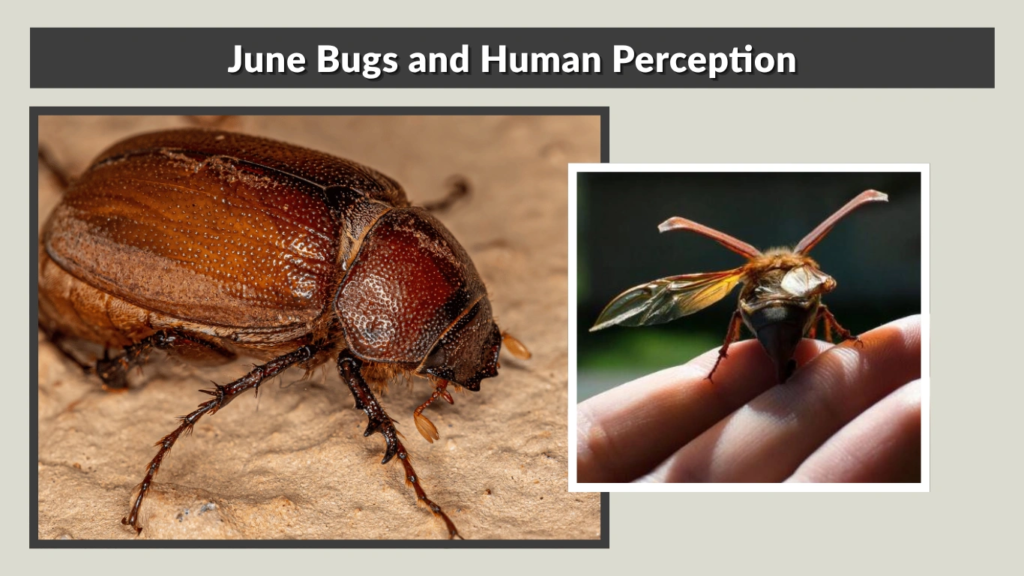
June bugs can see people — but not in the way you might think. To them, a person looks like a large, moving shadow. They can detect motion and light contrasts but cannot distinguish details such as faces or colors. So when a June bug flies toward you, it’s not an act of aggression. Most likely, it’s flying toward a nearby light source and simply crosses your path.
Their poor depth perception makes it difficult for them to gauge distance, which is why they often bump into walls, glass, or people. What seems like a “blind charge” is really just a navigation failure.
Do They Recognize Faces or Colors?
June bugs cannot recognize faces or complex shapes. Their eyes are optimized for detecting light patterns, not detailed vision. Some studies suggest they can perceive ultraviolet and blue light, which helps them orient under moonlight. However, they can’t differentiate between warm colors like red or orange. This limited color perception reinforces the illusion of blindness when they encounter artificial lighting or bright environments.
Survival Adaptations and Night Behavior
Why Poor Vision Isn’t a Weakness
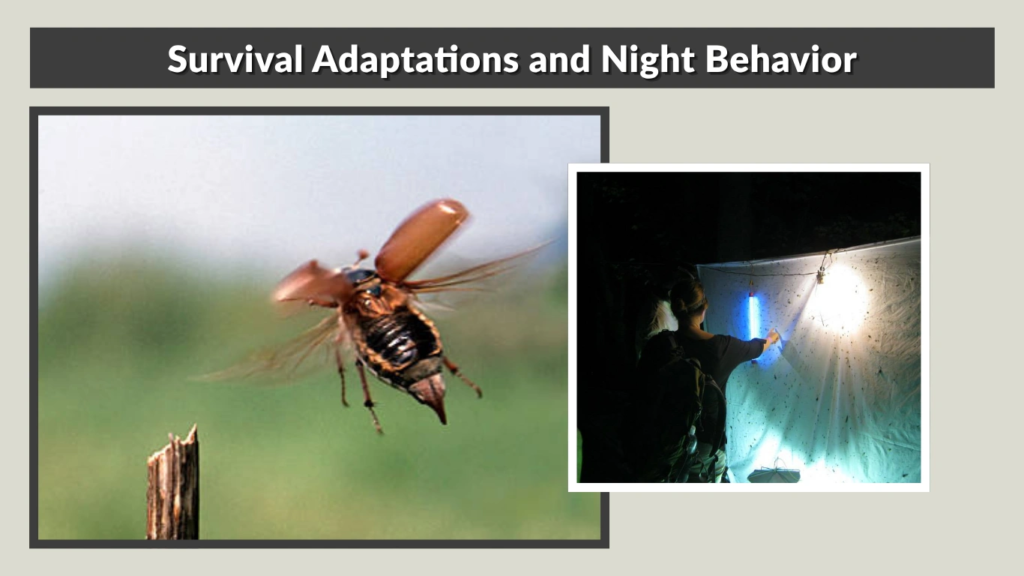
Although their vision is limited, June bugs are remarkably successful insects. Their clumsy flight and dark coloring actually serve protective functions. Nocturnal habits help them avoid daytime predators such as birds and lizards. At night, their drab brown bodies blend with tree bark and soil, offering natural camouflage.
Their “bad eyesight” is also part of their evolutionary trade-off — they don’t need perfect vision to survive. Since most of their life is spent underground as larvae, eyesight plays a minor role compared to smell and vibration detection. Once they reach adulthood, their main purpose is reproduction, not long-term survival.
Navigation by Moonlight
In natural conditions, June bugs use the moon and starlight as stable navigation cues. Their compound eyes are highly sensitive to faint light, allowing them to fly straight lines by maintaining a constant angle to a distant light source. But when artificial lights appear closer and brighter than the moon, this system malfunctions. The bug tries to maintain the same angle, resulting in a spiraling path that leads it straight into the light — and sometimes, into your living room.
Scientific Insight: How Vision Affects Their Lifecycle
Vision and Mating
Vision influences how June bugs find mates. Males use both sight and pheromones to locate females during the breeding season. Their limited eyesight means they rely heavily on scent signals detected by antennae. Once they detect a female’s pheromone, they fly toward the source, even if their path appears random to human observers.
In some species, slight flashes or wing movements during flight help them recognize potential mates under moonlight. Their ability to perceive movement, even in low light, is critical during these nighttime rituals.
Vision and Feeding
Adult June bugs feed on leaves and tree foliage, using light and scent to locate food. They prefer tender vegetation illuminated by moonlight or faint artificial glow. However, the larvae (white grubs) live entirely underground, feeding on roots. These grubs are blind, as eyesight offers no advantage below the surface. Their strong mouthparts and sensitivity to vibration help them locate roots efficiently, making them more destructive to lawns and crops than the adult beetles.
How to Coexist with June Bugs
Preventing Indoor Entry
June bugs are harmless but can be startling indoors. Keeping them out involves reducing light attraction near entry points. Use motion-activated or yellow “bug lights,” close doors promptly, and install fine-mesh window screens. Sealing cracks around foundations and vents prevents accidental entry. Since they cannot breed indoors, any intruding beetles will die naturally within days.
Natural Deterrents
Maintaining a healthy lawn is the best way to prevent infestations. Aerate and water regularly to discourage egg-laying, and apply beneficial nematodes to kill underground larvae. Predators like birds, bats, and toads also keep populations balanced. Avoid using heavy pesticides unless infestations are severe, as they can harm pollinators and beneficial insects.
FAQs
Are June bugs actually blind?
No, June bugs are not blind. They have compound eyes that detect light and movement, but they cannot focus or see detail. Their confusion around lights is due to disorientation, not blindness.
Why do June bugs fly into lights?
They navigate by keeping a steady angle to moonlight. Artificial lights mimic this cue, causing them to spiral endlessly around bulbs. This instinctive behavior, called positive phototaxis, explains their chaotic flight patterns.
Can June bugs see humans?
Yes, but only as moving shadows. They can detect motion and brightness but not features or faces. Their poor depth perception causes them to fly into people accidentally.
Are June bugs deaf as well as blind?
June bugs lack ears but can sense vibrations through fine body hairs and antennae. This allows them to detect predators or nearby movement even without hearing.
Do green June bugs have better vision than brown ones?
Yes. Green June bugs are diurnal and adapted to daylight, giving them stronger visual abilities. Brown June bugs are nocturnal and have more sensitive eyes designed for darkness, which makes them disoriented by bright lights.
