

Correctly identifying yellow jackets is important not only for curiosity but also for safety. These wasps are among the most aggressive stinging insects, and mistaking them for bees or other wasps can lead to risky encounters. By learning their key traits, you can quickly tell if the insect buzzing around your yard is a yellow jacket or something else entirely.
What Are Yellow Jackets?
Yellow jackets are a type of social wasp known for their bright yellow-and-black coloration and aggressive nest defense. Unlike honeybees, they can sting multiple times without losing their stinger, making them a greater threat when disturbed. They are predators and scavengers, feeding on insects, meats, and sweet foods.
While they help control pests, their tendency to nest near human activity and attack in large numbers makes them a significant safety concern, especially in late summer when colonies are at their peak.
Key Physical Features of Yellow Jackets

Identifying a yellow jacket comes down to a few distinctive physical traits that set them apart from other insects.
Body Size and Shape
Yellow jackets are typically between 10–16 mm (0.4–0.6 inches) long. Their bodies are compact and more robust compared to the slender frame of paper wasps.
Color Patterns
The most noticeable feature is their bright yellow-and-black banded pattern on the abdomen. The markings are sharp and bold, unlike bees which have a fuzzier appearance.
Hair and Texture
Yellow jackets have a smooth, shiny body with little or no visible hair, which differentiates them from bees that appear fuzzy.
Wings and Flight
Their transparent wings are folded lengthwise when at rest. In flight, they are quick and darting, making sharp turns as they move from place to place.
Yellow Jacket Identification Chart

| Feature | Yellow Jacket | Paper Wasp | Hornet | Honeybee |
| Body Size | 10–16 mm, stocky | 16–20 mm, slender | 18–25 mm, robust | 12–15 mm, oval body |
| Color Pattern | Bright yellow & black bands | Brown with yellow or reddish markings | Black & white or black & yellow | Golden brown with black bands |
| Hair/Texture | Smooth, shiny body | Smooth body | Smooth body | Fuzzy, hairy body |
| Wings | Transparent, folded lengthwise | Transparent, folded | Transparent, folded | Transparent, held flat |
| Behavior | Aggressive, scavenger | Less aggressive, hunts insects | Aggressive, strong defender | Docile unless provoked |
Common Species of Yellow Jackets

While all yellow jackets share similar traits, different species have distinct markings and nesting habits. Knowing which species you’re dealing with can help you understand their behavior.
Eastern Yellow Jacket (Vespula maculifrons)
- Found throughout eastern North America.
- Black antennae with bold yellow bands on the abdomen.
- Commonly nests underground.
Western Yellow Jacket (Vespula pensylvanica)
- Widespread in the western United States and Canada.
- Known for aggressive scavenging around garbage and picnics.
- Prefers ground nests but can occupy wall voids.
German Yellow Jacket (Vespula germanica)
- An invasive species in many regions.
- Has distinctive black dots on the front of the face.
- Builds nests in walls, attics, or other enclosed spaces.
Southern Yellow Jacket (Vespula squamosa)
- Common in the southeastern United States.
- Larger than most species, with reddish-brown mixed into the yellow-and-black pattern.
- Often takes over old nests and expands them.
Where You’ll Find Yellow Jackets

Yellow jackets build their nests in places that provide both protection and easy access to food.
- Underground: Many species use abandoned rodent burrows, enlarging them for their colonies.
- Wall Voids and Attics: These offer shelter and warmth, making them ideal for some species.
- Shrubs and Trees: While less common, some aerial nests are built in vegetation.
Activity peaks in late summer and early fall, when the colony population is at its largest and workers aggressively seek out food sources.
Behavior That Helps Identify Yellow Jackets
Even from a distance, you can often recognize yellow jackets by their behavior. They are highly aggressive when defending their nests and will chase intruders for long distances. They are also opportunistic feeders, swarming around open drinks, meat, and sweet foods at outdoor gatherings. Their rapid, darting flight pattern and constant movement set them apart from slower, hovering bees.
Safety Tips When You Spot a Yellow Jacket
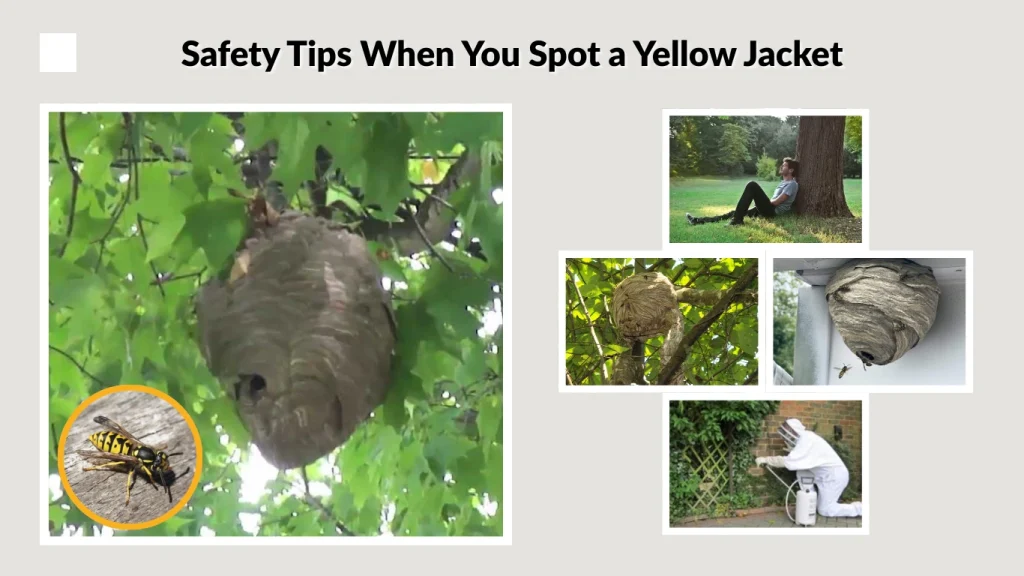
If you encounter a yellow jacket or discover a nest:
- Keep your distance and avoid sudden movements.
- Do not attempt to swat them; this will make them more aggressive.
- If a nest is near your home or in a high-traffic area, consider professional removal.
- Wear protective clothing when gardening or working in areas where nests may be hidden.
Difference Between Yellow Jackets and Other Wasps
Yellow jackets are often mistaken for other wasps, especially paper wasps and hornets, but there are clear differences in appearance, behavior, and nesting habits. Physically, yellow jackets are smaller and more compact than most hornets, with a body length of about 10–16 mm. Their bright yellow-and-black banded abdomen is more vividly patterned than that of paper wasps, which often have brownish bodies with yellow or reddish markings.
In terms of behavior, yellow jackets are far more aggressive, particularly when defending their nests. They can sting multiple times without losing their stinger, making them more dangerous than paper wasps, which are generally less defensive unless directly threatened. Hornets can also be aggressive, but their size and white or pale yellow markings make them easier to distinguish.
Nesting habits also set them apart. Yellow jackets frequently nest underground in rodent burrows or hidden spaces like wall voids, while paper wasps build open, umbrella-shaped nests in exposed locations, and hornets typically construct large, enclosed paper nests above ground. Understanding these differences is essential for safe identification and choosing the right approach if removal is necessary.
FAQs
How can you tell a yellow jacket from a bee?
Yellow jackets have smooth, shiny bodies with bright yellow-and-black bands, while bees are hairy and have a fuzzier, golden appearance. Yellow jackets are also slimmer and more aggressive, especially when defending their nests, and they can sting multiple times without losing their stinger.
Are all black-and-yellow wasps yellow jackets?
No, other wasps such as paper wasps and hornets also have black-and-yellow markings. However, yellow jackets are more compact, have consistent banding, and are generally more aggressive than most other wasps you may encounter.
Can you identify them by flight behavior?
Yes, yellow jackets have a fast, darting flight and rarely hover in one place for long. They move quickly between food sources and the nest, unlike bees, which may hover or move more slowly when foraging.
