
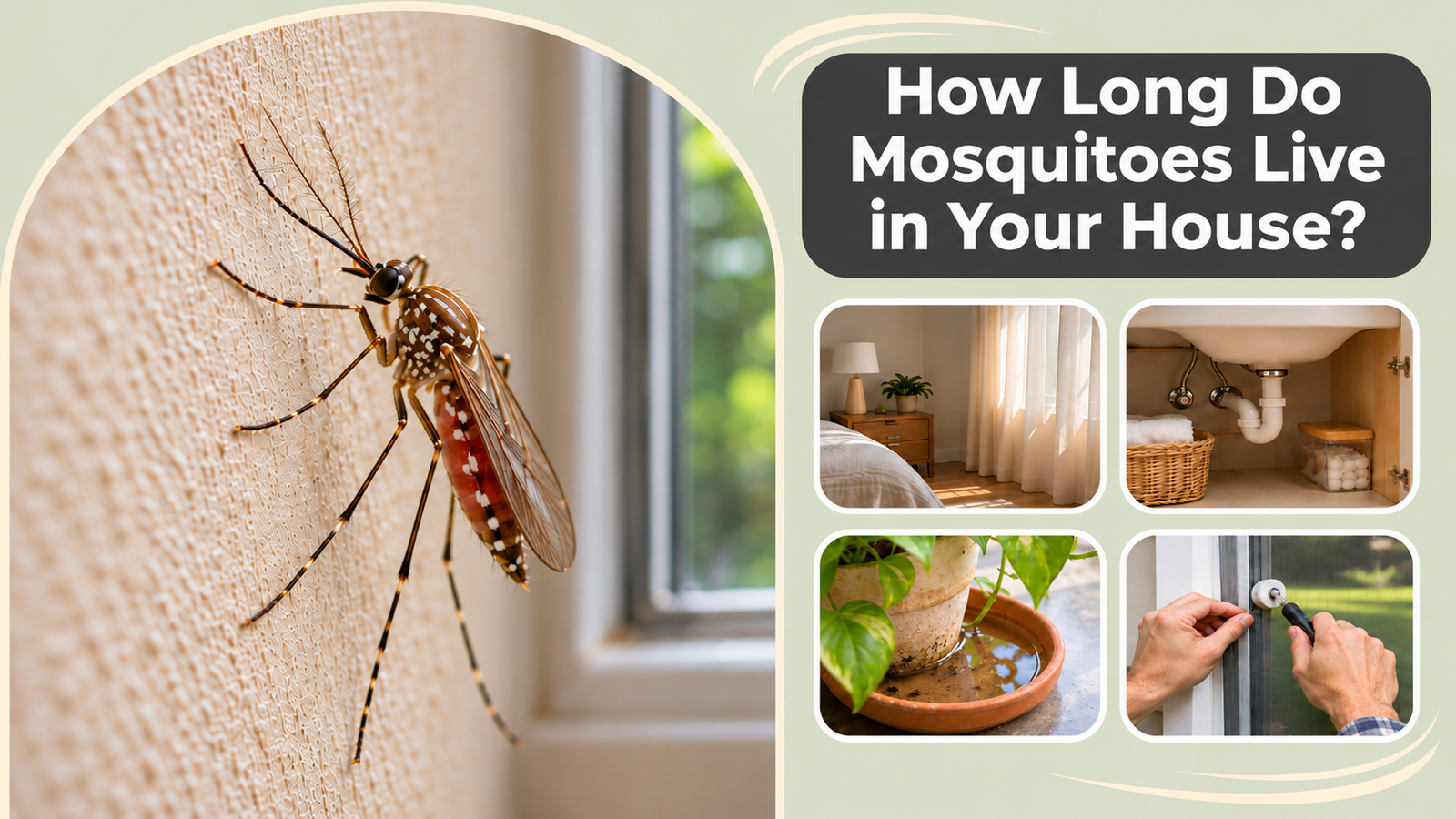
A mosquito in your house can survive for several days and may last a few weeks if conditions are favorable. The Centers for Disease Control and Prevention gives a general adult mosquito lifespan of about two to four weeks. That range covers the mosquito’s entire adult life, including any time it spent outdoors before entering your home. How long it has left depends on its age, species, and access to food and sheltered resting spots. If you keep seeing mosquitoes over several weeks, fresh adults may be coming in from outdoors or emerging from water inside your home.
What Determines How Long a Mosquito Lives Indoors?
Two mosquitoes that enter the same room on the same night can survive for different lengths of time. One may have just emerged as an adult, while the other may already be near the end of its life. The conditions they find inside also matter. A shaded, humid laundry room offers a different place to rest than a dry, air-conditioned bedroom.
Age, Temperature, and Humidity
The day you first spot a mosquito tells you when you noticed it. Its age is harder to judge. A newly emerged adult may have much of its lifespan ahead of it, while an older one might disappear after only a short time indoors. This is why the general adult lifespan is a poor countdown for a mosquito you just saw.
Dry air can increase moisture loss, while humid places can help a resting mosquito retain moisture. Conditions also vary from room to room. Even in an air-conditioned house, a dark cabinet under a sink or a sheltered space near a shower may offer a more humid resting spot.
Access to Sugar and Blood
Both male and female mosquitoes can feed on plant sugars for energy. A mosquito that recently fed may have enough stored energy to survive for a while in a room with few sugar sources. There’s no reliable number of days it will last without feeding, because its reserves, activity, and surroundings all play a role.
Females of most species use nutrients from blood meals to develop eggs. Males feed on sugars and never bite people. A female can survive for a time without biting, and taking a blood meal can allow her to produce eggs if she later finds a suitable place to lay them.
How Long Can a Mosquito Live in a Bedroom?
A mosquito can survive longer than a night in a bedroom. If you hear buzzing near your bed and then the room goes quiet, it may have landed on a curtain, behind the headboard, or beneath a piece of furniture. You might see it again hours or days later when it moves from its resting place.
What Happens If You Keep the Bedroom Door Closed?
A closed door can limit where the mosquito goes, but the room may still offer several places to rest. Check the folds of curtains, the wall near the window, and the shaded sides of furniture. A flashlight can help you spot a mosquito against a dark surface or in a narrow gap.
If you remove one mosquito and another shows up the next evening, check how the room connects to the outdoors. A loose window screen, gaps along its frame, or a door that opens onto a balcony can let more adults in. Inspect the screen edges as well as the mesh itself.
Where Do Mosquitoes Hide Inside a House?

Mosquitoes commonly rest in dark, sheltered places. They can be easy to miss when they settle on the underside of furniture or against a wall in a dim corner. Start checking in the room where you see them most often, then look at nearby entry points and places where water can collect.
| Room or area | Where to check |
|---|---|
| Bedroom | Curtain folds, behind the headboard, under the bed, and around window screens |
| Bathroom | Under the sink, around the shower, and near buckets or other water containers |
| Laundry room | Behind appliances and in shaded corners around utility sinks |
| Living room | Beneath furniture, behind curtains, and around plant saucers and vases |
| Garage or entryway | Near door frames, around stored buckets, and behind storage items |
If you find an adult resting under the bathroom sink, look at the surrounding area for standing water. The adult may have chosen the cabinet for shelter. Finding wriggling larvae or comma-shaped pupae in nearby water gives you much stronger evidence that mosquitoes are developing there.
Why Do Mosquitoes Keep Appearing in Your House?
Repeated sightings usually point to one of two things. Adults are entering from outside, or new mosquitoes are emerging from water nearby. It can be hard to tell which is happening from a single sighting, so pay attention to where you see them, when they show up, and whether you can find immature mosquitoes in water.
Adult Mosquitoes Are Getting In From Outside
Start with doors and windows that you use most often, especially if you tend to spot mosquitoes nearby. Look for torn mesh, a screen that has pulled away from its frame, or a patio door that stays open while people go in and out. Garage doors can also let insects in while they are raised.
Then check immediately outside those openings. Water in buckets, birdbaths, plant saucers, and other containers can produce adult mosquitoes close to the house. Finding and emptying those containers can reduce the number of new adults around an entrance.
Mosquitoes Are Breeding in Standing Water Indoors
Check anything that holds water for several days, including flower vases, plant saucers, and uncovered storage containers. Look for slender larvae that wriggle through the water when disturbed. Pupae look more like small commas and may tumble away from the surface when the container moves.
Some Aedes mosquitoes lay eggs on the inside wall of a container just above the waterline. The eggs can remain attached after you pour out the water and hatch when the container fills again. Scrubbing the inner walls and waterline helps remove eggs that emptying alone can leave behind.
How to Get Rid of Mosquitoes Inside Your House
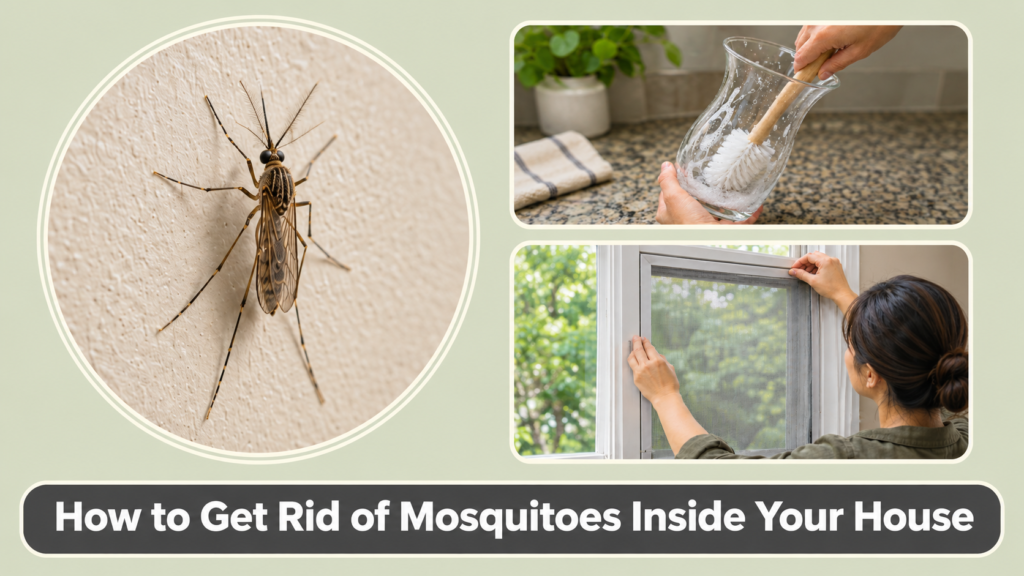
Start with the room where mosquitoes show up most often. Look for adults in resting spots, check nearby doors and windows for gaps, and inspect any containers that hold water. These steps help you address the mosquitoes you can see and the places that may be supplying new ones.
Empty and Scrub Water-Holding Containers
Once a week, empty and scrub items that collect water, such as vases, plant saucers, and buckets. Check outdoors after rain for items that fill up between cleanings. Turn unused containers upside down and tightly cover containers you use to store water.
Repair Screens and Check Where Sightings Continue
Patch torn window and door screens and reseat frames that have come loose. Close doors promptly, including the door between an attached garage and the house. If sightings continue, note which room they occur in and check that room’s nearest exterior opening and water sources again. A repeated pattern can help you narrow down where the mosquitoes are coming from.
Frequently Asked Questions
Can a Mosquito Survive in My Room for a Week?
Yes, an adult mosquito can survive in a room for a week under favorable conditions. Its age when it entered, the room’s humidity, and its access to sugar all affect how long it can last.
Will a Mosquito Die if It Can’t Bite Me?
A mosquito can survive without biting you. Male mosquitoes live on plant sugars, and females can also use sugars for energy. Most females need a blood meal to develop eggs, so keeping a mosquito away from people mainly limits its access to that meal.
Can Mosquitoes Breed in Houseplants?
They can breed in water left beneath a pot or in a container where a plant grows in water. Adult mosquitoes may rest on leaves, so check the saucer or reservoir for wriggling larvae to see whether breeding is happening.
Is the Mosquito I See Every Night the Same One?
It could be, especially if you see just one over a few nights. If you regularly see several, or keep seeing mosquitoes after removing them, check for an entry point or standing water that could be producing more adults.
How Quickly Can New Mosquitoes Appear From Standing Water?
Under favorable conditions, common Aedes mosquitoes can develop from egg to adult in about seven to ten days. If the water already contains larvae or pupae when you notice it, adults can emerge sooner.
