
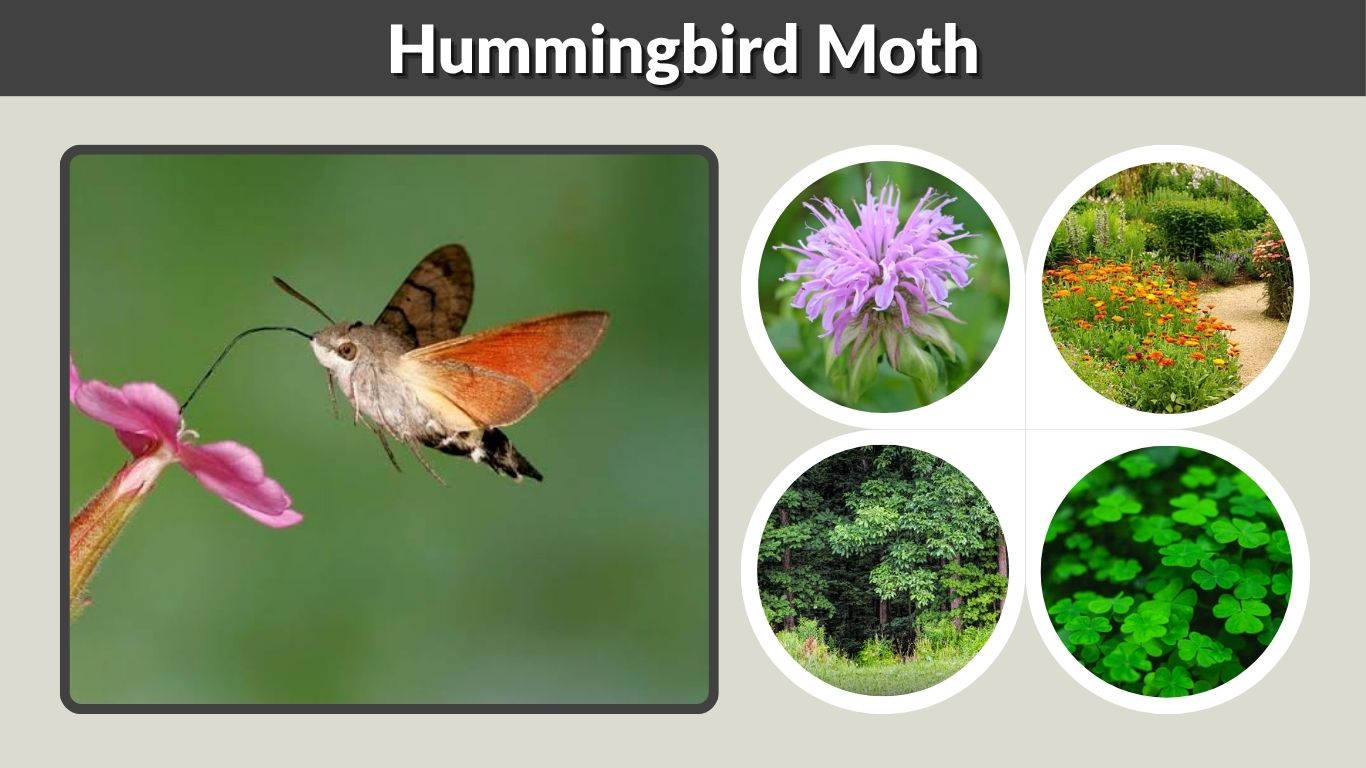
A hummingbird moth is one of nature’s most convincing look-alikes. With rapid wingbeats, a furry body, and the ability to hover while drinking nectar, these moths are frequently mistaken for tiny hummingbirds or large bumblebees. The name can refer to several sphinx or hawk moths, including hummingbird clearwings and the humming-bird hawk-moth. This guide covers hummingbird moth identification, size, species, caterpillars, host plants, life cycle, habitat, feeding behavior, and whether these unusual insects can bite or sting. Pasted text
What Is a Hummingbird Moth?
The term hummingbird moth generally describes certain members of the Sphingidae, or sphinx moth family, whose hovering flight and nectar-feeding behavior resemble those of hummingbirds. In North America, the hummingbird clearwing (Hemaris thysbe) is a familiar example. In Europe, the name is often associated with the humming-bird hawk-moth (Macroglossum stellatarum).
Why Does It Look Like a Hummingbird?
Hummingbird moths have stout bodies, powerful wings, large eyes, and long feeding mouthparts. Rather than landing on every flower, they can remain suspended in the air while extending a long proboscis into the bloom.
Their rapid movements, humming sound, flower-feeding habits, and relatively large bodies make them surprisingly easy to mistake for small birds from a distance.
Hummingbird Moth vs. Hummingbird
Despite their similar feeding styles, they are completely different animals. A hummingbird is a vertebrate bird with feathers and a bill, while a hummingbird moth is a six-legged insect with antennae and a coiled proboscis.
Both have independently developed the ability to hover while feeding from deep flowers, which explains their striking similarity.
Hummingbird Moth Identification and Size
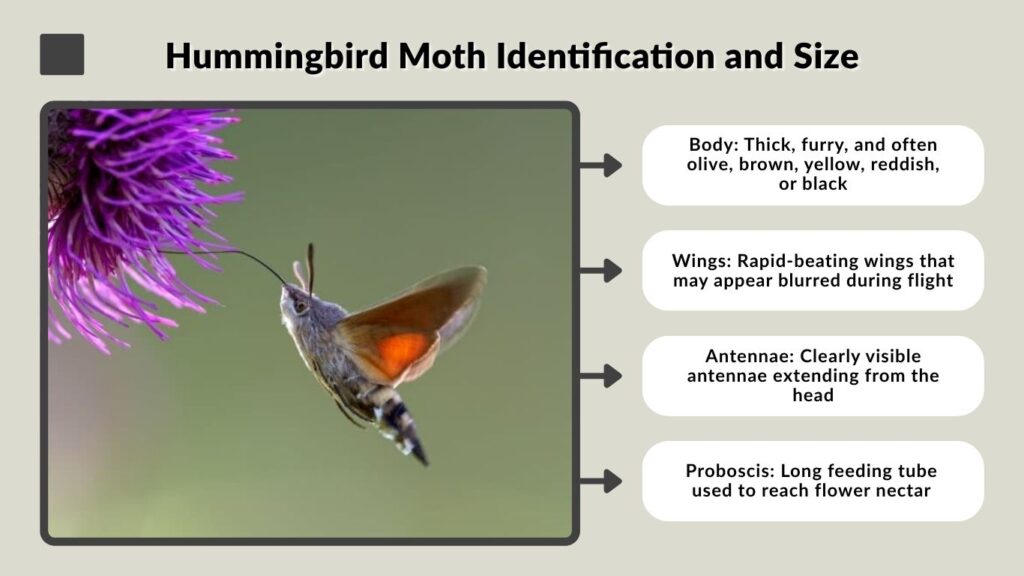
Identifying a hummingbird moth becomes easier once you know which features to examine. Color and wing patterns vary between species, so hovering behavior alone is not enough for precise identification. Clearwing species are especially distinctive because portions of their wings contain few scales and appear transparent. Body color, legs, wing borders, antennae, and size provide additional clues.
Key Identification Features
Common hummingbird moth characteristics include:
- Body: Thick, furry, and often olive, brown, yellow, reddish, or black
- Wings: Rapid-beating wings that may appear blurred during flight
- Antennae: Clearly visible antennae extending from the head
- Proboscis: Long feeding tube used to reach flower nectar
- Flight: Fast, controlled hovering around flowers
- Clear wings: Especially noticeable in Hemaris clearwing moths
- Abdomen: Thick and usually tapered toward the rear
The hummingbird clearwing has large transparent areas surrounded by reddish-brown wing margins and pale legs.
How Big Is a Hummingbird Moth?
Size depends on the species. The hummingbird clearwing has a wingspan of approximately 1 3⁄4 to 2 1⁄4 inches, while the European humming-bird hawk-moth typically has a wingspan of about 50–58 mm.
Their chunky bodies and hovering movements can make them appear larger than their actual measurements suggest.
Common Hummingbird Moth Species
“Hummingbird moth” is not limited to a single species. Several sphinx moths have hummingbird-like appearances or behavior, and the species someone encounters depends heavily on geographic location. North American gardens commonly attract clearwing moths, while the humming-bird hawk-moth is well known across Europe and nearby regions. Recognizing the species also helps explain differences in color, size, caterpillars, and host plants.
Well-Known Types
Several moths commonly associated with the hummingbird moth name include:
- Hummingbird Clearwing (Hemaris thysbe): A North American clearwing with reddish-brown wing edges.
- Snowberry Clearwing (Hemaris diffinis): A smaller clearwing that strongly resembles a bumblebee.
- Slender Clearwing (Hemaris gracilis): A similar but generally less frequently encountered clearwing species in parts of North America.
- Humming-bird Hawk-moth (Macroglossum stellatarum): A powerful day-flying species widely recognized in Europe.
Hummingbird Clearwing vs. Snowberry Clearwing
The hummingbird clearwing generally has pale or whitish legs and broad reddish-brown wing margins. The snowberry clearwing tends to have darker legs and different markings around its wings and body.
Both species hover around flowers during daylight and are regularly confused with bumblebees or tiny hummingbirds.
Hummingbird Moth Caterpillar and Life Cycle
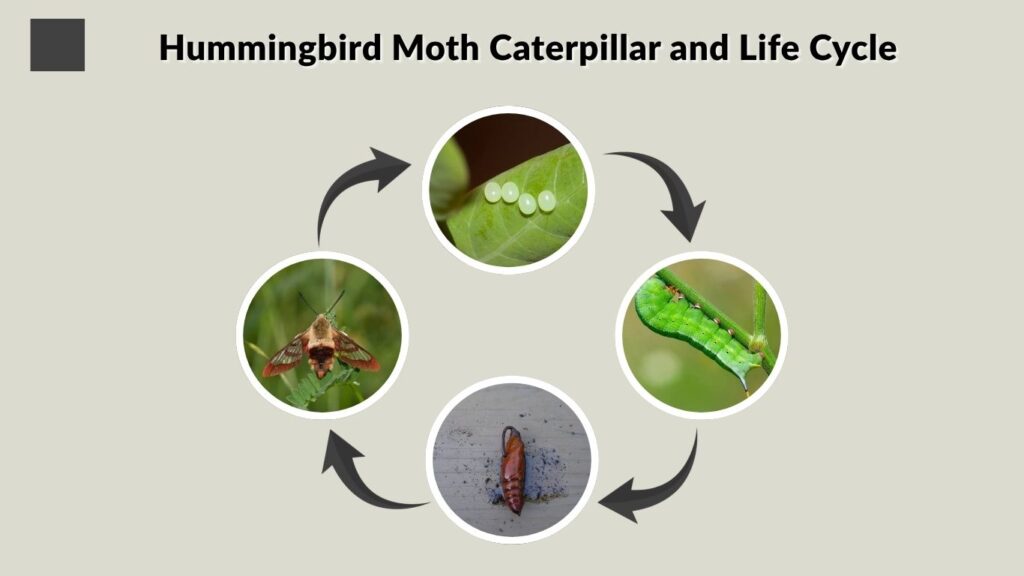
Before becoming a fast-flying nectar feeder, a hummingbird moth spends part of its life as a caterpillar. Like other butterflies and moths, sphinx moths undergo complete metamorphosis through egg, larval, pupal, and adult stages. Knowing the life cycle can also help gardeners understand why caterpillars and adult moths may appear in completely different places or at different times.
Four Life Cycle Stages
The hummingbird moth life cycle follows four main stages:
- Egg: Females deposit small eggs on suitable host plants.
- Caterpillar: The larva feeds heavily and molts as it becomes larger.
- Pupa: The mature caterpillar transforms into a pupa.
- Adult moth: The winged adult emerges, feeds on nectar, mates, and continues the cycle.
Hummingbird clearwings can overwinter as pupae in or near the soil.
What Does a Hummingbird Moth Caterpillar Look Like?
Hummingbird clearwing caterpillars are generally green and have pale longitudinal lines running along the body. Like many sphinx moth larvae, they possess a horn-like projection near the rear.
Color may change as the caterpillar develops, with mature individuals sometimes becoming darker or reddish along portions of the back.
Hummingbird Moth Host Plants
Host plants differ among species. Hummingbird clearwing larvae have been recorded feeding on plants such as:
- Viburnums
- Snowberry
- Coralberry or buckbrush
- Honeysuckle
- Hawthorn
- Cherry
- Plum
Providing appropriate native host plants can support the caterpillar stage as well as the adults seen visiting flowers.
Habitat, Range, and Feeding Behavior
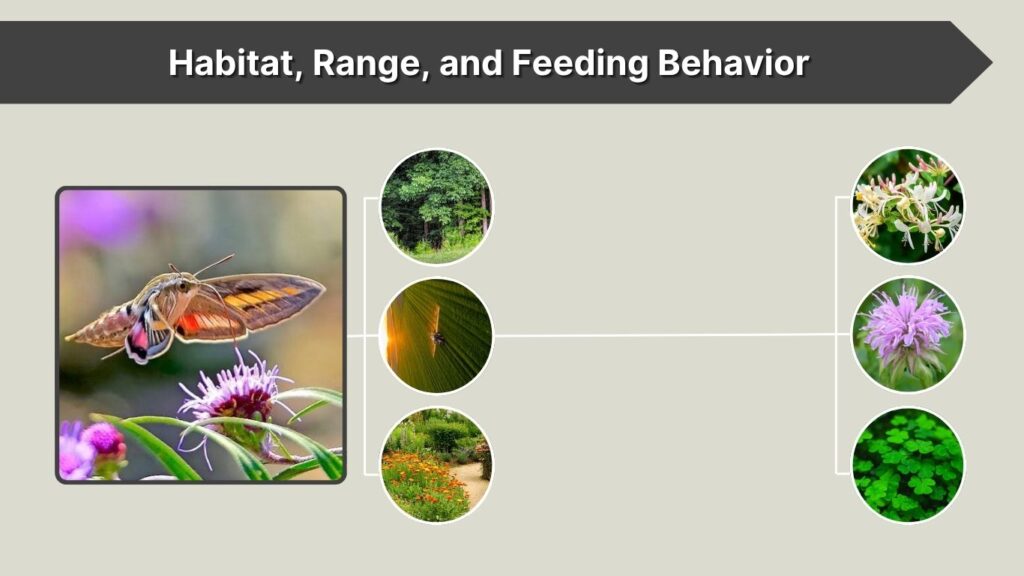
Hummingbird moths can occur in gardens, meadows, woodland edges, fields, and other areas rich in flowering plants. Their exact distribution depends on the species. Some are established residents across broad regions, while others migrate considerable distances. Gardens containing nectar-rich flowers often provide excellent opportunities to watch these insects hover and move quickly from bloom to bloom.
Where Do Hummingbird Moths Live?
The hummingbird clearwing occurs widely in North America and commonly uses open woodlands, woodland edges, fields, suburban landscapes, and flower gardens.
The humming-bird hawk-moth is associated with southern Europe and North Africa and regularly migrates northward, including into the United Kingdom.
What Do Hummingbird Moths Eat?
Adult hummingbird moths primarily consume flower nectar. They use their long proboscis while hovering instead of crawling deeply into the flower.
Hummingbird clearwings visit flowers such as honeysuckle, bee balm, clover, phlox, thistles, and vetches. Tubular and nectar-rich flowers are particularly attractive because their feeding structures are well suited to reaching nectar deep inside blossoms.
Do Hummingbird Moths Bite or Sting?
Their large size, rapid buzzing flight, and resemblance to bees can make hummingbird moths appear intimidating. However, their mouthparts are designed primarily for drinking nectar rather than attacking people. The bee-like appearance of some clearwing moths can also act as a useful visual defense against predators, even though the moth itself lacks the defensive equipment people associate with bees.
Are Hummingbird Moths Dangerous?
Hummingbird clearwings do not have a stinger. Their bee-like coloration can discourage predators by making the harmless moth resemble an insect capable of defending itself.
Seeing one hovering close to you usually means it is interested in nearby flowers rather than people.
Are Hummingbird Moths Good for Gardens?
Adult moths move repeatedly among blossoms while feeding, meaning they can contribute to flower pollination. More importantly, their presence adds to the diversity of insects using a garden habitat.
Growing nectar-producing flowers alongside suitable caterpillar host plants offers resources for multiple stages of their life cycle.
FAQs
Hummingbird moths generate many questions because their appearance falls somewhere between what people expect from a moth, bee, and hummingbird. The answers below address some of the most common concerns about identification, activity, caterpillars, lifespan, and attracting these fascinating insects to gardens.
1. Is a hummingbird moth actually a moth?
Yes. Hummingbird moths are insects belonging to the sphinx or hawk moth family, Sphingidae. Their hovering flight simply makes them look unusually bird-like.
2. Do hummingbird moths come out during the day?
Many hummingbird-like clearwing moths are active during daylight. Hummingbird clearwings may also be especially noticeable around dawn and dusk.
3. Is a hummingbird moth caterpillar a hornworm?
Hummingbird moth caterpillars belong to the sphinx moth family, whose larvae are commonly called hornworms because many have a horn-like projection at the rear of the body.
4. Why are hummingbird moth wings clear?
In clearwing species, portions of the wings lose or lack the dense covering of scales typical of most moth wings, producing the transparent appearance.
5. How can I attract hummingbird moths?
Grow nectar-rich flowers and suitable caterpillar host plants. Honeysuckle, bee balm, phlox, clover, viburnums, and snowberry can provide useful resources depending on which hummingbird moth species naturally occur in your region.
