
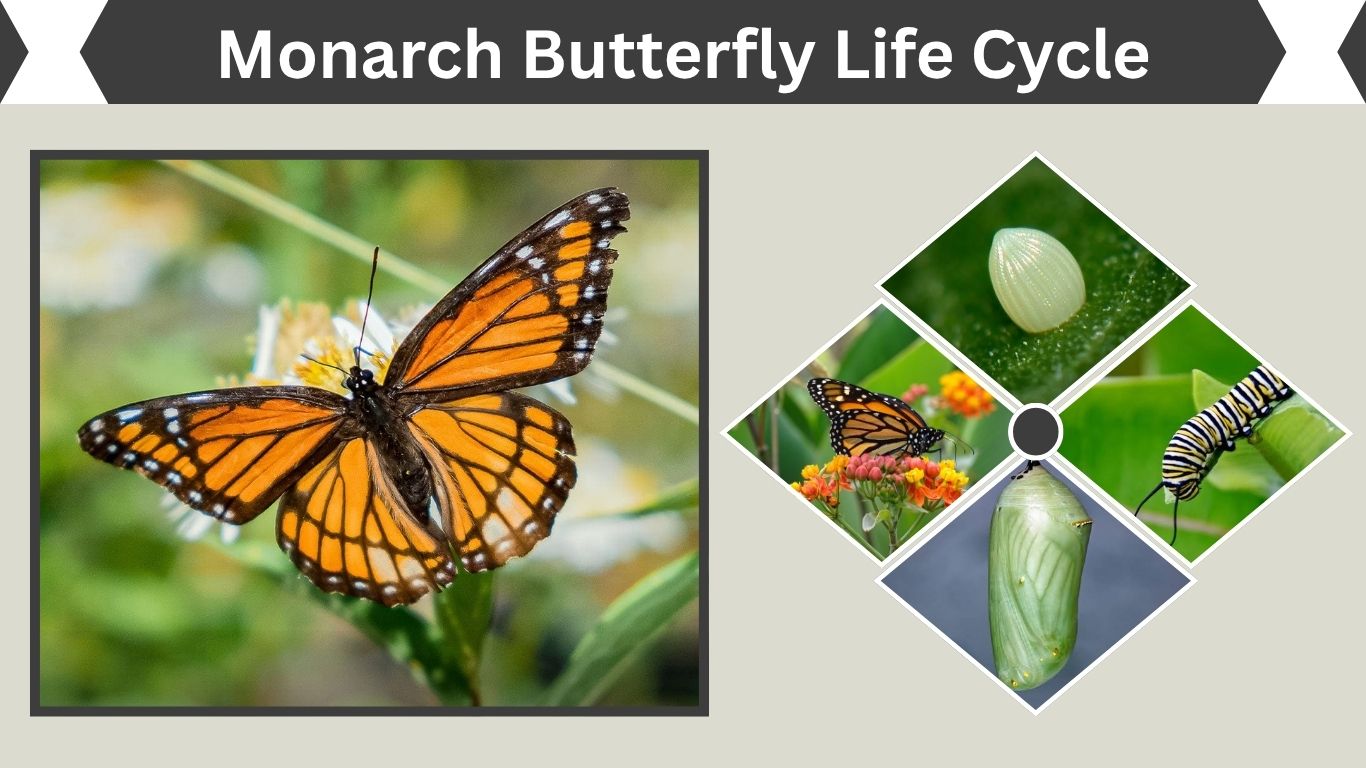
The monarch butterfly life cycle is one of the most fascinating transformations in nature. A monarch begins as a tiny egg on milkweed, becomes a striped caterpillar, forms a green chrysalis, and finally emerges as an orange-and-black butterfly. This process is called complete metamorphosis. Many people search for the monarch butterfly life cycle because they want to understand each stage, how long it takes, and how monarch lifespan changes during migration. This guide explains the full timeline in a simple, beginner-friendly way.
Monarch Butterfly Life Cycle Overview
The life cycle of a monarch butterfly has four main stages: egg, larva, pupa, and adult. Each stage has a different purpose. The egg protects the developing caterpillar, the caterpillar eats and grows, the chrysalis stage transforms the body, and the adult butterfly feeds, mates, migrates, and lays eggs.
Most monarchs complete the full egg-to-adult cycle in about one month, though the exact time depends on temperature, food quality, and weather conditions. Warm weather usually speeds up development, while cooler weather slows it down.
| Monarch Life Stage | Approximate Duration | Main Purpose |
|---|---|---|
| Egg | 3–5 days | Embryo develops on milkweed |
| Caterpillar/Larva | 10–14 days | Eats milkweed and grows quickly |
| Chrysalis/Pupa | 8–15 days | Body changes into butterfly |
| Adult Butterfly | 2–6 weeks or longer | Feeds, mates, migrates, lays eggs |
Stage 1: Monarch Butterfly Egg
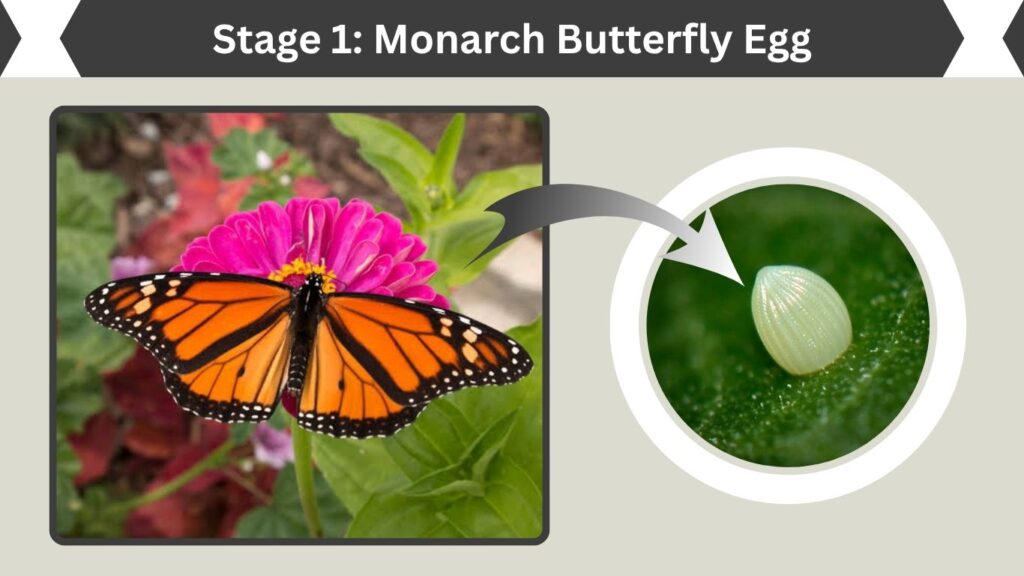
The monarch butterfly life cycle starts when a female monarch lays a tiny egg on a milkweed plant. Monarchs use milkweed as their host plant because monarch caterpillars can only eat milkweed leaves. The female usually lays one egg at a time, often on the underside of a leaf where it is more protected.
Monarch eggs are very small, usually white, cream, or pale yellow. They look like tiny oval domes with fine ridges. Many people confuse monarch eggs with aphids or milkweed sap, but monarch eggs are usually single, still, and attached firmly to the leaf.
How Long Does the Egg Stage Last?
The egg stage usually lasts about 3 to 5 days. During this time, the caterpillar develops inside the egg. Just before hatching, the egg may look slightly darker. The tiny caterpillar chews its way out and may eat part of the eggshell before starting on the milkweed leaf.
Where Are Monarch Eggs Found?
Monarch eggs are found on milkweed plants. The most common places include:
- Undersides of milkweed leaves
- Young tender leaves near the top of the plant
- Milkweed flower buds
- Small stems and new growth
- Healthy plants in sunny areas
Because the eggs are tiny, finding them requires close inspection.
Stage 2: Monarch Caterpillar Life Cycle
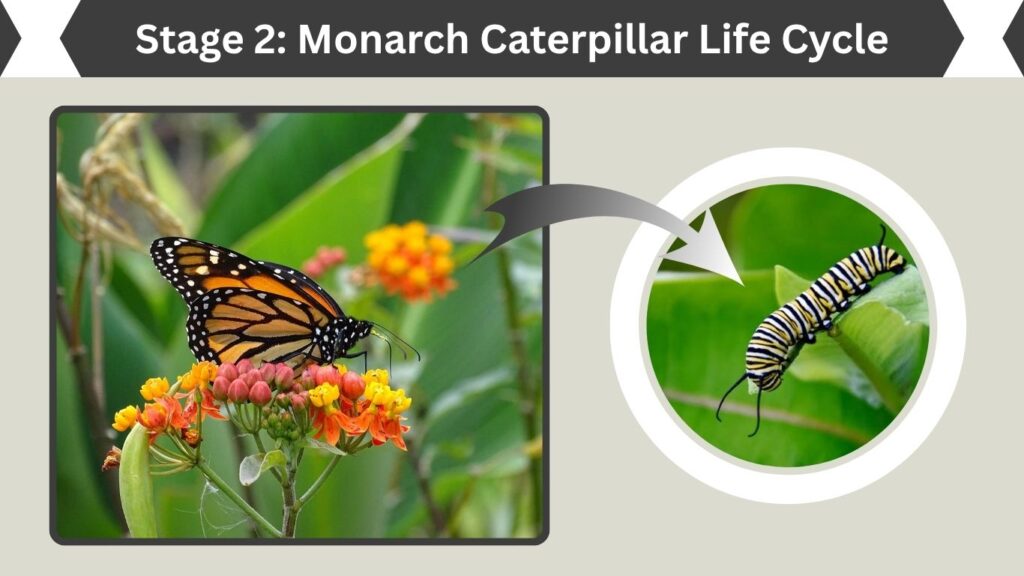
After hatching, the monarch enters the larval stage. This is the caterpillar stage, and its main job is to eat. Monarch caterpillars feed heavily on milkweed leaves and grow very fast. During this stage, they shed their skin several times.
These growth phases are called instars. A monarch caterpillar goes through five instars before it is ready to become a chrysalis. At first, the caterpillar is tiny and pale. As it grows, it develops the familiar black, white, and yellow stripes.
The Five Caterpillar Instars
| Instar | Appearance | What Happens |
|---|---|---|
| First instar | Very tiny, pale body | Begins eating milkweed |
| Second instar | Small stripes appear | Grows and molts |
| Third instar | Stripes become clearer | Eats more leaf tissue |
| Fourth instar | Larger body, stronger pattern | Rapid growth continues |
| Fifth instar | Large striped caterpillar | Prepares for chrysalis |
The caterpillar stage usually lasts around 10 to 14 days. During this short time, the caterpillar increases greatly in size. It may eat leaf edges, holes in leaves, and sometimes even tender stems.
Stage 3: Monarch Chrysalis
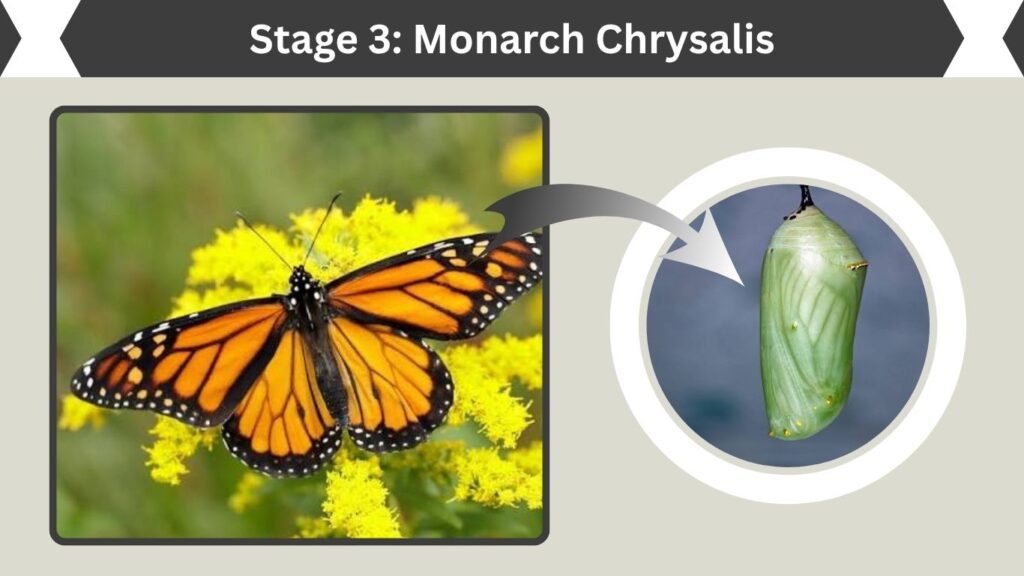
When the caterpillar is fully grown, it stops eating and searches for a safe place to pupate. It may leave the milkweed plant and attach itself to a stem, branch, fence, pot, or other stable surface. Then it hangs in a J-shape before shedding its final caterpillar skin.
Under that skin is the chrysalis. A monarch chrysalis is usually bright green with small gold-like markings. It is not a cocoon. Moths often make cocoons from silk, but butterflies form a chrysalis.
What Happens Inside the Chrysalis?
Inside the chrysalis, the caterpillar’s body changes into an adult butterfly. Wings, legs, antennae, and other adult structures form during this stage. Although the chrysalis may look still from the outside, major transformation is happening inside.
The chrysalis stage usually lasts about 8 to 15 days. In warm weather, the butterfly may emerge sooner. In cooler temperatures, it can take longer.
Signs a Monarch Is Ready to Emerge
A chrysalis becomes darker and more transparent before the butterfly emerges. You may begin to see the orange and black wing pattern through the chrysalis wall. This means the adult butterfly is nearly ready.
Stage 4: Adult Monarch Butterfly
The final stage of the monarch butterfly life cycle is the adult butterfly. When the butterfly emerges from the chrysalis, its wings are soft and folded. It hangs quietly while fluid pumps into the wings. After the wings expand and dry, the monarch can fly.
Adult monarch butterflies feed on nectar from flowers. They also mate and, in the case of females, lay eggs on milkweed to begin the next generation.
Adult Monarch Appearance
Adult monarchs are known for their orange wings, black veins, and white spots along the wing edges. Males and females look similar, but males have a small black spot on each hindwing and thinner black wing veins. Females usually have thicker wing veins and no hindwing scent spots.
Monarch Butterfly Life Cycle Timeline
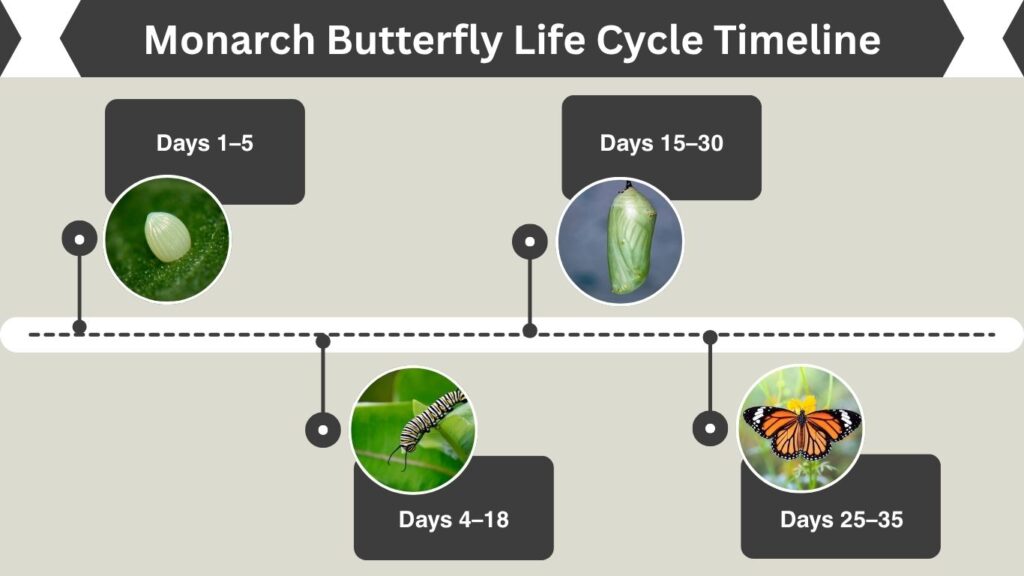
The monarch butterfly life cycle timeline can vary, but a typical summer generation develops from egg to adult in around 25 to 35 days. Weather and temperature are the biggest factors affecting speed.
| Timeline | Life Stage | Main Change |
|---|---|---|
| Days 1–5 | Egg | Caterpillar develops inside egg |
| Days 4–18 | Caterpillar | Eats milkweed and molts |
| Days 15–30 | Chrysalis | Transforms into adult butterfly |
| Days 25–35 | Adult | Emerges, flies, feeds, and reproduces |
This timeline is not exact for every monarch. Some may develop faster in warm conditions, while others may take longer if weather is cool or food is limited.
Monarch Butterfly Life Span
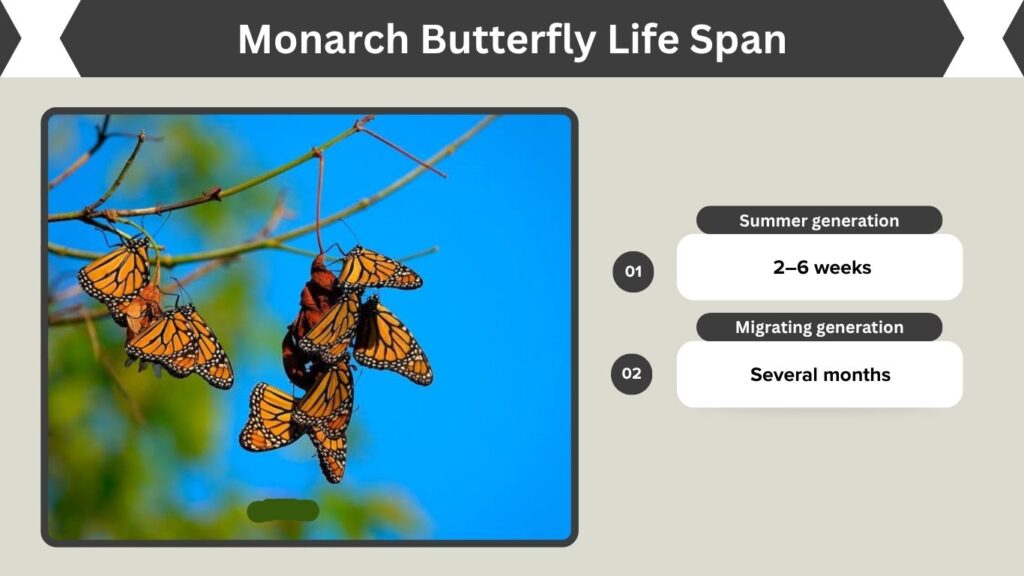
The monarch butterfly life span depends on the generation. Most adult monarchs live only a few weeks, but the migrating generation can live much longer.
Summer monarchs usually live about 2 to 6 weeks as adults. Their main purpose is to mate and lay eggs. The late-season migratory generation is different. These monarchs can live several months because they travel long distances, overwinter, and reproduce later.
Summer Monarch vs Migrating Monarch Lifespan
| Type of Monarch | Adult Lifespan | Main Role |
|---|---|---|
| Summer generation | 2–6 weeks | Mate and lay eggs |
| Migrating generation | Several months | Migrate, overwinter, reproduce later |
This difference is one reason monarchs are so remarkable. The butterflies that migrate are not the same short-lived adults that reproduce quickly in summer. They are a special long-lived generation adapted for travel and survival.
Monarch Butterfly Life Cycle and Migration
Migration makes the monarch life cycle even more complex. In North America, monarchs may travel long distances between breeding grounds and overwintering areas. During spring and summer, several generations develop and move north. In late summer or fall, a special generation begins its migration.
These migrating monarchs delay reproduction. Instead of laying eggs immediately, they focus on feeding, storing energy, and traveling. After overwintering, they begin the return journey and lay eggs when conditions are right.
Migration depends on many factors, including daylight, temperature, nectar availability, and habitat quality.
What Monarch Caterpillars Need to Survive
Monarch caterpillars need milkweed, safe habitat, and protection from harmful chemicals. They cannot survive on random garden leaves. If a monarch egg hatches on a non-milkweed plant, the caterpillar will not have the correct food.
Gardeners can support the monarch butterfly life cycle by planting native milkweed and nectar flowers. Adult butterflies need nectar, while caterpillars need milkweed leaves.
Helpful garden choices include:
- Native milkweed plants
- Nectar flowers that bloom at different times
- Chemical-free garden care
- Sunny planting areas
- Shelter from strong wind
- A mix of host plants and flowering plants
Avoid spraying pesticides on or near milkweed. Even organic sprays can harm eggs, caterpillars, or adult butterflies if used carelessly.
Common Problems During the Monarch Life Cycle
Not every monarch egg becomes a butterfly. Many are lost naturally. Eggs and caterpillars face predators, weather, disease, and food shortages. This is normal in nature, which is why female monarchs lay many eggs.
Common threats include ants, spiders, wasps, stink bugs, birds, parasites, storms, and pesticide exposure. Milkweed quality also matters. Dry, damaged, or chemically treated plants can reduce survival.
Some people raise monarchs indoors, but this should be done carefully. Poor cleaning, overcrowding, and releasing sick butterflies can create problems. For most people, the best support is improving outdoor habitat instead of collecting large numbers of eggs or caterpillars.
FAQs
What are the four stages of the monarch butterfly life cycle?
The four stages are egg, caterpillar, chrysalis, and adult butterfly. The egg hatches into a caterpillar, the caterpillar grows while eating milkweed, the chrysalis transforms the body, and the adult butterfly emerges to feed, mate, migrate, and lay eggs.
How long is the monarch butterfly life cycle?
The full monarch butterfly life cycle usually takes about 25 to 35 days from egg to adult. The timing depends on temperature, weather, and food quality. Warm conditions often speed up development, while cooler conditions may make each stage last longer.
What is the lifespan of a monarch butterfly?
Most adult monarch butterflies live about 2 to 6 weeks. However, the migrating generation can live for several months. These long-lived monarchs travel long distances, survive the overwintering period, and reproduce when conditions become suitable again.
What do monarch caterpillars eat?
Monarch caterpillars eat milkweed leaves. Milkweed is the only host plant for monarch larvae, so caterpillars cannot survive on ordinary garden plants. Adult monarch butterflies, however, drink nectar from many different flowers.
Is a monarch chrysalis the same as a cocoon?
No, a monarch chrysalis is not the same as a cocoon. Butterflies form a chrysalis, while many moths spin cocoons. The monarch chrysalis is a green protective case where the caterpillar transforms into an adult butterfly.
